
-
-
-
Girgaon, Mumbai - 400004
What Is the ASTM Standard?
ASTM Standards play an important role in the manufacturing, testing, inspection and quality control of steel pipes and tubes. These standards establish requirements for materials, chemical composition, mechanical properties, dimensions, manufacturing methods, testing and other product characteristics.
For stainless steel and alloy pipe applications, selecting the correct ASTM specification helps buyers, engineers and procurement teams ensure that the supplied pipes meet the required technical and performance requirements.
ASTM Specifications are commonly referenced when defining the material grade, manufacturing process, testing requirements and applicable acceptance criteria for pipes and tubes. The specific requirements depend on the ASTM specification and the type of product being supplied.
We explain what ASTM is, what ASTM stands for, what an ASTM standard means, how ASTM standards work, common ASTM standards for stainless steel pipes and tubes and the difference between ASTM and ASME standards.
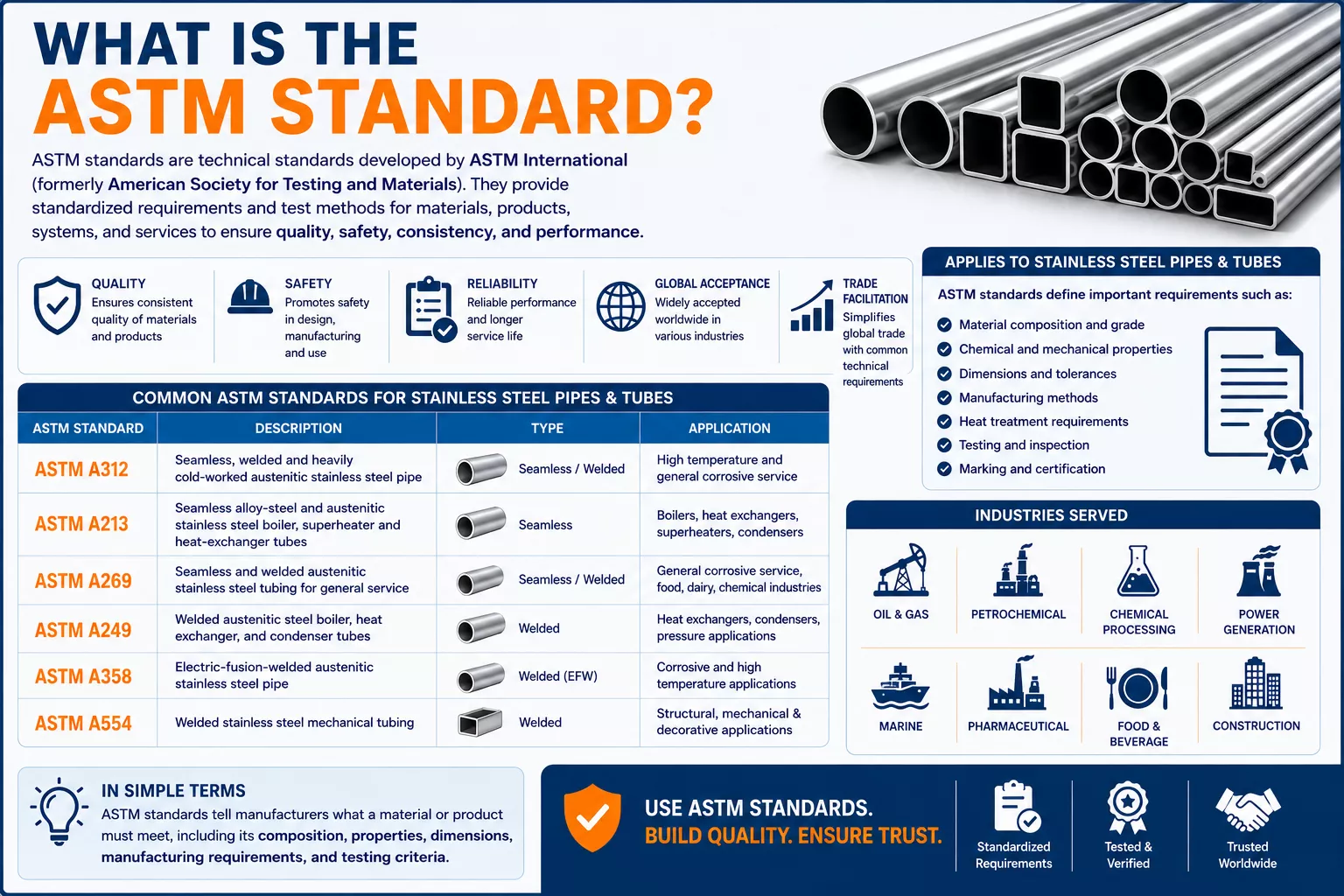
What Is an ASTM Standard?
ASTM is an international organization that develops and publishes technical standards for materials, products, systems, and services.
ASTM standards provide a common set of technical requirements that manufacturers, suppliers, engineers, inspectors, and buyers can use to define product quality, consistency, safety, and performance.
For steel pipes and tubes, an ASTM specification may cover requirements such as:
| Requirement | What It Covers |
|---|---|
| Chemical Composition | Specifies the required chemical elements and permitted composition ranges for the material. |
| Mechanical Properties | Defines requirements such as tensile strength, yield strength, and elongation. |
| Manufacturing Process | Specifies permitted manufacturing methods, such as seamless, welded, or cold-worked production. |
| Dimensions and Tolerances | Establishes dimensional requirements and permissible variations for the supplied product. |
| Heat Treatment | Defines applicable heat-treatment requirements for achieving the required material properties. |
| Hydrostatic or Nondestructive Testing | Specifies applicable testing requirements for checking product integrity and quality. |
| Surface Condition | Defines requirements related to surface quality, finish, and acceptable imperfections. |
| Marking and Identification | Specifies required product markings for identification and traceability. |
| Inspection Requirements | Defines applicable inspection and verification requirements for the product. |
| Material Certification | May define documentation and certification requirements used to verify compliance with the specification. |
For example, ASTM A312 is commonly specified for seamless, welded, and heavily cold-worked austenitic stainless steel pipes intended for high-temperature and general corrosive service.
What Does ASTM Stand For?
ASTM originally stood for American Society for Testing and Materials.
The organization is now known as ASTM International. Its standards are used internationally across industries including metals, construction, petroleum, chemical processing, manufacturing, aerospace, energy, and more.
In the steel pipe industry, ASTM specifications are frequently referenced when defining the required material, manufacturing method, testing, and quality requirements for pipes and tubes.
Why Are ASTM Standards Important?
ASTM standards help create consistent technical requirements between manufacturers, suppliers, engineers, inspectors, and buyers.
For stainless steel pipes and tubes, ASTM standards are important because they can help with the following:
| Benefit | How ASTM Standards Help |
|---|---|
| 1. Ensure Consistent Quality | ASTM specifications establish defined requirements for chemical composition, mechanical properties, dimensions, and testing. |
| 2. Simplify Purchasing | Buyers can specify an appropriate ASTM standard and material grade instead of describing every technical requirement separately. |
| 3. Support Material Selection | ASTM specifications help engineers identify materials suitable for particular temperature, pressure, corrosion, and service conditions. |
| 4. Improve Quality Control | Manufacturers can use ASTM requirements to establish inspection and testing procedures during production. |
| 5. Support International Supply | ASTM standards are widely recognized, making it easier for international buyers and suppliers to communicate technical requirements. |
For an exporter such as Kamal Steels, clearly identifying the applicable ASTM specification, grade, dimensions, and testing requirements helps ensure that the supplied stainless steel pipes and tubes match the customer's purchase specification.
How ASTM Standards Work
ASTM standards work by defining technical requirements for a particular material, product, test method, or application.
For a stainless steel pipe order, the specification may identify requirements covering the material, grade, manufacturing process, dimensions, heat treatment, testing, inspection, and marking.
| Stage | What It Defines |
|---|---|
| Material | Identifies the general type of material required for the product. |
| Grade | Identifies the specific material grade and its applicable chemical and mechanical requirements. |
| Manufacturing | Defines the permitted manufacturing method, such as seamless or welded production, where specified. |
| Dimensions | Establishes the required size, wall thickness, tolerances, and dimensional requirements. |
| Heat Treatment | Specifies applicable heat-treatment requirements for the material and product. |
| Testing | Defines required mechanical, hydrostatic, nondestructive, or other applicable tests. |
| Inspection | Establishes applicable inspection and verification requirements. |
| Marking | Defines product identification and traceability requirements. |
Example of an ASTM Pipe Specification
A stainless steel pipe purchase requirement might specify:
| Specification | Requirement |
|---|---|
| Product | Stainless Steel Seamless Pipe |
| ASTM Specification | ASTM A312 |
| Material Grade | TP316L |
| Dimensional Standard | ASME B36.19M |
| Testing & Inspection | As required by the applicable specification and purchase order |
The exact requirements depend on the applicable ASTM specification and the buyer's project requirements.
It is important to understand that ASTM does not simply mean a particular grade of steel. ASTM provides the applicable specification, while the grade identifies the particular material composition and properties within that specification.
ASTM Standards for Stainless Steel Pipes and Tubes
Several ASTM Standards are commonly used for stainless steel pipes and tubes. Different specifications apply to different products, manufacturing processes, and applications.
For example, one specification may cover process piping, another heat exchanger tubes, and another mechanical or ornamental tubing.
Some commonly encountered ASTM specifications include ASTM A312, ASTM A213, ASTM A269, ASTM A358, ASTM A249, and ASTM A554.
| ASTM Standard | Product Type | Typical Applications |
|---|---|---|
| ASTM A312 | Seamless, welded, and heavily cold-worked austenitic stainless steel pipe | Chemical processing, petrochemical, oil and gas, power generation, food processing, pharmaceutical, and refining |
| ASTM A213 | Seamless ferritic and austenitic alloy-steel boiler, superheater, and heat-exchanger tubes | Boilers, heat exchangers, superheaters, power plants, and process equipment |
| ASTM A269 | Seamless and welded austenitic stainless steel tubing | Instrumentation, food processing, pharmaceutical equipment, chemical processing, and general industry |
| ASTM A358 | Electric-fusion-welded austenitic chromium-nickel alloy steel pipe | Chemical processing, petrochemical facilities, refineries, heat exchangers, and high-temperature or corrosive services |
| ASTM A249 | Welded austenitic steel boiler, superheater, heat-exchanger, and condenser tubes | Heat exchangers, boilers, condensers, superheaters, and process equipment |
| ASTM A554 | Welded austenitic, ferritic, and martensitic stainless steel mechanical tubing | Architectural structures, railings, furniture, decorative applications, automotive components, and general fabrication |
The correct specification should be selected according to the pipe or tube type, manufacturing process, material grade, application, dimensions and required testing.
ASTM vs ASME: What Is the Difference?
ASTM and ASME are both important standards organizations, but they serve different purposes.
ASTM International primarily develops standards covering materials, products, testing methods, and related technical requirements.
ASME (American Society of Mechanical Engineers) develops codes and standards covering mechanical engineering, pressure equipment, piping, boilers, and related systems.
A simple way to understand the difference is:
| ASTM | ASME |
|---|---|
| Develops material and product specifications | Develops engineering codes and standards |
| Defines material and product requirements | Covers engineering design, construction, and safety requirements |
| Commonly referenced for steel and alloy materials | Commonly referenced for pressure equipment and piping |
| Examples: ASTM A312, ASTM A213, ASTM A269 | Examples: ASME B31.3, ASME Section VIII |
| Focuses heavily on materials, products, and testing | Focuses heavily on engineering systems and construction |
However, ASTM and ASME standards often work together.
For example, a stainless steel pipe may be manufactured to ASTM A312 requirements while its dimensions are specified according to an applicable ASME B36 dimensional standard, depending on the project specification.
Therefore, ASTM and ASME are not necessarily competing standards. They can address different parts of the same engineering requirement.
ASTM Standards and Material Grades
An ASTM specification and a material grade are related, but they are not the same thing.
For example:
ASTM A312 TP316L
Here:
| Designation | Meaning |
|---|---|
| ASTM A312 | Product specification |
| TP316L | Stainless steel grade |
The ASTM specification establishes the applicable product requirements, while 316L identifies the material grade and its corresponding chemical and mechanical requirements.
Some commonly used stainless steel grades include:
| Grade | General Characteristics |
|---|---|
| SS 304 | General-purpose austenitic stainless steel |
| SS 304L | Low-carbon version of 304 |
| SS 316 | Improved corrosion resistance compared with 304 |
| SS 316L | Low-carbon version of 316 |
| SS 321 | Titanium-stabilized stainless steel |
| SS 347 | Niobium-stabilized stainless steel |
| SS 310S | High-temperature stainless steel |
The same grade can appear under different product specifications depending on whether the product is a pipe, tube, plate, fitting, or another form.
Therefore, do not select a material based only on the grade. The applicable ASTM specification must also match the product type and application.
How to Select the Right ASTM Standard
Choosing the correct ASTM standard requires more than selecting a material grade. The product type, application, dimensions, manufacturing method, testing requirements, and documentation should all be considered before placing an order.
| Step | What to Check | Important Requirements |
|---|---|---|
| 1. Identify the Product | Determine the type of pipe or tube required. | Seamless pipe, welded pipe, ERW pipe, seamless tube, welded tube, heat exchanger tube, or mechanical tube. |
| 2. Select the Material Grade | Choose the grade suitable for the service conditions. | Corrosion resistance, operating temperature, pressure, mechanical requirements, chemical environment, and fabrication requirements. |
| 3. Determine the Application | Identify where the product will be used. | Process piping, heat exchangers, boilers, chemical processing, oil and gas, food processing, pharmaceutical, architectural, or mechanical applications. |
| 4. Check Dimensions | Confirm the required physical dimensions. | Outside diameter, wall thickness, length, pipe schedule, tube dimensions, and applicable dimensional standard. |
| 5. Confirm Testing Requirements | Identify the required inspection and testing. | Hydrostatic testing, tensile testing, hardness testing, flattening, flaring, nondestructive examination, PMI, intergranular corrosion testing, and radiographic examination, as applicable. |
| 6. Confirm Documentation | Determine the required material and inspection documents. | Mill Test Certificate (MTC), EN 10204 3.1 certificate, chemical analysis, mechanical test results, heat treatment records, inspection reports, and third-party inspection documents. |
Before placing an order, confirm the complete ASTM specification, material grade, dimensions, manufacturing method, testing requirements, inspection requirements and documentation to ensure the supplied material matches the project specification.
Frequently Asked Questions
ASTM originally stood for American Society for Testing and Materials. The organization is now known as ASTM International.
An ASTM standard is a technical specification, test method, practice, classification, or guide developed to establish consistent requirements for materials, products, processes, or services.
ASTM A312 is a specification for seamless, welded, and heavily cold-worked austenitic stainless steel pipes intended for high-temperature and general corrosive service.
ASTM A213 covers seamless ferritic and austenitic alloy-steel boiler, superheater, and heat-exchanger tubes. It is commonly used for elevated temperature and heat-transfer applications.
ASTM A269 covers seamless and welded austenitic stainless steel tubing intended for general corrosive service and applications requiring suitable stainless steel tubing performance.
ASTM A358 covers electric-fusion-welded austenitic chromium-nickel alloy steel pipe intended for corrosive or high-temperature service.
ASTM A249 covers welded austenitic steel boiler, superheater, heat exchanger, and condenser tubes. The specification includes requirements related to manufacturing, dimensions, testing, and quality.
ASTM A554 covers welded austenitic, ferritic, and martensitic stainless steel mechanical tubing. It is commonly associated with mechanical, ornamental, architectural, and general fabrication applications.
No. ASTM primarily develops material, product, and testing standards, while ASME develops engineering codes and standards for areas such as piping, boilers, pressure vessels, and mechanical systems. ASTM and ASME standards can be used together in industrial projects.
An ASTM product specification can include requirements for specific material grades, but the ASTM specification and material grade are separate designations. For example, ASTM A312 TP316L identifies both the product specification and the stainless steel grade.