
-
-
-
Girgaon, Mumbai - 400004
Stainless Steel Pipe Dimensions
Stainless Steel Pipe Dimensions are commonly specified using Nominal Pipe Size (NPS), Outside Diameter (OD), Wall Thickness and Schedule. The actual dimensions of a stainless steel pipe depend on the applicable dimensional standard, pipe size and schedule.
This stainless steel pipe dimensions guide provides pipe sizes in mm and inches, explains how to read OD, ID and wall thickness and covers common schedules such as Schedule 5S, 10S, 40S, 80S and 160. It also explains ASME B36.19M dimensions, grade-related considerations and the difference between stainless steel pipe and tube dimensions.
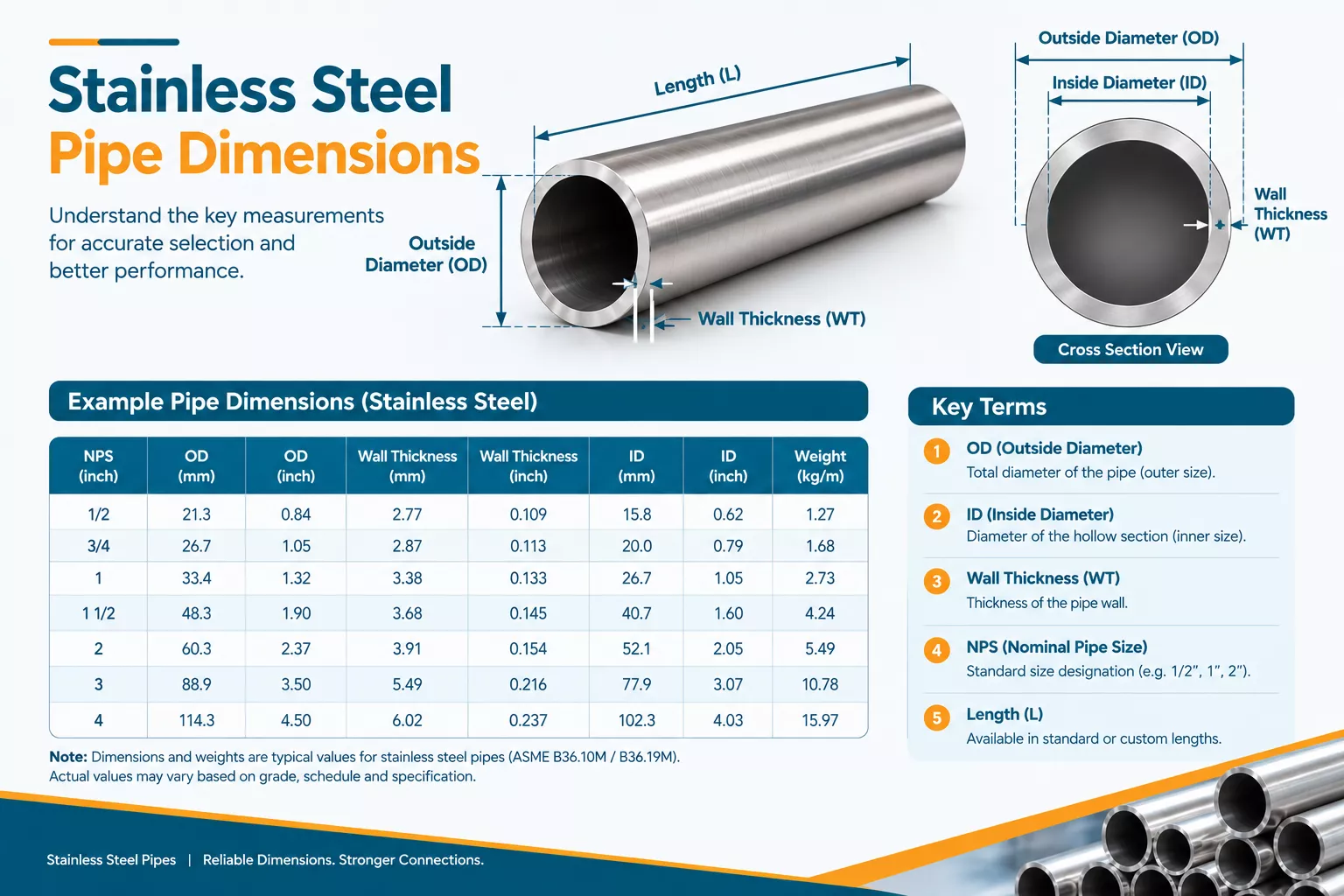
Stainless Steel Pipe Dimensions Chart
A stainless steel pipe dimensions chart shows the Nominal Pipe Size (NPS), Outside Diameter (OD), Wall Thickness and Inside Diameter (ID) for different pipe schedules. The chart below provides common stainless steel pipe dimensions in millimetres for Schedule 5S, 10S, 40S, 80S and 160.
The Outside Diameter is associated with the nominal pipe size, while the Wall Thickness changes according to the selected schedule. As the wall thickness increases, the inside diameter decreases for the same outside diameter.
| NPS | OD (mm) | 5S Wall / ID (mm) | 10S Wall / ID (mm) | 40S Wall / ID (mm) | 80S Wall / ID (mm) | 160 Wall / ID (mm) |
|---|---|---|---|---|---|---|
| 1/2" | 21.3 | 1.65 / 18.00 | 2.11 / 17.08 | 2.77 / 15.76 | 3.73 / 13.84 | 4.78 / 11.74 |
| 3/4" | 26.7 | 1.65 / 23.40 | 2.11 / 22.48 | 2.87 / 20.96 | 3.91 / 18.88 | 5.56 / 15.58 |
| 1" | 33.4 | 1.65 / 30.10 | 2.77 / 27.86 | 3.38 / 26.64 | 4.55 / 24.30 | 6.35 / 20.70 |
| 1 1/4" | 42.2 | 1.65 / 38.90 | 2.77 / 36.66 | 3.56 / 35.08 | 4.85 / 32.50 | 6.35 / 29.50 |
| 1 1/2" | 48.3 | 1.65 / 45.00 | 2.77 / 42.76 | 3.68 / 40.94 | 5.08 / 38.14 | 7.14 / 34.02 |
| 2" | 60.3 | 1.65 / 57.00 | 2.77 / 54.76 | 3.91 / 52.48 | 5.54 / 49.22 | 8.74 / 42.82 |
| 2 1/2" | 73.0 | 2.11 / 68.78 | 3.05 / 66.90 | 5.16 / 62.68 | 7.01 / 58.98 | 9.53 / 53.94 |
| 3" | 88.9 | 2.11 / 84.68 | 3.05 / 82.80 | 5.49 / 77.92 | 7.62 / 73.66 | 11.13 / 66.64 |
| 4" | 114.3 | 2.11 / 110.08 | 3.05 / 108.20 | 6.02 / 102.26 | 8.56 / 97.18 | 13.49 / 87.32 |
| 5" | 141.3 | 2.77 / 135.76 | 3.40 / 134.50 | 6.55 / 128.20 | 9.53 / 122.24 | 15.88 / 109.54 |
| 6" | 168.3 | 2.77 / 162.76 | 3.40 / 161.50 | 7.11 / 154.08 | 10.97 / 146.36 | 18.26 / 131.78 |
| 8" | 219.1 | 2.77 / 213.56 | 3.76 / 211.58 | 8.18 / 202.74 | 12.70 / 193.70 | 23.01 / 173.08 |
| 10" | 273.0 | 3.40 / 266.20 | 4.19 / 264.62 | 9.27 / 254.46 | 15.09 / 242.82 | 28.58 / 215.84 |
| 12" | 323.8 | 3.96 / 315.88 | 4.57 / 314.66 | 9.53 / 304.74 | 17.48 / 288.84 | 33.32 / 257.16 |
| 14" | 355.6 | 3.96 / 347.68 | 4.78 / 346.04 | 9.53 / 336.54 | 19.05 / 317.50 | — |
| 16" | 406.4 | 4.19 / 398.02 | 4.78 / 396.84 | 9.53 / 387.34 | 21.44 / 363.52 | — |
| 18" | 457.2 | 4.19 / 448.82 | 4.78 / 447.64 | 9.53 / 438.14 | 23.83 / 409.54 | — |
| 20" | 508.0 | 4.78 / 498.44 | 5.54 / 496.92 | 9.53 / 488.94 | 26.19 / 455.62 | — |
| 24" | 610.0 | 5.54 / 598.92 | 6.35 / 597.30 | 9.53 / 590.94 | 30.96 / 548.08 | — |
For engineering, fabrication or purchasing purposes, dimensions should be checked against the applicable pipe dimensional standard and the specific product specification rather than relying only on a general reference chart.
How to Find Stainless Steel Pipe Dimensions?
To identify the dimensions of a stainless steel pipe, first determine the nominal pipe size and required schedule. The relevant standard can then be used to identify the specified outside diameter and wall thickness.
Nominal Pipe Size (NPS)
Nominal Pipe Size, or NPS, is the standard designation used to identify pipe size in the inch-based system.
Examples include:
- NPS 1/2
- NPS 1
- NPS 2
- NPS 4
- NPS 6
- NPS 12
NPS should not be treated as the actual measured outside diameter.
Outside Diameter (OD)
Outside diameter is the measurement across the outside of the pipe.
For a given NPS, the standard OD remains associated with that nominal size while the wall thickness can vary according to the schedule.
Inside Diameter (ID)
Inside diameter is the distance across the internal opening of the pipe.
For a pipe with a known OD and wall thickness, the approximate ID can be determined using:
ID = OD − 2 × Wall Thickness
Actual manufacturing tolerances should also be considered when a precise internal dimension is required.
Wall Thickness
Wall thickness is the thickness of the pipe wall between the outside and inside surfaces.
A thicker wall generally results in a smaller internal diameter when the outside diameter remains the same.
Pipe Length
Pipe length is specified separately from diameter and wall thickness. Standard, random and cut lengths may be supplied depending on the product specification, manufacturing requirements and customer order.
Stainless Steel Pipe Dimensions in mm
Stainless steel pipe dimensions are often shown in millimetres (mm) for engineering drawings, fabrication and technical specifications. The main dimensions include the outside diameter (OD), wall thickness and inside diameter (ID).
For example, NPS 2 stainless steel pipe has a standardized outside diameter of 60.3 mm. This does not mean that a 2-inch pipe has an OD of 50.8 mm. The value of 50.8 mm is simply the mathematical conversion of 2 inches to millimetres.
For the actual pipe dimensions, the applicable NPS and dimensional standard should be used. The wall thickness then varies according to the selected schedule, which also affects the inside diameter.
Stainless Steel Pipe Dimensions in Inches
Stainless steel pipes are commonly identified by Nominal Pipe Size (NPS) in inches, such as 1/2", 1", 2", 4", 6", 8" and 12". These inch values are nominal size designations and do not necessarily represent the actual outside diameter of the pipe.
For example, NPS 2 is referred to as a 2-inch pipe, but its standardized outside diameter is 60.3 mm (approximately 2.375 inches). Similarly, NPS 4 has an outside diameter of 114.3 mm (approximately 4.500 inches).
Therefore, when selecting or ordering stainless steel pipe, the NPS, schedule, OD and wall thickness should be considered together rather than converting the nominal inch size directly into millimetres.
Stainless Steel Pipe Dimensions by Schedule
The schedule identifies the standardized wall thickness for a particular nominal pipe size. For the same NPS, changing the schedule changes the wall thickness and, consequently, the inside diameter of the stainless steel pipe.
Common stainless steel pipe schedules include 5S, 10S, 40S, 80S and 160. The table below explains how these schedules differ in terms of wall thickness and typical use.
| Schedule | Wall Thickness | Stainless Steel Pipe Dimensions & Typical Use |
|---|---|---|
| Schedule 5S | Light wall | Used where a lighter wall is suitable for the specified service and dimensional requirements. |
| Schedule 10S | Light wall | Commonly selected for relatively light-wall stainless steel piping applications. |
| Schedule 40S | Medium wall | A widely used stainless steel schedule for general industrial piping applications where its specified dimensions meet the design requirements. |
| Schedule 80S | Heavy wall | Provides a thicker wall than 40S for applicable NPS sizes and is selected where heavier-wall construction is required. |
| Schedule 160 | Heavier wall | Used for applicable nominal pipe sizes where the project specification requires a heavier wall. |
For the same NPS, a higher schedule generally means a thicker pipe wall and a smaller inside diameter. The actual stainless steel pipe dimensions should be confirmed from the applicable dimensional standard for the required NPS and schedule.
| Example | Outside Diameter | Schedule | Wall Thickness | Inside Diameter* |
|---|---|---|---|---|
| NPS 2 | 60.3 mm | 5S | 1.65 mm | 57.00 mm |
| NPS 2 | 60.3 mm | 40S | 3.91 mm | 52.48 mm |
| NPS 2 | 60.3 mm | 80S | 5.54 mm | 49.22 mm |
| NPS 2 | 60.3 mm | 160 | 8.74 mm | 42.82 mm |
*Inside diameter is calculated as OD − 2 × wall thickness and is shown here as a dimensional reference.
Important: Pipe schedule should not be treated as a universal pressure rating. Allowable pressure depends on factors such as material grade, wall thickness, operating temperature, design code, corrosion allowance and service conditions.
Stainless Steel Pipe Sizes and Pressure Rating
Stainless steel pipe size, wall thickness and schedule affect pressure capability, but pipe size or schedule alone does not establish the allowable working pressure. The pressure rating of a stainless steel pipe depends on the material, dimensions, operating conditions and applicable design requirements.
Pipe Size and Wall Thickness
For a given outside diameter, increasing the wall thickness reduces the internal diameter and provides more material to withstand internal pressure. Therefore, stainless steel pipe dimensions such as outside diameter and wall thickness are important when evaluating pressure capability.
Schedule and Wall Thickness
Different pipe schedules specify different wall thicknesses for applicable nominal pipe sizes. A heavier schedule generally has a thicker wall, which can affect the pipe's pressure capability.
However, a pipe schedule should not be converted directly into a universal pressure rating. The allowable working pressure must be determined from the applicable material, dimensions, temperature and engineering design requirements.
Factors Affecting Stainless Steel Pipe Pressure Rating
The pressure capability of stainless steel pipe can depend on several factors, including:
- Stainless steel grade
- Pipe outside diameter
- Wall thickness
- Operating temperature
- Design pressure
- Corrosion allowance
- Manufacturing specification
- Welded or seamless construction
- Applicable design code
- Service conditions
For pressure piping applications, the allowable working pressure should be established using the applicable engineering standard, material specification and design requirements rather than from pipe size or schedule alone.
ASME Stainless Steel Pipe Dimensions
ASME Stainless Steel Pipe Dimensions define standardized pipe sizes, outside diameters and wall thicknesses used for stainless steel piping. These dimensions help engineers, buyers and fabricators select the appropriate pipe size and schedule for a particular application.
ASME B36.19M Stainless Steel Pipe Dimensions
ASME B36.19M is the dimensional standard commonly used for stainless steel pipe. It provides standardized dimensions for stainless steel pipe based on nominal pipe size (NPS) and wall thickness designations such as 5S, 10S, 40S and 80S.
Stainless steel pipe dimensions are generally identified by the nominal pipe size together with the applicable schedule or wall thickness. The outside diameter is standardized for a given NPS, while the inside diameter changes as the wall thickness changes.
NPS and Schedule
NPS (Nominal Pipe Size) is the standard designation used to identify pipe size. It does not necessarily represent the actual outside diameter of the pipe.
The schedule identifies the wall thickness for applicable nominal pipe sizes. For example, an NPS 2 stainless steel pipe has an outside diameter of 60.3 mm. Changing from a lighter schedule to a heavier schedule increases the wall thickness and reduces the calculated inside diameter.
| NPS | Outside Diameter | Schedule | Wall Thickness | Calculated Inside Diameter |
|---|---|---|---|---|
| 2 | 60.3 mm | 5S | 1.65 mm | 57.00 mm |
| 2 | 60.3 mm | 40S | 3.91 mm | 52.48 mm |
| 2 | 60.3 mm | 80S | 5.54 mm | 49.22 mm |
The calculated inside diameter can be obtained using the basic relationship:
Inside Diameter = Outside Diameter − (2 × Wall Thickness)
Nominal Size vs Actual Pipe Dimensions
NPS is a nominal designation, so the stated pipe size should not be assumed to be the actual outside or inside diameter. For example, an NPS 2 pipe has a standardized outside diameter of 60.3 mm rather than 50.8 mm, even though 2 inches converts mathematically to 50.8 mm.
The actual manufactured pipe dimensions can also vary within the tolerances permitted by the applicable product specification. For accurate material selection, dimensional requirements should therefore be checked against the applicable standard, grade, schedule and product specification.
When selecting stainless steel pipe, consider the NPS, outside diameter, wall thickness, schedule, stainless steel grade and applicable specification together rather than relying on the nominal size alone.
Stainless Steel Pipe Dimensions by Grade
Stainless steel pipe dimensions by grade are generally selected using the same nominal pipe size, outside diameter and applicable wall thickness or schedule. The stainless steel grade primarily determines the material properties, chemical composition and service suitability rather than changing the standard outside diameter for a given NPS.
Do Stainless Steel Grades Change Pipe Dimensions?
Changing the stainless steel grade does not normally change the standardized outside diameter associated with a particular NPS. For example, NPS 2 Grade 304, 304L, 316 and 316L pipes can have the same nominal outside diameter of 60.3 mm when supplied to the same dimensional standard and schedule.
| Stainless Steel Grade | NPS Example | Standard Outside Diameter | Dimension Selection |
|---|---|---|---|
| 304 | 2 | 60.3 mm | Based on applicable schedule and specification |
| 304L | 2 | 60.3 mm | Based on applicable schedule and specification |
| 316 | 2 | 60.3 mm | Based on applicable schedule and specification |
| 316L | 2 | 60.3 mm | Based on applicable schedule and specification |
When selecting stainless steel pipe dimensions by grade, consider the stainless steel grade, NPS, outside diameter, wall thickness, schedule, length and applicable product specification together. The final dimensions should be confirmed against the relevant standard and material requirements for the application.
Stainless Steel Pipe Dimensions and Specifications
Stainless steel pipe dimensions and specifications define the size, wall thickness, material grade and manufacturing requirements of the pipe. When selecting stainless steel pipe, dimensions such as NPS, outside diameter, wall thickness and length should be considered together with the applicable material and product specification.
Stainless Steel Pipe Size and Dimensions
Stainless steel pipe dimensions are commonly identified by nominal pipe size (NPS), outside diameter and wall thickness or schedule. The outside diameter is standardized for a given NPS, while the inside diameter changes according to the wall thickness.
For example, an NPS 2 stainless steel pipe has a standard outside diameter of 60.3 mm. The calculated inside diameter will vary depending on whether the pipe is supplied in a lighter or heavier schedule.
Stainless Steel Pipe Wall Thickness
Wall thickness is an important part of stainless steel pipe dimensions because it affects the calculated inside diameter, weight and suitability for the intended service. Different schedules provide different wall thicknesses for applicable nominal pipe sizes.
Stainless Steel Pipe Length and Dimensions
Stainless steel pipes can be supplied in standard or specified lengths depending on the product specification and project requirements. Length requirements may vary for seamless and welded pipes and should be confirmed when placing an order.
Stainless Steel Pipe Specifications
In addition to dimensions, stainless steel pipe specifications can include the material grade, manufacturing method, applicable ASTM or ASME specification, chemical composition, mechanical properties, testing requirements and dimensional tolerances.
| Dimension / Specification | What It Defines |
|---|---|
| NPS | Nominal pipe size designation |
| Outside Diameter | Standard external diameter of the pipe |
| Wall Thickness | Thickness of the pipe wall |
| Inside Diameter | Internal diameter calculated from OD and wall thickness |
| Schedule | Wall thickness designation for applicable pipe sizes |
| Length | Specified or standard pipe length |
| Grade | Stainless steel material composition and properties |
| Product Specification | Manufacturing, testing and dimensional requirements |
For accurate material selection, stainless steel pipe dimensions should be checked against the applicable dimensional standard and product specification rather than relying only on the nominal pipe size.
Stainless Steel Pipe vs Tube Dimensions
Stainless steel pipe and tube dimensions are specified differently depending on the product type and application. Pipe dimensions are commonly identified by nominal pipe size and schedule, while stainless steel tubes are generally specified by their actual outside diameter and wall thickness.
How Stainless Steel Pipe Dimensions Are Specified
Stainless steel pipe is commonly identified by NPS together with a schedule or specified wall thickness. For a given NPS, the outside diameter remains standardized while the inside diameter changes with wall thickness.
How Stainless Steel Tube Dimensions Are Specified
Stainless steel tubing is generally ordered using actual outside diameter and wall thickness. Tube dimensions can therefore be specified directly in millimetres or inches, depending on the applicable specification and application.
| Feature | Stainless Steel Pipe | Stainless Steel Tube |
|---|---|---|
| Size Designation | Commonly NPS | Commonly actual OD |
| Wall Thickness | Commonly identified by schedule or thickness | Generally specified as actual wall thickness |
| Outside Diameter | Standardized according to nominal size | Specified as an actual dimension |
| Typical Applications | Fluid and process piping | Instrumentation, heat exchangers, structural and process applications |
Are Pipe and Tube Dimensions Interchangeable?
Stainless steel pipe and tube dimensions should not be treated as interchangeable simply because they have similar outside diameters. Their dimensional systems, specifications, tolerances and intended applications can differ.
When selecting between stainless steel pipe and tube, check the required outside diameter, wall thickness, length, grade, manufacturing method and applicable specification for the application.
Stainless Steel Pipe Dimensions FAQs
The main stainless steel pipe dimensions include nominal pipe size (NPS), outside diameter, wall thickness, inside diameter and pipe length. Schedule is also used to identify wall thickness for applicable nominal pipe sizes.
The standard outside diameter of an NPS 2 stainless steel pipe is 60.3 mm (2.375 inches). The actual inside diameter depends on the selected wall thickness or schedule.
Yes. For the same nominal pipe size, different schedules can have different wall thicknesses. As wall thickness increases, the calculated inside diameter decreases while the standard outside diameter for that NPS remains the same.
No. NPS is a nominal pipe size designation and does not necessarily represent the actual outside diameter. For example, an NPS 2 pipe has a standard outside diameter of 60.3 mm rather than 50.8 mm.
The calculated inside diameter can be found by subtracting twice the wall thickness from the outside diameter:
Inside Diameter = Outside Diameter − (2 × Wall Thickness)
No. Stainless steel pipe is commonly specified by NPS and schedule, while stainless steel tube is generally specified by actual outside diameter and wall thickness. The two dimensional systems should not be assumed to be interchangeable.
ASME B36.19M is commonly used for stainless steel pipe dimensions. The applicable product specification should also be checked for material, manufacturing, testing and dimensional requirements.