
-
-
-
Girgaon, Mumbai - 400004
Pipe OD vs ID: Outer Diameter, Inner Diameter, Formula & Dimensions
Pipe dimensions can be confusing because outside diameter (OD), inside diameter (ID), nominal pipe size (NPS), and wall thickness describe different aspects of a pipe. Understanding how these dimensions relate is important when selecting pipes for fabrication, fittings, flow systems, replacement work and industrial piping applications.
Pipe OD is the outside diameter measured across the external surface of the pipe, while pipe ID is the internal diameter of the opening through which fluid or gas flows. The difference between OD and ID is determined by the pipe wall thickness.
For a standard round pipe, the basic relationship is:
A pipe can have the same nominal size and outside diameter but a different inside diameter when its wall thickness or schedule changes. This is why NPS should not be treated as the actual OD or ID of a pipe.
This guide explains the difference between pipe OD and ID, their relationship with wall thickness and pipe schedule, common pipe dimensions, calculation methods and how to select the correct pipe size for industrial applications.
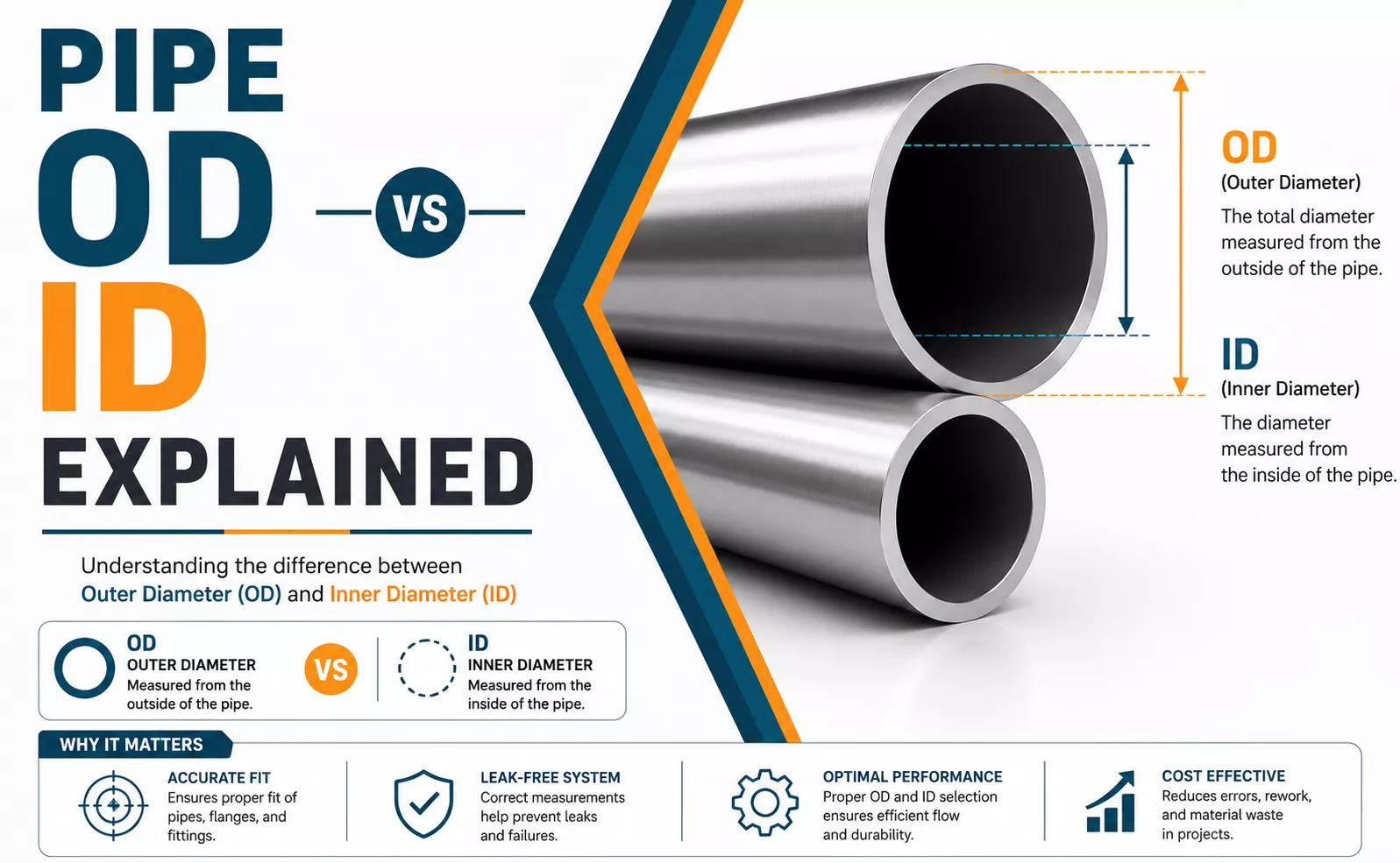
What Is Pipe OD?
In pipe engineering, OD refers to the actual Outside Diameter of the pipe, measured across the external surface through its center.
Pipe OD is mainly important for the external dimensions and physical fit of a piping system. It is commonly considered when selecting or designing:
- Pipe fittings
- Clamps and supports
- Couplings
- Sleeves
- Pipe hangers
- Welding connections
- Fabricated assemblies
- Installation clearances
For standardized steel and stainless steel pipes, the actual OD is generally established by the applicable dimensional standard. Different wall thicknesses or schedules can therefore exist under the same nominal pipe size while maintaining the same standard outside diameter.
Example of Pipe OD
An NPS 2 stainless steel pipe has a standard outside diameter of approximately 60.3 mm (2.375 inches).
The important point is that NPS 2 does not mean the actual pipe OD is 2 inches. NPS is a nominal designation, while OD represents the actual standardized outside dimension.
What Is Pipe ID?
ID stands for Inside Diameter. It is the distance measured across the internal opening of a pipe through its center. Pipe ID represents the available internal passage through which liquids, gases or other process media can flow.
Pipe ID is particularly important for applications involving:
- Fluid flow
- Gas flow
- Flow velocity
- Pressure drop
- Internal volume
- Internal clearance
- Pigging
- Internal inspection
- Process equipment connections
Unlike nominal pipe size, ID is an actual dimensional value and depends on the pipe's outside diameter and wall thickness. For a standard round pipe, the relationship can be expressed as:
A thicker pipe wall reduces the available internal opening when the outside diameter remains unchanged. This is why pipes with the same nominal size and standard OD can have different inside diameters when different wall thicknesses or schedules are specified.
Pipe OD vs ID: What Is the Difference?
The simplest way to understand the difference between pipe OD and ID is to consider where each measurement is taken. OD describes the external diameter of the pipe, while ID describes the internal opening available for flow.
| Dimension | Meaning | Mainly Used For |
|---|---|---|
| OD | Outside Diameter | External fit, fittings and supports |
| ID | Inside Diameter | Flow, capacity and internal clearance |
| Wall Thickness | Metal thickness between OD and ID | Strength and pressure design |
| NPS | Nominal Pipe Size | Standard pipe identification |
| Schedule | Standardized wall-thickness designation | Pipe wall selection |
In simple terms:
- OD tells you how large the pipe is externally.
- ID tells you how large the internal flow opening is.
- Wall thickness determines the difference between OD and ID.
Pipe OD, ID and Wall Thickness Formula
The outside diameter (OD), inside diameter (ID), and wall thickness of a pipe are directly related. Once any two dimensions are known, the third can be calculated using a simple geometric relationship.
For a standard round pipe, the wall thickness is present on both sides of the pipe. Therefore, the total difference between OD and ID is twice the wall thickness.
| Dimension to Calculate | Formula |
|---|---|
| Inside Diameter (ID) | ID = OD − (2 × Wall Thickness) |
| Outside Diameter (OD) | OD = ID + (2 × Wall Thickness) |
| Wall Thickness | Wall Thickness = (OD − ID) ÷ 2 |
Example: Calculate Pipe ID from OD and Wall Thickness
Consider a pipe with an outside diameter of 60.3 mm and a wall thickness of 3.91 mm. The inside diameter can be calculated as follows:
Substituting the known dimensions:
ID = 60.3 − 7.82
Therefore, the calculated inside diameter is 52.48 mm.
How Wall Thickness Affects Pipe ID
When the outside diameter remains constant, increasing the wall thickness reduces the inside diameter. Conversely, a thinner wall provides a larger internal opening.
| Pipe Condition | Effect on Wall Thickness | Effect on ID |
|---|---|---|
| Thinner wall | Decreases | Larger internal diameter |
| Thicker wall | Increases | Smaller internal diameter |
| Same OD, different schedule | May vary | May vary |
This relationship is important when selecting or replacing pipes because the nominal pipe size (NPS) alone does not determine the actual inside diameter. The OD, wall thickness or schedule, and applicable dimensional standard should also be checked.
For industrial applications, calculated dimensions should be verified against the applicable pipe dimensional standard, schedule and product specification before ordering or fabrication.
Pipe OD vs ID Chart
The following pipe OD vs ID chart shows how wall thickness affects the internal diameter while the standard outside diameter remains fixed for a given nominal pipe size.
| NPS | DN | Standard OD | Wall Thickness | Approx. ID |
|---|---|---|---|---|
| 1/2" | DN15 | 21.3 mm | 2.77 mm | 15.76 mm |
| 1" | DN25 | 33.4 mm | 3.38 mm | 26.64 mm |
| 2" | DN50 | 60.3 mm | 3.91 mm | 52.48 mm |
| 3" | DN80 | 88.9 mm | 5.49 mm | 77.92 mm |
| 4" | DN100 | 114.3 mm | 6.02 mm | 102.26 mm |
| 6" | DN150 | 168.3 mm | 7.11 mm | 154.08 mm |
| 8" | DN200 | 219.1 mm | 8.18 mm | 202.74 mm |
Note: The ID values shown are approximate calculations based on the listed OD and wall thickness. Actual pipe dimensions should always be verified against the applicable pipe dimensional standard, material specification and schedule.
Does Pipe Schedule Change the ID?
Yes. Pipe schedule is associated with standardized wall-thickness categories. When pipes have the same nominal size and standard outside diameter, different schedules can have different wall thicknesses.
As wall thickness increases, the available internal diameter decreases when the outside diameter remains the same. For example, consider an NPS 2 pipe with a standard OD of 60.3 mm:
| Pipe | OD | Wall Thickness | Effect on ID |
|---|---|---|---|
| Lower-wall pipe | 60.3 mm | Thinner | Larger ID |
| Schedule 40 example | 60.3 mm | 3.91 mm | 52.48 mm ID |
| Schedule 80 example | 60.3 mm | 5.54 mm | 49.22 mm ID |
| Higher-wall pipe | 60.3 mm | Thicker | Smaller ID |
Therefore, the basic relationship can be summarized as:
This relationship is important when calculating flow capacity, internal clearance, pressure requirements or replacing an existing pipe with a different schedule.
Is NPS the Same as Pipe OD?
No. NPS (Nominal Pipe Size) is a standardized designation used to identify pipe size. It is not necessarily the actual outside diameter or inside diameter of the pipe.
For example, common NPS designations correspond to the following standard outside diameters:
| Nominal Size | Actual OD |
|---|---|
| NPS 1/2 | 21.3 mm |
| NPS 1 | 33.4 mm |
| NPS 2 | 60.3 mm |
| NPS 3 | 88.9 mm |
| NPS 4 | 114.3 mm |
This is why a pipe should not be selected simply by assuming:
Instead, verify the actual OD, wall thickness, schedule and applicable dimensional standard when selecting or replacing a pipe.
For metric pipe identification, DN (Nominal Diameter) is also commonly used. NB (Nominal Bore) is another designation encountered in industrial piping markets.
OD vs ID: Which One Is More Important?
Neither pipe OD nor ID is universally more important. The dimension that matters most depends on how the pipe will be selected, connected, designed or used. In many industrial applications, both dimensions must be considered together with wall thickness and pipe schedule.
| Pipe Dimension | What It Determines | Commonly Checked For |
|---|---|---|
| OD (Outside Diameter) | External size of the pipe | Fittings, clamps, supports, couplings, sleeves, installation clearance and fabrication |
| ID (Inside Diameter) | Internal flow opening | Fluid flow, gas flow, flow velocity, pressure drop, internal capacity and clearance |
| Wall Thickness | Thickness of the pipe material | Pressure requirements, mechanical strength, corrosion allowance and temperature conditions |
When Is Pipe OD More Important?
Outside diameter (OD) is particularly important when the pipe needs to connect with or fit inside an external component. The actual OD may need to be checked when selecting fittings, clamps, supports, couplings, sleeves or fabricated connections.
When Is Pipe ID More Important?
Inside diameter (ID) becomes more important when the internal opening affects fluid or gas movement through the pipe. It is commonly considered when evaluating flow capacity, velocity, pressure drop, internal clearance and process requirements.
Why Is Wall Thickness Important?
Wall thickness affects both the internal diameter and the mechanical section of the pipe. A thicker wall generally provides a smaller internal opening when the OD remains constant, while also providing more material for pressure and mechanical requirements.
Which Dimensions Should You Check When Selecting a Pipe?
For industrial pipe selection, it is generally better to consider the complete dimensional and material specification rather than relying on only OD or ID. Important details may include:
- NPS: Nominal pipe size
- OD: Actual outside diameter
- ID: Actual inside diameter
- Wall Thickness: Pipe material thickness
- Schedule: Standardized wall-thickness designation
- Material Grade: Required material for the service condition
In simple terms, OD is mainly important for the external fit, ID is important for the internal flow opening, and wall thickness is important for strength and service requirements. The correct combination depends on the piping system, application and applicable specification.
How to Measure Pipe OD
Pipe OD (Outside Diameter) is measured across the outside surface of the pipe through its center. The measuring method depends on the pipe diameter and the level of accuracy required.
Common tools used to measure pipe OD include:
- Vernier caliper for small and medium-size pipes
- Outside micrometer for precise OD measurements
- Diameter tape for larger-diameter pipes
- Circumference measurement when direct OD measurement is difficult
For a direct measurement, place the measuring tool across the outside of the pipe and ensure that it passes through the widest part of the circular section. The measurement should be taken without excessive pressure on the pipe surface.
For large pipes, the OD can also be calculated from the measured circumference:
When checking a pipe for industrial use, it is recommended to take measurements at more than one location. This can help identify variations in diameter or out-of-roundness.
The measured OD should be compared with the specified pipe dimensions, allowable tolerances and applicable dimensional standard before the pipe is accepted or used for fabrication.
How to Measure Pipe ID
Pipe ID (Inside Diameter) is measured across the internal opening of the pipe through its center. ID is particularly important when the internal flow area, clearance or connection requirements need to be verified.
Common tools used to measure pipe ID include:
- Vernier caliper for accessible smaller pipe bores
- Inside caliper for internal diameter checking
- Bore gauge for accurate internal measurements
- Internal micrometer for precision measurements
To measure the ID directly, place the internal measuring jaws or instrument inside the pipe and position them across the bore. The measurement should be taken through the center of the pipe rather than at an angle.
If direct measurement is not practical, the internal diameter can be calculated when the actual OD and wall thickness are known:
Example: If the pipe has an OD of 60.3 mm and a wall thickness of 3.91 mm:
Therefore, the calculated inside diameter is 52.48 mm. For critical piping applications, the measured or calculated ID should be verified against the applicable dimensional standard, wall-thickness tolerance and product specification.
How to Select Pipe Using OD and ID
Selecting the correct pipe requires more than knowing the nominal pipe size. The OD, ID, wall thickness, schedule, material grade and applicable standards should be considered together with the piping system, operating conditions and connection requirements.
Use the following checklist to identify the key pipe dimensions and specifications before selecting or ordering a pipe.
| Selection Requirement | What to Check | Why It Matters |
|---|---|---|
| NPS / Nominal Size | Required NPS or DN | Identifies the nominal pipe size for the piping system |
| Outside Diameter (OD) | Actual pipe OD | Important for fittings, clamps, supports, sleeves and external connections |
| Inside Diameter (ID) | Required internal opening | Affects flow area, velocity, pressure drop and internal clearance |
| Wall Thickness | Required pipe wall thickness | Considered for pressure, temperature, mechanical loads and corrosion allowance |
| Pipe Schedule | Specified schedule or wall thickness | Determines the standardized wall-thickness category for the pipe |
| Material Grade | Required stainless steel, carbon steel or alloy grade | Determines corrosion resistance, strength and suitability for the service environment |
| Pipe Type | Seamless, welded, ERW or EFW, where applicable | Selected according to application, size, pressure and specification |
| Applicable Standard | ASTM, ASME, EN or specified product standard | Confirms dimensional, material, manufacturing and testing requirements |
Key Point When Selecting Pipe by OD and ID
A pipe should not be selected based only on its nominal size or outside diameter. The actual OD, required ID, wall thickness, schedule, material grade and applicable standard should all match the requirements of the piping system.
For pipe replacement or fabrication work, the existing pipe dimensions should also be measured and compared with the required specification before ordering. This helps ensure proper fit, adequate internal flow area and compatibility with the intended application.
Common Mistakes When Comparing Pipe OD and ID
Confusion between NPS, OD, ID, wall thickness and pipe schedule can lead to incorrect pipe selection, fitting problems and inaccurate flow calculations. The following are some common mistakes to avoid when measuring, comparing or replacing pipes.
| Common Mistake | What Is Wrong? | Correct Approach |
|---|---|---|
| 1. Assuming NPS Equals OD | The nominal pipe size is not necessarily the actual outside diameter of the pipe. | Check the actual OD against the applicable pipe dimensional standard. For example, an NPS 2 pipe has a standard OD of approximately 60.3 mm (2.375 inches). |
| 2. Assuming the Same NPS Means the Same ID | Pipes with the same nominal size can have different wall thicknesses and therefore different internal diameters. | Check the pipe schedule or actual wall thickness when determining the ID. |
| 3. Using ID to Select an External Fitting | The internal diameter does not determine how an external fitting, clamp or support will fit around the pipe. | Use the actual pipe OD when checking external connections and components. |
| 4. Ignoring Wall Thickness | OD alone cannot determine the internal diameter. | Consider both OD and wall thickness because: ID = OD − (2 × Wall Thickness). |
| 5. Using NPS for Flow Calculations | NPS is a nominal designation and does not directly represent the actual internal flow area. | Use the appropriate actual ID for flow, velocity and internal capacity calculations. |
| 6. Ignoring the Applicable Standard | Pipe dimensions, tolerances and requirements can vary according to the applicable specification. | Verify the required dimensions against the relevant ASTM, ASME, EN or other applicable standard. |
The safest approach is to verify the NPS, actual OD, ID, wall thickness, schedule and applicable standard before selecting or replacing an industrial pipe.
Pipe OD vs ID for Stainless Steel Pipes
For stainless steel pipes, understanding the relationship between OD, ID and wall thickness is important when selecting pipes for industrial piping, fabrication, process systems and replacement work. Stainless steel pipes are available in different grades, schedules, sizes and manufacturing types, so the complete specification should be checked before ordering.
A stainless steel pipe requirement may include the following dimensional, material and manufacturing details:
| Specification | What It Defines |
|---|---|
| Stainless Steel Grade | Material composition, corrosion resistance and mechanical properties |
| NPS | Nominal pipe size used for standard pipe identification |
| Outside Diameter (OD) | Actual external diameter of the pipe |
| Inside Diameter (ID) | Internal opening available for flow and clearance |
| Wall Thickness | Metal thickness between the outside and inside surfaces |
| Schedule | Standardized wall-thickness designation |
| Pipe Length | Required standard or custom pipe length |
| Manufacturing Type | Seamless, welded, ERW or EFW construction, where applicable |
| Applicable Standard | Required ASTM, ASME, EN or other specified product standard |
Example of a Stainless Steel Pipe Specification
A stainless steel pipe requirement may be specified as:
In this example, NPS 2 identifies the nominal pipe size, Schedule 40 identifies the specified wall-thickness category, and ASTM A312 TP304 identifies the applicable product specification and stainless steel grade.
The actual pipe OD and corresponding wall thickness should be verified against the applicable dimensional standard. The ID can then be determined from the actual OD and wall thickness where required.
Therefore, specifying only a "2-inch stainless steel pipe" may not provide enough information for accurate selection. The required grade, NPS, schedule or wall thickness, manufacturing type, applicable standard and length should be confirmed before ordering.
Standards Used for Pipe Dimensions
Pipe dimensions are governed by applicable dimensional standards and product specifications. These standards help define requirements for nominal size, outside diameter, wall thickness and dimensional tolerances.
Common references for industrial steel and stainless steel piping include:
- ASME B36.10M – Welded and Seamless Wrought Steel Pipe
- ASME B36.19M – Stainless Steel Pipe
- Applicable ASTM material and manufacturing specifications
The dimensional standard should be checked together with the applicable material specification because pipe size, wall thickness, manufacturing requirements, tolerances and material requirements may be addressed by different standards.
Why Pipe OD and ID Matter in Industrial Applications
Pipe OD, ID and wall thickness play an important role in industrial piping systems. The actual OD affects external connections and installation, while the ID influences internal flow area, velocity and clearance. Wall thickness is considered for pressure, mechanical strength and service conditions.
These dimensions are particularly important when selecting, replacing, fabricating or connecting pipes in the following industries:
Oil & Gas
OD is important for connecting pipes with fittings, flanges, supports and other piping components. ID is considered for hydrocarbon flow and the required internal capacity, while wall thickness is selected according to pressure and service conditions.
Petrochemical & Chemical Processing
Correct pipe dimensions help maintain the required flow area and ensure compatibility with process equipment and fittings. Wall thickness and material grade are also important for pressure, temperature and corrosive service conditions.
Power Generation
Power piping systems require suitable OD, ID and wall thickness for pressure and temperature conditions. Accurate dimensions are also necessary for reliable connections between pipes, valves, fittings and equipment.
Pharmaceutical & Food Processing
Internal pipe dimensions are important for controlled fluid transfer, cleaning and process connections. The selected pipe grade, surface finish, ID and OD should meet the requirements of the particular hygienic application.
Marine Applications
Accurate pipe dimensions are required for seawater, cooling and process piping systems. OD helps with external connections and installation, while ID and wall thickness are considered for flow and service requirements.
Water Treatment
Pipe ID affects the available flow area in water, wastewater and treatment systems. Correct OD is important for connections and installation, while wall thickness provides the required structural strength and service performance.
Engineering & Fabrication
Fabrication projects often require accurate OD and wall thickness measurements to ensure proper fit-up, welding, bending, supports and connections with other components.
General Industrial Piping
Industrial piping systems use OD, ID and wall thickness together to determine pipe compatibility, flow requirements, installation clearances and mechanical suitability for the intended service.
Why All Three Dimensions Matter
Pipe selection should not be based on OD or ID alone. The outside diameter determines external fit, the inside diameter affects flow and internal clearance, and wall thickness contributes to pressure and mechanical performance.
For industrial applications, these dimensions should be considered together with the NPS, schedule, material grade, manufacturing type and applicable pipe standard to ensure the selected pipe meets the requirements of the piping system.
Frequently Asked Questions About Pipe OD and ID
Pipe size is generally identified by NPS (Nominal Pipe Size) rather than directly by OD or ID. The actual OD is defined by the applicable dimensional standard, while the ID depends on the OD and wall thickness. For flow calculations, the actual ID is important; for fittings and external connections, the actual OD is important.
OD (Outside Diameter) is the measurement across the outside of the pipe, while ID (Inside Diameter) is the measurement across the internal opening. OD is important for fittings and external connections, while ID is important for flow and internal clearance.
Pipe OD can be measured using a vernier caliper, outside micrometer or diameter tape. ID can be measured using an inside caliper, bore gauge or internal micrometer. If the OD and wall thickness are known, ID can also be calculated using ID = OD − (2 × Wall Thickness).
Pipe OD can be calculated when the inside diameter and wall thickness are known using the formula: OD = ID + (2 × Wall Thickness). For example, if the ID is 50 mm and the wall thickness is 5 mm, the calculated OD is 60 mm.
Pipe OD can be measured using a vernier caliper, outside micrometer or diameter tape. For larger pipes, the circumference can also be measured and used to determine the approximate outside diameter. Industrial measurements should be checked according to the applicable dimensional standard.
A standard NPS 1 pipe has an outside diameter of approximately 33.4 mm (1.315 inches). The actual inside diameter will vary depending on the specified wall thickness or pipe schedule.
A standard NPS 2 pipe has an outside diameter of approximately 60.3 mm (2.375 inches). Its inside diameter depends on the wall thickness or schedule selected.
A standard NPS 4 pipe has an outside diameter of approximately 114.3 mm (4.5 inches). The actual ID varies according to the pipe wall thickness or schedule.
Pipe OD in millimetres depends on the nominal pipe size and applicable dimensional standard. For example, an NPS 1 pipe has an OD of 33.4 mm, NPS 2 has an OD of 60.3 mm, and NPS 4 has an OD of 114.3 mm.
A pipe with an actual outside diameter of exactly 1 inch (25.4 mm) is not identified simply as a 1-inch NPS pipe. NPS is a nominal designation, so the actual OD must be checked against the applicable pipe dimensional standard.