
-
-
-
Girgaon, Mumbai - 400004
Aluminium Pipes Exporter in India
What Are Aluminium Pipes?
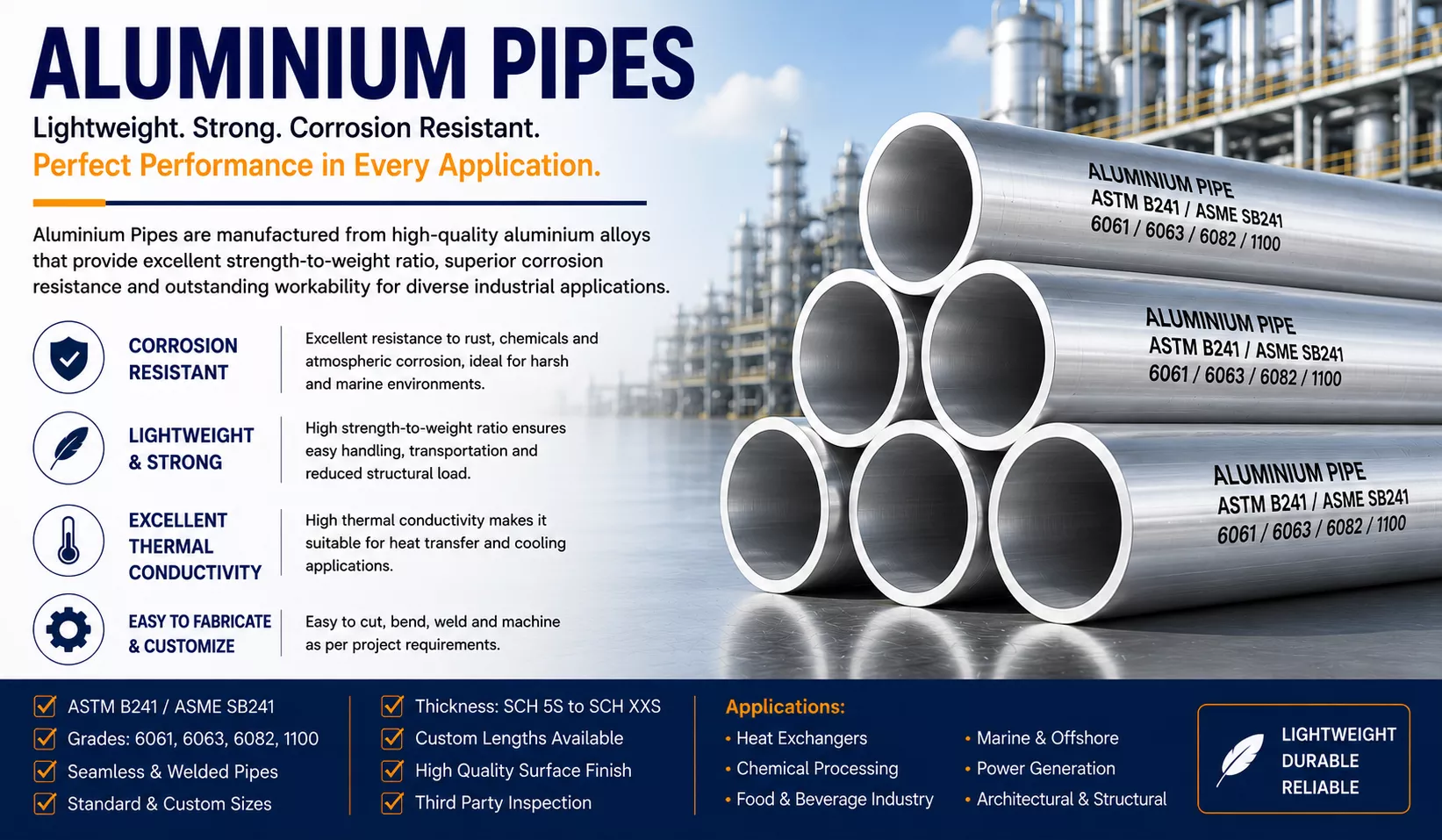
Aluminium Pipes are lightweight, corrosion-resistant tubular products widely used in industrial, engineering, construction, transportation and fluid-handling applications. Their low density, good strength-to-weight ratio and natural resistance to atmospheric corrosion make them suitable for applications where weight reduction and durability are important.
Aluminium Pipes are available in different grades, sizes, outside diameters, wall thicknesses and lengths to meet specific application requirements. Depending on the aluminium alloy and temper, these pipes can offer different levels of strength, machinability, weldability and corrosion resistance.
Kamal Steels is an Aluminium Pipes Exporter in India, supplying aluminium pipes in different grades, sizes, wall thicknesses and lengths for domestic and international customers. We support export requirements with suitable packaging, inspection, testing and documentation based on customer and project specifications.
Need The Best Price For Aluminium Pipes?
Share your required grade, size, schedule and quantity and our team will send a fast quotation with stock availability and delivery details.
Certifications & Compliance
- ISO 9001:2015 Certified
- ISO 14001 Certified
- ISO 45001 Certified
- PED Approved Materials
- MSME Registered Company
- IEC Export Certification
- GST Registered Business
Aluminium Pipe Specifications
| Specification | Details |
|---|---|
| Product Name | Aluminium Pipes |
| Grades | 1050, 1100, 3003, 5052, 6061, 6063, 7075 |
| Type | Seamless / Welded / Extruded |
| Size Range | 6 mm to 610 mm |
| Thickness | SCH 5 to SCH 160 |
| Length | Single Random / Double Random / Custom Length |
| Standards | ASTM B221, ASTM B241, ASME SB221 |
| End Finish | Plain End, Beveled End, Threaded End |
Aluminium Pipe Weight Chart
The following table provides the approximate weight of Aluminium 6061, 6063, and 5083 pipes based on Schedule 40 dimensions. Actual weight may vary depending on the alloy grade, manufacturing standard, wall thickness, and dimensional tolerances.
| Nominal Pipe Size (NPS) | Outside Diameter (mm) | Wall Thickness (mm) | Approx. Weight (kg/m) |
|---|---|---|---|
| 1/8" | 10.3 | 1.73 | 0.13 |
| 1/4" | 13.7 | 2.24 | 0.22 |
| 3/8" | 17.1 | 2.31 | 0.31 |
| 1/2" | 21.3 | 2.77 | 0.46 |
| 3/4" | 26.7 | 2.87 | 0.62 |
| 1" | 33.4 | 3.38 | 0.94 |
| 1-1/4" | 42.2 | 3.56 | 1.29 |
| 1-1/2" | 48.3 | 3.68 | 1.54 |
| 2" | 60.3 | 3.91 | 2.05 |
| 2-1/2" | 73.0 | 5.16 | 3.21 |
| 3" | 88.9 | 5.49 | 4.05 |
| 4" | 114.3 | 6.02 | 5.56 |
| 6" | 168.3 | 7.11 | 9.84 |
| 8" | 219.1 | 8.18 | 14.87 |
| 10" | 273.0 | 9.27 | 20.72 |
| 12" | 323.9 | 10.31 | 26.69 |
Note: The above weights are approximate for Aluminium Schedule 40 pipes manufactured in alloys such as 6061, 6063, and 5083. Actual weight depends on the alloy grade, pipe schedule (SCH 5S to SCH XXS), manufacturing tolerances, and applicable ASTM/ASME specifications.
Aluminium Pipe Size Chart & Dimensions
Aluminium pipes are available in a wide range of sizes, wall thicknesses and schedules suitable for structural, automotive and industrial applications.
| Nominal Pipe Size | Outside Diameter (OD) | SCH 40 Wall Thickness | SCH 80 Wall Thickness |
|---|---|---|---|
| 1/8" | 10.3 mm | 1.73 mm | 2.41 mm |
| 1/4" | 13.7 mm | 2.24 mm | 3.02 mm |
| 1/2" | 21.3 mm | 2.77 mm | 3.73 mm |
| 1" | 33.4 mm | 3.38 mm | 4.55 mm |
| 2" | 60.3 mm | 3.91 mm | 5.54 mm |
| 4" | 114.3 mm | 6.02 mm | 8.56 mm |
| 6" | 168.3 mm | 7.11 mm | 10.97 mm |
Aluminium Pipe Weight Calculator
The weight of an Aluminium Pipe can be calculated using the following standard formula:
Weight (kg/m) = (OD − WT) × WT × 0.00879
- OD = Outside Diameter (mm)
- WT = Wall Thickness (mm)
- 0.00879 = Density factor for Aluminium
This formula helps estimate the theoretical weight per meter of Aluminium Pipes for engineering, fabrication and procurement purposes. Actual weight may vary slightly depending on alloy grade, manufacturing tolerance and pipe dimensions.
Example Calculation
For an Aluminium Pipe with an Outside Diameter of 50 mm and a Wall Thickness of 3 mm:
Weight (kg/m) = (50 − 3) × 3 × 0.00879
Weight (kg/m) = 1.24 kg/m (Approx.)
Contact Kamal Steels for detailed Aluminium Pipe weight charts, size specifications and technical assistance.
Types of Aluminium Pipes
- Aluminium Seamless Pipes
- Aluminium Welded Pipes
- Aluminium Extruded Pipes
- Aluminium Round Pipes
- Aluminium Thin Wall Pipes
- Aluminium Thick Wall Pipes
- Aluminium Large Diameter Pipes
Aluminium Pipe Grades
| Material | UNS Number | Werkstoff No. |
|---|---|---|
| Aluminium 1100 Pipes | A91100 | 3.0255 |
| Aluminium 5052 Pipes | A95052 | 3.3523 |
| Aluminium 6061 Pipes | A96061 | 3.3211 |
| Aluminium 6063 Pipes | A96063 | 3.3206 |
| Aluminium 7075 Pipes | A97075 | 3.4365 |
Aluminium vs Stainless Steel Pipe
Aluminium Pipes and Stainless Steel Pipes are widely used across industrial, commercial and structural applications. While aluminium pipes are known for their lightweight properties and excellent thermal conductivity, stainless steel pipes offer superior strength, durability and corrosion resistance in demanding environments.
| Property | Aluminium Pipes | Stainless Steel Pipes |
|---|---|---|
| Weight | Very Lightweight | Heavier than Aluminium |
| Corrosion Resistance | Excellent | Excellent to Superior |
| Strength | Moderate | High |
| Temperature Resistance | Moderate | Excellent |
| Thermal Conductivity | Very High | Lower than Aluminium |
| Fabrication | Easy to Machine and Form | More Difficult to Machine |
| Cost | Generally Lower | Generally Higher |
| Common Applications | HVAC, Automotive, Aerospace, Construction | Chemical, Oil & Gas, Food Processing, Marine |
Aluminium Pipes are preferred where lightweight construction, good corrosion resistance and high thermal conductivity are required. Stainless Steel Pipes are the better choice for high-pressure, high-temperature and corrosive industrial environments that demand maximum strength and durability.
Chemical Composition of Aluminium Pipe
| Grade | Aluminium (%) | Magnesium (%) | Silicon (%) | Other Elements |
|---|---|---|---|---|
| 1050 | 99.5 Min | 0.05 Max | 0.25 Max | Fe, Cu, Mn Trace |
| 3003 | Al Balance | 0.05 – 0.2 | 0.6 Max | Mn 1.0 – 1.5 |
| 5052 | Al Balance | 2.2 – 2.8 | 0.25 Max | Cr 0.15 – 0.35 |
| 6061 | Al Balance | 0.8 – 1.2 | 0.4 – 0.8 | Mg, Cu, Cr |
| 6063 | Al Balance | 0.45 – 0.9 | 0.2 – 0.6 | Fe, Mn Trace |
| 7075 | Al Balance | 2.1 – 2.9 | 0.4 Max | Zn, Cu, Mg |
Aluminium Pipe Standards
| ASTM Standards | ASME Standards |
|---|---|
| ASTM B221 | ASME SB221 |
| ASTM B241 | ASME SB241 |
Mechanical Properties of Aluminium Pipe
Tensile Strength
Aluminium pipes provide good tensile strength depending on grade, making them suitable for structural and industrial applications.
Yield Strength
They offer moderate yield strength ensuring reliable performance in load-bearing and fluid transport systems.
Elongation
High elongation properties provide excellent ductility, allowing easy fabrication and bending.
| Grade | Tensile Strength (MPa, Min) | Yield Strength (MPa, Min) | Elongation (% Min) |
|---|---|---|---|
| 1050 | 65 – 95 | 30 Min | 25% |
| 6061 | 240 Min | 150 Min | 12% |
| 7075 | 570 Min | 505 Min | 11% |
Features of Aluminium Pipes
- Lightweight Structure: Aluminium pipes are extremely lightweight, making them easy to handle, transport and install in various applications.
- Excellent Corrosion Resistance: Naturally forms a protective oxide layer that prevents rust and corrosion in most environments.
- High Strength-to-Weight Ratio: Provides strong mechanical performance while maintaining low overall weight.
- Good Thermal & Electrical Conductivity: Ideal for heat transfer and electrical applications due to excellent conductivity.
- Easy Fabrication: Can be easily welded, machined and formed into various shapes and systems.
- Long Service Life: Offers durable performance with minimal maintenance requirements.
- Recyclable Material: 100% recyclable without losing its properties, making it environmentally friendly.
Applications of Aluminium Pipes
Aluminium Pipes are used in a wide range of systems and components where low weight, corrosion resistance, strength and thermal performance are required.
Fluid Transfer Systems
Used for transporting water, air, gases and selected fluids in industrial and commercial piping systems.
HVAC & Refrigeration
Used in refrigeration, air conditioning and HVAC systems where lightweight construction and heat transfer performance are important.
Heat Exchangers
Used in heat transfer equipment and cooling systems because aluminium provides good thermal conductivity.
Automotive Components
Used for fluid lines, air conditioning lines, cooling systems and other weight-sensitive vehicle components.
Aircraft Systems
Used in selected aircraft fluid, hydraulic and structural applications where weight reduction is important.
Structural Applications
Used for lightweight frameworks, supports, architectural structures and fabricated components.
Compressed Air Lines
Used in industrial compressed air distribution systems where lightweight and corrosion-resistant piping is preferred.
Industries Using Aluminium Pipes
Kamal Steels supplies Aluminium Pipes for industries that require lightweight, corrosion-resistant and durable piping materials for manufacturing, fabrication and engineering requirements.
Aerospace Industry
Aluminium Pipes are selected for aerospace applications where low weight, strength and reliable performance are important.
Automotive Industry
Used by automotive manufacturers and fabricators for lightweight vehicle systems and components.
HVAC & Refrigeration Industry
Used by HVAC and refrigeration equipment manufacturers for cooling, heating and air conditioning systems.
Marine Industry
Used for selected marine equipment and fabricated systems where corrosion resistance and low weight are required.
Construction Industry
Used by construction and architectural companies for lightweight structures, frameworks and fabricated components.
Electrical Industry
Used for electrical conduits, protective systems and fabricated components in electrical installations.
General Engineering Industry
Used by engineering companies for industrial equipment, machinery, fabrication and customized piping requirements.
Frequently Asked Questions
An aluminium pipe is a lightweight, corrosion-resistant metal pipe used in industrial, structural and fluid transport applications.
Aluminium pipes are widely used in aerospace, automotive, construction, HVAC systems, marine engineering and electrical industries.
The most commonly used grades are 1050, 3003, 5052, 6061 and 6063, depending on strength and application requirements.
Aluminium pipes are manufactured using processes such as extrusion, seamless drawing or welding depending on the required specifications.
Aluminium pipes can be joined using welding (TIG/MIG), flanges, compression fittings, couplings or threaded joints depending on application needs.
Aluminium pipes are generally suitable for low to medium pressure applications. High-pressure usage depends on grade, wall thickness and design standards.
6061 aluminium offers higher strength and is used for structural applications, while 6063 provides better surface finish and corrosion resistance for architectural use.
Aluminium is not commonly used for water pipes because it may react with certain water conditions. Materials like copper and stainless steel are preferred for long-term plumbing systems.
Yes, aluminium pipes are 100% recyclable without loss of quality, making them an environmentally friendly material.
Aluminium pipes offer benefits such as lightweight construction, corrosion resistance, high strength-to-weight ratio, good thermal conductivity and long service life.