
-
-
-
Girgaon, Mumbai - 400004
ASTM Standards
ASTM Standards are widely used by manufacturers, engineers, inspectors, suppliers and buyers to define material requirements and verify the quality and performance of industrial products. For stainless steel pipes and tubes, ASTM Specifications cover requirements such as chemical composition, mechanical properties, dimensions, manufacturing methods, testing and inspection.
Kamal Steels uses internationally recognized ASTM Specifications as part of its stainless steel piping product range and provides technical information to help customers understand material standards, product specifications and testing requirements.
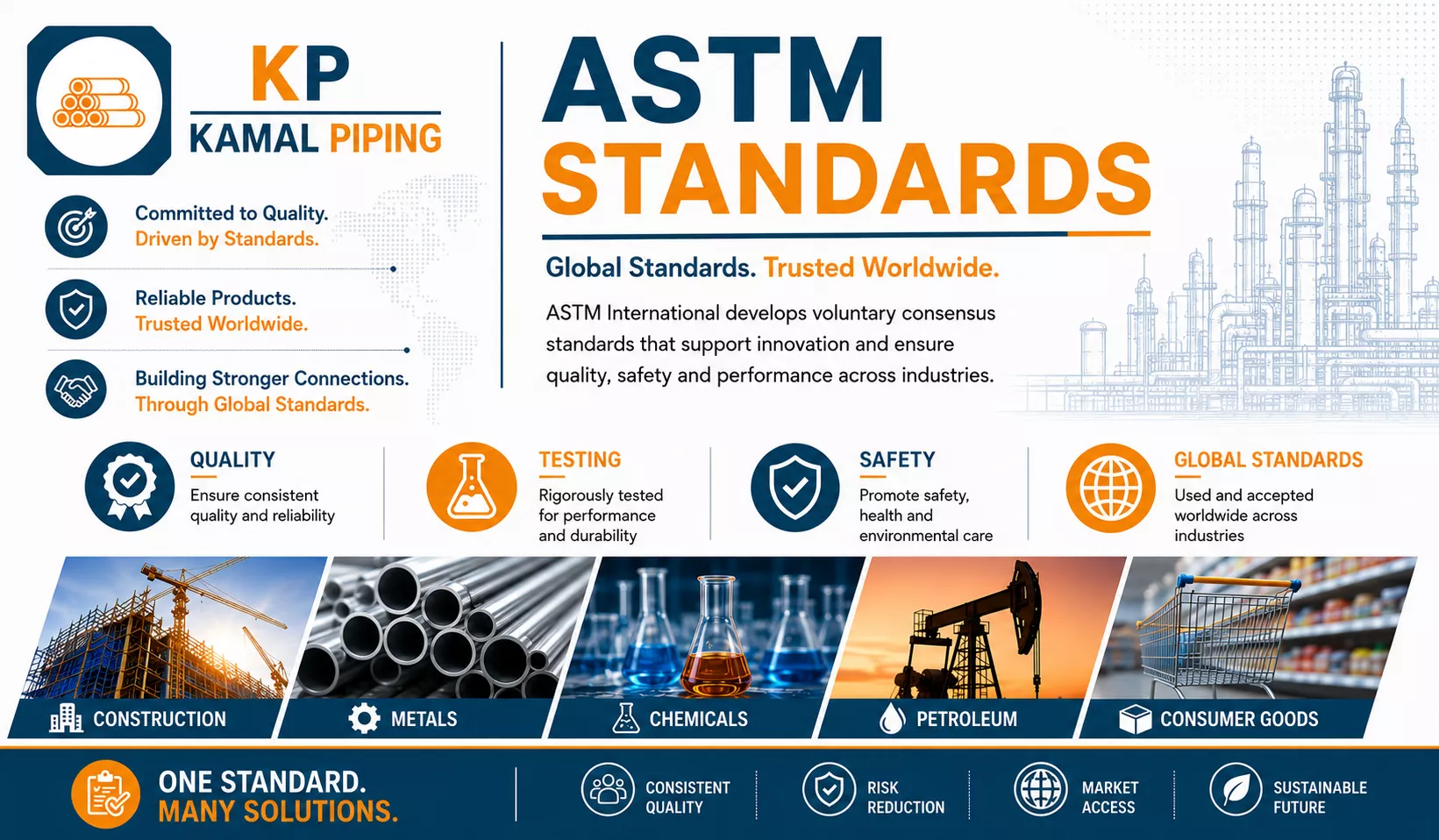
What Is ASTM?
ASTM International is a global standards development organization that creates voluntary consensus standards for materials, products, systems and test methods. Its standards are used in many industries worldwide, and the organization provides access to more than 12,000 standards.
ASTM standards are widely used in industries such as oil & gas, Petrochemicals, power generation, pharmaceuticals, food processing, marine, construction and water treatment. These standards help ensure consistency, safety and reliable performance across different suppliers and regions.
ASTM Standards Full Form
The ASTM full form is American Society for Testing and Materials. Although the organization is now officially known as ASTM International, the original full form is still widely used in technical documents, engineering specifications, procurement, and commercial communication across industries.
ASTM International develops globally recognized voluntary consensus standards that help ensure the quality, safety, performance, and reliability of materials, products, systems, and testing methods. Today, ASTM standards are followed by manufacturers, engineers, inspectors, and buyers in more than 140 countries.
What Are ASTM Standards?
ASTM standards are technical specifications that define how materials and products should be manufactured, tested, inspected, identified, and supplied. These standards establish uniform requirements for chemical composition, mechanical properties, dimensions, tolerances, heat treatment, surface finish, testing procedures, inspection methods, marking, certification, and packaging.
By following ASTM standards, manufacturers and suppliers can produce consistent, high-quality products that meet industry requirements and customer expectations. These standards also make it easier for engineers and buyers to compare products from different manufacturers while ensuring compatibility and regulatory compliance.
For example, ASTM A312 specifies the requirements for seamless, welded, and heavily cold-worked austenitic stainless steel pipes used in high-temperature and corrosive service. Similar ASTM specifications exist for stainless steel tubes, carbon steel pipes, duplex stainless steel products, fittings, flanges, and many other industrial materials.
ASTM standards are widely used in industries such as oil & gas, petrochemical processing, power generation, pharmaceuticals, food processing, marine engineering, construction, water treatment, and manufacturing, where product quality, safety, and long-term performance are critical.
Why ASTM Standards Matter
ASTM standards help reduce variations between manufacturers and ensure materials meet consistent quality, safety, and performance requirements. They provide a common technical language for manufacturers, suppliers, engineers, inspectors, and buyers, making product selection and quality verification much more reliable.
These standards are especially important in industries where product failure can result in costly downtime or safety risks, such as oil & gas, petrochemical plants, power generation, marine engineering, pharmaceuticals, construction, and pressure piping systems.
Main Benefits of ASTM Standards
- Consistent product quality across manufacturers.
- Improved safety in critical industrial applications.
- Reliable testing, inspection, and quality control.
- Easier comparison between different suppliers.
- Better compliance with project specifications and international requirements.
- Reduced risk of product failure during service.
ASTM Standard Numbering
Every ASTM standard has a unique designation consisting of a letter prefix followed by a number. The letter generally identifies the material category or type of standard, while the number specifies the individual material specification or testing method.
Understanding ASTM numbering helps engineers and buyers quickly identify the correct standard for a particular material or application.
Common ASTM Prefixes
| ASTM Prefix | Category |
|---|---|
| ASTM A | Iron and Steel Materials |
| ASTM B | Non-Ferrous Metals |
| ASTM C | Cement, Concrete & Ceramics |
| ASTM D | Plastics, Rubber & Miscellaneous Materials |
| ASTM E | Test Methods |
| ASTM F | Medical Devices & Consumer Products |
| ASTM G | Corrosion Testing |
ASTM Standards for Pipes, Tubes & Industrial Materials
ASTM International publishes thousands of standards covering metallic materials, industrial products, and testing methods. The table below highlights some of the most widely used ASTM Standards for stainless steel, carbon steel, alloy steel, duplex stainless steel, nickel alloys, titanium, pipes, tubes, fittings, and flanges used in Industries such as oil & gas, Refinery,petrochemical, power generation, marine, pharmaceutical, food processing, and Construction, Sugar.
| ASTM Standard | Product / Specification | Typical Applications |
|---|---|---|
| ASTM A53 | Carbon Steel Pipe | Structural & Pressure Applications |
| ASTM A106 | Carbon Steel Seamless Pipe | Steam Lines, Refineries, High Temperature Service |
| ASTM A178 | ERW Boiler Tubes | Boilers & Heat Exchangers |
| ASTM A179 | Seamless Heat Exchanger Tubes | Heat Exchangers & Condensers |
| ASTM A192 | Carbon Steel Boiler Tubes | High Pressure Boilers |
| ASTM A210 | Medium Carbon Steel Boiler Tubes | Boilers & Superheaters |
| ASTM A213 | Alloy & Stainless Steel Boiler Tubes | Power Plants & Heat Exchangers |
| ASTM A249 | Welded Austenitic Heat Exchanger Tubes | Heat Exchangers |
| ASTM A268 | Ferritic Stainless Steel Tubes | General Corrosion Service |
| ASTM A269 | Stainless Steel Instrumentation Tubes | Instrumentation & Process Industries |
| ASTM A270 | Sanitary Stainless Steel Tubes | Food, Dairy & Pharmaceutical |
| ASTM A312 | Stainless Steel Seamless & Welded Pipes | Oil & Gas, Chemical & Water Treatment |
| ASTM A333 | Low Temperature Carbon Steel Pipe | Cryogenic Service |
| ASTM A335 | Alloy Steel Pipe | High Temperature & Power Plants |
| ASTM A358 | EFW Stainless Steel Pipe | High Temperature & Corrosive Service |
| ASTM A376 | High Temperature Stainless Steel Pipe | Elevated Temperature Applications |
| ASTM A403 | Stainless Steel Pipe Fittings | Industrial Piping Systems |
| ASTM A409 | Large Diameter Welded Stainless Steel Pipe | Process Industries |
| ASTM A511 | Stainless Steel Mechanical Tubing | Mechanical Components |
| ASTM A554 | Welded Stainless Steel Mechanical Tubing | Architectural & Decorative Applications |
| ASTM A778 | Unannealed Welded Stainless Steel Pipe | Low Corrosion Applications |
| ASTM A789 | Duplex Stainless Steel Tubes | Heat Exchangers |
| ASTM A790 | Duplex Stainless Steel Pipes | Marine, Offshore & Desalination |
| ASTM A813 | Single Seam Welded Stainless Steel Pipe | Industrial Piping |
| ASTM A814 | Cold Worked Welded Austenitic Pipe | High Strength Applications |
| ASTM A928 | Duplex Stainless Steel EFW Pipe | Offshore Pipelines |
| ASTM B163 | Nickel Alloy Seamless Tubes | Condensers & Heat Exchangers |
| ASTM B165 | Monel Seamless Pipe & Tube | Marine & Chemical Processing |
| ASTM B167 | Nickel-Chromium Alloy Pipes & Tubes | High Temperature Service |
| ASTM B407 | Nickel-Iron-Chromium Alloy Pipe & Tube | Corrosion Resistant Applications |
| ASTM B444 | Nickel-Chromium-Molybdenum Pipe & Tube | Chemical Processing |
| ASTM B619 | Welded Nickel Alloy Pipe | Corrosive Process Industries |
| ASTM B622 | Seamless Nickel Alloy Pipe & Tube | Chemical & Offshore Industries |
| ASTM B705 | Welded Titanium Pipe | Marine & Aerospace |
| ASTM B729 | Seamless Titanium Pipe | Chemical Processing & Marine |
ASTM Pipe Standards
ASTM Pipe Standards define the manufacturing requirements, chemical composition, mechanical properties, dimensions, tolerances, testing methods, inspection procedures, marking, and performance requirements for pipes used in industrial applications. Selecting the correct ASTM specification depends on the material type, operating temperature, pressure, corrosion resistance, and whether the pipe is manufactured as seamless or welded.
Below are some of the most widely used ASTM pipe and tube standards across industries such as oil & gas, petrochemical, power generation, marine, food processing, pharmaceutical, and water treatment.
| ASTM Standard | Description | Common Grades / Applications |
|---|---|---|
| ASTM A312 | Seamless, welded and heavily cold-worked austenitic stainless steel pipes. | TP304, TP304L, TP316, TP316L, TP321, TP347 – Oil & Gas, Chemical, Food Processing, Water Treatment |
| ASTM A213 | Seamless ferritic and austenitic alloy steel tubes for boilers, superheaters and heat exchangers. | Power Plants, Boilers, Heat Exchangers, Condensers |
| ASTM A269 | Seamless and welded stainless steel tubing for general service and instrumentation. | Instrumentation, Pharmaceutical, Chemical Processing |
| ASTM A790 | Duplex stainless steel seamless and welded pipes with excellent strength and corrosion resistance. | Marine, Offshore, Desalination, Chemical Plants |
| ASTM A106 | Seamless carbon steel pipe for high-temperature service. | Steam Pipelines, Refineries, Petrochemical Plants, Power Stations |
These ASTM specifications are widely recognized worldwide and help ensure consistent quality, safety, and reliable performance for piping systems operating under demanding industrial conditions.
ASTM Standards for Tensile Testing
Tensile testing is one of the most important mechanical tests used to evaluate the strength and ductility of metallic materials. ASTM E8 / E8M is the internationally recognized standard for conducting tensile tests on metallic materials at room temperature. It determines key mechanical properties such as yield strength, ultimate tensile strength, elongation, and reduction of area.
In addition to ASTM E8 / E8M, several ASTM standards are commonly used for hardness, impact, corrosion resistance, and mechanical testing of metals to ensure products meet industry quality requirements.
| ASTM Standard | Testing Method | Purpose |
|---|---|---|
| ASTM E8 / E8M | Tensile Testing | Determines tensile strength, yield strength and elongation. |
| ASTM A370 | Mechanical Testing | Mechanical testing of steel products. |
| ASTM E18 | Rockwell Hardness Test | Measures Rockwell hardness of metals. |
| ASTM E10 | Brinell Hardness Test | Determines Brinell hardness values. |
| ASTM E92 | Vickers Hardness Test | Measures Vickers hardness of materials. |
| ASTM E23 | Charpy Impact Test | Evaluates impact toughness of metallic materials. |
| ASTM G48 | Pitting Corrosion Test | Determines pitting corrosion resistance of stainless steels. |
| ASTM G28 | Intergranular Corrosion Test | Evaluates susceptibility to intergranular corrosion. |
These ASTM testing standards play a vital role in quality assurance, material certification, product validation, and compliance with international engineering specifications across industries.
ASTM vs ASME vs ISO
Although ASTM, ASME, and ISO are often mentioned together, each organization serves a different purpose. ASTM primarily develops material specifications and testing standards, ASME focuses on engineering design codes and pressure equipment, while ISO publishes internationally accepted technical and management standards used across multiple industries.
| Standard | Main Focus | Examples |
|---|---|---|
| ASTM | Material specifications and testing methods. | ASTM A312, ASTM A213, ASTM A790 |
| ASME | Engineering design codes and pressure equipment. | ASME B31.3, ASME B36.10M, ASME B36.19M |
| ISO | International management systems and technical standards. | ISO 9001, ISO 14001, ISO 45001 |
Example: A stainless steel pipe may be manufactured according to ASTM A312, sized according to ASME B36.19M, and installed in a piping system designed to ASME B31.3. Meanwhile, the manufacturer may operate under an ISO 9001 certified quality management system. Together, these standards ensure quality materials, proper dimensions, safe design, and consistent manufacturing practices.
How to Choose the Right ASTM Standard
Selecting the correct ASTM standard depends on the material, manufacturing method, operating pressure, temperature, corrosion resistance, and project requirements. Before choosing a specification, always consider the service environment and whether the product is seamless, welded, forged, or intended for high-temperature or low-temperature applications.
| Product | Recommended ASTM Standard |
|---|---|
| Stainless Steel Pipe | ASTM A312 |
| Duplex Stainless Steel Pipe | ASTM A790 |
| Boiler & Heat Exchanger Tube | ASTM A213 |
| Instrumentation Tube | ASTM A269 |
| Carbon Steel Seamless Pipe | ASTM A106 |
| Carbon Steel Structural Pipe | ASTM A53 |
| Pipe Fittings | ASTM A403 |
| Forged Flanges & Fittings | ASTM A182 |
Choosing the correct ASTM specification ensures product compatibility, regulatory compliance, improved safety, and reliable long-term performance in industrial piping systems.
ASTM Standards PDF
Many engineers and buyers search for ASTM Standards PDF or ASTM Standards List PDF. However, official ASTM standards are protected by copyright and are generally not available for free download.
To ensure you are using the latest revisions and technical requirements, ASTM specifications should be obtained directly from ASTM International or an authorized distributor. This guarantees access to the most up-to-date information for material selection, testing procedures, inspection requirements, and engineering projects.
For educational purposes, guides such as this article provide an overview of commonly used ASTM standards, their applications, and their importance in industrial manufacturing and quality control.
Looking for ASTM Standard Stainless Steel Pipes & Tubes?
Kamal Steels is a trusted Manufacturer, Stockist, Supplier and Exporter of Stainless Steel Pipes and Tubes manufactured in accordance with internationally recognized ASTM specifications. We supply products in popular grades including 304, 304L, 316, 316L, 321, 347, Duplex, Super Duplex, Nickel Alloys, and many more.
Products can be supplied with EN 10204 3.1 material certificates, third-party inspection, PMI testing and export-quality packaging, as specified for the order.
Contact Kamal Steels today for competitive pricing, technical support, custom sizes, and worldwide export support. Our experts will help you select the right ASTM specification for your application.
Conclusion
ASTM standards provide a globally recognized framework for ensuring the quality, safety, and reliability of industrial materials and products. Whether you are specifying stainless steel pipes, carbon steel pipes, tubes, fittings, flanges, or performing mechanical testing, selecting the correct ASTM standard is essential for meeting project requirements and achieving long-term performance.
Understanding commonly used specifications such as ASTM A312, ASTM A213, ASTM A269, ASTM A790, ASTM A106, and ASTM A403 enables engineers, manufacturers, and buyers to make informed decisions while ensuring compliance with international engineering standards.
Frequently Asked Questions
ASTM International is a globally recognized standards organization that develops voluntary technical standards for materials, products, systems, and testing methods used across a wide range of industries.
ASTM stands for American Society for Testing and Materials. Today, the organization is officially known as ASTM International, although the original full form is still widely used.
ASTM standards are technical specifications that define the manufacturing, testing, inspection, dimensions, chemical composition, and performance requirements for materials and industrial products.
ASTM standards help ensure product quality, safety, consistency, and compliance with engineering specifications. They also make it easier to compare products from different manufacturers.
ASTM A312 is the standard specification for seamless, welded, and heavily cold-worked austenitic stainless steel pipes used in high-temperature and corrosive environments. Common grades include TP304, TP304L, TP316, TP316L, TP321, and TP347.
ASTM E8 / E8M is the primary standard for tensile testing of metallic materials. It is used to determine yield strength, tensile strength, elongation, and reduction of area.
ASTM pipe standards specify the manufacturing process, dimensions, testing methods, inspection requirements, and performance criteria for industrial pipes, including stainless steel, carbon steel, alloy steel, and duplex steel pipes.
ASTM develops material specifications and testing standards, while ASME develops engineering design codes for boilers, pressure vessels, and piping systems. Both standards are often used together in industrial projects.
ASTM standards are widely used in oil & gas, petrochemical, power generation, marine, pharmaceutical, food processing, construction, aerospace, water treatment, and manufacturing industries worldwide.
Official ASTM standards are protected by copyright and are generally available through ASTM International or authorized distributors. Free downloads of the complete standards are typically not available.
Choose the appropriate ASTM standard based on the material type, operating pressure, temperature, corrosion resistance, manufacturing method, and the specific requirements of your application or project.
ASTM standards are used by manufacturers, engineers, contractors, consultants, inspection agencies, government organizations, and industrial buyers to ensure quality, safety, and compliance with international engineering requirements.