
-
-
-
Girgaon, Mumbai - 400004
Stainless Steel Pipe Manufacturer in India
Choosing The Right Stainless Steel Pipe Manufacturer Can Directly Affect Project Timelines, Maintenance Costs, Product Performance And Long-Term Reliability. Kamal Steels Is A Stainless Steel Pipe Manufacturer In India And Also Serves As A Stockist, Supplier And Exporter Of Stainless Steel Pipes And Tubes For Industrial Applications Across India And International Markets.
Our Product Range Includes Stainless Steel Seamless Pipes, Welded Pipes, ERW Pipes And Precision Tubes In Widely Used Grades Such As 304/304L, 316/316L, 321, 310, 317L, 904L, Duplex And Super Duplex. We Support Industrial Buyers With Clear Technical Specifications, Material Testing Documentation And Traceability Where Required.
Based In Mumbai, India, Kamal Steels Supplies Stainless Steel Pipes And Tubes To EPC Contractors, Fabricators, Engineering Companies, Distributors And End Users. We Support Standard Requirements, Repeat Orders And Project-Specific Applications Across Key Industrial Sectors In India And International Markets.
When Selecting A Stainless Steel Pipe Manufacturer Or Supplier In India, Buyers Commonly Evaluate Material Grade, Manufacturing Standards, Dimensions, Availability, Test Certificates, Traceability, Price And Delivery Capability. Kamal Steels Helps Simplify This Process By Providing Clear Product Information And Technical Support To Help Buyers Select Suitable Stainless Steel Pipes And Tubes For Their Applications.
Explore Our Stainless Steel Pipe Grades, Specifications, Standards, Types, Seamless And Welded Pipe Options, Sizes, Dimensions, Applications, Quality Processes And Supply Capabilities To Make An Informed Purchasing Decision.
Table of Contents
- Stainless Steel Pipe Manufacturer & Stockist in India
- Stainless Steel Pipe Specifications
- Stainless Steel Pipe Standards
- Types of Stainless Steel Pipes
- Stainless Steel Pipe Schedule Chart
- Stainless Steel Pipe Weight Chart
- Stainless Steel Square Pipe Weight Chart
- Stainless Steel Pipe Sizes
- Stainless Steel Pipe Grades We Supply
- Stainless Steel Pipe Quality & Testing
- Seamless vs Welded Stainless Steel Pipe
- Stainless Steel Pipe Price in India
- Stainless Steel Pipe HSN Code
- How to Select the Right Stainless Steel Pipe
- Stainless Steel Pipe Applications & Industries
- Why Choose Kamal Steels for Stainless Steel Pipes?
- Frequently Asked Questions About Stainless Steel Pipe
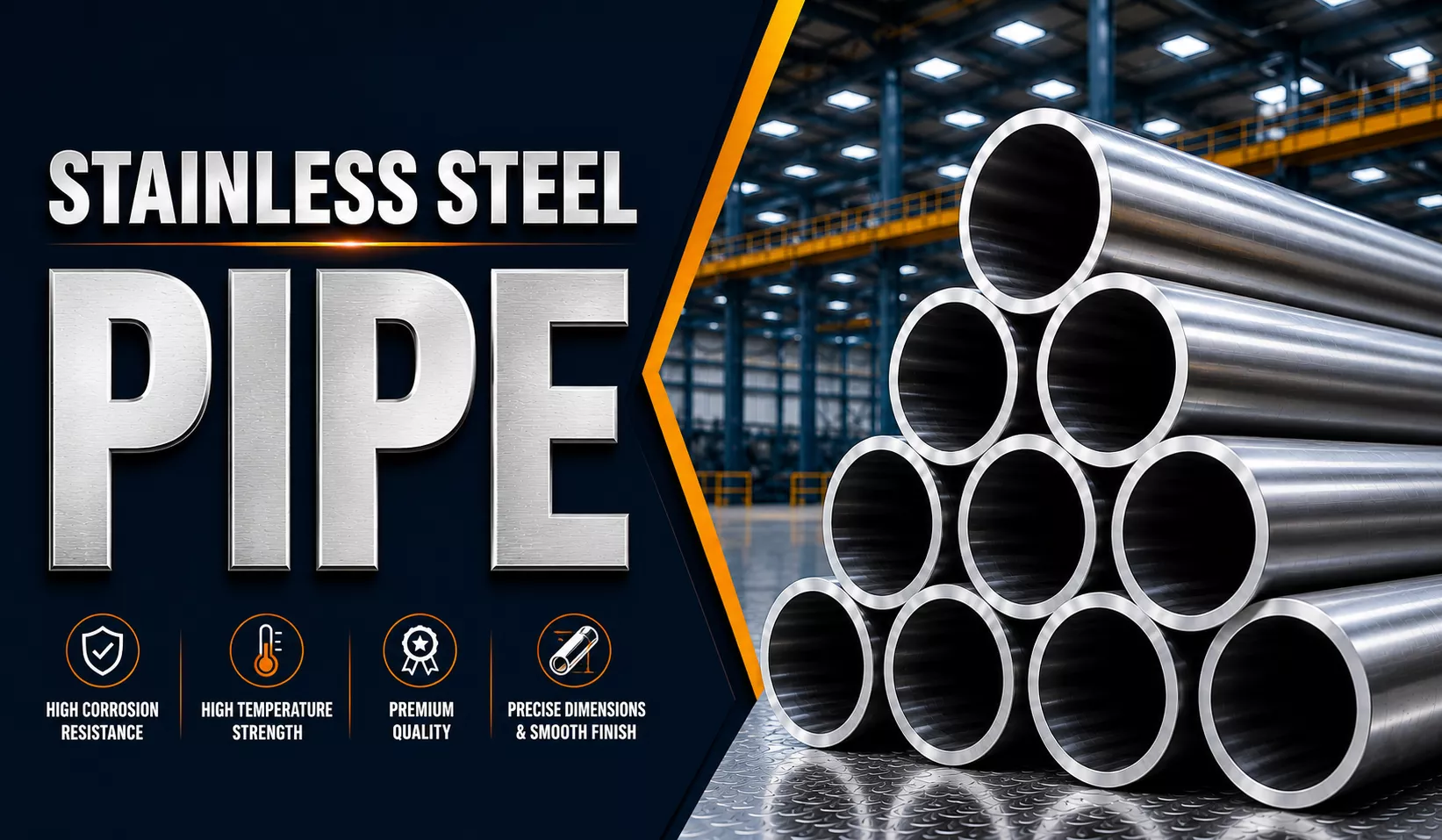
Stainless Steel Pipe Manufacturer & Stockist
When evaluating Stainless Steel Pipe Suppliers, buyers should look beyond product availability and consider factors that can affect the suitability and reliability of the material for their application. Key considerations include manufacturing method, dimensional requirements, applicable specifications and service conditions.
The required pipe should be selected according to factors such as outside diameter, wall thickness, schedule, length, pressure, temperature and corrosion exposure. These requirements help determine the appropriate product for process, fabrication and piping applications.
Documentation and inspection requirements may also form an important part of procurement. Depending on the project, buyers may require material test certificates, chemical composition, mechanical test results, dimensional inspection, surface examination and material traceability.
For larger or recurring requirements, procurement teams may also consider stock availability, order quantities, inspection requirements, documentation, packaging and delivery schedules. Defining these requirements before placing an order can help streamline purchasing and reduce delays.
Stainless Steel Pipe Specifications
Stainless steel pipe specifications cover the material, dimensions and technical requirements used to identify and order a pipe. The exact requirements depend on the pipe type, application and project specification.
| Specification | Typical Requirements / Options |
|---|---|
| Material Grade | 304, 304L, 316, 316L, 321, 310, 317L, 904L, Duplex and Super Duplex |
| Pipe Type | Seamless, welded and ERW stainless steel pipe |
| Nominal Pipe Size | Specified according to NPS / NB requirements |
| Outside Diameter | Selected according to the required nominal size and applicable dimensional specification |
| Wall Thickness | Selected according to schedule, design pressure, temperature and application requirements |
| Pipe Schedule | Common schedules include 5S, 10S, 40S, 80S, 160S and XXS, depending on size and applicable requirements |
| Pipe Length | Standard or specified lengths according to purchase requirements |
| End Finish | Plain end, bevelled end or threaded end, where applicable |
| Surface Finish | Finish requirements depend on manufacturing method, application and project specification |
| Dimensional Tolerance | Outside diameter, wall thickness and length tolerances according to the applicable product requirements |
| Testing & Inspection | May include chemical analysis, mechanical testing, dimensional inspection, hydrostatic testing and non-destructive testing, as applicable |
| Documentation | Material test certificates, inspection documentation and traceability records where specified |
Stainless Steel Pipe Standards
Stainless steel pipes are manufactured and supplied according to different material and dimensional standards depending on their intended application. The applicable specification should be confirmed against the purchase order and project requirements.
| Standard | Coverage | Typical Application / Grades |
|---|---|---|
| ASTM A312 / ASME SA312 | Seamless, welded and heavily cold-worked austenitic stainless steel pipe | High-temperature and general corrosive service; commonly includes TP304, TP304L, TP316 and TP316L |
| ASTM A790 / ASME SA790 | Seamless and welded ferritic/austenitic stainless steel pipe | Duplex stainless steel applications requiring high strength and resistance to pitting, crevice corrosion and stress-corrosion cracking |
| ASTM A213 / ASME SA213 | Seamless ferritic and austenitic alloy-steel boiler, superheater and heat-exchanger tubes | Primarily a tube specification; applicable to specified heat-exchanger, boiler and high-temperature tube applications |
| ASTM A554 | Welded austenitic stainless steel mechanical tubing | Round, square and rectangular tubing for mechanical, structural, architectural and decorative applications |
| ASME B36.19M | Dimensional standards for stainless steel pipe | Nominal pipe sizes, outside diameters and wall thicknesses for applicable stainless steel pipe schedules |
| ASTM A999/A999M | General requirements for alloy and stainless steel pipe and tube products | Referenced where applicable together with the specific product specification |
Important: The applicable material, dimensional, testing and inspection requirements should always be confirmed against the relevant product specification, purchase order and project requirements.
Types of Stainless Steel Pipes
Stainless Steel Pipes are available in different types based on their manufacturing process and shape. The most common options include seamless, welded, ERW, round and square pipes, selected according to the application and project requirements.
| Type | Key Information | Common Applications |
|---|---|---|
| Stainless Steel Seamless Pipe | Manufactured without a longitudinal welded seam and commonly used where seamless construction is required. | Oil & gas, petrochemical, chemical and process piping |
| Stainless Steel Welded Pipe | Manufactured by forming stainless steel material and joining the seam by welding. | Industrial piping, chemical processing and water systems |
| Stainless Steel ERW Pipe | Produced using electric resistance welding and available in different sizes and wall thicknesses. | General industrial and fabrication applications |
| Stainless Steel Round Pipe | Circular pipe commonly used for fluid handling and general piping requirements. | Process piping, fluid handling and engineering applications |
| Stainless Steel Square Pipe | Square-profile pipe commonly selected for fabrication and structural requirements. | Architectural, structural and fabrication applications |
| Stainless Steel EFW Pipe | Manufactured using electric fusion welding, commonly selected for larger-diameter stainless steel pipe applications. | Industrial process piping, chemical plants, power generation and large-diameter fluid transport |
| Stainless Steel LSAW Pipe | Manufactured by forming steel plate into a cylindrical shape and welding the longitudinal seam using a submerged arc welding process. | Oil and gas transmission, water pipelines, infrastructure and industrial projects |
| Duplex Steel Pipe | Made from duplex stainless steel with a mixed austenitic-ferritic microstructure, offering high strength and good resistance to chloride-related corrosion. | Oil and gas, petrochemical plants, offshore systems and chemical processing |
| Super Duplex Steel Pipe | Made from super duplex stainless steel grades such as UNS S32750 and S32760, designed for high strength and enhanced resistance to pitting and crevice corrosion. | Offshore engineering, seawater systems, desalination plants and demanding chemical processing environments |
Stainless Steel Pipe Schedule Chart
Stainless steel pipe schedule indicates the wall thickness for a given nominal pipe size. Common schedules include 5S, 10S, 40S, 80S, 160S and XXS. The applicable schedule depends on the required dimensions and service conditions.
| Schedule | Common Description | Typical Use |
|---|---|---|
| 5S | Light wall | Light-duty piping applications |
| 10S | Light wall | General industrial and process piping |
| 40S | Standard wall range | General industrial and process applications |
| 80S | Heavy wall | Higher pressure applications |
| 160S | Extra heavy wall | High-pressure service applications |
| XXS | Extra-extra heavy wall | Specified heavy-duty applications |
Stainless Steel Pipe Weight Chart
Stainless Steel Pipe Weight depends mainly on the outside diameter, wall thickness, material density and pipe length. The following chart provides representative theoretical weights for common pipe sizes.
| Nominal Size | Outside Diameter (mm) | Wall Thickness (mm) | Approx. Weight (kg/m) |
|---|---|---|---|
| 1/2" | 21.3 | 2.77 | 1.28 |
| 1" | 33.4 | 3.38 | 2.59 |
| 2" | 60.3 | 3.91 | 5.52 |
| 3" | 88.9 | 5.49 | 11.53 |
| 4" | 114.3 | 6.02 | 16.08 |
| 6" | 168.3 | 7.11 | 28.26 |
Actual weight may vary according to grade, dimensions, manufacturing tolerance and specified wall thickness. For purchasing and shipment calculations, refer to the Stainless Steel Pipe Weight Calculator.
Stainless Steel Square Pipe Weight Chart
Stainless steel square pipe weight is primarily determined by the outside dimensions, wall thickness, material density and length. The chart below provides representative weight values for common square pipe sizes.
| Square Pipe Size (mm) | Wall Thickness (mm) | Approx. Weight (kg/m) |
|---|---|---|
| 20 × 20 | 1.5 | 0.87 |
| 25 × 25 | 1.5 | 1.11 |
| 40 × 40 | 2.0 | 2.40 |
| 50 × 50 | 2.0 | 3.04 |
| 75 × 75 | 3.0 | 6.65 |
| 100 × 100 | 3.0 | 9.00 |
Square pipe weight can vary with grade, wall thickness, dimensional tolerance and manufacturing requirements. For exact weight calculations, use the actual dimensions specified for the required product.
Stainless Steel Pipe Sizes
Stainless Steel Pipe Sizes are generally specified by nominal pipe size (NPS) or nominal bore (NB), along with the outside diameter and wall thickness. The required size depends on flow requirements, pressure conditions and piping design.
| Nominal Pipe Size (NPS) | Nominal Bore (NB) | Outside Diameter (mm) |
|---|---|---|
| 1/2" | 15 | 21.3 |
| 1" | 25 | 33.4 |
| 2" | 50 | 60.3 |
| 3" | 80 | 88.9 |
| 4" | 100 | 114.3 |
| 6" | 150 | 168.3 |
| 8" | 200 | 219.1 |
| 10" | 250 | 273.0 |
| 12" | 300 | 323.9 |
Stainless steel pipes are available in different wall thicknesses and schedules for the same nominal size. The final dimensions should be selected according to the applicable standard and project requirements.
Stainless Steel Pipe Grades We Supply
Stainless steel pipe grades are selected according to corrosion resistance, temperature, strength and the operating environment. Kamal Steels supplies commonly used austenitic, high-alloy and duplex stainless steel grades for different industrial requirements.
| Stainless Steel Grade | Grade Type | Key Characteristics | Common Applications |
|---|---|---|---|
| SS 304 / SS 304L | Austenitic | Good general corrosion resistance and formability | Food processing, chemical, architectural and general industrial applications |
| SS 316 / SS 316L | Austenitic | Enhanced resistance to chlorides and corrosive environments | Marine, chemical, pharmaceutical and process industries |
| SS 321 | Austenitic | Good resistance to intergranular corrosion at elevated temperatures | Heat exchangers, aerospace and high-temperature applications |
| SS 310 / SS 310S | Austenitic | High-temperature oxidation and corrosion resistance | Furnaces, heat-treatment equipment and high-temperature service |
| 317L | Austenitic | Higher corrosion resistance than conventional 316L in selected environments | Chemical processing and corrosive service applications |
| SS 904L | High-Alloy Austenitic | High resistance to severe corrosive environments | Chemical processing, marine and specialized industrial applications |
| Duplex | Ferritic-Austenitic | High strength with good resistance to corrosion and stress-corrosion cracking | Oil & gas, petrochemical, marine and process industries |
| Super Duplex | Ferritic-Austenitic | Very high strength and enhanced resistance to pitting and crevice corrosion | Offshore, marine, chemical and demanding process applications |
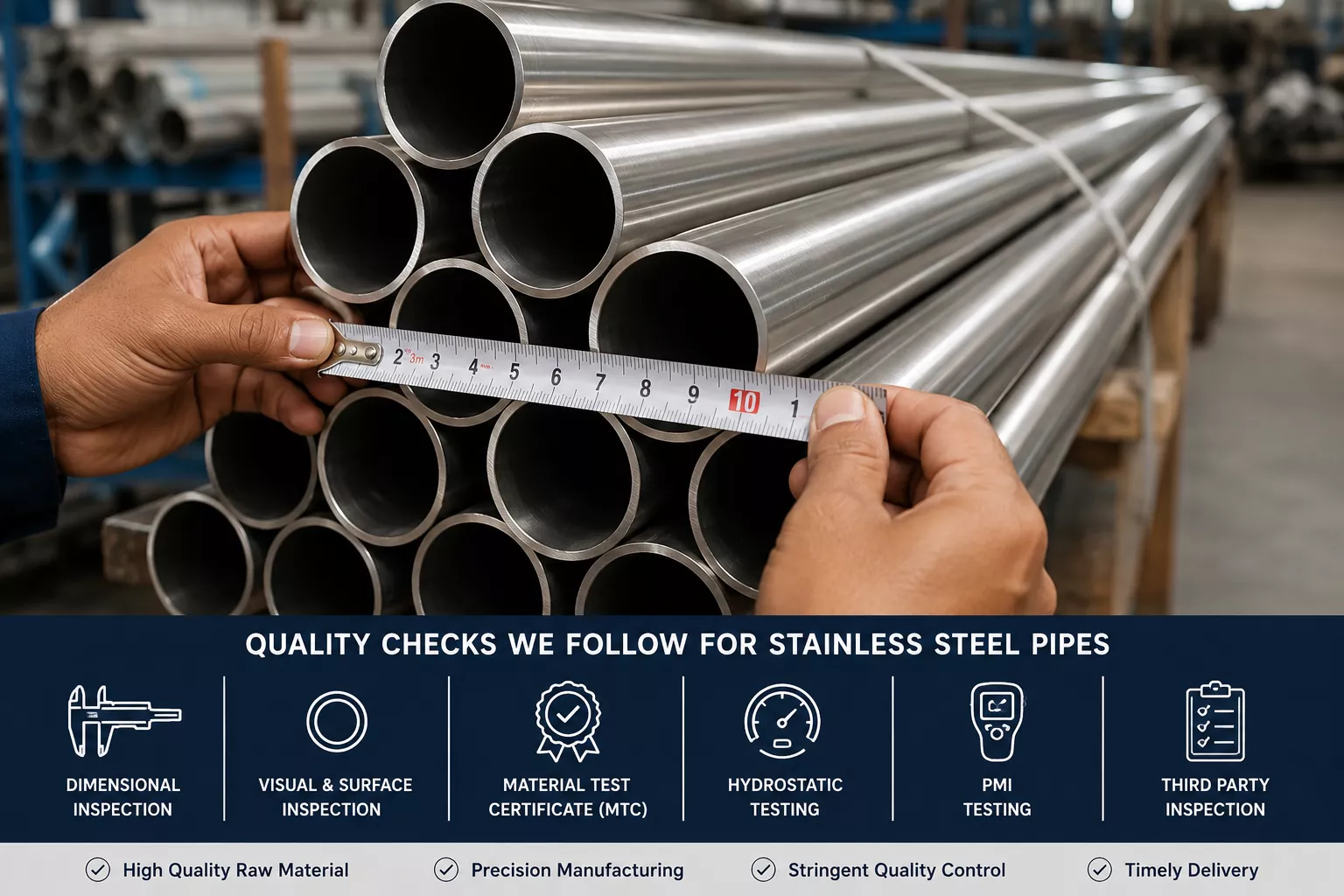
Stainless Steel Pipe Quality & Testing
Stainless steel pipe quality is verified through applicable inspection and testing requirements to confirm that the supplied material meets the specified product and project requirements.
Depending on the order specification, quality checks may include chemical composition, mechanical properties, dimensional inspection, surface inspection and hydrostatic testing. Non-destructive testing may also be applicable for specified products and requirements.
Material documentation can include Material Test Certificates (MTCs), inspection reports and traceability records, where required. These documents help buyers verify the material grade, test results and conformity with the applicable specification.
Stainless Steel Pipe Price in India
Stainless steel pipe prices in India vary according to the grade, pipe type, size, wall thickness, schedule, quantity and market conditions. Seamless and high-alloy grades may have different pricing from standard welded pipes and commonly used grades.
| Price Factor | How It Affects Price |
|---|---|
| Grade | Higher-alloy grades generally have higher material costs. |
| Pipe Type | Seamless, welded and ERW pipes can have different pricing. |
| Size & Wall Thickness | Dimensions and material quantity affect the overall cost. |
| Quantity | Order volume can influence the quoted price. |
| Market Conditions | Raw material and stainless steel market prices can affect quotations. |
For an accurate quotation, buyers should provide the required grade, size, wall thickness or schedule, pipe type, quantity and delivery requirements.
Seamless vs Welded Stainless Steel Pipe
Seamless and welded stainless steel pipes differ mainly in their manufacturing process. The appropriate option depends on the required application, dimensions, service conditions and applicable specification.
| Feature | Seamless Pipe | Welded Pipe |
|---|---|---|
| Manufacturing | Produced without a longitudinal welded seam. | Produced by forming material and welding the seam. |
| Size Availability | Available in specified sizes and wall thicknesses. | Available in a wide range of sizes and dimensions. |
| Typical Use | Pressure, temperature and demanding service applications. | General industrial, process and fabrication applications. |
| Selection | Selection should be based on application requirements and the applicable product specification. | |
Stainless Steel Pipe HSN Code
Stainless steel pipe HSN classification is used for taxation and customs documentation in India. The applicable HSN code can vary according to the product type, material and applicable tariff classification.
Buyers should confirm the correct HSN classification with their tax advisor, customs documentation or the applicable Indian tariff schedule before invoicing or importing.
How to Select the Right Stainless Steel Pipe
Selecting the right stainless steel pipe requires matching the material and dimensions with the actual service conditions and project requirements.
| Consideration | What to Check |
|---|---|
| Application | Process, fluid handling, structural or fabrication requirement. |
| Grade | Corrosion resistance, temperature and required mechanical performance. |
| Pipe Type | Seamless, welded or ERW based on the application and specification. |
| Size & Thickness | Required diameter, wall thickness and schedule. |
| Standard | Applicable ASTM, ASME, EN, DIN or project specification. |
| Testing & Documentation | MTC, inspection and testing requirements where applicable. |
Stainless Steel Pipe Applications & Industries
Stainless steel pipes are used across industries where corrosion resistance, durability and reliable performance are required. The appropriate grade and pipe type depend on the operating environment.
| Industry | Common Applications |
|---|---|
| Oil & Gas | Process piping and fluid transportation. |
| Petrochemical | Process and corrosive-service piping. |
| Chemical | Corrosive fluid and process systems. |
| Pharmaceutical | Process and hygienic piping systems. |
| Food & Beverage | Processing and fluid handling systems. |
| Power Generation | Process, utility and high-temperature applications. |
| Marine | Applications exposed to marine and chloride environments. |
Why Choose Kamal Steels for Stainless Steel Pipes?
Kamal Steels supports industrial buyers with stainless steel pipe sourcing, product selection and supply requirements for domestic and international projects.
| Product Range | Stainless steel pipes and tubes in commonly required grades and types. |
|---|---|
| Technical Support | Product information based on grade, size, specification and application. |
| Documentation | Quality and material documentation according to order requirements. |
| Supply Support | Support for standard orders, project requirements and repeat procurement. |
| International Supply | Supply support for buyers in India and international markets. |
Frequently Asked Questions
Stainless Steel 316 contains molybdenum, which generally provides better resistance to chlorides and corrosive environments than Stainless Steel 304. Grade 304 is commonly used for general industrial applications, while 316 is often selected for marine, chemical and chloride-containing environments.
Stainless steel pipe cost depends on the grade, pipe type, size, wall thickness, schedule, quantity and prevailing raw material prices. For an accurate quotation, the required specifications and quantity should be provided.
Strength depends on the stainless steel grade, pipe type and wall thickness. Duplex and Super Duplex grades generally provide higher strength than commonly used austenitic grades such as 304 and 316.
Stainless steel pipe can be cut using equipment such as band saws, abrasive saws and other suitable cutting tools. The method should be selected according to the pipe size, wall thickness and required finish.
Schedule 40 refers to a specified wall thickness for a particular nominal pipe size. The actual wall thickness varies according to the pipe size and should be checked against the applicable dimensional standard.
Stainless steel is highly corrosion resistant but is not completely rust proof. Corrosion resistance depends on the grade, surface condition and service environment. Proper grade selection and maintenance can help improve service life.
Stainless steel pipes are generally specified by nominal pipe size and schedule, while tubes are commonly specified by outside diameter and wall thickness. Their dimensional standards and applications can also differ.
Stainless steel pipes can be welded using suitable processes such as TIG or other qualified welding methods. The welding procedure depends on the stainless steel grade, wall thickness, joint design and application.
The required pipe size depends on factors such as flow rate, pressure, temperature, fluid characteristics and piping design. Nominal size, outside diameter and wall thickness should be selected according to project requirements.
Seamless stainless steel pipe is manufactured without a longitudinal welded seam, while welded pipe is produced by forming stainless steel material and joining the seam by welding. The suitable type depends on the application and applicable specification.