
-
-
-
Girgaon, Mumbai - 400004
What Is Stainless Steel Pipe and How Is It Manufactured?
How Stainless Steel Pipes Are Manufactured: Process, Grades & Standards
Stainless Steel Pipe is a hollow cylindrical tube manufactured from corrosion-resistant stainless steel alloys and widely used for transporting liquids, gases, steam and process fluids across industrial applications. Due to their excellent corrosion resistance, high strength, durability and long service life, stainless steel pipes have become the preferred choice in oil & gas, petrochemical, power generation, food processing, pharmaceutical, marine and water treatment industries.
These pipes are produced through seamless or welded manufacturing methods using stainless steel grades such as SS 304, SS 304L, SS 316, SS 316L, Duplex 2205 and Super Duplex 2507. The manufacturing process involves melting, refining, billet formation, pipe forming, welding, heat treatment, pickling, passivation and extensive quality testing to ensure compliance with ASTM and ASME standards.
Kamal Steels is a stainless steel pipe Manufacturer and Stockist in India, supplying stainless steel seamless and welded pipes in various grades, sizes, schedules and specifications for industrial and commercial requirements.
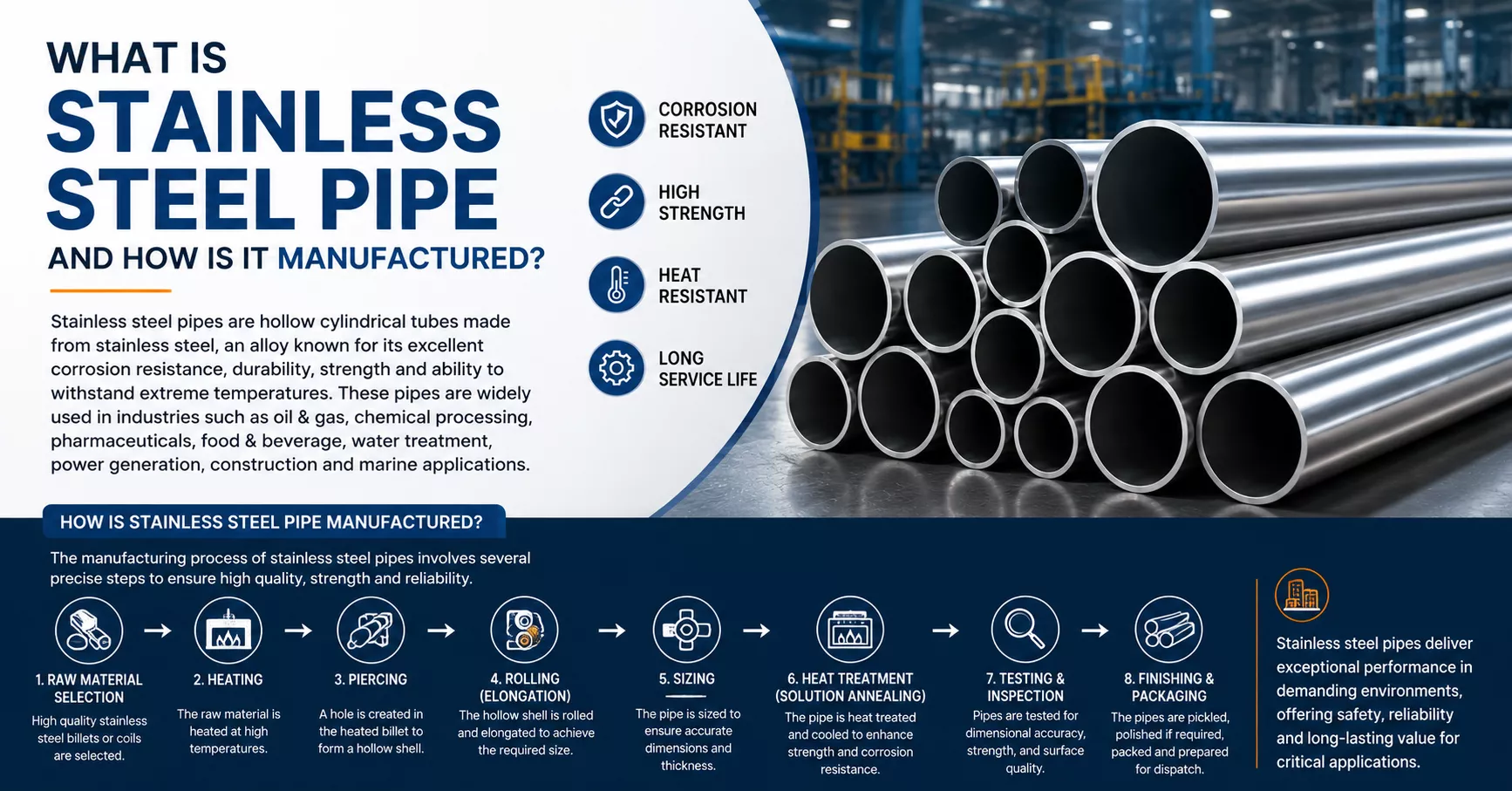
What Is Stainless Steel Pipe?
A Stainless Steel Pipe is a tubular product manufactured from iron-based alloys containing a minimum of 10.5% chromium. The chromium reacts with oxygen to form a passive oxide layer that protects the material from corrosion, rust and oxidation.
Stainless steel pipes are available in seamless and welded forms and are designed to transport fluids, gases, chemicals and steam under varying pressure and temperature conditions.
- Excellent corrosion resistance
- High pressure capability
- Long service life
- Superior mechanical strength
- Excellent weldability
- Low maintenance cost
- Suitable for hygienic applications
Why Stainless Steel Is Used for Pipes
Stainless steel is widely used for piping systems because it combines corrosion resistance, durability, strength and temperature resistance. Unlike conventional carbon steel, stainless steel provides long-term performance even in aggressive environments containing moisture, acids, chemicals and chlorides.
| Property | Benefit |
|---|---|
| Corrosion Resistance | Long service life |
| Heat Resistance | High temperature applications |
| Mechanical Strength | Pressure handling capability |
| Hygienic Surface | Food & pharmaceutical use |
| Low Maintenance | Reduced operating costs |
What Are the Types of Stainless Steel Pipes?
Stainless steel pipes are available in different types based on their manufacturing method, construction, shape and intended application. The most commonly used types include seamless, welded, ERW, fabricated, round, square and rectangular stainless steel pipes.
| Type of Stainless Steel Pipe | Description | Common Applications |
|---|---|---|
| Stainless Steel Seamless Pipes | Manufactured from solid stainless steel billets without a longitudinal weld joint. | High-pressure piping, process plants, oil and gas, chemical and power applications. |
| Stainless Steel Welded Pipes | Manufactured by forming stainless steel strip, sheet, or plate into a tubular shape and welding the edges. | Process piping, chemical, pharmaceutical, food processing, water and general industrial applications. |
| Stainless Steel ERW Pipes | Manufactured using an electric resistance welding process to join the formed stainless steel material. | Industrial piping, structural applications, water systems and general engineering requirements. |
| Stainless Steel Fabricated Pipes | Fabricated from stainless steel plate or sheet to produce large-diameter or customized pipe sections. | Large-diameter piping, industrial projects, tanks, ducts and customized fabrication requirements. |
| Stainless Steel Round Pipes | Circular stainless steel pipes available in different outside diameters and wall thicknesses. | Fluid transportation, process piping, structural work and general industrial applications. |
| Stainless Steel Square Pipes | Square-shaped hollow stainless steel sections with uniform sides and dimensions. | Structural, architectural, fabrication, engineering and decorative applications. |
| Stainless Steel Rectangular Pipes | Rectangular hollow stainless steel sections manufactured in different widths, heights and wall thicknesses. | Structural fabrication, architectural work, machinery, construction and engineering applications. |
Among these, seamless and welded stainless steel pipes are the primary types used for industrial piping systems. The appropriate type depends on the required grade, size, wall thickness, pressure, temperature, manufacturing requirements, application and applicable standard.
How Are Stainless Steel Pipes Manufactured?
| Stage | Seamless Pipe | Welded Pipe |
|---|---|---|
| Raw Material | Stainless steel billet | Strip, sheet or plate |
| Preparation | Billet inspection | Cutting/slitting |
| Forming | Heating and piercing | Forming into tubular shape |
| Joining | No weld | Longitudinal welding |
| Sizing | Rolling and sizing | Sizing |
| Heat Treatment | Where required | Where required |
| Finishing | Cleaning/pickling/passivation | Weld cleaning/finishing |
| Testing | Inspection and testing | Weld and product inspection |
| Final Stage | Marking & packaging | Marking & packaging |
What Are the Common Stainless Steel Pipe Grades?
Some commonly specified stainless steel pipe grades include:
| Grade | General Characteristics |
|---|---|
| 304 | General corrosion resistance and versatile applications |
| 304L | Low-carbon version of 304, commonly used for welded applications |
| 316 | Improved resistance to pitting and corrosive environments |
| 316L | Low-carbon 316, widely used for welded process applications |
| 310 | Suitable for elevated-temperature applications |
| 321 | Stabilized grade for elevated-temperature service |
| 347 | Stabilized grade used in elevated-temperature applications |
| Duplex | High strength and corrosion resistance |
| Super Duplex | Very high strength and enhanced corrosion resistance |
What Are Stainless Steel Pipe Sizes, Schedules & Dimensions?
Stainless steel pipe dimensions are normally specified using nominal pipe size, outside diameter, wall thickness, schedule and length.
Common pipe schedules include:
- Schedule 5
- Schedule 10
- Schedule 40
- Schedule 80
- Schedule 160
- XXS
A stainless steel pipe size chart helps identify nominal sizes and corresponding dimensions, while a stainless steel pipe thickness chart helps compare different wall thicknesses.
The correct dimensions should be selected according to the applicable dimensional standard and system design.
What Are Stainless Steel Pipes Used For?
Stainless steel pipes are used in many industries, including:
- Oil and gas
- Petrochemical
- Chemical processing
- Pharmaceutical
- Food and beverage
- Power generation
- Marine
- Water treatment
- Heat exchangers
- Fertilizer
- Sugar
- Construction
- Process piping
The grade should always be selected according to the service environment.
What Affects Stainless Steel Pipe Price?
The stainless steel pipe price depends on more than the material grade.
Important factors include:
- Grade
- Pipe size
- Wall thickness
- Schedule
- Seamless or welded construction
- Surface finish
- Specification
- Testing requirements
- Quantity
- Raw material market conditions
Therefore, stainless steel pipe price per kg should be compared only when the pipes have equivalent grades, dimensions, specifications and finishes.
How to Choose a Stainless Steel Pipe Supplier?
When selecting a stainless steel pipe supplier, consider more than price.
Check:
- Required grades
- Size availability
- Seamless and welded options
- Stock availability
- Applicable standards
- Material certificates
- Testing and inspection
- Packaging
- Delivery capability
A reliable supplier should be able to provide the material according to the required technical specification.
Why Choose Kamal Steels?
Kamal Steels is a stainless steel pipe manufacturer and stockist in India, supplying stainless steel seamless and welded pipes in various grades, sizes, schedules, and specifications.
The company caters to industrial requirements where material quality, dimensional accuracy, applicable standards, testing and documentation are important.
For buyers comparing stainless steel pipe manufacturers in India or specifically looking for stainless steel pipe manufacturers in Mumbai, factors such as product range, stock availability, manufacturing capability, testing, certification and delivery should be considered.
Customers searching for a stainless steel pipe near me or stainless steel pipe shop near me should also verify whether the supplier has the required grade, size, specification and documentation.
If researching the top 10 stainless steel pipe manufacturers in India, it is better to compare manufacturers based on actual product capabilities, quality systems, stock range, testing, certifications and supply experience rather than rankings alone.
Conclusion
Stainless steel pipes are selected for applications requiring a combination of corrosion resistance, strength, durability and reliable performance. The right pipe depends on the required grade, dimensions, manufacturing method, applicable standard, operating conditions and project requirements.
Stainless steel pipe is a hollow tubular product manufactured from corrosion-resistant stainless steel alloys and used for transporting fluids, gases, and industrial process materials.
Stainless steel pipes are manufactured using seamless or welded production methods involving melting, refining, pipe forming, heat treatment, finishing, inspection, and quality testing.
Seamless pipes have no welded seam and offer higher pressure resistance, while welded pipes are more economical and available in larger diameters.
Stainless Steel 304 and Stainless Steel 316 are the most commonly used grades due to their excellent corrosion resistance, durability, and versatility.
ASTM A312 is a standard specification covering seamless, welded, and heavily cold-worked austenitic stainless steel pipes for high-temperature and corrosive service applications.
Chromium forms a passive oxide layer on the surface of stainless steel that protects the material from corrosion and rust formation.
SS 316L, Duplex 2205, and Super Duplex 2507 pipes are commonly recommended for marine and offshore environments due to their superior resistance to chloride corrosion.
Stainless steel pipes are highly corrosion-resistant but may corrode under extreme conditions if the wrong grade is selected or maintenance is neglected.
Stainless steel pipes are widely used in oil & gas, petrochemical, chemical processing, marine, food processing, pharmaceutical, power generation, and water treatment industries.
Stainless steel pipes are available in various sizes and schedules including Sch 5S, Sch 10S, Sch 40S, Sch 80S, Sch 160, and XXS depending on pressure and application requirements.
Common tests include hydrostatic testing, PMI testing, dimensional inspection, flattening tests, chemical analysis, tensile testing, and visual inspection to ensure ASTM compliance.
Depending on the operating environment and maintenance practices, stainless steel pipes can provide reliable service for several decades.
ASTM A312 covers stainless steel pipes used in high-temperature and corrosive services, while ASTM A269 covers stainless steel tubing used in instrumentation and general service applications.
Yes, grades such as 304H, 310S, and 321 stainless steel are specifically designed for elevated-temperature applications.
The correct pipe should be selected based on operating pressure, temperature, corrosion conditions, applicable standards, fluid type, and project requirements.
Stainless steel pipes offer better corrosion resistance, longer service life, lower maintenance costs, improved hygiene, and superior performance in aggressive environments compared to carbon steel pipes.
Get Expert Advice on Stainless Steel Pipes
Looking for premium quality Stainless Steel Seamless Pipes, Stainless Steel Welded Pipes, Duplex Steel Seamless Pipes, Duplex Steel Welded Pipes or custom industrial piping solutions? Kamal Steels offers technical support, competitive pricing, ready stock availability, and worldwide supply.
Contact our team today for product recommendations, pricing, technical specifications, and material selection assistance.
Get Expert Assistance Today