
-
-
-
Girgaon, Mumbai - 400004
Stainless Steel Pipe Weight Calculator
Stainless Steel Pipe Weight Calculator
Stainless Steel Pipe Weight Calculation helps engineers, procurement teams, fabricators and industrial buyers estimate material quantities, transportation requirements and project costs. Knowing the weight of a pipe before procurement can improve planning accuracy and reduce material estimation errors.
The weight of a stainless steel pipe depends on its outside diameter (OD), wall thickness, length and material grade. Whether you are selecting ASTM A312 seamless pipes, welded pipes, SS 304 pipes or SS 316 pipes, accurate weight calculations are important for budgeting, logistics and fabrication planning.
This Stainless Steel Pipe Weight Calculator Guide explains the standard pipe weight formula, calculation methods, weight charts and practical examples. It will help you calculate weight per meter, compare pipe schedules and determine the theoretical weight of stainless steel pipes used in industrial applications.
Request a Quote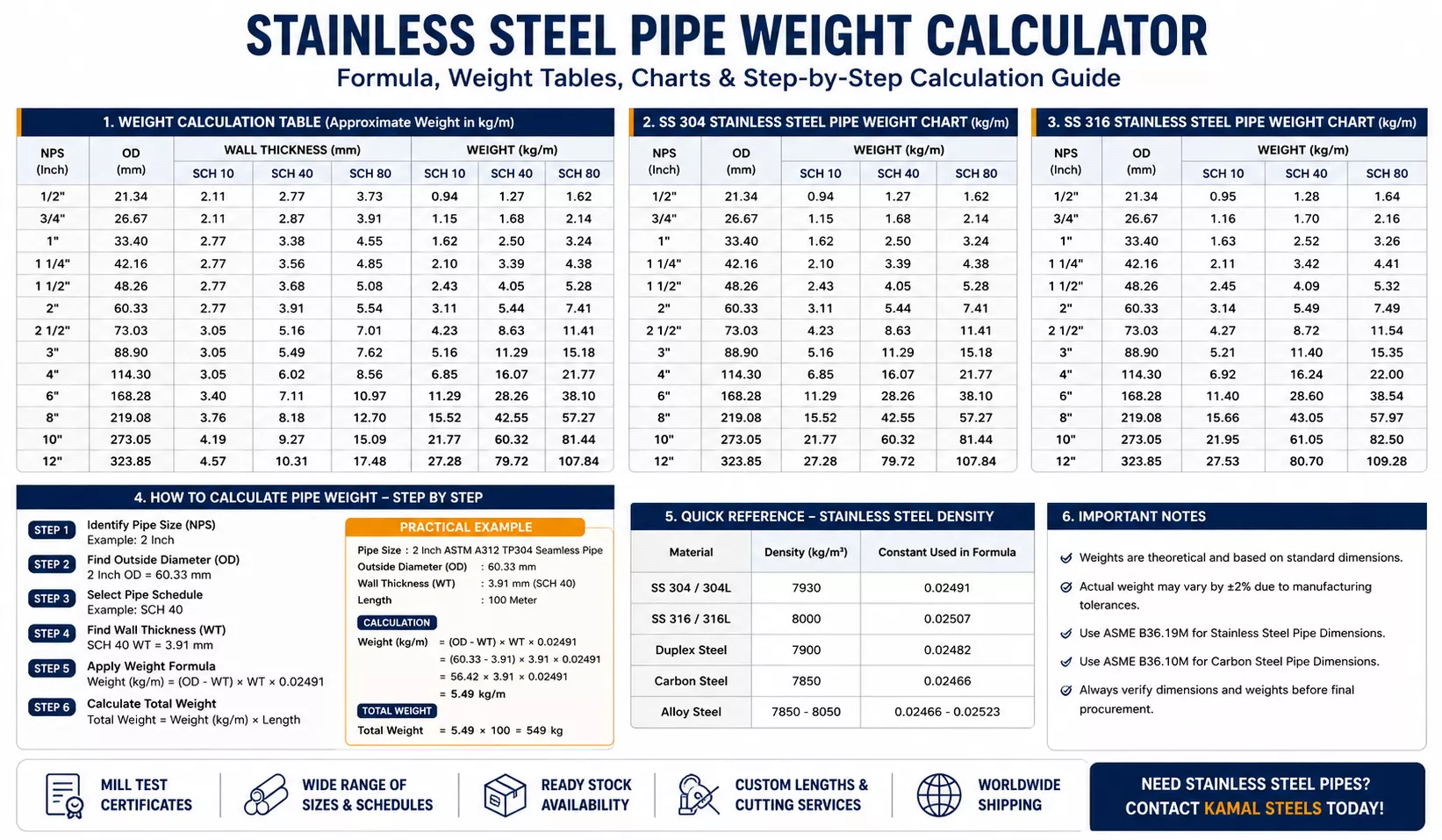
What is a Stainless Steel Pipe Weight Calculator?
A Stainless Steel Pipe Weight Calculator is a tool used to calculate the theoretical weight of stainless steel pipes based on their dimensions and material properties. The calculator determines weight using factors such as outside diameter (OD), wall thickness, pipe length and stainless steel density.
The calculated weight can be expressed in kilograms per meter (kg/m), kilograms per pipe length, pounds per foot or total project weight. These values help engineers, buyers and fabricators estimate material quantities and transportation requirements accurately.
Parameters Used in Pipe Weight Calculation
- Outside Diameter (OD)
- Wall Thickness (WT)
- Pipe Length
- Material Density
- Pipe Schedule
Purpose of a Pipe Weight Calculator
The primary purpose of a pipe weight calculator is to provide fast and accurate weight estimations for engineering, procurement and project planning activities.
- Estimate material quantities
- Determine transportation loads
- Calculate project costs
- Improve procurement planning
- Support engineering calculations
- Optimize inventory management
Benefits of Using a Pipe Weight Calculator
| Benefit | Advantage |
|---|---|
| Fast Calculations | Instant weight estimation |
| Cost Control | Improves budgeting accuracy |
| Material Planning | Reduces procurement errors |
| Transportation Planning | Optimizes logistics costs |
| Inventory Management | Helps maintain stock levels |
| Engineering Support | Simplifies project calculations |
Why Pipe Weight Calculation Matters
Accurate stainless steel pipe weight calculations are essential for successful project execution. Weight data influences material costs, transportation planning, structural design and procurement decisions.
Material Cost Estimation
Stainless steel pipes are generally priced based on weight. Knowing the exact pipe weight allows procurement teams to estimate project costs more accurately and compare supplier quotations effectively.
Transportation Planning
Pipe weight directly affects freight costs, truck loading capacities, container utilization and lifting requirements. Accurate calculations help reduce transportation expenses and improve logistics planning.
Structural Load Calculations
Engineers use pipe weight information to determine support spacing, hanger requirements and structural load distribution. This ensures safe installation and long-term system reliability.
Procurement Accuracy
Incorrect weight calculations can result in excess material purchases or insufficient quantities, leading to project delays and increased costs. Accurate estimates support efficient procurement and inventory control.
Stainless Steel Pipe Weight Formula
The weight of a stainless steel pipe is determined using its outside diameter (OD), wall thickness (WT) and material density. Accurate weight calculations help engineers, fabricators and procurement teams estimate material requirements, transportation loads and project costs.
Formula Variables Explained
| Variable | Description |
|---|---|
| OD | Outside Diameter of Pipe (mm) |
| WT | Wall Thickness of Pipe (mm) |
| 0.02491 | Constant Based on Stainless Steel Density |
Alternative Engineering Formula
For detailed engineering calculations, pipe weight can also be calculated using the following formula:
This formula considers outside diameter, inside diameter, pipe length and material density to calculate the theoretical weight of a stainless steel pipe.
Example Calculation
The following example shows how to calculate the weight of a 2-inch ASTM A312 TP304 stainless steel seamless pipe.
| Pipe Size | 2 Inch |
|---|---|
| Specification | ASTM A312 TP304 |
| Outside Diameter (OD) | 60.3 mm |
| Wall Thickness (WT) | 3.91 mm |
Calculation:
(60.3 − 3.91) × 3.91 × 0.02491
= 5.49 kg/m
Therefore, the theoretical weight of this stainless steel pipe is approximately 5.49 kilograms per meter.
This value can be used for material estimation, freight calculations, fabrication planning and procurement purposes.
Need Stainless Steel Pipes for Your Project?
Get technical support, weight estimation assistance and competitive pricing from Kamal Steels.
Request a QuoteStainless Steel Pipe Weight Calculation Table
The table below provides approximate theoretical weights for commonly used stainless steel pipes. Actual weights may vary depending on manufacturing tolerances, material grade and applicable standards.
| Pipe Size | OD (mm) | Wall Thickness (mm) | Weight (kg/m) | Weight (lb/ft) |
|---|---|---|---|---|
| 1/2" | 21.34 | 2.77 | 1.27 | 0.85 |
| 3/4" | 26.67 | 2.87 | 1.69 | 1.14 |
| 1" | 33.40 | 3.38 | 2.50 | 1.68 |
| 1-1/2" | 48.26 | 3.68 | 4.05 | 2.72 |
| 2" | 60.33 | 3.91 | 5.44 | 3.66 |
| 3" | 88.90 | 5.49 | 11.29 | 7.58 |
| 4" | 114.30 | 6.02 | 16.07 | 10.80 |
| 6" | 168.28 | 7.11 | 28.26 | 18.99 |
Factors Affecting Stainless Steel Pipe Weight
Several factors influence the theoretical and actual weight of a stainless steel pipe.
Outside Diameter (OD)
Larger outside diameters require more material and therefore increase pipe weight.
Wall Thickness
As wall thickness increases, the weight per meter also increases significantly.
Pipe Schedule
Higher schedules such as SCH 80 and SCH 160 have thicker walls and greater weight compared to SCH 10 or SCH 40 pipes.
Material Grade
Different stainless steel grades have slightly different densities, which can affect final weight calculations.
Pipe Length
The total weight increases proportionally with pipe length. Longer pipes require greater transportation and handling capacity.
Pipe Schedule vs Weight Relationship
Pipe schedule directly affects wall thickness and weight. For the same pipe size, a higher schedule pipe will weigh more because it contains more material.
| Schedule | Wall Thickness | Weight | Pressure Capability |
|---|---|---|---|
| SCH 10S | Thin | Low | Moderate |
| SCH 40S | Medium | Medium | High |
| SCH 80S | Thick | High | Very High |
| SCH 160 | Extra Thick | Very High | Maximum |
Applications of Stainless Steel Pipe Weight Calculations
Accurate pipe weight calculations are used throughout engineering, procurement, fabrication and construction projects.
- Material estimation and budgeting
- Transportation and freight planning
- Pipe rack and support design
- Structural load calculations
- Inventory management
- Project procurement planning
- Fabrication and installation scheduling
- Export shipment calculations
Industries that frequently use pipe weight calculations include energy projects, refineries, chemical plants, pharmaceutical facilities, food processing units, infrastructure developments and marine engineering applications.
Common Mistakes When Calculating Pipe Weight
Although stainless steel pipe weight calculations are straightforward, small errors in dimensions or material data can produce inaccurate results. Incorrect weight calculations may affect material estimation, project budgeting, transportation planning and procurement decisions. Understanding the most common mistakes can help improve calculation accuracy and avoid costly errors.
1. Using the Wrong Outside Diameter (OD)
One of the most common mistakes is using an incorrect outside diameter value. Pipe weight formulas require the actual outside diameter (OD) in millimeters or inches. Using an approximate dimension instead of the standard OD specified by ASME standards can result in inaccurate weight calculations.
2. Confusing OD with NPS
Many users mistakenly assume that Nominal Pipe Size (NPS) is the same as the outside diameter. In reality, NPS is a nominal designation and does not always match the actual OD of the pipe. For example, a 2-inch pipe has an actual outside diameter of 60.3 mm, not exactly 2 inches.
3. Ignoring Wall Thickness
Wall thickness has a significant impact on pipe weight. Even a small increase in thickness can substantially increase the weight per meter. Failing to use the correct schedule or wall thickness value may lead to inaccurate material and transportation estimates.
4. Using Incorrect Density Values
Pipe weight calculations depend on material density. Using density values intended for carbon steel, alloy steel or other materials instead of stainless steel can produce incorrect results. Always use the appropriate density value for the specific material grade being calculated.
5. Forgetting Manufacturing Tolerances
Theoretical weight calculations are based on nominal dimensions. Actual pipe weights may vary slightly due to manufacturing tolerances permitted by ASTM and ASME standards. For critical projects, engineers should consider allowable dimensional tolerances when estimating total material weight.
Why Choose Kamal Steels?
Kamal Steels is a trusted manufacturer, stockist and exporter of stainless steel pipes, tubes, fittings and flanges serving customers across India and international markets. With decades of industry experience, we supply high-quality piping products that meet ASTM, ASME and international quality standards.
Our extensive inventory includes Stainless Steel Seamless Pipes, Stainless Steel Welded Pipes, ASTM A312 Pipes, SS 304 Pipes, SS 316 Pipes and various industrial piping solutions available in multiple sizes, schedules and wall thicknesses. Ready stock availability enables faster deliveries and reduced project lead times.
Quality is a key focus at Kamal Steels. All materials are supplied with Mill Test Certificates (MTC), inspection reports and complete traceability documentation. Products undergo dimensional inspection and quality checks to ensure compliance with customer specifications and international standards.
We support EPC contractors, fabricators, engineering companies, project consultants, procurement managers and industrial buyers by providing technical assistance, competitive pricing and reliable supply solutions for small and large-scale projects.
Whether you require ASTM A312 TP304 seamless pipes, ASTM A312 TP316 pipes, custom sizes or bulk export quantities, our experienced team can help you select the right material for your application while ensuring quality, value and timely delivery.
| Experience | Decades of Industry Expertise |
|---|---|
| Products | Pipes, Tubes, Fittings & Flanges |
| Documentation | MTC & Inspection Reports |
| Supply Capability | Domestic & Export Orders |
| Inventory | Ready Stock Availability |
| Support | Technical & Commercial Assistance |
Frequently Asked Questions About Stainless Steel Pipe Weight Calculator
A Stainless Steel Pipe Weight Calculator is a tool used to calculate the theoretical weight of stainless steel pipes using outside diameter (OD), wall thickness, length and material density.
Stainless steel pipe weight is commonly calculated using the formula: Weight (kg/m) = (OD − WT) × WT × 0.02491, where OD is the outside diameter and WT is the wall thickness in millimeters.
Accurate pipe weight calculation helps with material estimation, transportation planning, project budgeting, structural load calculations and procurement planning.
To calculate pipe weight, you generally need the outside diameter (OD), wall thickness (WT), pipe length and material grade or density.
Yes. Higher pipe schedules have thicker walls, resulting in greater weight, higher pressure capability and increased material consumption.
SS 316 pipes are generally slightly heavier than SS 304 pipes due to differences in chemical composition and material density.
Yes. Pipe weight calculators can provide results in kilograms per meter (kg/m), kilograms per piece, pounds per foot (lb/ft) and total project weight.
ASTM A312 is one of the most widely used standards covering stainless steel seamless and welded pipes used in industrial applications.
A pipe weight calculator provides theoretical values based on standard engineering formulas. Actual pipe weight may vary slightly due to manufacturing tolerances.
Kamal Steels supplies stainless steel seamless and welded pipes in various grades, sizes, wall thicknesses and schedules with domestic and export delivery support.