
-
-
-
Girgaon, Mumbai - 400004
Stainless Steel ERW Pipe Manufacturer in India
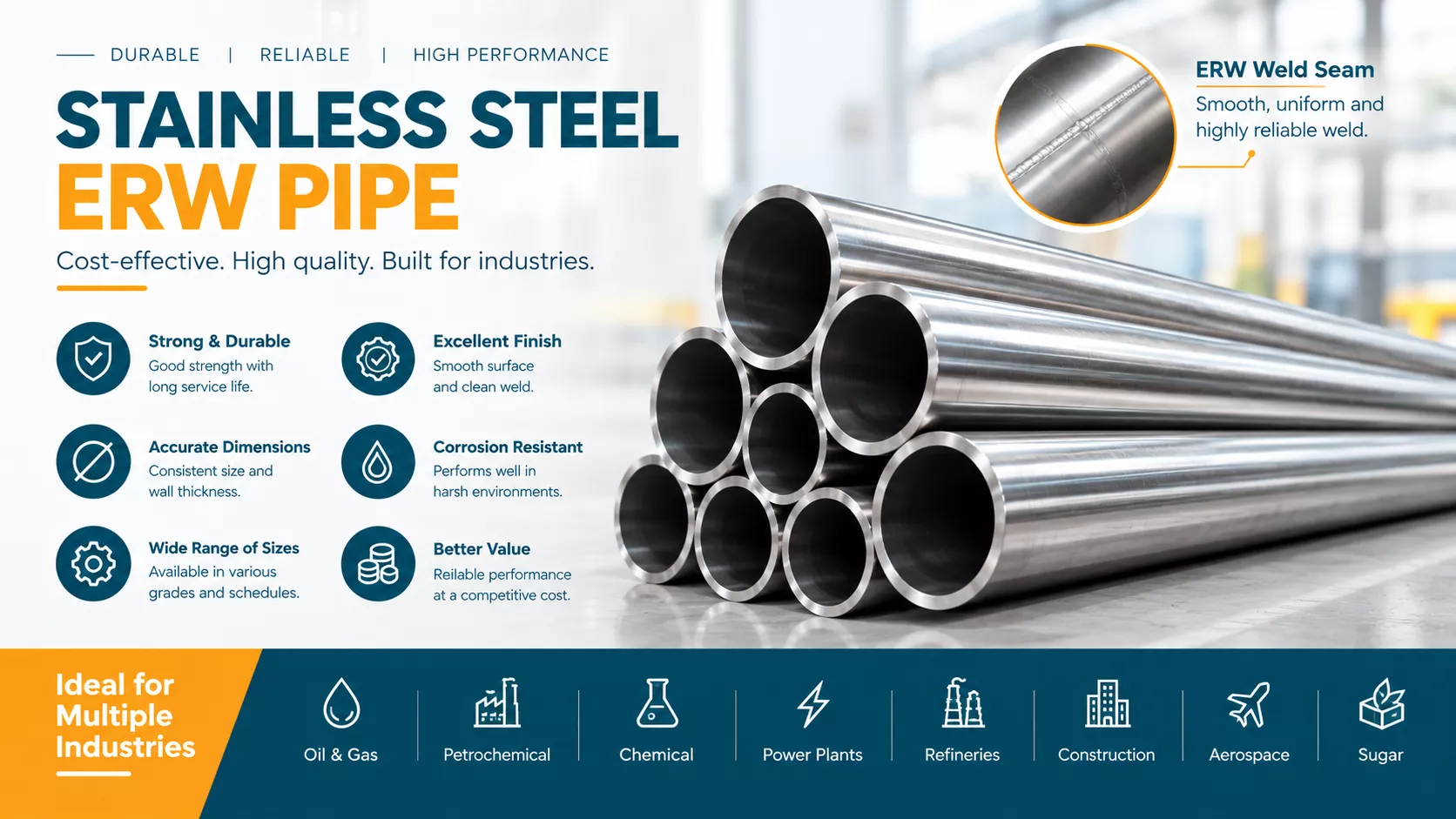
Kamal Steels offers Stainless Steel ERW Pipes in different grades, sizes, wall thicknesses and specifications for industrial and commercial requirements. Stainless steel Electric Resistance Welded (ERW) pipes are manufactured by forming stainless steel strip into a tubular shape and joining the edges through an electric resistance welding process.
SS ERW Pipes are used in industrial equipment, structural applications, fabrication, fluid handling and general engineering. Selection depends on the material grade, outside diameter, wall thickness, applicable standard, operating conditions and inspection requirements.
We cater to buyers seeking stainless steel welded pipes in grades such as 304, 304L, 316 and 316L, subject to product specifications and availability. Material test certificates and inspection documentation can be discussed when requesting a quotation.
Stainless Steel ERW Pipe Specifications
Stainless steel ERW pipe specifications define the material grade, dimensions, manufacturing requirements, welding quality and testing criteria. The applicable specification depends on whether the product is intended for pressure service, general industrial use or structural applications.
| Parameter | Specification Details |
|---|---|
| Product | Stainless Steel ERW / Welded Pipe |
| Manufacturing Process | Electric Resistance Welding (ERW) |
| Common Grades | 304, 304L, 316 and 316L |
| Material Standards | ASTM A312, ASTM A778 or other applicable standards, depending on product type and service |
| Dimensional Standard | ASME B36.19M, where applicable |
| Size | As per the selected outside diameter and product specification |
| Wall Thickness | As specified by the applicable schedule or ordered dimensions |
| Surface Finish | As specified by the product standard and purchase order |
| Testing and Documentation | As required by the applicable standard and purchase order |
Actual sizes, grades, manufacturing routes and testing requirements should be confirmed against the applicable product standard before placing an order.
SS ERW Pipe Size and Thickness Chart
Stainless steel ERW pipes are specified by nominal pipe size (NPS or NB), outside diameter and wall thickness. Nominal pipe size is a designation and does not always represent the actual outside diameter.
The following table provides selected nominal pipe sizes and their standard outside diameters. Wall thickness depends on the required schedule and applicable dimensional standard.
| Nominal Pipe Size (NPS) | Nominal Bore (NB) | Outside Diameter (mm) |
|---|---|---|
| 1/2 inch | 15 NB | 21.3 |
| 3/4 inch | 20 NB | 26.7 |
| 1 inch | 25 NB | 33.4 |
| 1 1/4 inch | 32 NB | 42.2 |
| 1 1/2 inch | 40 NB | 48.3 |
| 2 inch | 50 NB | 60.3 |
| 2 1/2 inch | 65 NB | 73.0 |
| 3 inch | 80 NB | 88.9 |
| 4 inch | 100 NB | 114.3 |
| 6 inch | 150 NB | 168.3 |
| 8 inch | 200 NB | 219.1 |
| 10 inch | 250 NB | 273.1 |
| 12 inch | 300 NB | 323.9 |
Note: The outside diameters above are common ASME pipe dimensions. Confirm the required size range and dimensional tolerance against the selected product standard. Availability of these sizes in ERW construction must be confirmed separately.
Stainless Steel ERW Pipe Schedule and Dimensions
Pipe schedule identifies a standard wall-thickness series for a given nominal pipe size. Common schedules for stainless steel pipes include Schedule 5S, 10S, 40S and 80S under ASME B36.19M, where applicable.
The actual wall thickness varies with nominal pipe size. Therefore, a schedule number should always be checked against the dimensional table rather than treated as a fixed thickness in millimetres.
| Schedule | Meaning | Selection Consideration |
|---|---|---|
| Schedule 5S | Light-wall series | Suitable only where the design and applicable specification permit the wall thickness |
| Schedule 10S | Light-wall stainless steel pipe series | Confirm operating pressure, corrosion allowance and mechanical requirements |
| Schedule 40S | Standard wall-thickness series for many stainless steel pipe sizes | Verify actual dimensions and design pressure |
| Schedule 80S | Heavier-wall series | Evaluate pressure, temperature, weight and connection requirements |
For procurement, specify the nominal size, schedule or exact wall thickness, grade, length and applicable standard. This helps avoid dimensional mismatches between the ordered pipe and the installation design.
SS ERW Pipe Pressure Rating Chart
The pressure capacity of a stainless steel ERW pipe depends on its outside diameter, wall thickness, material grade, design temperature, allowable stress, weld quality and the governing design code. A schedule number alone does not establish the maximum allowable working pressure.
For pressure service, the design engineer should calculate or verify the allowable pressure using the applicable piping code and material properties at the intended operating temperature. Manufacturing and examination requirements must also be appropriate for the service.
| Factor | Effect on Pressure Capacity |
|---|---|
| Outside Diameter | Forms part of the pipe geometry used in pressure design |
| Wall Thickness | Greater effective wall thickness can increase pressure capacity, subject to design requirements |
| Material Grade | Determines applicable mechanical properties and allowable stress |
| Operating Temperature | Can change the allowable material stress |
| Weld Quality | Must satisfy the applicable manufacturing, examination and design-code requirements |
| Corrosion and Tolerances | Reduce the wall available for pressure containment when applicable allowances are considered |
Important: Do not use a generic pressure value as a design rating for all SS ERW pipes. The required pressure calculation must use the exact pipe dimensions, material, temperature and applicable code.
Types of Stainless Steel ERW Pipes
Stainless steel ERW pipes can be classified by material grade, dimensions, finish and intended application. The selected type should meet the corrosion resistance, fabrication and operating requirements of the project.
Stainless Steel 304 ERW Pipe
Grade 304 is a widely used austenitic stainless steel with good general corrosion resistance and formability. It is commonly considered for equipment, fabrication, general industrial services and architectural applications where the environment is suitable.
Stainless Steel 304L ERW Pipe
Grade 304L has a lower maximum carbon content than Grade 304. Its lower carbon content can help reduce sensitization risks during welding, making it useful for certain welded fabrications and corrosive-service applications.
Stainless Steel 316 ERW Pipe
Grade 316 contains molybdenum, which improves resistance to pitting and crevice corrosion in many chloride-containing environments compared with Grade 304. The suitability of Grade 316 depends on the concentration, temperature and exposure conditions.
Stainless Steel 316L ERW Pipe
Grade 316L is the low-carbon version of Grade 316. It is often selected for welded components where reduced sensitization risk is important, while retaining the molybdenum-containing alloy's corrosion-resistance characteristics.
Grade selection should be based on the service environment, applicable product specification, welding requirements and project documentation.
Chemical Composition of Stainless Steel ERW Pipes
The chemical composition of stainless steel determines important properties such as corrosion resistance, weldability and mechanical performance. The following table gives typical maximum or range values for selected elements in common austenitic grades. Exact limits depend on the applicable material specification and product form.
| Grade | Carbon (C), Max. % | Chromium (Cr), % | Nickel (Ni), % | Molybdenum (Mo), % |
|---|---|---|---|---|
| 304 | 0.08 | 18.0–20.0 | 8.0–10.5 | Not specified as a required addition |
| 304L | 0.03 | 18.0–20.0 | 8.0–12.0 | Not specified as a required addition |
| 316 | 0.08 | 16.0–18.0 | 10.0–14.0 | 2.0–3.0 |
| 316L | 0.03 | 16.0–18.0 | 10.0–14.0 | 2.0–3.0 |
These are commonly referenced composition ranges for the grades, not a substitute for the product standard. Other elements, including manganese, silicon, phosphorus, sulfur and nitrogen, also have specified limits. Verify the complete chemical analysis against the applicable standard and material test certificate.
Mechanical Properties of SS ERW Pipes
Mechanical properties indicate how a stainless steel pipe responds to tensile loading and deformation. Specified minimum values can vary with the product standard, grade, heat treatment, dimensions and manufacturing requirements.
| Property | Purpose |
|---|---|
| Tensile Strength | Measures the maximum tensile stress reached during a tensile test |
| Yield Strength | Indicates the stress associated with specified permanent deformation |
| Elongation | Measures ductility during a tensile test |
| Hardness | Indicates resistance to localized indentation under a defined test method |
Mechanical acceptance values should be taken from the applicable pipe specification. For a purchase order, confirm the required test methods, acceptance criteria and material documentation rather than relying on generic values for the grade alone.
Stainless Steel ERW Pipe Manufacturing Process
Stainless steel ERW pipe production involves forming a stainless steel strip into a tubular shape and joining the longitudinal edges through electric resistance welding. The exact production route and finishing operations depend on the pipe specification and manufacturer.
- Strip inspection: The stainless steel strip is checked for grade identification, dimensions, surface condition and conformity with the production requirements.
- Slitting and preparation: Where required, the strip is prepared to the width needed for the specified pipe diameter.
- Roll forming: Forming rolls progressively shape the strip into a cylindrical tube with aligned edges.
- Electric resistance welding: Electrical resistance generates heat at the meeting edges, which are joined under controlled pressure.
- Weld finishing: The weld area is finished as required by the manufacturing specification.
- Sizing and straightening: The pipe is brought to the required dimensional tolerances and straightness.
- Cutting and inspection: The pipe is cut to length and inspected according to the applicable product requirements.
- Marking and packing: Accepted material is identified and packed according to the order and transport requirements.
Not every ERW pipe follows an identical finishing route. Heat treatment, pickling, additional nondestructive examination and other operations are performed where required by the applicable specification and purchase order.
Factors Affecting Stainless Steel ERW Pipe Quality
SS ERW pipe quality depends on the incoming strip, forming accuracy, welding parameters and inspection controls. Problems at any stage can affect the finished pipe's dimensions, surface condition or weld integrity.
- Strip quality: Surface defects, laminations or inconsistent strip dimensions can affect forming and the finished product.
- Edge preparation: Poor edge alignment or contamination can interfere with consistent weld formation.
- Welding parameters: Incorrect electrical input, welding speed or pressure can contribute to weld defects.
- Dimensional control: Inadequate forming or sizing control can result in out-of-tolerance diameter, wall thickness or ovality.
- Surface condition: Handling damage, contamination or unsuitable finishing may affect appearance and corrosion performance.
- Inspection and traceability: Appropriate testing, grade identification and documentation help establish conformity with the ordered specification.
For critical applications, buyers should clearly specify the required manufacturing standard, weld examination, testing, marking and certification before production or dispatch.
Stainless Steel Welded Pipe Price in India
The price of stainless steel welded pipes in India depends on the material grade, outside diameter, wall thickness, length, order quantity and applicable manufacturing specification. Prices can also vary with stainless steel raw-material costs, surface finish, testing and documentation requirements.
Grade 316 and 316L pipes may cost more than comparable Grade 304 and 304L products because their alloy composition differs. However, the final price depends on the complete specification and prevailing market conditions.
For an accurate quotation from Kamal Steels, provide the following details:
- Stainless steel grade, such as 304, 304L, 316 or 316L
- Nominal pipe size or outside diameter
- Schedule or required wall thickness
- Required length and total quantity
- Applicable ASTM, ASME or other product standard
- Testing, inspection and material certificate requirements
- Delivery location and packaging requirements
Providing these details helps establish a quotation based on the actual product requirements rather than a generic per-kilogram or per-metre price.
Stainless Steel ERW Pipe Stock Availability
Kamal Steels caters to enquiries for stainless steel pipes in different grades, dimensions and specifications. Availability depends on the required grade, pipe size, wall thickness, product standard and order quantity.
For stock enquiries, buyers should share the grade, outside diameter, schedule or wall thickness, length and quantity. If the application requires a specific pressure-piping standard, confirm that the offered product complies with that standard before ordering.
Material test certificates, inspection reports and other documentation can be discussed according to the applicable specification and purchase order. Grade marking, traceability and packaging requirements should also be confirmed before dispatch.
Request a quotation: Contact Kamal Steels with your pipe specifications and quantity to check current availability and pricing.
Frequently Asked Questions
What is an SS ERW pipe?
An SS ERW pipe is a stainless steel pipe manufactured by forming stainless steel strip into a tubular shape and joining its longitudinal edges using electric resistance welding. It is used in industrial, fabrication and engineering applications, depending on the applicable specification.
What is the full form of ERW?
ERW stands for Electric Resistance Welding. This process uses electrical resistance to generate heat at the edges of the formed metal strip, allowing them to be joined under controlled pressure.
Which stainless steel grades are used for SS ERW pipes?
Common stainless steel grades include 304, 304L, 316 and 316L. Grade 304 is widely used for general applications, while Grades 316 and 316L may be preferred for environments requiring improved resistance to pitting and crevice corrosion. Grade selection depends on the operating conditions and applicable product specification.
What is the difference between ERW and seamless pipes?
ERW pipes are manufactured by forming stainless steel strip and welding the longitudinal edges. Seamless pipes are produced without a welded seam. The appropriate pipe type depends on the application, design conditions, required dimensions and governing standard.
Which standards apply to stainless steel ERW pipes?
The applicable standard depends on the pipe type and intended service. ASTM A312 covers specified stainless steel pipe products, including welded pipes, while ASTM A778 covers certain welded, unannealed austenitic stainless steel tubular products. ASME B36.19M provides dimensional requirements for stainless steel pipe. Always confirm the required standard before ordering.
How do I select the correct SS ERW pipe schedule?
Pipe schedule determines a standard wall-thickness series for a given nominal pipe size. Selection depends on the required dimensions, design pressure, operating temperature, material grade and applicable design code. The allowable working pressure should be verified for the specific pipe rather than determined from the schedule alone.
What is the price of stainless steel welded pipes in India?
The price depends on the stainless steel grade, outside diameter, wall thickness, schedule, quantity, manufacturing specification and current raw-material rates. Share your required dimensions and quantity with Kamal Steels to request a quotation.
Can I request a specific pipe size or wall thickness?
Yes. Share the required grade, outside diameter or nominal pipe size, schedule or wall thickness, length and quantity. Kamal Steels can check availability against your specifications and confirm the options that can be supplied.
What affects the quality of stainless steel ERW pipes?
Pipe quality depends on the stainless steel strip condition, edge preparation, forming accuracy, welding parameters, dimensional control and inspection. Buyers should confirm the applicable manufacturing standard, testing requirements and material documentation for their application.
What information is required for an SS ERW pipe quotation?
Please provide the stainless steel grade, pipe size, schedule or wall thickness, required length, quantity and applicable standard. You can also share testing, material certificate, inspection, packaging and delivery requirements to help obtain an accurate quotation.
Contact Kamal Steels
Looking for stainless steel ERW pipes for an industrial project, fabrication requirement or bulk order?
Contact Kamal Steels to enquire about stainless steel pipe grades, dimensions, specifications, stock availability and pricing.
Call or WhatsApp: +91-8879048749 / +91-9820982737
Email: sales@kamalpiping.com
Location: Mumbai, Maharashtra, India
Share your material specification and required quantity, and our team will check availability and respond with a quotation.
Speak to Our Sales Team