
-
-
-
Girgaon, Mumbai - 400004
Stainless Steel LSAW Pipe Manufacturers in india
Kamal Steels supplies Stainless Steel LSAW Pipes for industrial piping systems that require longitudinally welded pipe construction, specified dimensions and material traceability. LSAW stands for Longitudinal Submerged Arc Welded, a welding process in which the pipe seam runs along the length of the pipe.
Stainless Steel LSAW Pipes are selected according to the required grade, outside diameter, wall thickness, design pressure, temperature, corrosion exposure and applicable product specification. Austenitic stainless steel grades such as 304L and 316L may be considered where they meet the project requirements.
Depending on the material and application, the relevant specification may include ASTM A358/A358M for electric-fusion-welded austenitic chromium-nickel stainless steel pipe. The exact manufacturing route, pipe class, inspection and testing requirements must be confirmed against the purchase specification.
Stainless Steel LSAW Pipe: Quick Overview
| Product | Stainless Steel LSAW Pipe |
|---|---|
| Full form | Longitudinal Submerged Arc Welded Pipe |
| Construction | Pipe formed from plate with a longitudinal welded seam |
| Material grades | Grade selection depends on the project specification; 304L and 316L are examples of austenitic stainless steel grades |
| Related specification | ASTM A358/A358M may apply to qualifying electric-fusion-welded austenitic stainless steel pipe |
| Dimensions | Outside diameter and wall thickness as specified in the purchase order |
| Inspection | As required by the applicable standard, pipe class and purchase specification |
| Applications | Industrial process systems, chemical facilities, utilities and project-specific piping installations |
What Is Stainless Steel LSAW Pipe?
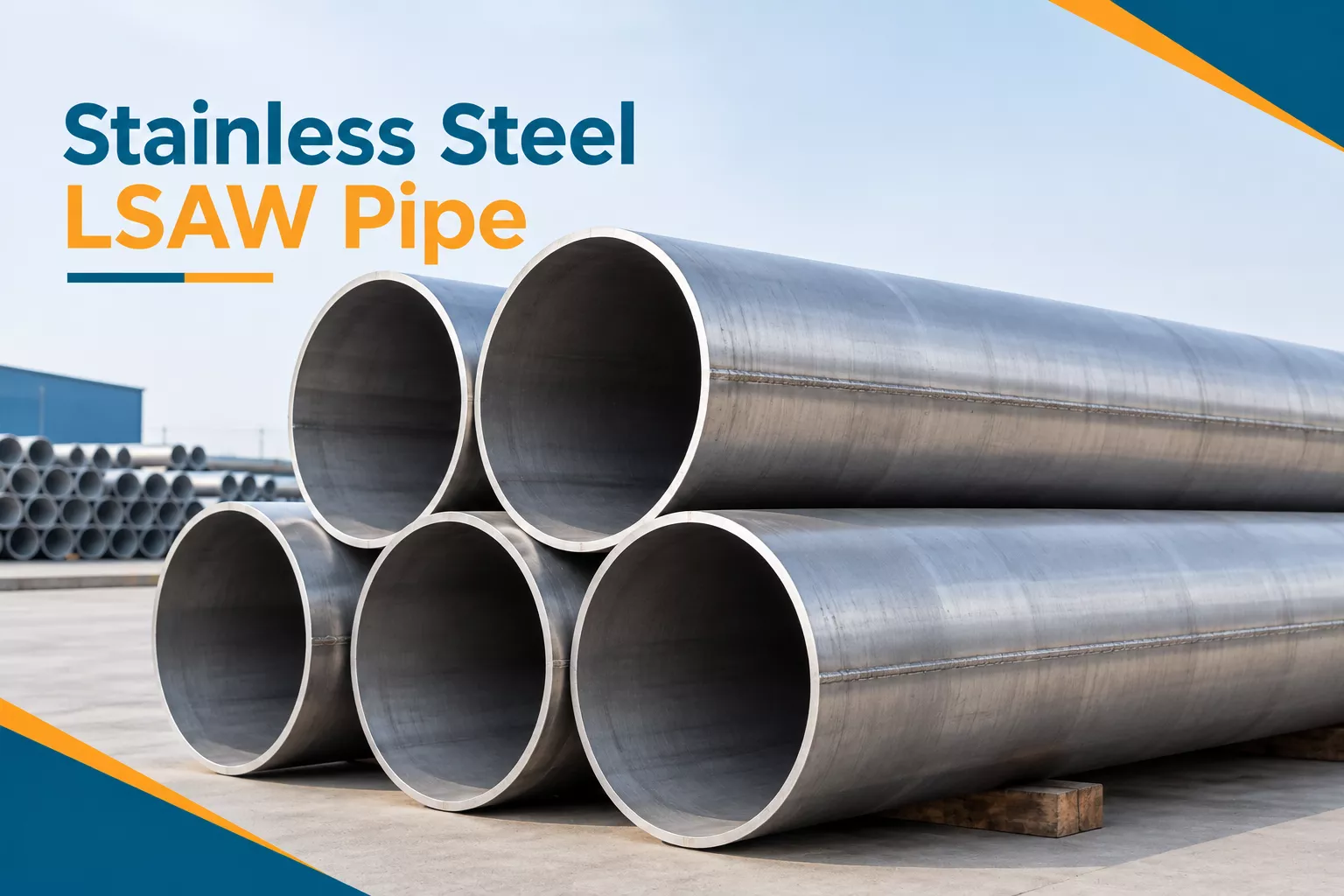
Stainless Steel LSAW Pipe is a welded pipe made by forming stainless steel plate into a cylindrical shape and joining the longitudinal seam using a submerged arc welding process. LSAW refers to the orientation and welding method of the seam, not to a particular stainless steel grade.
The final pipe must meet the applicable material, dimensional, manufacturing, heat-treatment and inspection requirements. Not every large-diameter stainless steel welded pipe is automatically an LSAW pipe, and not every LSAW pipe is manufactured to the same product standard.
When specifying this product, buyers should identify the material grade, governing standard, pipe class where applicable, dimensions, end preparation, testing requirements and any project-specific requirements.
LSAW Pipe Manufacturing Process
The manufacturing route depends on the pipe specification, dimensions, material and approved production procedure. A typical plate-formed LSAW route includes the following stages:
- Plate selection: Select stainless steel plate that meets the specified grade, thickness and material requirements.
- Plate preparation: Inspect and prepare plate edges for forming and welding.
- Pipe forming: Form the plate into a cylindrical or near-cylindrical pipe shape using the selected forming method.
- Longitudinal seam welding: Weld the longitudinal seam using a qualified welding procedure appropriate to the material and specification.
- Dimensional checks: Check parameters such as outside diameter, wall thickness, length, straightness and ovality against the applicable requirements.
- Heat treatment and finishing: Apply heat treatment, surface finishing and end preparation when required by the specification or purchase order.
- Inspection and testing: Carry out the specified non-destructive examination and mechanical or other tests.
- Documentation and marking: Verify identification, traceability, markings and inspection documents before dispatch.
The exact process sequence and acceptance criteria must be established by the governing standard and the manufacturer's approved procedures.
Stainless Steel LSAW Pipe Grades
Grade selection depends on corrosion exposure, temperature, pressure, fabrication requirements and the applicable specification. The following grades are examples of austenitic stainless steels that may be evaluated for welded pipe applications. Their availability in a particular LSAW product and standard must be confirmed.
| Grade | General characteristics | Selection considerations |
|---|---|---|
| 304 / 304L | General-purpose austenitic stainless steel grades | Consider the process environment, chloride exposure, temperature and required carbon limit. |
| 316 / 316L | Molybdenum-bearing austenitic stainless steel grades | Often considered where improved resistance to certain corrosive environments is required; actual suitability depends on service conditions. |
| 321 | Titanium-stabilized austenitic stainless steel | Evaluate where stabilization and elevated-temperature requirements are relevant. |
| 347 | Niobium-stabilized austenitic stainless steel | Confirm temperature, welding, heat-treatment and specification requirements. |
| 310S | High-chromium, high-nickel austenitic heat-resistant stainless steel | Evaluate for suitable high-temperature service; verify the design and oxidation environment. |
This list is a grade-selection guide, not confirmation that every grade is available as LSAW pipe or covered by every listed specification. Confirm the product form, grade, standard and class before placing an order.
Explore related products: Stainless Steel Pipes and Stainless Steel Tubes.
Applicable Standards and Specifications
The governing standard should match the material, manufacturing process, dimensions and intended service. ASTM A358/A358M covers electric-fusion-welded austenitic chromium-nickel stainless steel pipe for corrosive or high-temperature service and general applications. It defines pipe classes with different welding and radiographic examination requirements.
| Standard or reference | Relevance | What to confirm |
|---|---|---|
| ASTM A358/A358M | Electric-fusion-welded austenitic chromium-nickel stainless steel pipe | Grade, class, dimensions, heat treatment, examination and supplementary requirements. |
| ASME SA-358 | Related specification used in applicable ASME Boiler and Pressure Vessel Code contexts | Confirm the required code edition and project-specific specification. |
| ASTM A999/A999M | General requirements referenced by certain alloy and stainless steel pipe specifications | Applicability depends on the governing product specification. |
| Project or purchaser specification | Defines additional service, dimensional, inspection and documentation requirements | Design code, material grade, testing, acceptance criteria and documentation. |
Important: Do not assume that ASTM A312, ASTM A358 and other welded stainless steel pipe specifications are interchangeable. ASTM A358/A358M specifically addresses electric-fusion-welded austenitic chromium-nickel stainless steel pipe. Confirm the latest applicable edition with the purchaser or engineering team.
Stainless Steel LSAW Pipe Dimensions and Wall Thickness
Pipe dimensions are selected according to the engineering design and applicable dimensional standard. Outside diameter, wall thickness, length, end preparation and tolerances should be specified on the enquiry or purchase order.
| Dimension | Specification detail |
|---|---|
| Nominal pipe size (NPS) | Specify the required nominal size or project-designated size. |
| Outside diameter (OD) | Specify the required outside diameter in mm or inches. |
| Wall thickness | Specify the required thickness or applicable schedule where the governing standard defines it. |
| Length | Specify fixed length, random length or project-defined cut length. |
| Pipe ends | Plain end, bevelled end or another specified end preparation. |
| Tolerances | Use the tolerances stated in the governing product and dimensional standards. |
Do not select a wall thickness from schedule alone without checking the applicable dimensional standard, design conditions and manufacturing specification. The relationship between nominal pipe size, outside diameter and wall thickness must be verified for the ordered product.
LSAW vs. Other Welded Pipe Types
LSAW, EFW, ERW and spiral-welded describe manufacturing or welding approaches. These terms should not be treated as identical product specifications. Stainless steel grade and product standard also affect the final requirements.
| Pipe type | Seam or process description | Key selection point |
|---|---|---|
| Stainless Steel LSAW Pipe | Longitudinal seam made using submerged arc welding in the specified manufacturing route | Confirm material, forming method, welding procedure and governing product specification. |
| Stainless Steel EFW Pipe | Electric-fusion-welded pipe; the specific standard defines applicable manufacturing and inspection requirements | ASTM A358/A358M is relevant to covered austenitic stainless steel pipe products. |
| Stainless Steel Erw Pipe | Electric-resistance-welded pipe | Verify that the specified manufacturing route and product standard are suitable for the application. |
| Seamless Pipe | Produced without a welded longitudinal seam | Compare its specified manufacturing route, grade, dimensions and service suitability with welded alternatives. |
Choose a pipe based on engineering requirements, code compliance and documented quality—not simply on the manufacturing label or assumed strength advantage.
Inspection, Testing and Material Documentation
Inspection requirements depend on the applicable specification, pipe class, service conditions and purchaser requirements. Potential checks and documents include:
- Material Test Certificate (MTC): Verify grade, heat or lot identification, chemical analysis and applicable mechanical test results.
- Dimensional inspection: Confirm outside diameter, wall thickness, length and specified tolerances.
- Weld examination: Apply the specified radiographic, ultrasonic or other examination requirements where applicable.
- Mechanical testing: Confirm required tensile, bend or other tests under the governing standard.
- Hydrostatic or other leak testing: Verify the test requirement and acceptance criteria for the ordered product.
- Heat treatment: Confirm the required condition and supporting records where specified.
- Traceability and marking: Ensure product identification matches the MTC and purchase order.
- Third-party inspection: Arrange when required by the purchaser or project specification.
Not every test is mandatory for every pipe. The purchase order should identify required tests, examination extent, acceptance criteria, reporting and inspection hold points.
Industrial Applications of Stainless Steel LSAW Pipe
Stainless steel LSAW pipes may be considered for project-specific systems where the required dimensions, welded construction, material grade and product specification are suitable. Applications can include:
- Oil and gas facilities: Selected process, utility and plant piping systems subject to design approval.
- Chemical processing: Lines handling compatible chemicals and process fluids.
- Petrochemical plants: Piping systems where the selected alloy meets corrosion and temperature requirements.
- Power generation: Specified utility and process services, subject to code and material requirements.
- Water and utility systems: Applications where the grade and pipe design are suitable for the water chemistry and operating conditions.
- Industrial infrastructure: Project-defined installations requiring specified welded stainless steel pipe.
Application suitability cannot be determined from stainless steel grade alone. Consider fluid chemistry, chlorides, operating temperature, pressure, erosion, weld condition, cleaning requirements and applicable design code.
How to Select the Right Stainless Steel LSAW Pipe
For an accurate technical review and quotation, include the following information in your enquiry:
- Required stainless steel grade and material designation.
- Governing product standard and edition.
- Nominal pipe size or outside diameter.
- Wall thickness and dimensional standard.
- Required length and quantity.
- Design pressure, operating temperature and service medium where relevant.
- Pipe class, weld examination, heat treatment and other testing requirements.
- End preparation, surface finish, marking and packing instructions.
- Required MTC, traceability and third-party inspection documents.
- Delivery location and required delivery schedule.
Providing these details helps determine whether the requested grade, product form and manufacturing specification match the application.
For product enquiries, visit the Kamal Steels contact page.
Factors Affecting Stainless Steel LSAW Pipe Price
Stainless Steel LSAW Pipe prices vary according to the material and the technical requirements of the order. Important cost factors include:
- Stainless steel grade and alloy composition.
- Outside diameter, wall thickness and ordered length.
- Manufacturing route and applicable product specification.
- Required pipe class, heat treatment and non-destructive examination.
- Mechanical testing, inspection, traceability and documentation.
- Order quantity, cutting, end preparation and packaging.
- Freight, delivery location and applicable taxes or duties.
A reliable quotation should be based on a defined grade, specification, dimensions, testing scope and quantity. No fixed price should be assumed without reviewing the actual requirements.
Stainless Steel LSAW Pipe FAQs
Stainless Steel LSAW Pipe is a welded pipe manufactured with a longitudinal seam using a submerged arc welding process. Its grade, dimensions and inspection requirements depend on the governing product specification.
LSAW stands for Longitudinal Submerged Arc Welded. It describes a pipe manufacturing and welding method in which the seam runs along the pipe length.
ASTM A358/A358M may apply to electric-fusion-welded austenitic chromium-nickel stainless steel pipe. The correct standard must be confirmed against the grade, manufacturing route, service and project requirements.
Grades such as 304L and 316L are common austenitic stainless steel grades for welded pipe applications. The suitability and availability of a grade as LSAW pipe depend on the applicable specification and order requirements.
No. LSAW describes a longitudinal submerged arc welding route, while EFW refers to electric-fusion welding as defined by the applicable product specification. Confirm the manufacturing route and standard rather than treating the terms as interchangeable.
Dimensions depend on the manufacturer, material, product specification and project. Specify the outside diameter, wall thickness, length and dimensional standard when requesting a quotation.
Requirements may include dimensional inspection, mechanical tests, weld examination, hydrostatic or other leak testing, heat-treatment verification and material documentation. The governing standard and purchase order determine which tests apply.
Material test documentation should be specified and confirmed at the time of order. The certificate and traceability records should match the ordered grade, heat or lot identification and applicable specification.
Price depends on grade, dimensions, quantity, manufacturing requirements, testing, inspection, documentation, finishing, packaging and delivery terms. A quotation requires the actual technical and commercial details.
Provide the grade, product standard, outside diameter, wall thickness, length, quantity, required tests, documentation, end preparation and delivery location. Include the service conditions or project specification when relevant.
Stainless Steel LSAW Pipe from Kamal Steels
Choosing Stainless Steel LSAW Pipe requires matching the material grade, dimensions, welding route and inspection requirements to the intended service. Kamal Steels can review enquiries based on the specification and product details provided.
For a product enquiry, share your required grade, standard, dimensions, quantity and testing requirements through the contact page.