
-
-
-
Girgaon, Mumbai - 400004
Stainless Steel EFW Pipe Manufacturers in india
Stainless Steel EFW Pipe is an electric-fusion-welded stainless steel pipe used in industrial systems where material composition, weld quality, dimensions and inspection requirements must meet a defined specification. EFW stands for Electric Fusion Welded, a term associated with a welding process that uses electrical energy to produce the weld.
EFW stainless steel pipes are considered for chemical processing, petrochemical facilities, power generation, industrial utilities and other applications where the selected stainless steel grade is compatible with the process environment. Grades such as 304L and 316L may be specified where their corrosion resistance and mechanical properties meet the design requirements.
Kamal Steels supplies stainless steel and alloy products for industrial procurement. When sourcing Stainless Steel EFW Pipes, buyers should verify the grade, manufacturing specification, pipe class, dimensions, weld examination, testing requirements and material documentation before ordering.
Stainless Steel EFW Pipe at a Glance
| Product | Stainless Steel EFW Pipe |
|---|---|
| Full form | Electric Fusion Welded Pipe |
| Manufacturing method | Pipe formed from suitable material and joined using an electric-fusion welding process |
| Relevant specification | ASTM A358/A358M for covered electric-fusion-welded austenitic chromium-nickel stainless steel pipe |
| Example material grades | 304L and 316L, where covered by the applicable product specification |
| Dimensions | As specified by the applicable dimensional standard and purchase order |
| Inspection | Testing and weld examination according to the governing standard, pipe class and purchaser requirements |
| Typical industries | Chemical, petrochemical, power generation, process plants and industrial utilities |
The exact product specification must be selected according to the required material, manufacturing route and service conditions. ASTM A358/A358M is a relevant specification for covered electric-fusion-welded austenitic stainless steel pipe, but it should not be assumed to apply to every product described as EFW.
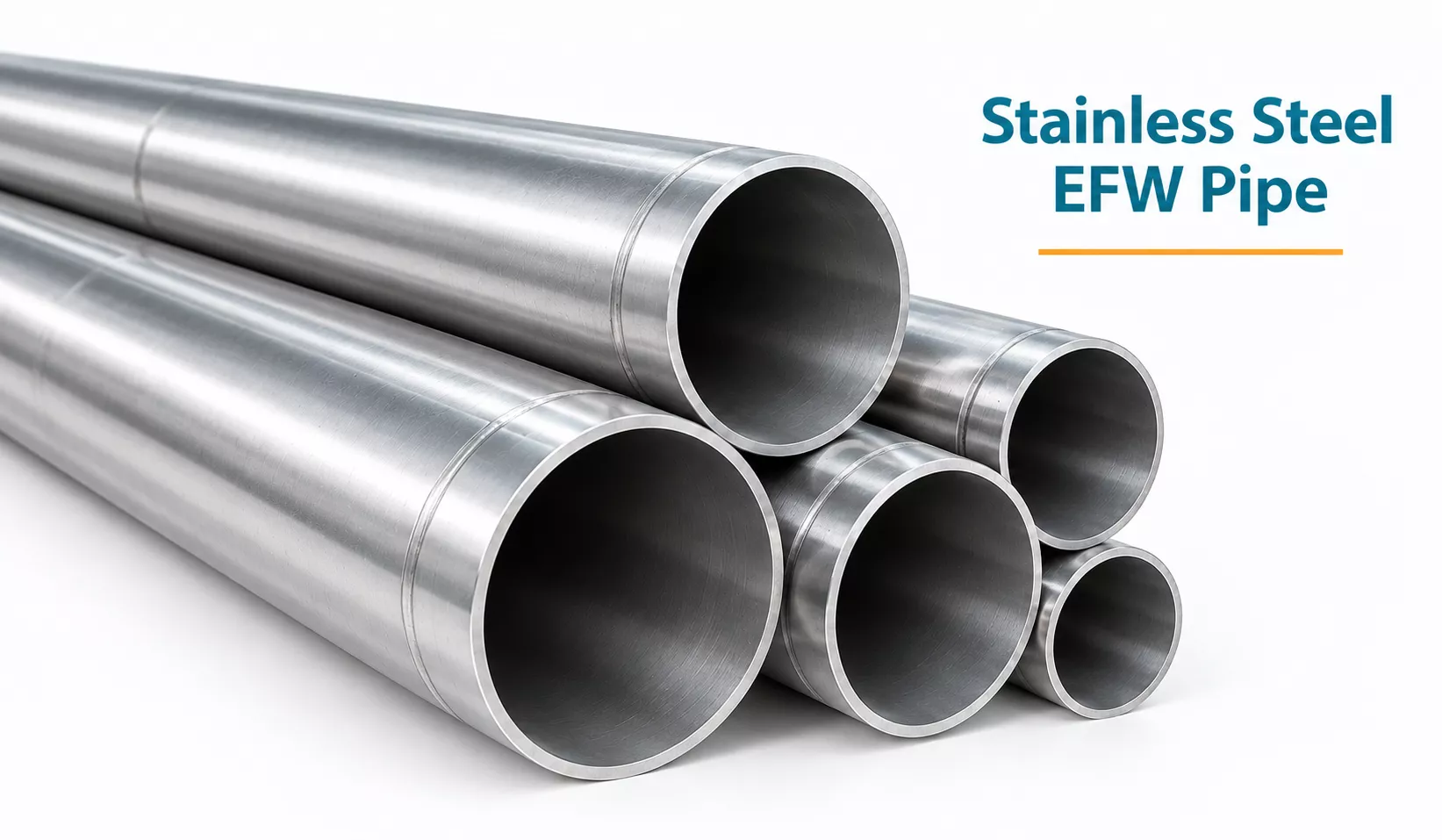
What Is Stainless Steel EFW Pipe?
Stainless Steel EFW Pipe is a welded pipe produced by forming stainless steel plate or another suitable starting material into a pipe shape and joining the seam using an electric-fusion welding process. The manufacturing route, filler metal use, heat treatment and inspection requirements depend on the applicable product specification.
EFW describes a manufacturing process rather than a particular stainless steel grade. A pipe may have an EFW designation, but its suitability for pressure, temperature or corrosive service must still be established using the material grade, governing standard, design code and test results.
Why Is EFW Used for Stainless Steel Pipe?
Electric-fusion welding can be used to manufacture welded pipe to defined dimensional and material requirements. Depending on the applicable specification and manufacturing route, the process can accommodate project-specific pipe sizes, wall thicknesses and inspection requirements.
The finished pipe must comply with the required chemical composition, mechanical properties, dimensional tolerances and weld acceptance criteria. Buyers should confirm these details from the material test certificate and inspection documents rather than relying on the EFW label alone.
EFW Pipe for Industrial Procurement
When requesting EFW stainless steel pipe, specify the intended service, material grade, applicable standard, pipe class where required, dimensions and inspection scope. This helps the supplier assess whether the requested product matches the engineering specification.
How EFW Stainless Steel Pipe Is Manufactured
Manufacturing details vary according to the product standard, material grade, pipe dimensions and approved production route. A typical plate-formed welded pipe process may involve the following stages.
- Material verification: Confirm the starting material's grade, thickness, identification and required material records.
- Plate preparation: Prepare the plate edges and surface for forming and welding.
- Pipe forming: Form the material into the specified pipe geometry using the manufacturing method appropriate to the product.
- Electric-fusion welding: Join the prepared edges using a qualified welding procedure suitable for the material and governing specification.
- Weld and dimensional checks: Inspect the seam and verify dimensions against the applicable acceptance requirements.
- Heat treatment and finishing: Apply required heat treatment, surface finishing and end preparation where specified.
- Testing and documentation: Complete the required examinations, tests, marking and traceability records.
This is a general manufacturing overview, not a universal process sequence. The actual procedure and acceptance criteria must follow the applicable standard and approved manufacturing documentation.
Stainless Steel Grades Used for EFW Pipe
Grade selection should reflect the process fluid, operating temperature, chloride exposure, pressure and fabrication requirements. The following are examples of austenitic stainless steel grades; confirm that the required grade and product form are permitted by the selected EFW specification.
| Grade | General characteristics | Selection considerations |
|---|---|---|
| 304 / 304L | General-purpose austenitic stainless steel grades | Consider for compatible process environments; verify corrosion exposure, temperature and carbon requirements. |
| 316 / 316L | Molybdenum-bearing austenitic stainless steel grades | Often considered where improved resistance to certain corrosive environments is needed. |
| 321 | Titanium-stabilized austenitic stainless steel | Evaluate when stabilization and elevated-temperature requirements are relevant. |
| 347 | Niobium-stabilized austenitic stainless steel | Confirm the required grade, heat treatment, welding procedure and service conditions. |
| 310S | High-chromium, high-nickel heat-resistant austenitic stainless steel | Assess for appropriate high-temperature service and confirm product-standard coverage. |
This table is a material-selection guide, not a statement that every listed grade is available in every EFW size or specification. The exact grade and product standard must be confirmed before procurement.
For other stainless steel product forms, see Stainless Steel Pipe and Stainless Steel Tubes.
ASTM A358/A358M for Electric-Fusion-Welded Stainless Steel Pipe
ASTM A358/A358M covers electric-fusion-welded austenitic chromium-nickel stainless steel pipe for corrosive or high-temperature service and general applications. It defines requirements that include material, manufacture, testing and inspection. The applicable edition and any supplementary requirements should be identified in the purchase specification.
Understanding ASTM A358 Pipe Classes
ASTM A358/A358M uses pipe classes with different requirements for weld construction and radiographic examination. The class should therefore be specified rather than assuming that every ASTM A358 pipe has the same examination scope.
| Pipe Class | General distinction | Procurement consideration |
|---|---|---|
| Class 1 | Includes double-welded construction and radiographic examination requirements under the specification. | Confirm the applicable examination extent and acceptance criteria. |
| Class 2 | Includes double-welded construction without the same full radiographic examination requirement as Class 1. | Check the exact requirements in the specified standard edition. |
| Class 3 | Includes single-welded construction with radiographic examination requirements under the specification. | Confirm weld configuration, examination scope and acceptance criteria. |
| Class 4 | Includes single-welded construction with requirements differing from Class 3. | Review the governing edition to confirm the required examination scope. |
| Class 5 | Includes double-welded construction with radiographic examination requirements under the specification. | Confirm the required class, examination and supplementary provisions before ordering. |
The table provides a high-level orientation only. Class descriptions must be checked against the current applicable edition of ASTM A358/A358M; do not use this summary as a substitute for the standard's exact requirements.
ASTM A358 vs ASTM A312
ASTM A358/A358M specifically addresses electric-fusion-welded austenitic chromium-nickel stainless steel pipe. ASTM A312/A312M covers seamless, welded and heavily cold-worked austenitic stainless steel pipe under its defined scope. The specifications are not interchangeable simply because both may cover stainless steel pipe.
Confirm the required manufacturing route, grade, dimensions, pipe class where applicable, design code and inspection requirements with the engineering or procurement team.
Stainless Steel EFW Pipe Sizes and Dimensions
Stainless steel EFW pipe dimensions must be specified according to the relevant product and dimensional standards. The size designation alone does not define every requirement for outside diameter, wall thickness, length and tolerance.
| Dimension | Information to Specify |
|---|---|
| Nominal pipe size | Required NPS or project-designated size. |
| Outside diameter | Required outside diameter in millimetres or inches. |
| Wall thickness | Specified thickness or schedule, subject to the governing dimensional standard. |
| Pipe length | Fixed, random or project-defined cut length. |
| Pipe ends | Plain end, bevelled end or another specified preparation. |
| Dimensional tolerances | Tolerances stated in the applicable product or dimensional specification. |
| Surface finish | Finish and cleaning requirements, where applicable. |
Does Schedule 40 Define Every EFW Pipe Dimension?
No. A schedule designation identifies a nominal wall-thickness series within the applicable dimensional system. The actual wall thickness depends on the nominal size and dimensional standard. The manufacturing specification also determines applicable tolerances and other product requirements.
When requesting a quotation, provide both the nominal size and the required wall thickness or schedule, together with the governing standard and material grade.
EFW vs ERW, LSAW and Seamless Stainless Steel Pipe
Manufacturing terms describe different processes. EFW, ERW and LSAW should not be treated as interchangeable labels, and seamless pipe is a different manufacturing category. The correct choice depends on the product standard, service conditions and engineering requirements.
| Pipe Type | Manufacturing Description | What Buyers Should Verify |
|---|---|---|
| Stainless Steel EFW Pipe | Electric-fusion-welded pipe manufactured according to a specified welding route and product standard. | Governing standard, grade, class, weld examination and acceptance criteria. |
| Stainless Steel ERW Pipe | Electric-resistance-welded pipe, produced using electrical resistance heating and pressure. | Whether the manufacturing route and product specification meet the project requirements. |
| Stainless Steel LSAW Pipe | Pipe with a longitudinal seam produced using a submerged arc welding route. | Forming method, weld procedure, dimensions and governing specification. |
| Seamless Pipe | Pipe manufactured without a longitudinal welded seam. | Applicable seamless pipe specification, grade, dimensions and testing. |
Is EFW Pipe Better Than Seamless Pipe?
Neither manufacturing category is automatically better for every application. Performance depends on the material, product specification, dimensions, manufacturing quality, testing and operating conditions. A welded pipe that fully meets the specified requirements may be appropriate for a particular service, while another application may require seamless pipe.
Procurement decisions should be based on the applicable engineering specification and documented product compliance, rather than assuming one manufacturing route always offers superior performance.
Weld Inspection, Testing and Quality Documentation
Inspection requirements for EFW stainless steel pipe depend on the governing product standard, pipe class and purchaser requirements. Before placing an order, identify which examinations and documents are mandatory for the application.
- Chemical analysis: Verify the material composition against the specified grade.
- Mechanical testing: Confirm the required tensile and other mechanical tests.
- Weld examination: Specify radiographic or other non-destructive examination where required by the applicable standard or purchase order.
- Dimensional inspection: Check outside diameter, wall thickness, length and tolerances.
- Heat treatment: Confirm the required material condition and supporting records.
- Leak or pressure testing: Verify the applicable test requirement and acceptance criteria.
- Material Test Certificate: Confirm grade, heat identification, test results and traceability documentation.
- Third-party inspection: Arrange if required by the project or purchaser.
Not every test applies to every order. The purchase specification should define the examination method, extent, acceptance criteria and required reports.
Where Stainless Steel EFW Pipe Is Used
Stainless steel EFW pipe may be considered for industrial installations where the selected material, pipe dimensions and weld quality meet the process and design requirements. Application suitability should be established for the actual service conditions.
Chemical Processing Plants
Chemical plants may use stainless steel welded pipe for compatible process fluids, transfer lines and utility systems. The selected grade must be assessed against the chemical concentration, temperature, impurities and cleaning conditions.
Petrochemical and Refinery Facilities
Selected process and utility services in petrochemical plants and refineries may require stainless steel pipe with specified mechanical properties and corrosion resistance. The product must comply with the relevant piping code and project specification.
Power Generation and Industrial Utilities
EFW pipe may be evaluated for selected utility, process and equipment connections where the material grade, operating conditions and inspection requirements are suitable.
Water Treatment and General Industrial Systems
Water treatment and industrial utility installations may use stainless steel welded pipe where resistance to the water chemistry and environmental exposure has been verified.
These are potential application areas, not a guarantee that every EFW pipe grade or class is suitable for every service. Confirm pressure, temperature, fluid compatibility and project-specific requirements before selection.
What to Specify When Buying Stainless Steel EFW Pipe
A complete enquiry helps the supplier identify the required product and prepare a technically comparable quotation. Include the following information wherever applicable.
- Material grade: Exact stainless steel grade and designation.
- Product standard: Applicable ASTM or ASME specification and edition.
- Pipe class: Required class when the selected specification defines classes.
- Dimensions: Nominal size, outside diameter, wall thickness or schedule.
- Quantity and length: Required pieces, total length or weight.
- Service conditions: Operating pressure, temperature and fluid where relevant.
- Testing: Required weld examination, mechanical testing and pressure or leak tests.
- Documentation: MTC, traceability, inspection reports and any specified third-party inspection.
- End preparation: Plain, bevelled or other specified pipe ends.
- Delivery: Destination, packing, required delivery date and commercial terms.
If the enquiry calls for ASTM A358/A358M, include the required grade and pipe class. This is important because the applicable class affects the specified construction and examination requirements.
To discuss a requirement, visit the Kamal Steels contact page with your product specification and quantity.
Stainless Steel EFW Pipe Price and Cost Factors
Stainless Steel EFW Pipe prices depend on the material grade, dimensions, quantity, manufacturing requirements, testing scope and delivery terms. A price comparison is meaningful only when the products being compared meet the same technical and commercial requirements.
What Affects the Cost of EFW Stainless Steel Pipe?
- Stainless steel grade: Alloy composition and raw material market prices affect the cost.
- Diameter and wall thickness: These determine material consumption and influence manufacturing requirements.
- Pipe class and specification: Required welding, examination and testing may affect the final quotation.
- Order quantity: Quantity, cut lengths and order configuration can change unit pricing.
- Inspection requirements: Additional non-destructive examination, documentation or third-party inspection may add cost.
- Finishing and packaging: Surface finish, end preparation, protective packaging and export packing affect the total.
- Delivery terms: Freight, destination and agreed commercial terms influence the delivered price.
How to Compare Supplier Quotations
Compare quotations using the same grade, product standard, pipe class, size, wall thickness, quantity, inspection scope and delivery terms. Check whether the quoted price includes the requested documentation and testing before making a purchasing decision.
For a current quotation, send your specifications and delivery requirements to Kamal Steels through the contact page. Pricing and availability should be confirmed for the particular order.
Frequently Asked Questions About Stainless Steel EFW Pipe
Stainless Steel EFW Pipe is a welded stainless steel pipe produced using an electric-fusion welding process. The applicable product standard defines the material, manufacturing and inspection requirements.
EFW stands for Electric Fusion Welded. It identifies a welding-related manufacturing route; it does not specify the stainless steel grade by itself.
ASTM A358/A358M covers electric-fusion-welded austenitic chromium-nickel stainless steel pipe within its defined scope. Confirm the grade, pipe class, dimensions and edition required for the particular order.
EFW refers to electric-fusion welding, while ERW means electric-resistance welding. They describe different welding processes and should not be treated as interchangeable manufacturing designations. Check the governing product standard.
ASTM A358/A358M covers specified electric-fusion-welded austenitic stainless steel pipe for corrosive or high-temperature service and general applications. Suitability depends on the grade, pipe class, design conditions and applicable engineering requirements.
Grades such as 304L and 316L may be considered for welded stainless steel pipe applications. The actual grades permitted depend on the governing product specification and the manufacturing route.
Testing may include chemical analysis, mechanical tests, dimensional inspection, weld examination, heat-treatment verification and pressure or leak testing where specified. The product standard and purchase order determine the applicable requirements.
Specify the grade, product standard, pipe class where applicable, nominal size, outside diameter, wall thickness, length, quantity, inspection requirements and delivery location.
Price depends on the grade, pipe dimensions, quantity, product specification, pipe class, weld examination, testing, documentation, packaging and delivery terms.
Request the material test certificate, heat identification and traceability records, plus the inspection and test reports required by the applicable product specification and purchase order.
Source Stainless Steel EFW Pipe to Your Specification
Stainless Steel EFW Pipe should be selected according to its material grade, manufacturing specification, pipe class, dimensions and inspection requirements. ASTM A358/A358M is a relevant specification for covered electric-fusion-welded austenitic stainless steel pipe, but the exact requirements must be verified for each order.
Kamal Steels welcomes industrial enquiries with a clear product specification, dimensions, quantity and documentation requirements. Share these details to discuss a quotation for your application.
Related products: Stainless Steel Pipe | Stainless Steel Tube