
-
-
-
Girgaon, Mumbai - 400004
Stainless Steel Pipe Weight Chart
Use This Stainless Steel Pipe Weight Chart and Calculator to estimate pipe weight per metre, weight per foot and total weight from outside diameter, wall thickness, length and stainless steel density.
Stainless Steel Pipe Weight is mainly determined by outside diameter, wall thickness, pipe length and material density. For the same nominal size, a thicker-wall or heavier-schedule pipe generally weighs more.
This guide explains the stainless steel pipe weight formula, schedule-based weight calculation, theoretical weight per metre and the difference between seamless and welded pipe weight. Chart values are estimates and should be checked against the applicable product specification before procurement.
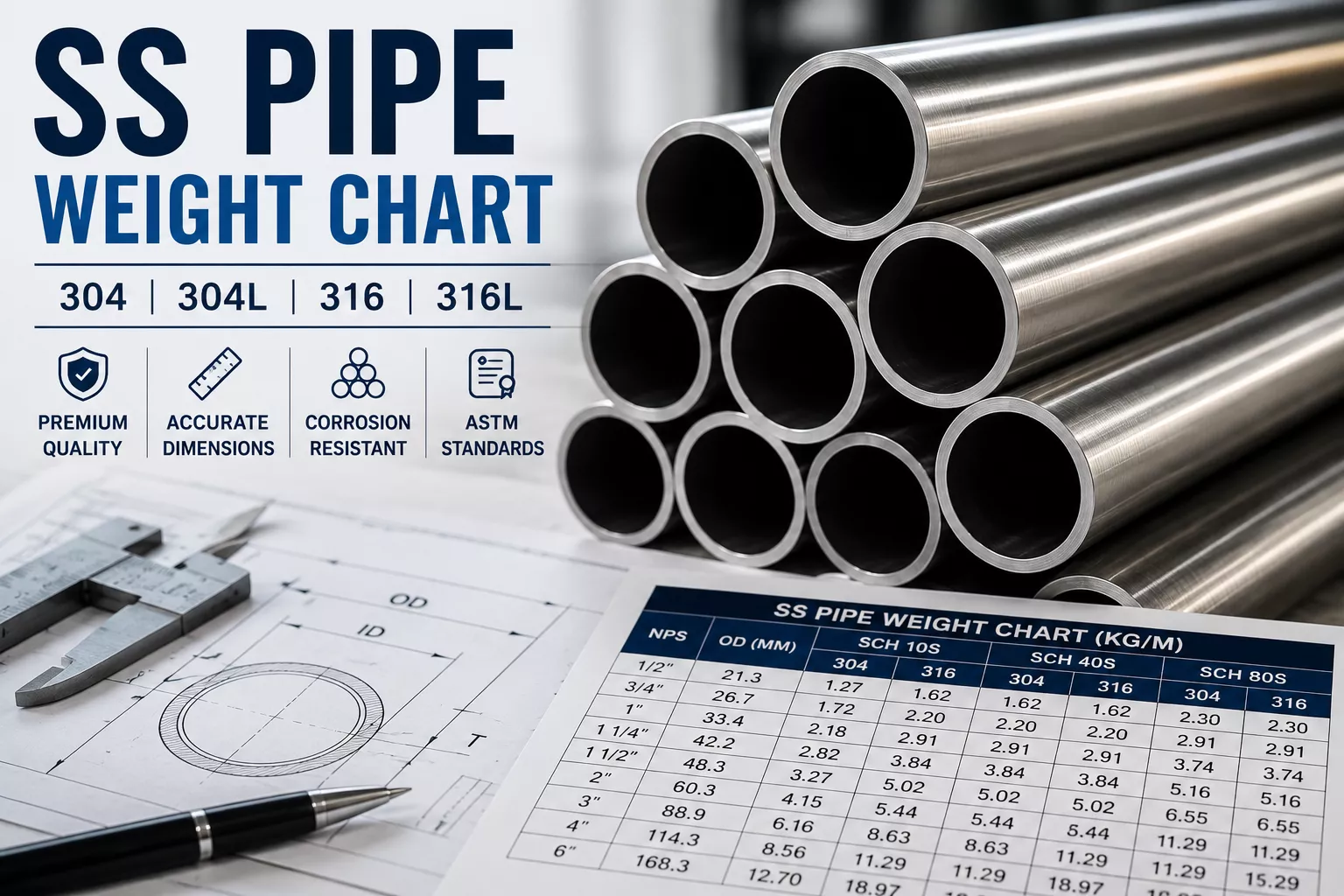
Stainless Steel Pipe Weight
Stainless steel pipe weight per metre can be estimated from the outside diameter, wall thickness and material density. For a general stainless steel calculation, use:
Weight (kg/m) = 0.02491 × T × (OD − T)
In this formula, OD and T are in millimetres. The exact coefficient depends on the density of the stainless steel grade. For example, SS 304 and SS 316 may use a coefficient close to 0.0249 when a density of approximately 7.93 to 8.00 g/cm³ is assumed.
To calculate total pipe weight:
Total Weight (kg) = Weight per Metre (kg/m) × Length (m)
| Input | Example |
|---|---|
| Outside diameter | 60.3 mm |
| Wall thickness | 3.91 mm |
| Material | Stainless steel |
| Length | 6 m |
What Is a Stainless Steel Pipe Weight Chart?
A stainless steel pipe weight chart is a reference table showing the theoretical weight of pipe according to nominal size, outside diameter, wall thickness, schedule, length and material density.
Pipe weight is normally expressed as kilograms per metre (kg/m) or pounds per foot (lb/ft). For the same outside diameter, increasing the wall thickness generally increases the amount of stainless steel material and therefore the pipe weight.
Weight charts support material estimation, transport planning, handling, inventory control and preliminary project costing. They should not replace the certified weight or dimensional information supplied with the pipe.
| Parameter | Importance in Pipe Weight |
|---|---|
| Nominal Pipe Size | Identifies the standard pipe size and corresponding dimensions. |
| Outside Diameter | Influences the amount of stainless steel material used in the pipe. |
| Wall Thickness | A greater wall thickness generally results in higher pipe weight. |
| Schedule | Indicates the standardized wall thickness range for a given pipe size. |
| Pipe Length | Determines the total weight of the required pipe quantity. |
| Material Density | Grade-dependent density used to select the appropriate calculation coefficient. |
Stainless Steel Pipe Weight Calculator
Enter the outside diameter, wall thickness, pipe length and material density to estimate stainless steel pipe weight per metre and total weight.
Stainless Steel Pipe Weight Formula
The general stainless steel pipe weight formula uses outside diameter, wall thickness and material density:
Weight (kg/m) = π × [OD2 − (OD − 2T)2] × Density ÷ 4,000,000
When OD and T are in millimetres and density is in kg/m³, the result is weight in kilograms per metre.
A commonly used simplified form is:
Weight (kg/m) = C × T × (OD − T)
Here, C is a material-dependent coefficient. The value 0.02466 is commonly associated with carbon steel at about 7,850 kg/m³. Stainless steel requires a coefficient based on the selected grade density, commonly around 0.0249 to 0.0251 for many austenitic stainless-steel calculations.
| Symbol | Meaning | Unit |
|---|---|---|
| OD | Outside diameter | mm |
| T | Wall thickness | mm |
| Density | Density of the selected stainless steel grade | kg/m³ |
| C | Material-specific calculation coefficient | — |
Total pipe weight is calculated as:
Total Weight (kg) = Weight per Metre (kg/m) × Length (m)
Stainless Steel Pipe Size & Dimensions Chart
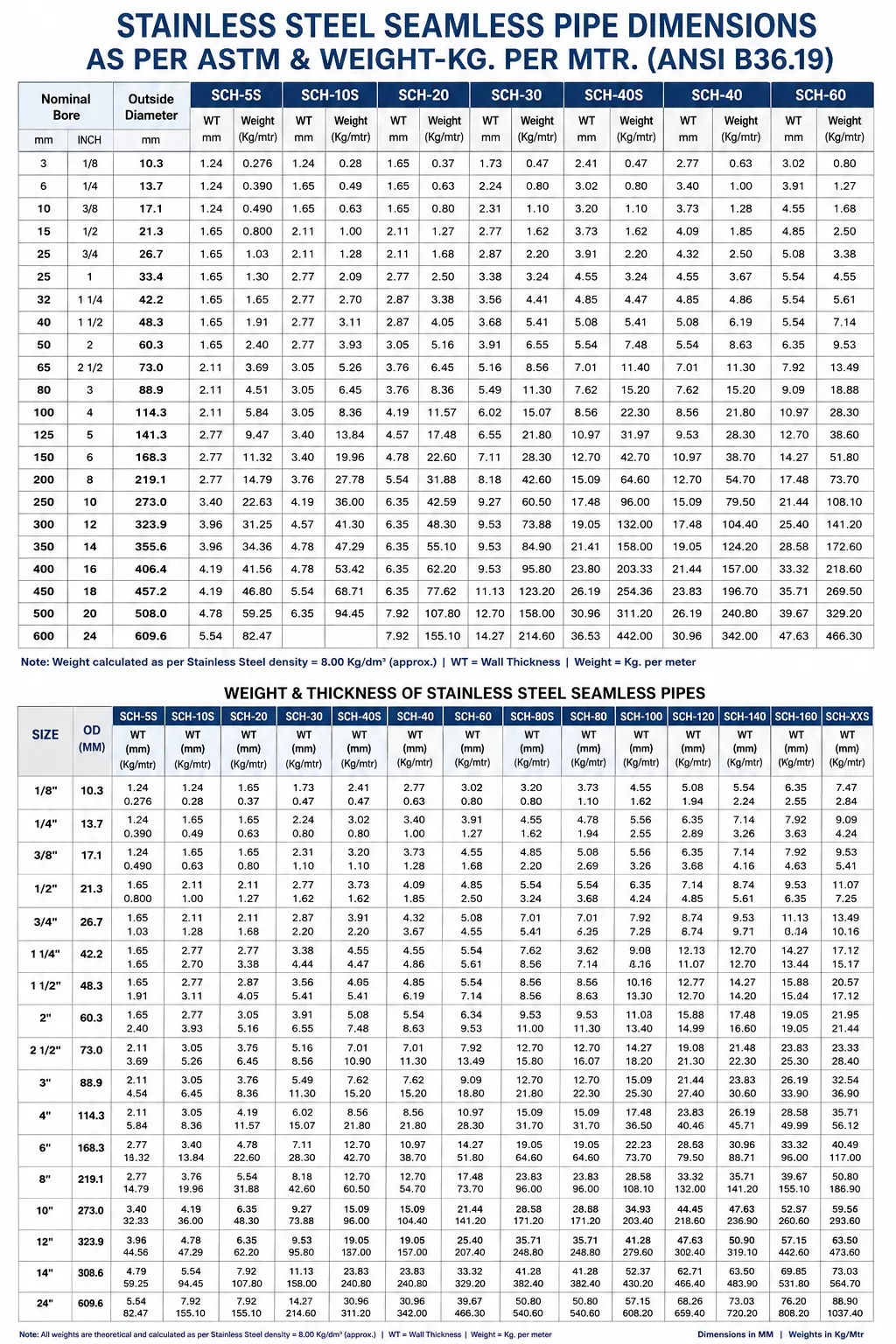
Stainless steel pipe dimensions are generally identified using nominal pipe size (NPS), outside diameter, wall thickness, schedule and length. These dimensions determine the physical size of the pipe and are also important when calculating its theoretical weight.
The nominal pipe size is a standardized designation and does not always represent the actual outside diameter. The actual outside diameter and wall thickness should therefore be checked against the applicable dimensional standard.
| Dimension | Description |
|---|---|
| Nominal Pipe Size (NPS) | Standard designation used to identify the pipe size. |
| Outside Diameter (OD) | Actual diameter measured across the outside surface of the pipe. |
| Wall Thickness | Thickness of the stainless steel pipe wall. |
| Schedule | Standard designation related to pipe wall thickness. |
| Length | Specified length of the individual pipe or total quantity. |
Common stainless steel pipe schedule designations include 5S, 10S, 40S and 80S. Other schedule designations may apply depending on the nominal size and specification. Always verify the exact wall thickness against the applicable dimensional standard.
Stainless Steel Pipe Weight Chart
The following examples show approximate weight per metre for selected pipe sizes and wall thicknesses. Values are calculated using an assumed stainless steel density of 7,930 kg/m³ and should be verified against the selected grade and dimensional standard.
| Nominal Size | OD (mm) | Wall Thickness (mm) | Approx. Weight (kg/m) |
|---|---|---|---|
| 1/2" | 21.3 | 2.77 | 1.28 |
| 1" | 33.4 | 3.38 | 2.68 |
| 2" | 60.3 | 3.91 | 5.54 |
| 3" | 88.9 | 5.49 | 11.52 |
| 4" | 114.3 | 6.02 | 16.38 |
| 6" | 168.3 | 7.11 | 28.77 |
These values are theoretical examples based on the listed dimensions and assumed density. Actual weight may vary with grade, dimensional tolerance, manufacturing condition and supplied length.
Seamless vs Welded Pipe Weight
For weight calculation, outside diameter, wall thickness, length and material density are the main variables. The manufacturing method itself does not automatically make a seamless pipe heavier than a welded pipe.
| Factor | Seamless Pipe | Welded Pipe |
|---|---|---|
| Manufacturing | Produced from a solid billet or hollow billet process | Produced from strip, sheet or plate with a welded seam |
| Weight calculation | Based on OD, wall thickness, length and density | Based on OD, wall thickness, length and density |
| Equivalent dimensions | Theoretical weights are generally comparable when grade, OD, wall thickness and length are equivalent. | |
| Actual supplied weight | May vary because of dimensional tolerances, manufacturing variation and actual length. | |
Stainless Steel Pipe Weight by Schedule
Pipe schedule identifies a wall-thickness series for a particular nominal pipe size. Since weight increases with the amount of metal in the pipe, a thicker schedule generally has a higher theoretical weight.
| Designation | General description | Typical weight effect |
|---|---|---|
| 5S | Light-wall stainless steel pipe series | Generally lower weight |
| 10S | Light-wall stainless steel pipe series | Higher than lighter-wall options |
| 40S | Medium-wall stainless steel pipe series | Higher weight due to greater wall thickness |
| 80S | Heavy-wall stainless steel pipe series | Higher theoretical weight |
Schedule values are size-dependent. Confirm the exact wall thickness from the applicable stainless steel dimensional standard rather than assuming one fixed thickness for every pipe size.
- Stainless Steel Pipe Weight Calculator
- Pipe Schedule Chart
- Stainless Steel 304 Seamless Pipes
- Stainless Steel 304 Seamless Tubes
- Request stainless steel pipe pricing
Stainless Steel Pipe Weight FAQs
The main information required is the outside diameter, wall thickness, pipe length and material density. Pipe size and schedule can be used to identify the outside diameter and wall thickness.
Stainless steel pipe weight per metre can be calculated from the outside diameter, wall thickness and material density. A simplified formula is: Weight (kg/m) = C × T × (OD − T), where C is a coefficient based on the density of the selected stainless steel grade.
Stainless steel pipe weight mainly depends on outside diameter, wall thickness, pipe length and material density. For the same outside diameter, increasing the wall thickness generally increases the weight per metre.
Pipe length changes the total weight but does not change the weight per metre. Total weight is calculated by multiplying weight per metre by the total pipe length. For example, a pipe weighing 8 kg/m would weigh approximately 48 kg over a 6-metre length.
Yes. Schedule identifies a wall-thickness series for a particular nominal pipe size. A heavier schedule generally has a thicker wall and therefore a higher theoretical weight per metre. The exact wall thickness must be checked against the applicable dimensional standard.
When seamless and welded pipes have the same outside diameter, wall thickness, length and stainless steel grade, their theoretical weights are generally similar. The manufacturing method itself is not the main factor in dimensional weight calculation.
Weight charts provide theoretical values. Actual supplied weight may vary because of dimensional tolerances, manufacturing variation, material density, surface condition and actual pipe length.
A general chart can be used for estimation, but accurate calculations should consider the density of the selected grade. SS 304, SS 316 and other grades may have slightly different densities.
Kilograms per metre, written as kg/m, is the theoretical weight of one metre of pipe. Total pipe weight is calculated by multiplying the kg/m value by the required length.
A stainless steel pipe size chart provides dimensions such as nominal size, outside diameter, wall thickness and schedule. A weight chart uses these dimensions and material density to estimate pipe weight.