
-
-
-
Girgaon, Mumbai - 400004
Pipe Schedule Chart
Pipe Schedule Chart: Complete Guide to Pipe Dimensions, Wall Thickness, OD, ID & Weight
At Kamal Steels, we supply a comprehensive range of stainless steel, carbon steel, alloy steel, duplex and nickel alloy pipes for industrial applications worldwide. Selecting the correct pipe schedule is a critical part of any piping system, as it directly influences wall thickness, pressure handling capability, flow characteristics, durabilit and overall project performance.
A Pipe Schedule Chart serves as a valuable reference for engineers, contractors, fabricators and procurement professionals by providing detailed information on pipe sizes, outside diameter (OD), inside diameter (ID), wall thickness and weight. Understanding these dimensions helps ensure proper material selection and compliance with project specifications across industries such as oil & gas, petrochemical, power generation, chemical processing, water treatment, marine and infrastructure.
This guide covers standard pipe schedules, dimensional data, thickness classifications and industry standards used for stainless steel and carbon steel pipes. Whether you are comparing Schedule 10, Schedule 40, Schedule 80, or higher schedules, this resource will help you identify the most suitable pipe specification for your application.
Request a Quote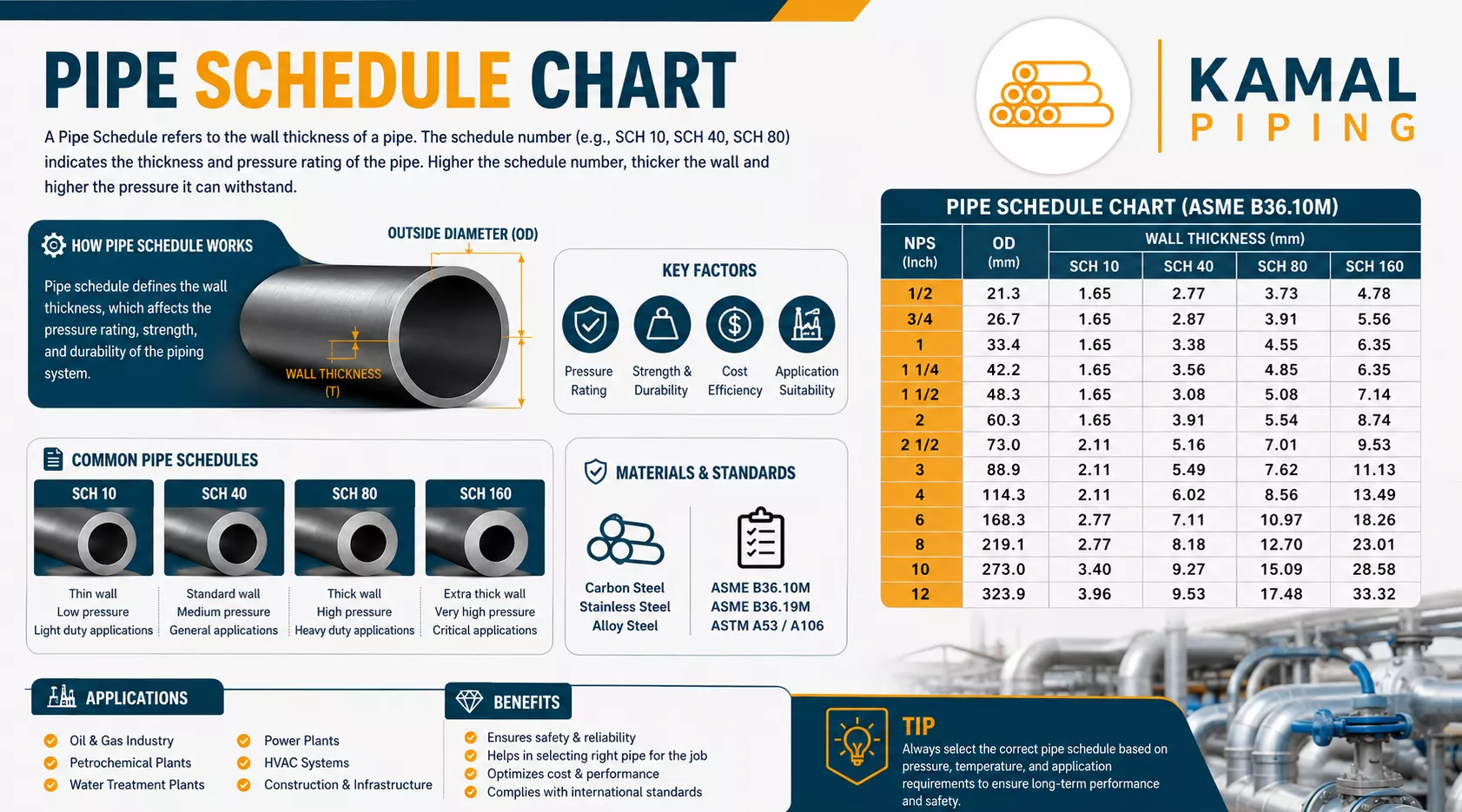
What Is a Pipe Schedule?
A pipe schedule is a standardized system used to define the wall thickness of a pipe. The schedule number does not represent an exact measurement but indicates the relative thickness of the pipe wall for a given Nominal Pipe Size (NPS). Common schedule numbers include Schedule 5, Schedule 10, Schedule 20, Schedule 40, Schedule 80, Schedule 120, and Schedule 160.
Pipe schedules are established by industry standards such as ASME B36.10M and ASME B36.19M to ensure consistency in dimensions, pressure ratings, and performance across different piping systems. Engineers, fabricators and procurement teams use pipe schedules to select the appropriate pipe for specific operating conditions.
Purpose of a Pipe Schedule
The primary purpose of a pipe schedule is to specify wall thickness while maintaining a standard outside diameter (OD) for each pipe size. By varying the wall thickness, manufacturers can produce pipes capable of handling different pressure, temperature and mechanical load requirements.
- Determines pipe wall thickness.
- Helps calculate pressure-handling capability.
- Impacts pipe weight and material cost.
- Ensures compatibility with fittings and flanges.
- Supports compliance with ASME and ASTM standards.
Pipe Schedule Numbering System
As the schedule number increases, the pipe wall becomes thicker. Higher schedule pipes generally provide greater strength and pressure resistance. For example, a Schedule 80 pipe has a thicker wall than a Schedule 40 pipe of the same nominal size.
Although the wall thickness changes with the schedule number, the outside diameter remains constant for the same NPS. The internal diameter decreases as wall thickness increases.
Impact of Pipe Schedule on Strength
Wall thickness directly affects the structural strength and pressure capacity of a pipe. Thicker schedules can withstand higher internal pressures, mechanical stresses and harsh operating conditions. However, they also increase pipe weight and material costs.
| Parameter | Schedule 40 | Schedule 80 |
|---|---|---|
| Outside Diameter (OD) | Same | Same |
| Wall Thickness | Lower | Higher |
| Inside Diameter (ID) | Larger | Smaller |
| Weight | Lower | Higher |
| Pressure Capacity | Lower | Higher |
For example, a 2-inch Schedule 80 pipe has the same outside diameter as a 2-inch Schedule 40 pipe, but its thicker wall reduces the internal diameter while increasing strength, weight and pressure-handling capability.
Pipe Schedule Chart
The following Pipe Schedule Chart provides standard dimensions for commonly used pipe sizes. It includes Nominal Pipe Size (NPS), Outside Diameter (OD), and wall thickness values for Schedule 5, Schedule 10, Schedule 40, Schedule 80, and Schedule 160 pipes.
| NPS | OD (mm) | SCH 5 | SCH 10 | SCH 40 | SCH 80 | SCH 160 |
|---|---|---|---|---|---|---|
| 1/8" | 10.29 | 1.24 | 1.73 | 1.73 | 2.41 | 3.20 |
| 1/4" | 13.72 | 1.65 | 2.24 | 2.24 | 3.02 | 4.78 |
| 3/8" | 17.15 | 1.65 | 2.31 | 2.31 | 3.20 | 4.78 |
| 1/2" | 21.34 | 1.65 | 2.11 | 2.77 | 3.73 | 4.78 |
| 3/4" | 26.67 | 1.65 | 2.11 | 2.87 | 3.91 | 5.56 |
| 1" | 33.40 | 1.65 | 2.77 | 3.38 | 4.55 | 6.35 |
| 1-1/4" | 42.16 | 1.65 | 2.77 | 3.56 | 4.85 | 6.35 |
| 1-1/2" | 48.26 | 1.65 | 2.77 | 3.68 | 5.08 | 7.14 |
| 2" | 60.33 | 1.65 | 2.77 | 3.91 | 5.54 | 8.74 |
| 2-1/2" | 73.03 | 2.11 | 3.05 | 5.16 | 7.01 | 9.53 |
| 3" | 88.90 | 2.11 | 3.05 | 5.49 | 7.62 | 11.13 |
| 4" | 114.30 | 2.11 | 3.05 | 6.02 | 8.56 | 13.49 |
| 5" | 141.30 | 2.77 | 3.40 | 6.55 | 9.53 | 15.88 |
| 6" | 168.28 | 2.77 | 3.40 | 7.11 | 10.97 | 18.26 |
| 8" | 219.08 | 2.77 | 3.76 | 8.18 | 12.70 | 23.01 |
| 10" | 273.05 | 3.40 | 4.19 | 9.27 | 15.09 | 28.58 |
| 12" | 323.85 | 3.96 | 4.57 | 10.31 | 17.48 | 33.32 |
| 14" | 355.60 | 3.96 | 6.35 | 11.13 | 19.05 | 35.71 |
| 16" | 406.40 | 4.19 | 6.35 | 12.70 | 21.44 | 40.49 |
| 18" | 457.20 | 4.19 | 6.35 | 14.27 | 23.83 | 46.02 |
| 20" | 508.00 | 4.78 | 6.35 | 15.09 | 26.19 | 50.01 |
| 24" | 609.60 | 5.54 | 6.35 | 17.48 | 30.96 | 59.54 |
Wall thickness values are shown in millimeters (mm). For exact dimensions and tolerances, refer to ASME B36.10M and ASME B36.19M standards.
Need Pipes in SCH 5, SCH 10, SCH 40, SCH 80 or SCH 160?
Kamal Steels supplies Stainless Steel, Carbon Steel, Alloy Steel and Duplex Steel Pipes in all standard schedules, sizes and grades with ready stock availability.
Request a Free QuotePipe Schedule Number Explained
A pipe schedule number is a standardized designation used to indicate the wall thickness of a pipe. Common schedule numbers include Schedule 5, Schedule 10, Schedule 20, Schedule 40, Schedule 80, Schedule 120, and Schedule 160. As the schedule number increases, the pipe wall becomes thicker, resulting in higher strength, greater pressure resistance, and increased weight.
The schedule number itself is not a direct measurement of wall thickness. Instead, the actual thickness varies depending on the Nominal Pipe Size (NPS). For example, the wall thickness of a 2-inch Schedule 40 pipe is different from that of a 6-inch Schedule 40 pipe.
How Pipe Schedule Numbers Affect Pipe Dimensions
For a given NPS, the outside diameter (OD) remains constant regardless of the schedule. However, increasing the schedule number increases wall thickness and reduces the inside diameter (ID).
| Pipe Schedule | Wall Thickness | Pressure Rating | Weight | Typical Applications |
|---|---|---|---|---|
| Schedule 5 | Very Thin | Low | Light | Food Processing, Pharmaceutical, Low Pressure Systems |
| Schedule 10 | Thin | Moderate | Light | Water Lines, Chemical Processing, Utility Piping |
| Schedule 20 | Medium Thin | Moderate | Medium | Industrial Utilities, Process Services |
| Schedule 40 | Medium | High | Medium | General Industrial Piping, Oil & Gas, Construction |
| Schedule 80 | Thick | Very High | Heavy | High Pressure Systems, Petrochemical Plants |
| Schedule 120 | Very Thick | Extremely High | Very Heavy | Power Plants, Critical Process Piping |
| Schedule 160 | Extra Thick | Maximum | Extremely Heavy | High Pressure & High Temperature Applications |
The selection of pipe schedule depends on operating pressure, temperature, corrosion allowance, fluid type, and project specifications. Engineers typically select higher schedules for demanding environments such as oil & gas, petrochemical, power generation, and high-pressure process plants.
Pipe Schedule Comparison Chart
The chart below illustrates how pipe wall thickness generally increases as the schedule number rises. Higher schedules provide greater pressure resistance, mechanical strength and durability, while also increasing pipe weight and reducing the internal diameter.
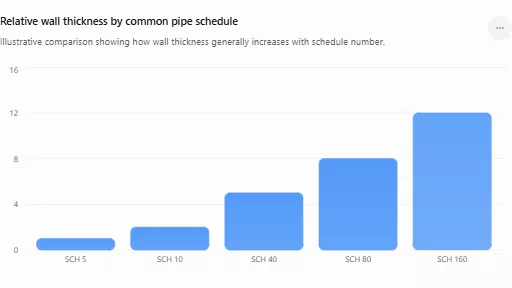
As shown above, Schedule 5 and Schedule 10 pipes have relatively thin walls and are commonly used in low-pressure applications. Schedule 40 is the industry standard for general-purpose piping, while Schedule 80 and Schedule 160 pipes are preferred for high-pressure and heavy-duty industrial services.
Pipe Weight Chart
The following pipe weight chart shows the approximate weight per meter for commonly used Schedule 40 steel pipes. Actual weights may vary depending on material grade, manufacturing standard, and tolerance requirements.
| NPS | OD (mm) | Wall Thickness (mm) | Weight (kg/m) |
|---|---|---|---|
| 1/2" | 21.34 | 2.77 | 1.27 |
| 3/4" | 26.67 | 2.87 | 1.69 |
| 1" | 33.40 | 3.38 | 2.50 |
| 1-1/4" | 42.16 | 3.56 | 3.39 |
| 1-1/2" | 48.26 | 3.68 | 4.05 |
| 2" | 60.33 | 3.91 | 5.44 |
| 2-1/2" | 73.03 | 5.16 | 8.63 |
| 3" | 88.90 | 5.49 | 11.29 |
| 4" | 114.30 | 6.02 | 16.07 |
| 6" | 168.28 | 7.11 | 28.26 |
| 8" | 219.08 | 8.18 | 42.55 |
| 10" | 273.05 | 9.27 | 60.32 |
| 12" | 323.85 | 10.31 | 79.72 |
Calculate Pipe Weight Instantly
Use our Pipe Weight Calculator to determine pipe weight based on OD, wall thickness, material and length.
Use Pipe Weight CalculatorUnderstanding NPS, OD, ID & Wall Thickness
Understanding pipe dimensions is essential when selecting the correct pipe size and schedule for industrial applications. Four key terms are commonly used in piping standards: Nominal Pipe Size (NPS), Outside Diameter (OD), Inside Diameter (ID), and Wall Thickness.
Nominal Pipe Size (NPS)
Nominal Pipe Size (NPS) is a standardized designation used to identify pipe sizes. Although called a "size," NPS is not always equal to the actual outside or inside diameter of the pipe. It serves as a reference system that helps standardize pipe dimensions, fittings, valves, and flanges across the industry.
For example, a 2-inch NPS pipe has an actual outside diameter of 2.375 inches (60.33 mm), regardless of its schedule.
Outside Diameter (OD)
Outside Diameter (OD) is the actual measurement across the outside surface of a pipe. The OD remains constant for a given NPS, even when the schedule number changes. This allows fittings and flanges to remain compatible across different pipe schedules.
For instance, both a 2-inch Schedule 40 pipe and a 2-inch Schedule 80 pipe have the same outside diameter of 60.33 mm.
Inside Diameter (ID)
Inside Diameter (ID) is the diameter of the open flow area inside the pipe. Unlike OD, the ID changes as wall thickness changes. Pipes with thicker walls have a smaller internal diameter, which affects flow capacity.
Wall Thickness
Wall thickness is the distance between the outer surface and inner surface of the pipe. It is determined by the pipe schedule and directly impacts pressure rating, strength, durability, and weight.
Higher schedule pipes such as Schedule 80 and Schedule 160 have thicker walls and can withstand higher operating pressures than lower schedules such as Schedule 5 or Schedule 10.
ID = OD − (2 × Wall Thickness)
Example:
OD = 60.33 mm
Wall Thickness = 3.91 mm
ID = 60.33 − (2 × 3.91) = 52.51 mm
| Parameter | Description | Importance |
|---|---|---|
| NPS | Nominal Pipe Size designation | Standardizes pipe selection |
| OD | Outside Diameter | Determines fitting compatibility |
| ID | Inside Diameter | Affects flow capacity |
| Wall Thickness | Pipe wall measurement | Determines pressure rating and strength |
Pipe Schedule vs Wall Thickness
Pipe schedule and wall thickness are directly related. As the schedule number increases, the pipe wall becomes thicker. This increases pressure resistance and strength while reducing the internal diameter and increasing pipe weight.
| Characteristic | Lower Schedule (SCH 5 / SCH 10) | Higher Schedule (SCH 80 / SCH 160) |
|---|---|---|
| Outside Diameter (OD) | Same | Same |
| Wall Thickness | Thinner | Thicker |
| Inside Diameter (ID) | Larger | Smaller |
| Pressure Capacity | Lower | Higher |
| Mechanical Strength | Lower | Higher |
| Weight | Lighter | Heavier |
| Material Cost | Lower | Higher |
For the same Nominal Pipe Size (NPS), the outside diameter remains unchanged across all schedules. The primary difference is the wall thickness, which affects the pipe's internal diameter, weight, and pressure rating.
Pressure Rating & Pipe Schedule Relationship
Pipe schedule and pressure rating are closely related. In general, pipes with higher schedule numbers have thicker walls, enabling them to withstand higher internal pressures. However, pressure rating is not determined by pipe schedule alone. Factors such as material grade, operating temperature, pipe size, and applicable design codes also affect the maximum allowable pressure.
For the same Nominal Pipe Size (NPS) and material, a Schedule 80 pipe can typically handle higher pressure than a Schedule 40 pipe because of its greater wall thickness. Similarly, Schedule 160 pipes are designed for more demanding high-pressure applications.
| Pipe Schedule | Relative Wall Thickness | Pressure Capability | Typical Service |
|---|---|---|---|
| SCH 5 | Very Thin | Low | Low Pressure Systems |
| SCH 10 | Thin | Moderate | Utility & Process Piping |
| SCH 40 | Medium | High | General Industrial Applications |
| SCH 80 | Thick | Very High | High Pressure Systems |
| SCH 120 | Very Thick | Extremely High | Power & Process Plants |
| SCH 160 | Extra Thick | Maximum | Critical High Pressure Service |
ASME B36.10M Pipe Dimensions
ASME B36.10M is the standard covering welded and seamless wrought steel pipe dimensions. It includes carbon steel, alloy steel, and mild steel pipes in schedules such as SCH 10, SCH 20, SCH 40, SCH 80, SCH 120 and SCH 160.
The standard defines outside diameter (OD), wall thickness, and dimensional tolerances for NPS pipe sizes used in industrial piping systems worldwide.
ASME B36.19M Stainless Steel Pipe Dimensions
ASME B36.19M covers stainless steel pipe dimensions and schedules including SCH 5S, SCH 10S, SCH 40S, and SCH 80S. The standard is commonly used for grades such as 304, 304L, 316, 316L, 321, and 347H stainless steel pipes.
Compared to ASME B36.10M, this standard focuses specifically on corrosion-resistant stainless steel piping systems used in chemical, pharmaceutical, food processing, and marine industries.
Pipe Material Selection Guide
| Material | Key Benefits | Common Applications |
|---|---|---|
| Carbon Steel | High Strength, Cost Effective | Oil & Gas, Power Plants |
| Stainless Steel | Corrosion Resistance | Chemical, Food Processing |
| Mild Steel | Easy Fabrication | Construction, Water Lines |
| Duplex Steel | High Strength & Corrosion Resistance | Marine, Offshore |
| Alloy Steel | High Temperature Resistance | Refineries, Boilers |
Industry Applications
Pipe schedules are used across a wide range of industries to ensure safe operation under varying pressure and temperature conditions.
| Industry | Common Pipe Schedules | Applications |
|---|---|---|
| Oil & Gas Industry | SCH 40, SCH 80, SCH 160 | Process & Transmission Pipelines |
| Petrochemical Industry | SCH 40, SCH 80 | Chemical Processing Systems |
| Power Plant Industry | SCH 80, SCH 120, SCH 160 | Steam & Boiler Piping |
| Water Treatment | SCH 10, SCH 40 | Water Distribution Systems |
| Food & Beverage | SCH 5S, SCH 10S | Sanitary Process Piping |
| Petrochemical Industry | SCH 5S, SCH 10S | Clean Process Systems |
About Kamal Steels
Kamal Steels is a trusted supplier, stockist and exporter of stainless steel pipes, carbon steel pipes, alloy steel pipes, duplex steel pipes, fittings, flanges and industrial piping products. We provide high-quality materials manufactured according to international standards including ASTM, ASME and API specifications.
With extensive industry experience and a commitment to quality, Kamal Steels serves customers across oil & gas, petrochemical, power generation, water treatment, marine, pharmaceutical and construction industries worldwide.
Our product range includes seamless pipes, welded pipes, tubes, fittings, flanges and piping accessories available in various grades, sizes and schedules to meet diverse project requirements.
Need Help Selecting the Right Pipe Schedule?
Our technical team can help you choose the correct pipe schedule based on pressure, temperature and application requirements.
Talk to Our ExpertsFrequently Asked Questions About Pipe Schedule Charts
A pipe schedule is a standardized designation used to indicate the wall thickness of a pipe. Common schedules include SCH 5, SCH 10, SCH 40, SCH 80, SCH 120 and SCH 160.
SCH stands for Schedule and represents the wall thickness category of a pipe. Higher schedule numbers generally indicate thicker pipe walls.
Schedule 80 pipe has a thicker wall than Schedule 40 pipe. While both have the same outside diameter (OD), Schedule 80 provides higher pressure resistance and a smaller inside diameter (ID).
The correct pipe schedule depends on operating pressure, temperature, fluid type, material grade and design code requirements. Higher pressure applications generally require thicker wall schedules.
Yes. Higher schedule pipes typically have thicker walls and can withstand greater internal pressure. However, pressure rating also depends on pipe material, size and operating temperature.
Schedule 40 is the most widely used pipe schedule in industrial, commercial and construction applications because it offers a balance between strength, cost and availability.
Pipe Schedule Charts are generally based on ASME B36.10M for carbon steel and alloy steel pipes and ASME B36.19M for stainless steel pipes.
You can refer to the Pipe Schedule Chart on this page to find NPS, outside diameter (OD), wall thickness and schedule dimensions for commonly used pipe sizes.
Pipe weight can be calculated using pipe size, wall thickness, material density and pipe length. You can also use our Pipe Weight Calculator for quick and accurate results.
Kamal Steels supplies stainless steel, carbon steel, alloy steel and duplex steel pipes in various schedules, sizes and grades with worldwide delivery and competitive pricing.
Looking for Industrial Pipes & Tubes?
Kamal Steels is a leading supplier and exporter of Stainless Steel Pipes, Carbon Steel Pipes, Alloy Steel Pipes, Duplex Steel Pipes, Tubes, Fittings and Flanges in various sizes and schedules.
Get Latest Price