
-
-
-
Girgaon, Mumbai - 400004
Stainless Steel Pipe Size Chart in mm and Inches
Use This Stainless Steel Pipe Size Chart To Compare Common Pipe Sizes, Nominal Pipe Size (NPS), Nominal Bore (NB), Outside Diameter (OD), Inside Diameter (ID), Wall Thickness And Schedule In Millimetres And Inches.
A 2-Inch Stainless Steel Pipe Has A Standard Outside Diameter Of 60.3 Mm (2.375 Inches). Its Inside Diameter Depends On The Selected Wall Thickness Or Schedule.
For Final Selection, Confirm The Stainless Steel Grade, Pipe Type, Dimensional Standard, Schedule, Pressure Design, Operating Temperature, Quantity And Required Length.
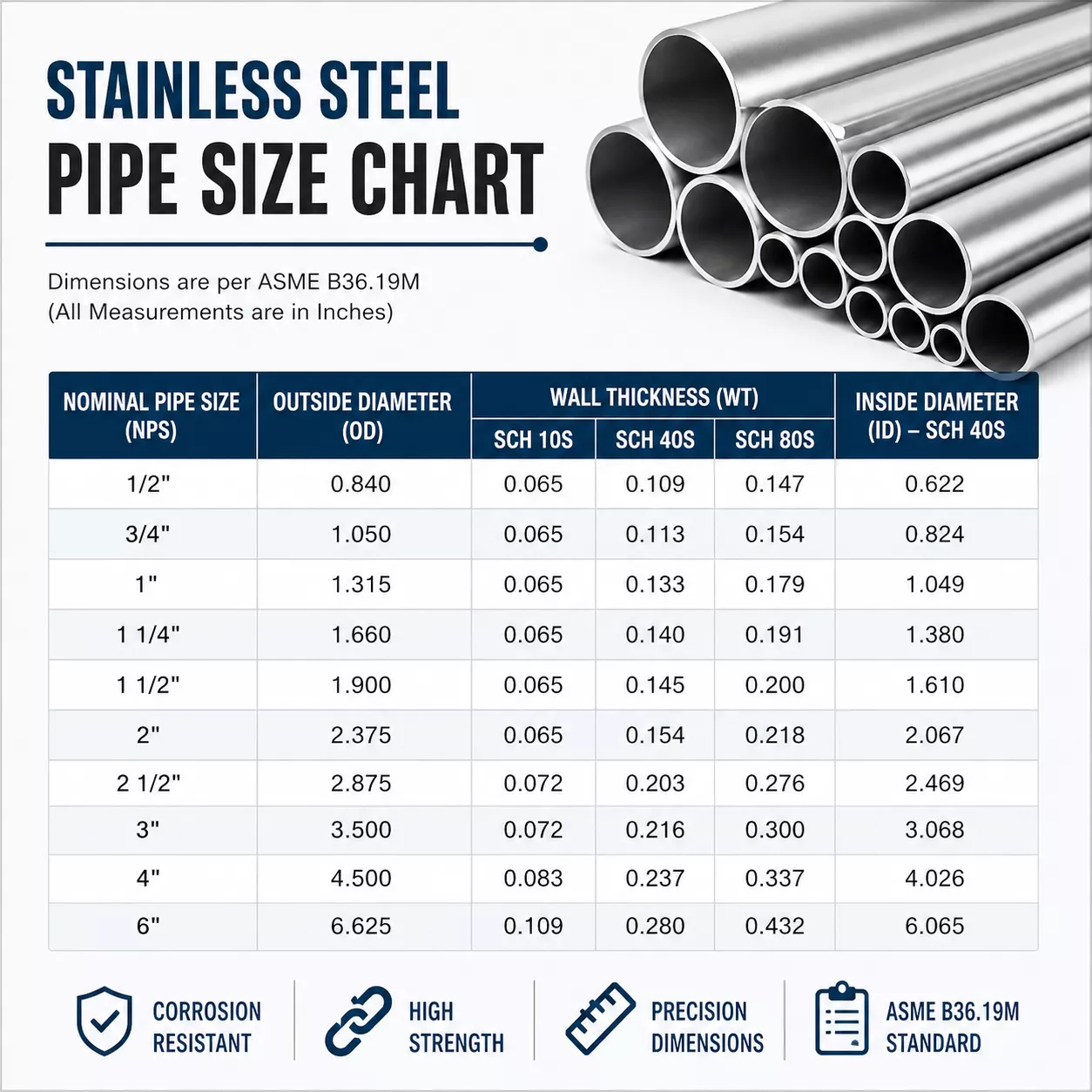
Stainless Steel Pipe NB Size Chart in mm
Stainless steel pipe sizes are commonly identified using nominal pipe size (NPS) or nominal bore (NB). The standard outside diameter (OD) is fixed for each nominal pipe size, while the inside diameter (ID) changes according to the selected wall thickness or schedule.
| NPS | NB / DN | Standard OD | Common stainless schedules |
|---|---|---|---|
| 1/2 inch | 15 | 21.3 mm / 0.840 inch | 5S, 10S, 40S, 80S |
| 1 inch | 25 | 33.4 mm / 1.315 inches | 5S, 10S, 40S, 80S |
| 2 inches | 50 | 60.3 mm / 2.375 inches | 5S, 10S, 40S, 80S |
| 4 inches | 100 | 114.3 mm / 4.500 inches | 5S, 10S, 40S, 80S |
| 8 inches | 200 | 219.1 mm / 8.625 inches | 5S, 10S, 40S, 80S |
| 12 inches | 300 | 323.9 mm / 12.750 inches | 5S, 10S, 40S, 80S |
The values above are common reference dimensions. Always check the complete size, schedule, material specification and applicable standard before ordering.
What Is a Stainless Steel Pipe Size Chart?
A stainless steel pipe size chart is a dimensional reference showing how pipe sizes are identified and measured. It may include nominal pipe size (NPS), nominal bore (NB), nominal diameter (DN), outside diameter (OD), inside diameter (ID), wall thickness, schedule and nominal weight.
Nominal size is a standardized designation and should not be treated as the exact measured outside or inside diameter. For example, a 2-inch pipe has a standard OD of 60.3 mm, rather than 50.8 mm.
The correct chart helps engineers, fabricators, contractors, procurement teams and buyers compare pipe dimensions, check fitting compatibility and prepare technical purchase specifications.
Stainless Steel Pipe Size Chart in mm and Inches
The table below shows common stainless steel pipe nominal sizes, NB or DN designations and standard outside diameters. The OD remains standardized for a nominal size, while the ID changes with wall thickness.
| NPS / Nominal Size | NB / DN | Pipe Size | Outside Diameter (mm) | Outside Diameter (inches) |
|---|---|---|---|---|
| 1/2 inch | 15 | 1/2" | 21.3 | 0.840" |
| 3/4 inch | 20 | 3/4" | 26.7 | 1.050" |
| 1 inch | 25 | 1" | 33.4 | 1.315" |
| 1-1/4 inch | 32 | 1-1/4" | 42.2 | 1.660" |
| 1-1/2 inch | 40 | 1-1/2" | 48.3 | 1.900" |
| 2 inch | 50 | 2" | 60.3 | 2.375" |
| 2-1/2 inch | 65 | 2-1/2" | 73.0 | 2.875" |
| 3 inch | 80 | 3" | 88.9 | 3.500" |
| 4 inch | 100 | 4" | 114.3 | 4.500" |
| 5 inch | 125 | 5" | 141.3 | 5.563" |
| 6 inch | 150 | 6" | 168.3 | 6.625" |
| 8 inch | 200 | 8" | 219.1 | 8.625" |
| 10 inch | 250 | 10" | 273.1 | 10.750" |
| 12 inch | 300 | 12" | 323.9 | 12.750" |
| 14 inch | 350 | 14" | 355.6 | 14.000" |
| 16 inch | 400 | 16" | 406.4 | 16.000" |
| 18 inch | 450 | 18" | 457.2 | 18.000" |
| 20 inch | 500 | 20" | 508.0 | 20.000" |
| 24 inch | 600 | 24" | 609.6 | 24.000" |
This table provides nominal sizes and standard outside diameters. It does not provide a single inside diameter for each size because the ID depends on the selected schedule or wall thickness.
Stainless Steel Pipe NB, OD and ID
NB means nominal bore, OD means outside diameter and ID means inside diameter. These terms describe different aspects of pipe identification and measurement.
- NB: A nominal designation used to identify pipe size.
- DN: A nominal diameter designation used in metric pipe specifications and standards.
- OD: The actual outside diameter of the pipe.
- ID: The internal opening available for fluid flow.
The nominal ID can be calculated using:
ID = OD − (2 × wall thickness)
| Pipe Size | NB / DN | OD (mm) | Wall Thickness (mm) | Calculated ID (mm) |
|---|---|---|---|---|
| 1/2" | 15 | 21.3 | 2.11 | 17.08 |
| 1" | 25 | 33.4 | 2.77 | 27.86 |
| 2" | 50 | 60.3 | 3.91 | 52.48 |
| 3" | 80 | 88.9 | 5.49 | 77.92 |
| 4" | 100 | 114.3 | 6.02 | 102.26 |
| 6" | 150 | 168.3 | 7.11 | 154.08 |
| 8" | 200 | 219.1 | 8.18 | 202.74 |
NB, NPS and DN are nominal size designations. They should not be treated as direct measurements of the actual pipe bore or outside diameter. For example, 50 NB corresponds to NPS 2 and has a standard OD of 60.3 mm for standard stainless steel pipe dimensions.
Stainless Steel Pipe Diameter Chart
A stainless steel pipe diameter chart helps identify the standard outside diameter corresponding to a nominal pipe size. This is particularly useful when checking pipe compatibility with fittings, valves, flanges, equipment and existing piping.
| Nominal Pipe Size | NB | Outside Diameter (mm) |
|---|---|---|
| 1/2" | 15 NB | 21.3 |
| 1" | 25 NB | 33.4 |
| 2" | 50 NB | 60.3 |
| 3" | 80 NB | 88.9 |
| 4" | 100 NB | 114.3 |
| 6" | 150 NB | 168.3 |
| 8" | 200 NB | 219.1 |
| 10" | 250 NB | 273.1 |
| 12" | 300 NB | 323.9 |
Stainless Steel Pipe Schedule and Wall Thickness
Pipe schedule identifies a standardized wall-thickness series. For a given nominal pipe size, a heavier schedule generally has a thicker wall and a smaller internal diameter. The standard outside diameter normally remains the same for that nominal size.
Common stainless steel schedule designations include 5S, 10S, 40S and 80S. Exact values depend on nominal size and the applicable dimensional standard.
Stainless steel pipe dimensions are commonly checked against ASME B36.19M, which covers welded and seamless wrought stainless steel pipe. Do not assume that a carbon-steel schedule table under ASME B36.10M has identical values for every stainless steel pipe size.
| Pipe Size | Schedule | Wall Thickness (mm) | OD (mm) |
|---|---|---|---|
| 1 inch | 10S | 2.77 | 33.4 |
| 1 inch | 40S | 3.38 | 33.4 |
| 2 inches | 10S | 2.77 | 60.3 |
| 2 inches | 40S | 3.91 | 60.3 |
| 2 inches | 80S | 5.54 | 60.3 |
| 4 inches | 10S | 3.05 | 114.3 |
| 4 inches | 40S | 6.02 | 114.3 |
Verify schedule and wall-thickness values against the latest approved dimensional reference before using them for design, pressure calculations or procurement.
Stainless Steel Pipe Dimensions Chart
Stainless steel pipe dimensions include nominal size, NB or DN, OD, ID, wall thickness, schedule, length and nominal weight. The following table shows how each dimension is used.
| Dimension | Meaning | Why It Matters |
|---|---|---|
| Nominal pipe size | Standard pipe size designation | Identifies the pipe size |
| NPS | Nominal Pipe Size | Commonly used in inch-based specifications |
| NB / DN | Nominal Bore / Nominal Diameter | Used for nominal pipe identification |
| OD | Outside Diameter | Important for fittings, flanges and connections |
| ID | Inside Diameter | Influences flow area |
| Wall thickness | Thickness of the pipe wall | Influences ID, weight and pressure design |
| Schedule | Wall-thickness designation | Helps specify the required pipe wall |
| Length | Overall pipe length | Important for quantity and installation planning |
| Nominal weight | Approximate mass per unit length | Useful for transport, supports and quantity estimation |
Stainless Steel Pipe Size Conversion: Inches to mm
Nominal pipe sizes are often written in inches, while actual outside diameter and wall thickness are usually shown in millimetres. Nominal size should not simply be multiplied by 25.4 to determine the actual pipe OD.
| Nominal Pipe Size | NB / DN | Actual OD (mm) |
|---|---|---|
| 1/2" | 15 | 21.3 |
| 3/4" | 20 | 26.7 |
| 1" | 25 | 33.4 |
| 1-1/2" | 40 | 48.3 |
| 2" | 50 | 60.3 |
| 3" | 80 | 88.9 |
| 4" | 100 | 114.3 |
| 6" | 150 | 168.3 |
| 8" | 200 | 219.1 |
For example, 2 inches multiplied by 25.4 equals 50.8 mm, but the standardized outside diameter of NPS 2 pipe is 60.3 mm. This is why a standard pipe chart should be used instead of a simple unit conversion.
How to Read a Stainless Steel Pipe Size Chart
Read the nominal size, OD, schedule and wall thickness together. Do not use the nominal size alone to estimate the actual bore or flow area.
For example, a requirement for a 2-inch stainless steel pipe, Schedule 40S means:
- 2 inch: Nominal pipe size.
- 50 NB / DN 50: Nominal size designation.
- 60.3 mm: Standard outside diameter.
- 40S: Stainless steel schedule designation.
- 3.91 mm: Nominal wall thickness for the selected size and schedule.
- ID: Calculated from OD and wall thickness.
The final purchase description should also identify the stainless steel grade, pipe type, applicable product specification, length, quantity, end finish and testing or certification requirements.
How to Choose the Right Stainless Steel Pipe Size
Selecting a stainless steel pipe size requires more than matching an inch or NB designation. Consider the service conditions, required flow, connections, material grade and applicable engineering standard.
- Flow rate: Select an appropriate internal diameter for the required flow and allowable pressure loss.
- Operating pressure: Confirm the required wall thickness and schedule through the applicable design code.
- Operating temperature: Check the temperature limits and material properties for the application.
- Material grade: Select SS 304, SS 316L, duplex or another grade according to corrosion, temperature and service requirements.
- Pipe type: Specify seamless or welded construction where required by the design or product specification.
- Connections: Match the OD and wall details with fittings, valves, flanges and equipment.
- Standard: Confirm the applicable dimensional and material standards before ordering.
- Installation: Consider pipe weight, supports, available space, bending, fabrication and handling.
When requesting a quotation, provide the stainless steel grade, NPS or NB size, schedule or wall thickness, seamless or welded type, applicable standard, quantity and required length.
- Stainless Steel Pipe Weight Chart
- Stainless Steel Pipe Thickness Chart
- SS 304 Seamless Tubes
- SS 316L Seamless Pipes
- Request Stainless Steel Pipe Sizes and Pricing
Request Stainless Steel Pipe Sizes and Pricing
Kamal Steels supplies stainless steel pipes in different grades, sizes, schedules and specifications. Send your required grade, size, schedule, pipe type, quantity and length to confirm availability and receive technical and commercial details.
Request a QuoteStainless Steel Pipe Size FAQs
A stainless steel pipe size chart shows nominal pipe size, NB or DN, outside diameter, inside diameter, wall thickness, schedule and other dimensional information used to identify stainless steel pipe.
A 2-inch nominal stainless steel pipe has a standard outside diameter of 60.3 mm, or 2.375 inches. The inside diameter depends on wall thickness and schedule.
NB means nominal bore. It is a nominal pipe-size designation and should not be treated as the exact measured inside diameter.
OD is the outside diameter measured across the external surface of the pipe. ID is the internal diameter. The ID changes when wall thickness or schedule changes.
Schedule identifies a wall-thickness series. For a particular nominal size, a thicker wall generally reduces the internal diameter while the standard outside diameter remains the same.
SS 304 and SS 316 pipe can use the same dimensional chart when the applicable pipe specification and dimensional standard are the same. The grade changes the material properties and chemical composition, not the nominal size designation.
Consider flow rate, pressure, temperature, wall thickness, material grade, pipe type, connections, applicable standards, installation requirements and required length. Confirm the final selection with the project engineer or qualified supplier.
Kamal Steels supplies stainless steel pipes in different grades, sizes, schedules and specifications. Buyers can submit the required grade, size, schedule, quantity and standard through the quotation page.