
-
-
-
Girgaon, Mumbai - 400004
Pipe Thickness Chart
Standard Pipe Thickness Chart
At Kamal Steels, our Pipe Thickness Chart helps engineers, contractors, fabricators and buyers quickly identify the standard wall thickness of steel pipes based on nominal pipe size (NB), outside diameter (OD) and pipe schedule. Whether you're selecting pipes for construction, industrial processing, oil & gas, or structural applications, this chart provides a reliable reference for choosing the correct pipe dimensions.
This guide includes standard Pipe Wall Thickness Charts for popular schedules such as Schedule 10, Schedule 20, Schedule 40, Schedule 80 and Schedule 160. You'll also find information on pipe dimensions in millimeters, wall thickness comparisons and standard pipe sizes to simplify material selection, fabrication and engineering calculations.
Use this Pipe Thickness Chart to compare wall thickness across different pipe schedules, understand the relationship between OD, NB and schedule numbers and select the most suitable pipe for your project requirements. As a trusted Manufacturer and Stockist Kamal Steels provides high-quality steel pipes along with accurate technical resources to help customers make informed purchasing and engineering decisions.
Get Expert Assistance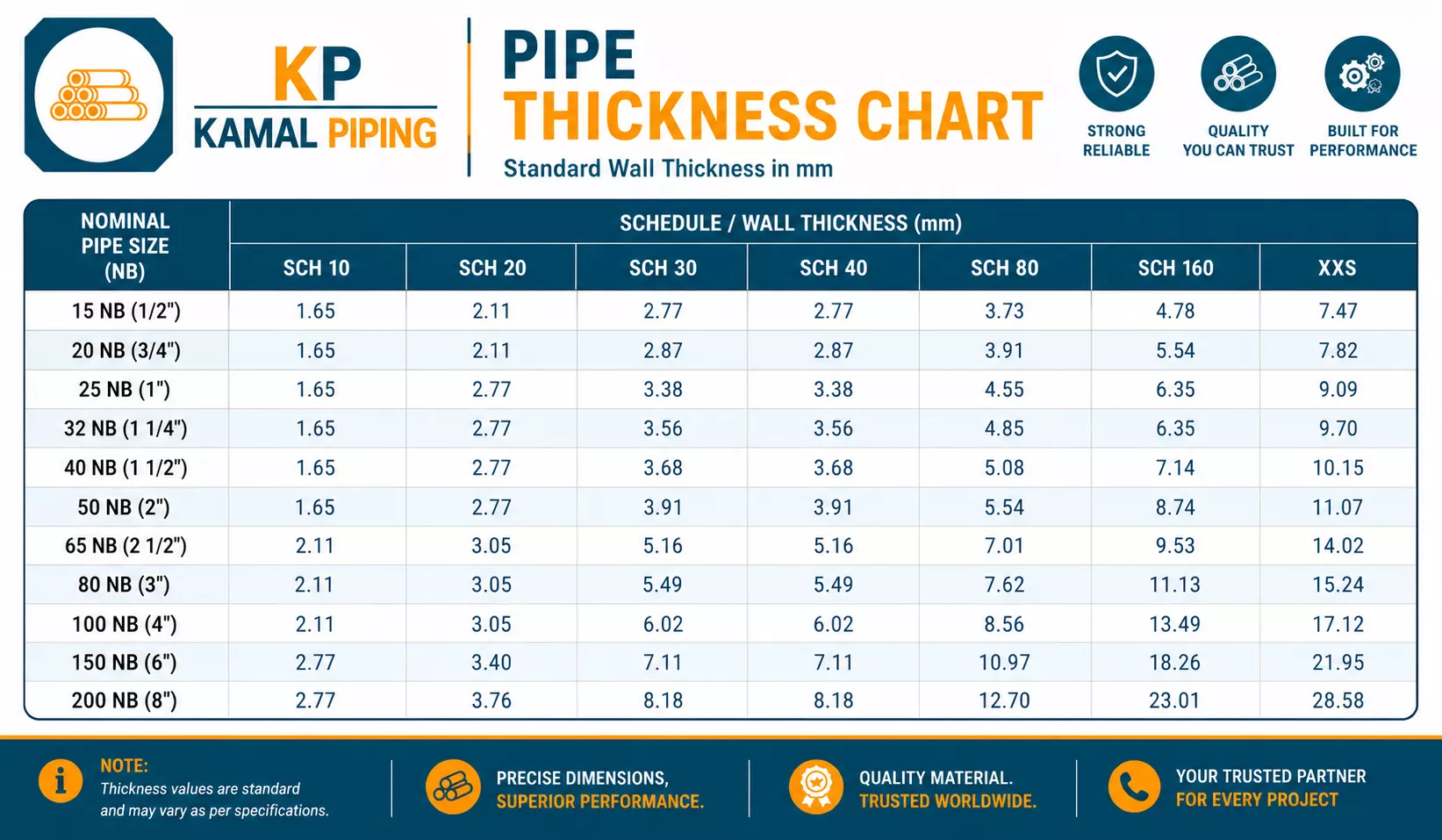
Pipe Thickness Chart in mm
The Pipe Thickness Chart in mm below provides the standard wall thickness ranges for different types of steel and plastic pipes. Pipe thickness plays a vital role in determining a pipe's strength, pressure rating, durability, weight, and suitability for various industrial, structural, and construction applications.
| Pipe Type | Common Thickness Range |
|---|---|
| MS Pipe | 1.6 mm to 10 mm |
| Mild Steel Pipe | 1.6 mm to 10 mm |
| ERW Pipe | 1.6 mm to 10 mm |
| SS Pipe | 0.8 mm to 8 mm |
| Carbon Steel Pipe | 2 mm to 20 mm |
| GI Pipe | 1.6 mm to 6 mm |
| Seamless Pipe | 2 mm to 20 mm |
| HDPE Pipe | 1.9 mm to 29.7 mm |
MS Pipe Thickness Chart
The MS Pipe Thickness Chart helps engineers, fabricators, contractors, and buyers select the correct mild steel pipe based on nominal bore (NB), outside diameter (OD), and pipe class. Wall thickness varies depending on whether the pipe is manufactured to Class A, Class B, or Class C specifications.
| Nominal Bore (NB) | Outside Diameter (OD) | Class A | Class B | Class C |
|---|---|---|---|---|
| 15 mm | 21.3 mm | 2.0 mm | 2.65 mm | 3.25 mm |
| 20 mm | 26.9 mm | 2.0 mm | 2.65 mm | 3.25 mm |
| 25 mm | 33.7 mm | 2.6 mm | 3.25 mm | 4.0 mm |
| 32 mm | 42.4 mm | 2.6 mm | 3.25 mm | 4.0 mm |
| 40 mm | 48.3 mm | 3.2 mm | 3.25 mm | 4.0 mm |
| 50 mm | 60.3 mm | 3.2 mm | 3.65 mm | 4.5 mm |
| 65 mm | 76.1 mm | 3.2 mm | 3.65 mm | 4.5 mm |
| 80 mm | 88.9 mm | 3.6 mm | 4.0 mm | 5.0 mm |
| 100 mm | 114.3 mm | 3.6 mm | 4.5 mm | 5.4 mm |
Pipe Wall Thickness Chart
The Pipe Wall Thickness Chart helps compare wall thickness across different pipe schedules and standards. It is widely used by engineers, contractors, and fabricators to select the correct pipe thickness based on pressure requirements, strength, and industrial applications.
| NPS / Size | SCH 20 | SCH 40 | SCH 80 | SCH 160 |
|---|---|---|---|---|
| 1/2 inch | 1.65 mm | 2.77 mm | 3.73 mm | 4.78 mm |
| 3/4 inch | 1.65 mm | 2.87 mm | 3.91 mm | 5.56 mm |
| 1 inch | 1.65 mm | 3.38 mm | 4.55 mm | 6.35 mm |
| 1.5 inch | 2.11 mm | 3.68 mm | 5.08 mm | 7.11 mm |
| 2 inch | 2.77 mm | 3.91 mm | 5.54 mm | 8.56 mm |
| 3 inch | 2.87 mm | 5.16 mm | 7.62 mm | 11.13 mm |
| 4 inch | 3.05 mm | 6.02 mm | 8.56 mm | 12.70 mm |
Pipe Schedule Thickness Chart
The Pipe Schedule Thickness Chart explains the relationship between schedule numbers and pipe wall thickness. As the schedule number increases, the wall becomes thicker, allowing the pipe to withstand higher operating pressures.
| Pipe Schedule | Wall Thickness Description |
|---|---|
| SCH 10 | Light wall thickness |
| SCH 20 | Medium-light wall thickness |
| SCH 40 | Standard wall thickness |
| SCH 80 | Heavy wall thickness |
| SCH 160 | Extra heavy wall thickness |
MS C Class Pipe Thickness Chart
The MS C Class Pipe Thickness Chart is commonly used to identify heavy-duty mild steel pipes designed for higher pressure and demanding industrial applications. C Class pipes have thicker walls than A Class and B Class pipes of the same nominal bore.
| Nominal Bore (NB) | A Class | B Class | C Class |
|---|---|---|---|
| 15 mm | 2.0 mm | 2.65 mm | 3.25 mm |
| 25 mm | 2.6 mm | 3.25 mm | 4.0 mm |
| 50 mm | 2.9 mm | 3.65 mm | 4.5 mm |
| 100 mm | 3.6 mm | 4.5 mm | 5.4 mm |
MS B Class Pipe Thickness Chart
The MS B Class Pipe Thickness Chart provides the standard wall thickness for B Class mild steel pipes, which are widely used in plumbing, water supply, structural fabrication, and general industrial applications.
| Nominal Bore (NB) | Outside Diameter (OD) | B Class Thickness |
|---|---|---|
| 15 mm | 21.3 mm | 2.65 mm |
| 20 mm | 26.9 mm | 2.65 mm |
| 25 mm | 33.7 mm | 3.25 mm |
| 40 mm | 48.3 mm | 3.25 mm |
| 50 mm | 60.3 mm | 3.65 mm |
| 80 mm | 88.9 mm | 4.0 mm |
MS Pipe Thickness Chart PDF
Looking for an MS Pipe Thickness Chart PDF? Download or bookmark this page to access standard pipe thickness charts, wall thickness tables, pipe schedule information, and Class A, B, and C dimensions whenever you need them. This guide is a convenient reference for engineers, contractors, fabricators, and procurement professionals.
IS 1239 Pipe Thickness Chart
The IS 1239 Pipe Thickness Chart is widely used in India for selecting mild steel pipes used in water supply, structural fabrication, and general engineering. Under the IS 1239 standard, pipe wall thickness varies according to the nominal bore (NB) and whether the pipe is manufactured in Class A, Class B, or Class C.
| Nominal Bore (NB) | Outside Diameter (OD) | Typical Thickness |
|---|---|---|
| 15 mm | 21.3 mm | 2.0 mm to 3.25 mm |
| 20 mm | 26.9 mm | 2.0 mm to 3.25 mm |
| 25 mm | 33.7 mm | 2.6 mm to 4.0 mm |
| 50 mm | 60.3 mm | 3.2 mm to 4.5 mm |
| 100 mm | 114.3 mm | 3.6 mm to 5.4 mm |
Stainless Steel Pipe Thickness Chart
The Stainless Steel Pipe Thickness Chart provides standard wall thickness ranges for SS 304, SS 316, and other stainless steel grades used in food processing, chemical plants, pharmaceuticals, and industrial piping systems.
| Outside Diameter (OD) | Typical Thickness Range |
|---|---|
| 12.7 mm | 0.8 mm to 2.0 mm |
| 19.05 mm | 1.0 mm to 2.5 mm |
| 25.4 mm | 1.0 mm to 3.0 mm |
| 38.1 mm | 1.2 mm to 3.0 mm |
| 50.8 mm | 1.5 mm to 4.0 mm |
| 76.2 mm | 2.0 mm to 5.0 mm |
ERW Pipe Thickness Chart
The ERW Pipe Thickness Chart is commonly used for structural steel, industrial piping, construction, and fabrication projects. ERW pipes are manufactured in various wall thicknesses depending on the application and applicable standards.
| Outside Diameter (OD) | Thickness Range |
|---|---|
| 21.3 mm | 1.6 mm to 3.2 mm |
| 33.7 mm | 1.6 mm to 4.0 mm |
| 48.3 mm | 2.0 mm to 4.5 mm |
| 60.3 mm | 2.0 mm to 5.0 mm |
| 88.9 mm | 2.6 mm to 6.0 mm |
| 114.3 mm | 3.2 mm to 6.0 mm |
Seamless Pipe Thickness Chart
The Seamless Pipe Thickness Chart is intended for applications requiring high pressure resistance, elevated temperatures, and superior mechanical strength. Seamless pipes are widely used in oil & gas, power generation, and petrochemical industries.
| Outside Diameter (OD) | Thickness Range |
|---|---|
| 21.3 mm | 2.0 mm to 4.0 mm |
| 33.7 mm | 2.6 mm to 5.0 mm |
| 48.3 mm | 3.2 mm to 6.0 mm |
| 60.3 mm | 3.6 mm to 8.0 mm |
| 88.9 mm | 4.0 mm to 10.0 mm |
| 114.3 mm | 4.5 mm to 12.0 mm |
GI Pipe Thickness Chart
The GI Pipe Thickness Chart provides standard wall thickness information for galvanized iron pipes used in plumbing, water distribution, fencing, and light structural applications.
| Nominal Size | Thickness Range |
|---|---|
| 15 mm | 2.0 mm to 2.6 mm |
| 20 mm | 2.0 mm to 2.6 mm |
| 25 mm | 2.0 mm to 3.2 mm |
| 50 mm | 2.6 mm to 4.0 mm |
| 100 mm | 3.2 mm to 5.0 mm |
HDPE Pipe Thickness Chart
The HDPE Pipe Thickness Chart is based on the pipe's SDR (Standard Dimension Ratio). Lower SDR values indicate thicker pipe walls and higher pressure ratings.
| SDR Class | Wall Thickness Level |
|---|---|
| SDR 11 | Heavy Wall |
| SDR 13.6 | Medium-Heavy Wall |
| SDR 17 | Standard Wall |
| SDR 21 | Light Wall |
| SDR 26 | Lighter Wall |
Pipe Thickness Reference by Material
Different pipe materials have different wall thickness standards depending on their intended service conditions. The table below provides a quick reference for common applications.
| Pipe Type | Common Use |
|---|---|
| Carbon Steel Pipe | Pressure and industrial piping |
| Cast Iron Pipe | Drainage and water systems |
| Copper Pipe | Plumbing and refrigeration |
| Galvanized Pipe | Water supply, fencing, and general use |
| Steel Pipe | Structural and process applications |
Pipe Thickness Calculation
Pipe wall thickness is the distance between the outside surface and inside surface of the pipe. In general, thicker walls provide greater strength, higher pressure resistance, and longer service life.
Where:
- OD = Outside Diameter
- ID = Inside Diameter
How to Use This Pipe Thickness Chart
- Identify the pipe material (MS, SS, ERW, GI, HDPE, or Seamless).
- Find the nominal bore (NB) or outside diameter (OD).
- Select the required wall thickness or pipe schedule.
- Compare the values with your project specifications.
- Download or bookmark the chart for quick future reference.
Conclusion
A Pipe Thickness Chart is an essential reference for selecting the correct wall thickness based on pipe size, material, and schedule. Whether you're working with MS, Stainless Steel, ERW, Seamless, GI, Carbon Steel, or HDPE pipes, understanding the correct thickness helps ensure safety, durability, pressure resistance, and compliance with project requirements.
At Kamal Steels, we provide accurate and easy-to-understand pipe thickness charts covering IS 1239, pipe schedules, wall thickness in millimetres, and standard dimensions. Use this guide to compare pipe specifications, simplify material selection, and make informed engineering and purchasing decisions for construction, industrial, and infrastructure projects.
Get Technical SupportFrequently Asked Questions
A Pipe Thickness Chart is a reference table that displays the wall thickness of different pipe sizes based on nominal bore (NB), outside diameter (OD), and pipe schedule. It helps users select the appropriate pipe for structural, industrial, plumbing, and pressure applications.
An MS Pipe Thickness Chart provides the standard wall thickness of mild steel pipes according to pipe size and Class A, B, or C specifications. It is widely used in construction, fabrication, and engineering projects.
A Pipe Schedule Thickness Chart shows the wall thickness of pipes according to schedule numbers such as SCH 10, SCH 20, SCH 40, SCH 80, and SCH 160. Higher schedule numbers indicate thicker pipe walls and greater pressure-handling capability.
The IS 1239 Pipe Thickness Chart is an Indian standard used for mild steel pipes. It specifies wall thickness based on nominal bore (NB) and pipe class, making it a common reference for water supply, structural, and industrial piping systems.
Pipe wall thickness is measured as the distance between the outer surface and the inner surface of the pipe wall. It is generally expressed in millimetres (mm) or by a schedule number, depending on the applicable standard.
Wall thickness affects the pipe's strength, weight, pressure rating, corrosion allowance, and service life. Selecting the correct thickness helps ensure safe and reliable performance in industrial, commercial, and structural applications.
Class A pipes have the thinnest walls, Class B pipes have medium wall thickness, and Class C pipes have the thickest walls. As the wall thickness increases, the pipe becomes heavier and suitable for higher-pressure applications.
Select the pipe thickness based on the operating pressure, temperature, material, industry standard, corrosion allowance, and application requirements. Referring to a standard Pipe Thickness Chart helps ensure the correct selection.
Yes. This page can be saved or printed as a PDF for offline use. A downloadable Pipe Thickness Chart PDF is useful for engineers, contractors, procurement teams, and fabrication workshops.
Kamal Steels is a trusted manufacturer, supplier, stockist, and exporter of MS Pipes, ERW Pipes, Stainless Steel Pipes, Seamless Pipes, Carbon Steel Pipes, Duplex Steel Pipes, and Nickel Alloy Pipes. Contact our team for technical assistance, product availability, and competitive pricing.
Looking for High-Quality Steel Pipes?
Kamal Steels is a leading manufacturer, supplier, stockist, and exporter of MS Pipes, ERW Pipes, Stainless Steel Pipes, Seamless Pipes, Carbon Steel Pipes, GI Pipes, Duplex Steel Pipes, Super Duplex Pipes, and Nickel Alloy Pipes. We supply pipes in a wide range of sizes, wall thicknesses, schedules, and specifications for construction, infrastructure, industrial processing, oil & gas, petrochemical, power generation, and engineering applications.