
-
-
-
Girgaon, Mumbai - 400004
What is ASME Standard?
ASME Standard and codes play an important role in the design, manufacturing, testing, inspection and safe use of mechanical equipment and engineering systems. These standards establish technical requirements for components, materials, dimensions, pressure ratings, manufacturing methods, testing, inspection and other engineering requirements.
For stainless steel and alloy pipe applications, understanding the applicable ASME Standard or code helps buyers, engineers, manufacturers and procurement teams select products suitable for specific industrial applications and project requirements.
ASME standards and codes are commonly referenced for pipe dimensions, fittings, flanges, valves, pressure equipment, piping systems, boilers and other mechanical components. The specific requirements depend on the applicable ASME standard or code, product type, operating conditions and project specification.
We explain what ASME is, what ASME stands for, what an ASME standard means, how ASME standards work, common ASME standards for stainless steel pipes and tubes and the difference between ASME and ASTM standards.
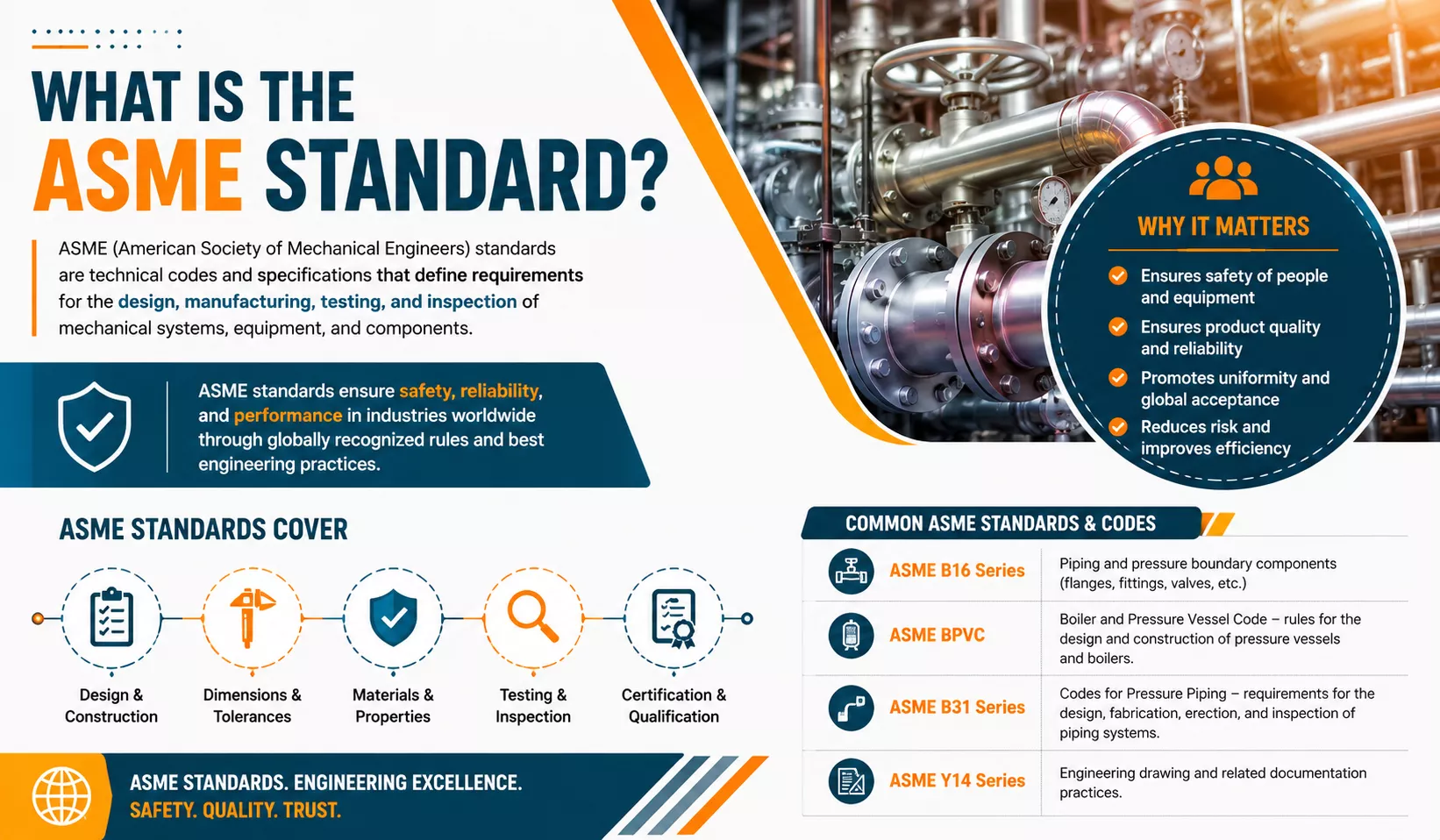
ASME Standard Full Form
ASME (American Society of Mechanical Engineers) is an organization that develops engineering codes and standards for mechanical systems, equipment, and related engineering applications.
ASME standards and codes are widely used in industries such as:
| Industry | Typical Applications |
|---|---|
| Oil & Gas | Piping systems, pressure equipment and process facilities |
| Petrochemical | Process piping, equipment and pressure systems |
| Chemical Processing | Process piping and equipment for corrosive service |
| Power Generation | Boilers, piping, pressure equipment and heat-transfer systems |
| Refineries | Process piping, fittings, flanges and pressure systems |
| Construction | Mechanical systems and engineering components |
| Pharmaceutical | Process piping and hygienic equipment |
| Food Processing | Process piping and sanitary systems |
| Manufacturing | Mechanical equipment, piping and industrial systems |
ASME publications cover areas including pressure vessels, piping, boilers, valves, flanges, fittings and other mechanical components.
What is ASME Standard?
An ASME standard is a technical document that establishes requirements for engineering products, components, dimensions, materials, design, manufacturing, testing, or safe operation.
For pipes and tubes, ASME standards can define requirements related to:
| Requirement | Purpose |
|---|---|
| Dimensions | Defines pipe, tube, fitting, or component sizes |
| Wall Thickness | Establishes standard thicknesses |
| Pressure Rating | Defines pressure-temperature limitations |
| Material | Identifies permitted materials |
| Testing | Establishes applicable testing requirements |
| Manufacturing | Provides manufacturing requirements |
| Inspection | Supports quality and compliance checks |
| Design | Establishes engineering design requirements |
The applicable ASME code or standard should be selected according to the product type, application, design requirements, material, operating conditions, and project specification.
What Does ASME Stand For?
ASME stands for American Society of Mechanical Engineers.
ASME develops internationally recognized codes and standards that help establish consistent engineering, design, manufacturing, inspection, and safety requirements.
Why Are ASME Standards Important?
ASME standards and codes help establish consistent engineering requirements for the design, selection, manufacturing, installation, inspection, and use of mechanical equipment and piping systems.
In the stainless steel pipe and tube industry, the applicable ASME requirements can help engineers, manufacturers, suppliers, and buyers ensure that products are suitable for the intended application and project specifications.
| Importance | How ASME Standards Help |
|---|---|
| Safe Engineering Design | Provides recognized engineering requirements that support the safe design and operation of piping, pressure equipment, and mechanical systems. |
| Consistent Dimensions | Establishes standardized dimensions for pipes, flanges, fittings, valves, and other components to improve compatibility between products. |
| Pressure and Temperature Requirements | Helps define applicable pressure-temperature ratings and engineering requirements for components and piping systems. |
| Product Compatibility | Standardized dimensions and specifications help ensure that pipes, fittings, flanges and other components can be properly integrated into a piping system. |
| Quality Control | Provides recognized technical requirements that can support manufacturing, inspection and quality-control procedures. |
| Inspection and Testing | Applicable ASME codes and standards may establish or reference requirements for inspection, testing and verification. |
| International Projects | Widely recognized ASME codes and standards help engineers, contractors, manufacturers and buyers communicate technical requirements across international projects. |
For Kamal Steels, understanding the applicable ASME requirements helps support the supply of stainless steel pipes, tubes and related products according to the required dimensions, specifications and project requirements.
The applicable ASME code or standard should always be confirmed based on the product type, application, operating conditions, design requirements and project specification.
How Do ASME Standards Work?
ASME standards and codes are applied according to the type of component, engineering application, design requirements, dimensions, pressure, temperature, and operating conditions involved in a project.
A piping system may use different ASME standards for different components. Each standard addresses specific technical requirements for the particular product or engineering application.
| Component | ASME Standard | Typical Coverage |
|---|---|---|
| Stainless Steel Pipe | ASME B36.19 | Pipe dimensions, outside diameters, and wall thicknesses for stainless steel pipe. |
| Flanges | ASME B16.5 | Flange dimensions, pressure-temperature ratings, materials, and related requirements. |
| Butt-Weld Fittings | ASME B16.9 | Dimensions, tolerances, and related requirements for factory-made wrought butt-welding fittings. |
| Forged Fittings | ASME B16.11 | Requirements for forged socket-welding and threaded fittings. |
For example, a stainless steel piping project could specify ASME B36.19 for pipe dimensions, ASME B16.5 for flanges, and ASME B16.9 for butt-weld fittings.
Therefore, a complete piping system may require several ASME standards rather than relying on a single standard for every component. The applicable requirements should be determined from the project specification, component type, operating conditions, and engineering design.
ASME Standards for Pipes and Tubes
Several ASME standards are commonly referenced in piping applications. Different standards apply to specific components such as pipes, flanges, fittings, valves, gaskets, and other piping components.
The following table provides an overview of commonly referenced ASME standards and their typical applications:
| ASME Standard | Covers | Common Application |
|---|---|---|
| ASME B16.5 | Pipe flanges and flanged fittings | Piping connections |
| ASME B16.9 | Factory-made wrought butt-welding fittings | Elbows, tees, reducers, caps |
| ASME B16.10 | Face-to-face and end-to-end dimensions of valves | Valve installation and replacement |
| ASME B16.11 | Forged socket-welding and threaded fittings | Small-diameter piping connections |
| ASME B16.20 | Metallic gaskets for pipe flanges | Flanged piping connections |
| ASME B16.21 | Nonmetallic flat gaskets for pipe flanges | Flange sealing applications |
| ASME B16.25 | Buttwelding ends | Preparation of pipe and fitting ends for welding |
| ASME B16.28 | Wrought steel butt-welding short-radius elbows and returns | Compact piping layouts |
| ASME B16.34 | Valves with flanged, threaded, and welding ends | Industrial piping valve applications |
| ASME B16.47 | Large-diameter steel flanges | Large-diameter piping connections |
| ASME B16.48 | Line blanks | Piping system isolation |
| ASME B16.49 | Factory-made wrought steel buttwelding induction bends | Pipeline and process piping |
| ASME B36.10M | Welded and seamless wrought steel pipe dimensions | Carbon and alloy steel piping |
| ASME B36.19M | Stainless steel pipe dimensions | Stainless steel piping |
These ASME standards address different components and engineering requirements within a piping system. For example, ASME B36.19M is used for stainless steel pipe dimensions, while ASME B16.5 covers flanges and flanged fittings. Other standards cover fittings, valves, gaskets, welding ends, line blanks, and induction bends.
The applicable standard depends on the product type, design requirements, operating conditions, and project specification.
ASME Codes vs ASME Standards: What Is the Difference?
ASME codes and standards are closely related, but they generally serve different purposes within engineering and industrial applications.
| ASME Codes | ASME Standards |
|---|---|
| Provide broader engineering requirements | Address specific technical requirements |
| May cover design, construction, inspection, and safety requirements | Commonly cover components, dimensions, ratings, and technical specifications |
| Example: ASME BPVC | Example: ASME B16.5 |
| Commonly applied to pressure equipment and engineering systems | Commonly applied to piping components and dimensional requirements |
For example, the ASME Boiler and Pressure Vessel Code (BPVC) provides comprehensive requirements for boilers, pressure vessels, and related equipment, whereas ASME B16.5 addresses pipe flanges and flanged fittings.
ASME vs ASTM: What Is the Difference?
ASME and ASTM are both widely recognized in the engineering and manufacturing industries, but they address different aspects of a product or engineering project.
| ASME | ASTM |
|---|---|
| American Society of Mechanical Engineers | ASTM International |
| Focuses on engineering codes and technical standards | Focuses heavily on materials, products, and testing requirements |
| Covers piping, pressure vessels, boilers, fittings, flanges, valves, and related engineering systems | Covers steel, stainless steel, alloys, products, and test methods |
| Example: ASME B36.19M | Example: ASTM A312 |
| Helps define engineering, component, dimensional, and system requirements | Helps define material, product, manufacturing, and testing requirements |
Simple Example
A stainless steel pipe used in an industrial piping system may be specified using both ASTM and ASME requirements:
| Requirement | Example | Purpose |
|---|---|---|
| Material Specification | ASTM A312 TP316L | Defines the applicable pipe specification and grade |
| Pipe Dimensions | ASME B36.19M | Defines applicable stainless steel pipe dimensions |
| Piping Design | ASME B31.3 | Provides requirements for process piping design and construction |
Therefore, ASTM and ASME are not necessarily alternatives. They can be used together to define different technical requirements for the same product or engineering project.
How to Select the Right ASME Standard
Selecting the appropriate ASME standard depends on the component, material, dimensions, operating conditions, connection type, application, and applicable engineering code.
| Requirement | What to Check |
|---|---|
| Product | Pipe, flange, fitting, valve, or other component |
| Material | Stainless steel, carbon steel, alloy steel, or other material |
| Size | NPS and applicable dimensional requirements |
| Wall Thickness | Schedule or specified wall thickness |
| Pressure | Design and operating pressure |
| Temperature | Operating and design temperature |
| Connection | Butt-weld, threaded, socket-weld, or flanged connection |
| Application | Process, chemical, oil & gas, power, pharmaceutical, or other service |
| Code | Applicable piping or pressure-equipment code |
Always verify the applicable edition of the relevant ASME standard or code and confirm any project-specific requirements before finalizing an engineering or purchasing specification.
Benefits of Using ASME-Compliant Products
Using products manufactured and supplied according to the applicable ASME requirements can provide several advantages for engineering and industrial projects.
| Benefit | How It Helps |
|---|---|
| Consistent Dimensions | Standardized dimensions improve compatibility between piping components. |
| Better Engineering Control | Defined technical requirements support proper system design and component selection. |
| Improved Safety | Applicable ASME codes and standards help address engineering, design, and safety requirements. |
| Easier Procurement | Standardized specifications make it easier to communicate technical requirements to suppliers. |
| International Acceptance | ASME requirements are widely referenced in engineering and industrial projects worldwide. |
| Simplified Inspection | Defined requirements help inspectors verify dimensions, materials, testing, and documentation. |
For Kamal Steels, understanding the applicable ASME requirements helps support the supply of stainless steel pipes, tubes, and related products according to customer and project specifications.
Frequently Asked Questions About ASME Standards
ASME stands for American Society of Mechanical Engineers. ASME develops engineering codes and standards used for mechanical systems, piping, pressure equipment, and related applications.
An ASME standard is a technical document that establishes requirements for engineering products, components, materials, dimensions, testing, design, or related applications.
ASME B16.5 covers pipe flanges and flanged fittings, including requirements related to dimensions, materials, tolerances, marking, and pressure-temperature ratings.
ASME B16.9 covers factory-made wrought butt-welding fittings, including elbows, tees, reducers, crosses, caps, and other commonly used piping fittings.
ASME B16.11 covers forged fittings, including socket-welding and threaded fittings commonly used for industrial piping connections.
ASME B36.10M covers dimensions of welded and seamless wrought steel pipe, including nominal pipe sizes, outside diameters, wall thicknesses, and schedules.
ASME B36.19M covers dimensions of stainless steel pipe. It includes standardized dimensions and commonly used stainless steel pipe schedules.
No. ASME focuses mainly on engineering codes and standards for piping, pressure equipment, mechanical systems, and components, while ASTM develops standards covering materials, products, testing methods, and related technical requirements. Both can be used together in industrial projects.
ASME B36.10M covers dimensions of welded and seamless wrought steel pipe, while ASME B36.19M specifically covers dimensions of stainless steel pipe.
ASME documents can reference materials and material specifications, but exact material requirements may come from applicable specifications such as ASTM standards. The project specification should be checked to determine the required stainless steel grade and material requirements.
ASME B31.3 is the Process Piping Code. It provides requirements related to materials, design, fabrication, assembly, examination, inspection, and testing of process piping systems.
ASME and ASTM requirements can be used together to define different parts of a piping specification. For example, ASTM A312 TP316L may define the stainless steel pipe material and product requirements, while ASME B36.19M may define the pipe dimensions.