
-
-
-
Girgaon, Mumbai - 400004
Schedule 40 vs Schedule 80 Pipe
Schedule 40 and Schedule 80 Pipes have the same outside diameter (OD) for the same nominal pipe size, but they differ mainly in wall thickness, inside diameter (ID), weight and pressure capacity. Schedule 40 has a thinner wall and larger ID, while Schedule 80 has a thicker wall and smaller ID.
The right choice depends on the operating pressure, temperature, required flow area, material, installation conditions and applicable piping standard.
| Feature | Schedule 40 Pipe | Schedule 80 Pipe |
|---|---|---|
| Wall Thickness | Thinner | Thicker |
| Outside Diameter (OD) | Same for the same NPS | Same for the same NPS |
| Inside Diameter (ID) | Larger | Smaller |
| Weight | Lower | Higher |
| Pressure Capacity | Generally lower | Generally higher |
| Flow Area | Larger | Smaller |
| Material Usage | Less | More |
| Cost | Generally lower | Generally higher |
| Best Suited For | General-purpose and moderate-duty piping | Higher-pressure and more demanding service |
In simple terms
Schedule 40 = thinner wall + larger ID + lighter pipe
Schedule 80 = thicker wall + smaller ID + heavier pipe
For example, an NPS 2 pipe has an OD of approximately 60.3 mm under the standard dimensional system. The OD remains the same between Schedule 40 and Schedule 80, but Schedule 80 uses a thicker wall, which reduces its internal diameter.
Important: Schedule alone does not determine the actual allowable working pressure. Pressure capacity depends on the pipe material, grade, size, wall thickness, temperature, manufacturing specification, design code and service conditions. Always verify the applicable pressure rating before selecting a pipe.
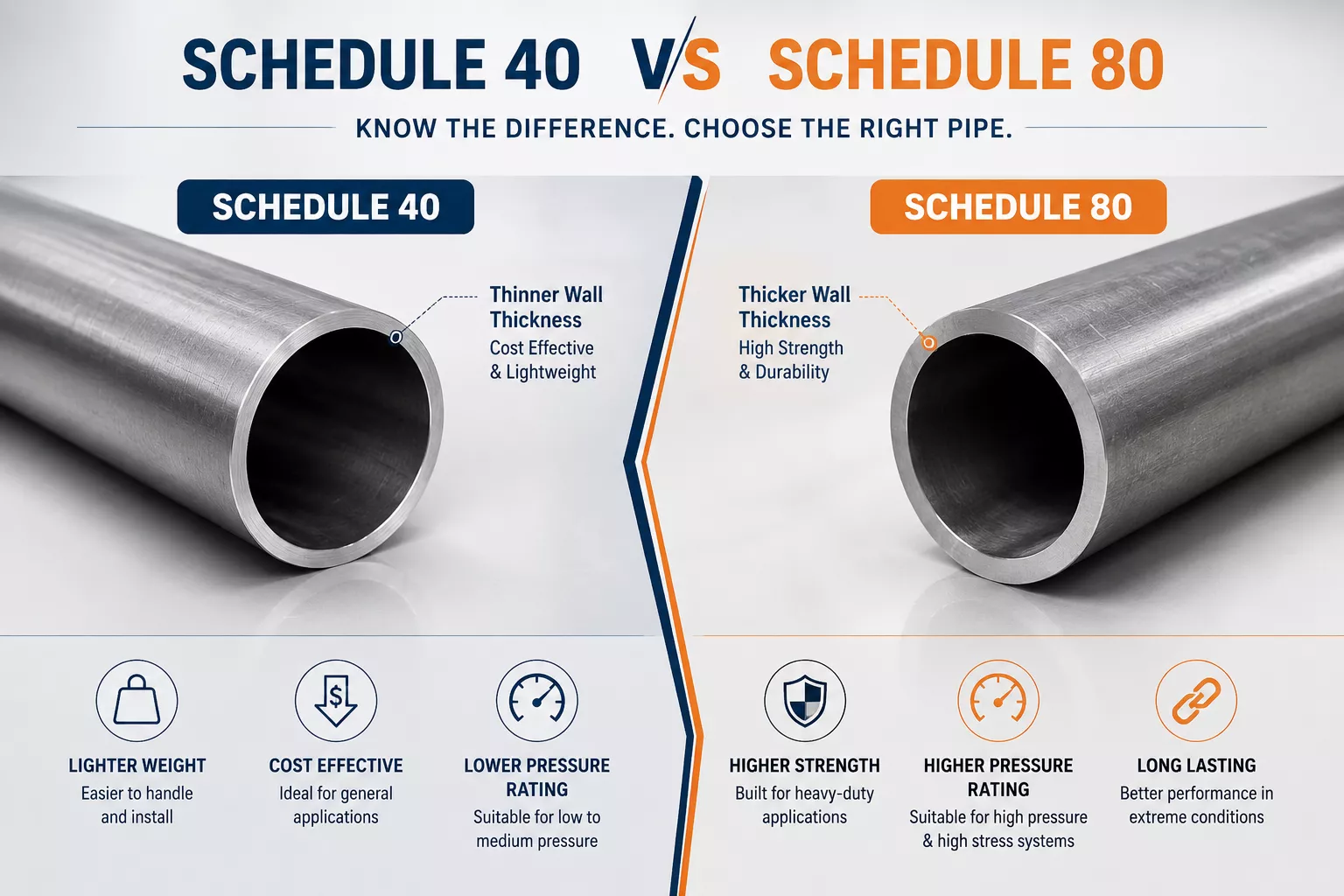
What Is Schedule 40 Pipe?
Schedule 40 pipe is a standard pipe wall-thickness designation commonly used for general-purpose and industrial piping systems. For a given nominal pipe size (NPS), Schedule 40 has a specified wall thickness and the same standard outside diameter (OD) used for other schedules of that size.
Compared with Schedule 80 pipe of the same NPS, Schedule 40 has a thinner wall and larger inside diameter (ID). The thinner wall also means less material and lower weight, while the larger ID provides a greater internal flow area.
Schedule 40 pipe is available in materials such as carbon steel, stainless steel, alloy steel and plastic piping materials, depending on the application and applicable product standard. Its suitability for a particular pressure or temperature service must be determined from the material, dimensions, design conditions and applicable standard rather than from the schedule designation alone.
What Is Schedule 80 Pipe?
Schedule 80 pipe is a pipe wall-thickness designation used when a piping system requires a thicker wall than a lower schedule of the same nominal pipe size (NPS). For the same NPS, Schedule 80 generally has the same standard outside diameter (OD) as Schedule 40, but a thicker wall and smaller inside diameter (ID).
The additional wall thickness increases the amount of material in the pipe and can provide greater resistance to internal pressure and mechanical loads, depending on the pipe material, temperature, design conditions and applicable code or specification. The smaller ID also results in a lower internal flow area compared with Schedule 40 of the same NPS.
Schedule 80 pipe is commonly selected for industrial process piping, chemical processing, oil and gas, power generation and other demanding service conditions where a thicker pipe wall may be required. It is available in materials including carbon steel, stainless steel, alloy steel, PVC and CPVC, depending on the application and applicable product standard.
Schedule 40 vs Schedule 80: What Is the Difference?
The main difference between Schedule 40 and Schedule 80 pipe is wall thickness. For the same nominal pipe size (NPS), both schedules generally have the same standard outside diameter (OD), but Schedule 80 has a thicker wall. As a result, Schedule 80 has a smaller inside diameter (ID) and greater pipe weight, while Schedule 40 provides a larger internal flow area and uses less material.
| Feature | Schedule 40 | Schedule 80 |
|---|---|---|
| Wall Thickness | Thinner | Thicker |
| Outside Diameter (OD) | Same for the same NPS | Same for the same NPS |
| Inside Diameter (ID) | Larger | Smaller |
| Flow Area | Larger | Smaller |
| Weight | Lower | Higher |
| Material Used | Less | More |
| Pressure Capability | Generally lower | Generally higher |
| Cost | Generally lower | Generally higher |
| Typical Selection | General-purpose and moderate-duty service | Higher-pressure or more demanding service |
For example, an NPS 2 pipe has a standard OD of approximately 60.3 mm (2.375 inches). The OD remains the same for Schedule 40 and Schedule 80, but Schedule 80 has a thicker wall, reducing the available internal diameter.
The difference can be summarized as:
Same NPS + Same OD → Schedule 40 = thinner wall and larger ID → Schedule 80 = thicker wall and smaller ID.
Which One Should You Choose?
Choose Schedule 40 when the required design conditions can be met with its specified wall thickness and the larger ID, lower weight and lower material cost are beneficial.
Choose Schedule 80 when the piping system requires a thicker wall because of pressure, mechanical loading, service conditions or other design requirements.
Important: Schedule alone should not be used to determine pressure rating. The allowable pressure depends on the pipe material, grade, dimensions, operating temperature, manufacturing specification and applicable design code.
For a quick comparison, Schedule 40 is generally the lighter and more economical option, while Schedule 80 provides a thicker wall and is commonly selected for more demanding service conditions.
Schedule 40 vs Schedule 80 Dimensions Chart
For the same Nominal Pipe Size (NPS), Schedule 40 and Schedule 80 pipes generally have the same standard outside diameter (OD). The main dimensional difference is the wall thickness, which changes the inside diameter (ID). Schedule 80 has a thicker wall and therefore a smaller ID than Schedule 40.
The table below compares commonly used Schedule 40 Pipe Dimensions and Schedule 80 Pipe Dimensions:
| NPS | OD | Schedule 40 Pipe Thickness | Schedule 40 Approx. ID | Schedule 80 Pipe Thickness | Schedule 80 Approx. ID |
|---|---|---|---|---|---|
| 1/2" | 21.3 mm | 2.77 mm | 15.76 mm | 3.73 mm | 13.84 mm |
| 3/4" | 26.7 mm | 2.87 mm | 20.93 mm | 3.91 mm | 18.88 mm |
| 1" | 33.4 mm | 3.38 mm | 26.64 mm | 4.55 mm | 24.30 mm |
| 1 1/2" | 48.3 mm | 3.68 mm | 40.94 mm | 5.08 mm | 38.14 mm |
| 2" | 60.3 mm | 3.91 mm | 52.48 mm | 5.54 mm | 49.22 mm |
| 3" | 88.9 mm | 5.49 mm | 77.92 mm | 7.62 mm | 73.66 mm |
| 4" | 114.3 mm | 6.02 mm | 102.26 mm | 8.56 mm | 97.18 mm |
| 6" | 168.3 mm | 7.11 mm | 154.08 mm | 10.97 mm | 146.36 mm |
| 8" | 219.1 mm | 8.18 mm | 202.74 mm | 12.70 mm | 193.70 mm |
Note: The ID values are calculated from the listed OD and nominal wall thickness using ID = OD − (2 × Wall Thickness). Actual dimensions and permitted tolerances should be verified against the applicable pipe dimensional standard and product specification.
What Does the Chart Show?
The chart demonstrates three important points:
- Same NPS: Schedule 40 and Schedule 80 use the same nominal pipe size designation.
- Same standard OD: For the same NPS, the standard outside diameter remains the same.
- Different wall thickness and ID: Schedule 80 has a thicker wall, resulting in a smaller internal diameter.
For example, a 2-inch Schedule 40 pipe has an OD of approximately 60.3 mm and a nominal wall thickness of 3.91 mm, giving an approximate ID of 52.48 mm. A 2-inch Schedule 80 pipe has the same OD but a thicker 5.54 mm wall, reducing the approximate ID to 49.22 mm.
Therefore:
Same NPS + Same OD + Thicker Wall = Smaller ID
The difference in wall thickness is one of the key reasons Schedule 80 pipe provides greater pressure-handling capability than Schedule 40, although the actual allowable pressure must be determined from the material, temperature, applicable standard, dimensions and design requirements rather than schedule alone.
Schedule 40 vs Schedule 80 Pressure Rating
Schedule 40 and Schedule 80 do not have one universal pressure rating. The allowable pressure depends on the pipe material, NPS, wall thickness, operating temperature, applicable standard and design conditions.
For the same NPS, Schedule 80 has a thicker wall than Schedule 40. This generally provides greater pressure capacity when the pipes are made from the same material and are evaluated under comparable conditions.
| Factor | Schedule 40 | Schedule 80 |
|---|---|---|
| Wall Thickness | Thinner | Thicker |
| Inside Diameter | Larger | Smaller |
| Pressure Capacity | Generally lower | Generally higher |
| Material Requirement | Less material | More material |
| Weight | Lower | Higher |
| Typical Use | General and moderate-pressure service | Higher-pressure and demanding service |
For example, a 2-inch pipe has the same standard OD for both schedules, but Schedule 80 has a thicker wall. This additional wall thickness generally increases resistance to internal pressure.
Important: Schedule 80 should not automatically be considered suitable for every high-pressure application. The actual allowable working pressure must be checked using the relevant material standard, temperature rating, design code and manufacturer's data.
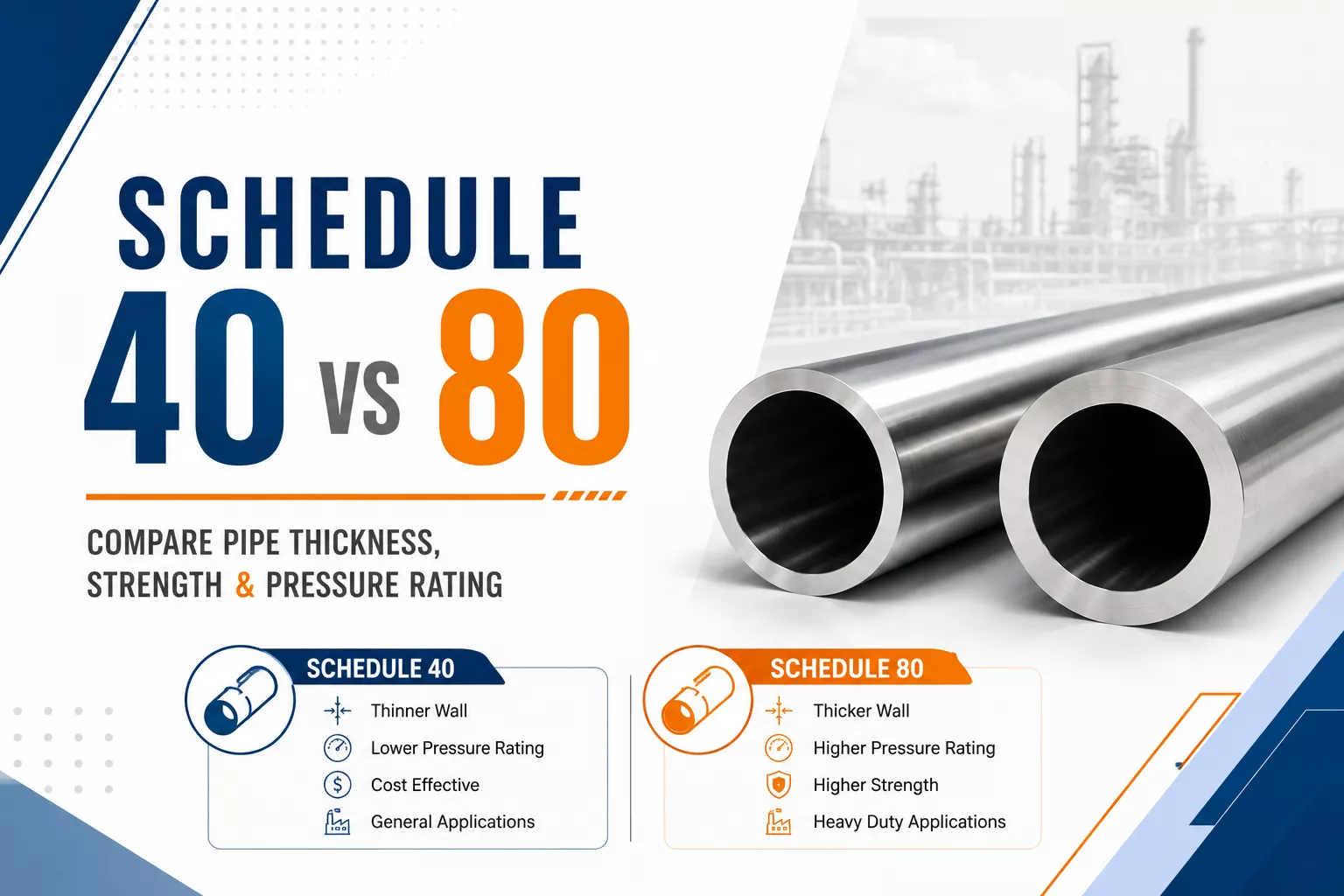
Schedule 40 vs Schedule 80: Which Is Better?
Neither Schedule 40 nor Schedule 80 is universally better. The better choice depends on the operating pressure, temperature, required flow area, material, installation conditions and project requirements.
Schedule 40 is often preferred when a thinner wall provides sufficient mechanical and pressure performance. Its larger ID, lower weight and lower material requirement can make it a practical choice for general-purpose piping.
Schedule 80 is preferred when additional wall thickness and pressure or mechanical resistance are required. The trade-off is a smaller ID, higher weight and generally higher material cost.
| Requirement | Better Choice | Why |
|---|---|---|
| Lower material cost | Schedule 40 | Uses less material |
| Lower pipe weight | Schedule 40 | Thinner wall |
| Larger internal diameter | Schedule 40 | Provides a larger flow passage |
| Higher pressure requirement | Schedule 80* | Thicker wall generally provides higher pressure capacity |
| Greater mechanical protection | Schedule 80* | More wall material |
| General-purpose piping | Schedule 40* | Often sufficient where design requirements allow |
| Demanding industrial service | Schedule 80* | May provide additional wall thickness |
* The final selection must be based on the applicable design calculations, material specification, temperature and pressure requirements.
How to Choose Between Schedule 40 and Schedule 80
Choosing between Schedule 40 and Schedule 80 should start with the actual operating requirements, rather than simply selecting the thicker pipe.
1. Check Operating Pressure
Determine the maximum design pressure of the piping system. If Schedule 40 does not provide the required allowable pressure at the operating temperature, a thicker-wall option such as Schedule 80 may be required.
2. Check Operating Temperature
Temperature affects the allowable pressure of many pipe materials. Always evaluate the pipe using the applicable material specification, temperature limits and design code.
3. Compare Required ID
Schedule 80 has a thicker wall and therefore a smaller ID for the same NPS. If maintaining a larger internal flow area is important, Schedule 40 may be preferable when it meets the design requirements.
4. Consider Weight and Installation
Schedule 80 contains more material, making it heavier than Schedule 40. This can affect handling, supports, transportation, fabrication and installation.
5. Consider Material and Service Conditions
Pipe selection should also account for the material and the service environment. For industrial applications, factors such as corrosion resistance, temperature, pressure, mechanical loads and chemical exposure may influence the required pipe specification.
6. Check the Applicable Standard
Verify the required dimensions and allowable pressure against the applicable ASTM, ASME or other relevant product and design standard. Schedule alone is not enough to determine whether a pipe is suitable.
Quick Selection Guide
Choose Schedule 40 when:
- The required pressure rating can be met.
- A larger internal diameter is beneficial.
- Lower weight is preferred.
- Cost and ease of installation are important.
- The application does not require additional wall thickness.
Choose Schedule 80 when:
- A thicker pipe wall is required by the design.
- Higher pressure capacity is needed.
- Greater mechanical resistance is required.
- The smaller ID is acceptable for the application.
- Project specifications call for Schedule 80.
Bottom Line
The choice between Schedule 40 and Schedule 80 should be based on the complete piping specification, not schedule number alone. Compare NPS, OD, wall thickness, ID, material grade, operating pressure, temperature, flow requirements and applicable standards before selecting the pipe.
Frequently Asked Questions
The main difference is wall thickness. For the same nominal pipe size, Schedule 80 has a thicker wall, smaller inside diameter, greater weight, and generally higher pressure capacity than Schedule 40. Schedule 40 has a thinner wall and larger internal flow area.
Schedule 80 generally provides greater wall thickness and mechanical strength than Schedule 40 when comparing pipes of the same material and nominal size. However, the actual allowable pressure and strength depend on the material, temperature, dimensions, and applicable design standard.
Yes. For the same nominal pipe size, Schedule 40 and Schedule 80 generally have the same standard outside diameter. The main dimensional difference is wall thickness, which results in a different inside diameter.
Schedule 40 has a larger inside diameter because its wall is thinner. Schedule 80 has a thicker wall, which reduces the available internal diameter for the same nominal pipe size and standard outside diameter.
Neither schedule is universally better. Schedule 40 may be suitable when the required pressure rating can be achieved with a thinner wall, while Schedule 80 is generally selected when additional wall thickness and pressure or mechanical resistance are required. The choice should be based on the application and design requirements.
Generally, yes. Schedule 80 contains more material because of its thicker wall, making it heavier and typically more expensive than Schedule 40. The final cost also depends on the pipe material, size, length, grade, manufacturing method, and market conditions.
Schedule 80 may be preferred when a thicker wall is required for higher pressure or mechanical loading. However, schedule alone does not determine the allowable working pressure. The pipe material, NPS, operating temperature, design pressure, applicable standard, and engineering calculations must also be considered.
Compare the required operating pressure, temperature, flow area, material, pipe size, wall thickness, installation requirements, and applicable standards. Choose Schedule 40 when its specifications meet the system requirements; choose Schedule 80 when the application requires additional wall thickness or pressure and mechanical performance.