
-
-
-
Girgaon, Mumbai - 400004
Schedule 80 Pipe Dimensions in mm & Inches
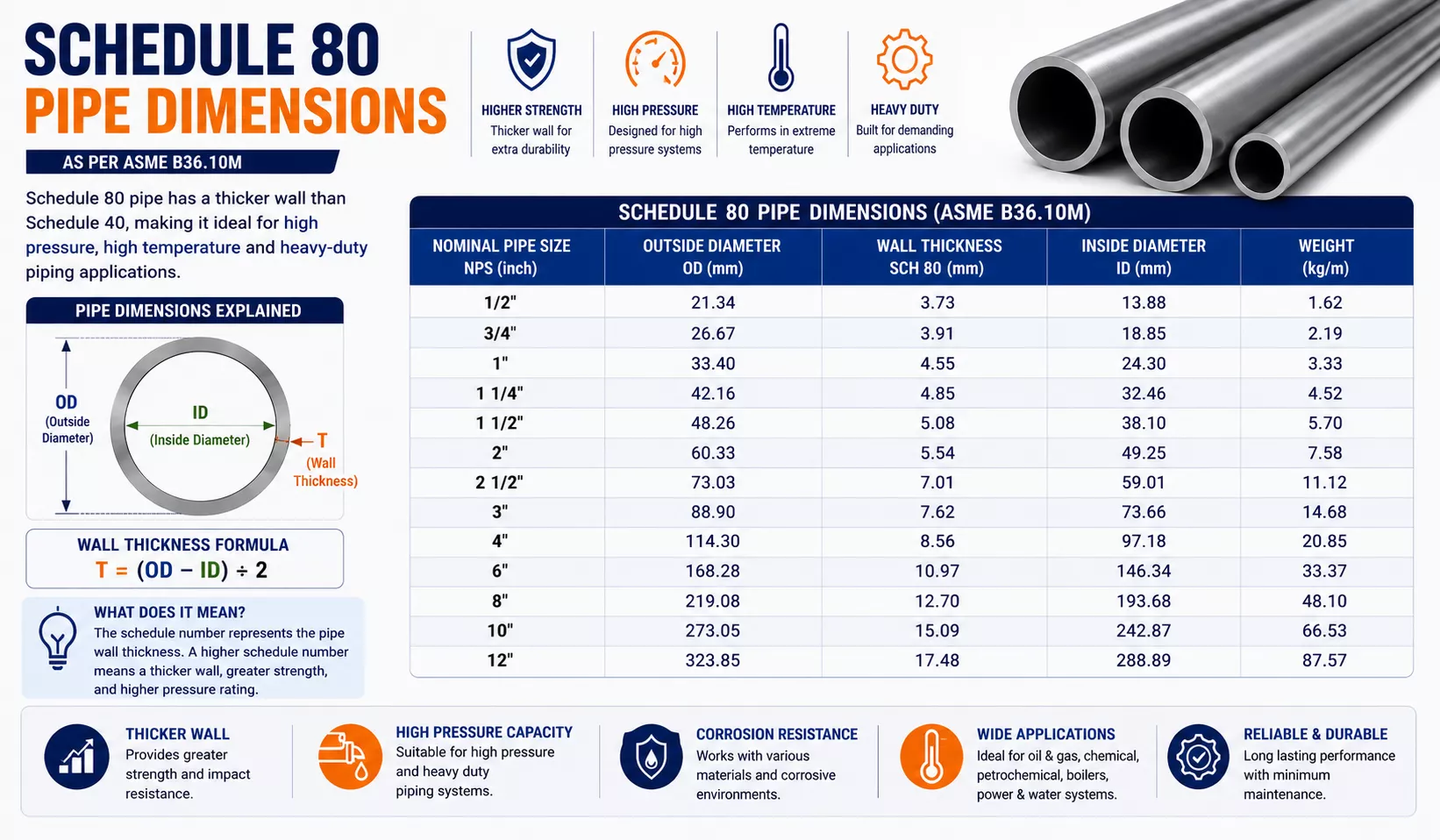
Schedule 80 Pipe Dimensions vary according to the nominal pipe size. Schedule 80 is a pipe wall designation that generally indicates a heavier wall than Schedule 40 for the same nominal pipe size. The outside diameter remains based on the nominal pipe size, while the thicker wall results in a smaller inside diameter.
Schedule 80 Steel Pipe Dimensions in mm include the nominal pipe size (NPS), outside diameter (OD), wall thickness and inside diameter (ID). For example, a 2-inch Schedule 80 pipe has an outside diameter of 60.3 mm and a nominal wall thickness of 5.54 mm (0.218 inch).
This Schedule 80 Pipe Dimensions Chart provides common pipe sizes with outside diameter, wall thickness and approximate inside diameter in millimetres and inches.
What Is Schedule 80 Pipe?
Schedule 80 Pipe is a pipe with a heavier nominal wall thickness than Schedule 40 pipe for the same nominal pipe size. The schedule number identifies a pipe wall series rather than one fixed wall thickness for every pipe size.
The actual Schedule 80 pipe dimensions depend on the Nominal Pipe Size (NPS). As the NPS changes, the outside diameter and nominal wall thickness also change. Because Schedule 80 has a thicker wall than Schedule 40 for the same applicable NPS, its inside diameter is generally smaller.
Schedule 80 pipe is commonly selected when a heavier pipe wall is required. The appropriate pipe size, material grade, manufacturing specification, operating temperature, and design conditions should be considered before selecting a pipe for a particular application.
Schedule 80 Pipe Dimensions Chart in mm & Inches
Schedule 80 steel pipe dimensions in mm are determined by the nominal pipe size and its corresponding outside diameter and nominal wall thickness. The approximate inside diameter can be calculated by subtracting twice the wall thickness from the outside diameter.
| Nominal Pipe Size (NPS) | DN | Outside Diameter (OD) mm | Wall Thickness mm | Wall Thickness (inch) | Inside Diameter (ID) mm |
|---|---|---|---|---|---|
| 1/2 Inch | 15 | 21.3 | 3.73 | 0.147 | 13.8 |
| 3/4 Inch | 20 | 26.7 | 3.91 | 0.154 | 18.9 |
| 1 Inch | 25 | 33.4 | 4.55 | 0.179 | 24.3 |
| 1-1/4 Inch | 32 | 42.2 | 4.85 | 0.191 | 32.5 |
| 1-1/2 Inch | 40 | 48.3 | 5.08 | 0.200 | 38.1 |
| 2 Inch | 50 | 60.3 | 5.54 | 0.218 | 49.2 |
| 2-1/2 Inch | 65 | 73.0 | 7.01 | 0.276 | 59.0 |
| 3 Inch | 80 | 88.9 | 7.62 | 0.300 | 73.7 |
| 4 Inch | 100 | 114.3 | 8.56 | 0.337 | 97.2 |
| 5 Inch | 125 | 141.3 | 9.53 | 0.375 | 122.2 |
| 6 Inch | 150 | 168.3 | 10.97 | 0.432 | 146.4 |
DN80 Schedule 80 pipe corresponds to NPS 3. The nominal outside diameter is 88.9 mm, and the Schedule 80 nominal wall thickness is 7.62 mm. The approximate inside diameter is 73.7 mm, calculated from the nominal OD and wall thickness.
Note: The dimensions in this chart are for commonly referenced steel pipe dimensions. Stainless steel pipe dimensions should be checked against the applicable dimensional standard, such as ASME B36.19M, because certain Schedule 80S dimensions differ from ASME B36.10M.
Schedule 80 Pipe Pressure Rating
The Schedule 80 pipe pressure rating is not a single fixed pressure value that applies to every Schedule 80 pipe. The allowable working pressure depends on several factors, including pipe material, grade, nominal pipe size, wall thickness, operating temperature, allowable stress, design code, and applicable product specification.
Schedule 80 pipe has a thicker nominal wall than Schedule 40 for the same nominal pipe size. The additional wall thickness generally provides greater pressure-handling capability under comparable design conditions. However, the schedule designation alone should not be used to determine the maximum allowable working pressure.
| Factor | Effect on Pressure Rating |
|---|---|
| Pipe Material | Different materials have different allowable stresses and pressure-temperature capabilities. |
| Pipe Grade | The grade affects mechanical properties and allowable stress used for pressure design. |
| Pipe Size | Pressure capacity varies with nominal size and pipe dimensions. |
| Wall Thickness | A thicker wall generally provides greater pressure resistance under comparable conditions. |
| Operating Temperature | Allowable pressure may decrease as operating temperature increases, depending on the material and design code. |
| Design Code | The applicable piping code determines the requirements used for pressure design and allowable stress. |
| Corrosion Allowance | Additional wall allowance may be required where corrosion or material loss is expected during service. |
| Joint Type | Welded, seamless, and other construction methods may have different design considerations. |
For example, a 2-inch Schedule 80 pipe has a nominal outside diameter of 60.3 mm and a nominal wall thickness of 5.54 mm. Its pressure capacity cannot be determined from these dimensions alone because the material grade, design temperature, allowable stress, corrosion allowance, and applicable design code must also be considered.
For engineering applications, the allowable working pressure should be determined using the applicable piping code and material specification. The calculation should consider operating temperature, allowable stress, corrosion allowance, manufacturing tolerances, joint efficiency where applicable, and other project-specific design requirements.
Therefore, Schedule 80 should be understood primarily as a pipe dimensional or wall-thickness series designation, not as a universal pressure class. Always verify the required pressure rating with the applicable standard, material specification, and engineering design before selecting the pipe.
Schedule 80 Pipe Schedule Chart
A Pipe Schedule Chart helps identify the nominal wall thickness series used for different pipe sizes. Common pipe schedules include Schedule 10, Schedule 40, Schedule 80, and Schedule 160. The applicable schedules and dimensions depend on the nominal pipe size and the dimensional standard being used.
The schedule number does not represent a fixed wall thickness in millimetres. The nominal wall thickness changes according to the Nominal Pipe Size (NPS). Therefore, a Schedule 40 or Schedule 80 pipe can have different wall thicknesses at different pipe sizes.
| Pipe Schedule | General Description | Relative Wall Thickness |
|---|---|---|
| Schedule 10 | Light-wall pipe series used for applicable pipe sizes and service conditions | Generally thinner |
| Schedule 40 | Common pipe schedule used across many industrial and general piping applications | Generally thicker than Schedule 10 |
| Schedule 80 | Heavier-wall pipe series commonly selected where greater wall thickness is required | Generally thicker than Schedule 40 |
| Schedule 160 | Heavy-wall pipe series available for applicable nominal pipe sizes | Generally thicker than Schedule 80 |
For the same nominal pipe size, a higher schedule generally indicates a thicker nominal wall and a smaller inside diameter. For example, a 2-inch Schedule 40 pipe has a nominal wall thickness of 3.91 mm, while a 2-inch Schedule 80 pipe has a nominal wall thickness of 5.54 mm.
The outside diameter (OD) for the same NPS generally remains unchanged when comparing different schedules, while the increased wall thickness reduces the available inside diameter (ID).
For exact pipe dimensions, always refer to the applicable dimensional standard and the specific NPS and schedule rather than treating the schedule number as a direct wall-thickness measurement.
Schedule 40 vs Schedule 80 Inside Diameter
Schedule 80 pipe is thicker than Schedule 40 for the same nominal pipe size. Because the outside diameter remains the same for the same NPS, the thicker Schedule 80 wall results in a smaller inside diameter.
For example, a 2-inch pipe has an outside diameter of 60.3 mm. A 2-inch Schedule 40 pipe has a nominal wall thickness of 3.91 mm, giving an approximate inside diameter of 52.5 mm. A 2-inch Schedule 80 pipe has a nominal wall thickness of 5.54 mm, giving an approximate inside diameter of 49.2 mm.
The approximate inside diameter can be calculated using the following formula:
ID = OD − (2 × Wall Thickness)
| NPS | OD (mm) | Schedule 40 ID (mm) | Schedule 80 ID (mm) |
|---|---|---|---|
| 1 Inch | 33.4 | 26.6 | 24.3 |
| 2 Inch | 60.3 | 52.5 | 49.2 |
| 3 Inch | 88.9 | 77.9 | 73.7 |
| 4 Inch | 114.3 | 102.3 | 97.2 |
| 6 Inch | 168.3 | 154.1 | 146.4 |
| 8 Inch | 219.1 | 202.7 | 193.7 |
Therefore, when comparing pipes of the same nominal size, Schedule 80 has a smaller inside diameter than Schedule 40. The exact dimensions should always be verified against the applicable pipe dimensional standard and product specification.
Schedule 40 vs Schedule 80: Schedule 80 has a thicker nominal wall than Schedule 40 for the same nominal pipe size. For a detailed comparison of dimensions and thickness, see our Schedule 40 vs Schedule 80 Pipe guide.
Key Takeaways
- Schedule 80 pipe has a heavier nominal wall than Schedule 40 for the same nominal pipe size.
- Schedule 80 pipe dimensions vary according to the Nominal Pipe Size (NPS).
- The outside diameter is based on the nominal pipe size, while the wall thickness determines the approximate inside diameter.
- Schedule 80 pipe thickness in mm changes according to the NPS and should be taken from the applicable dimensional standard.
- Schedule 80 does not have one universal pressure rating. Pressure capacity depends on material, temperature, dimensions, design code, and other engineering factors.
- Always verify the pipe specification, material grade, dimensions, and applicable standard before selecting pipe for an engineering application.
Frequently Asked Questions
DN80 corresponds to NPS 3. A DN80 Schedule 80 steel pipe has a nominal outside diameter of 88.9 mm and a nominal wall thickness of 7.62 mm. Its approximate inside diameter is 73.7 mm.
Schedule 80 does not represent one fixed thickness in millimetres. The wall thickness changes according to the nominal pipe size. For example, 1-inch Schedule 80 pipe has a nominal wall thickness of 4.55 mm, while 2-inch Schedule 80 pipe has a thickness of 5.54 mm.
An 80 mm designation should not automatically be interpreted as an 80 mm outside diameter. In pipe sizing, DN80 generally corresponds to NPS 3, which has an outside diameter of 88.9 mm. The wall thickness depends on the selected pipe schedule.
A 12-inch Schedule 80 pipe has a nominal outside diameter of 323.8 mm and a nominal wall thickness of 17.48 mm. Its approximate inside diameter is 288.8 mm, calculated from the nominal dimensions.
The nominal wall thickness of a 2-1/2 inch Schedule 80 pipe is 7.01 mm (0.276 inch).
The nominal wall thickness of a 3-inch Schedule 80 pipe is 7.62 mm (0.300 inch). Its nominal outside diameter is 88.9 mm.
Schedule 80 pipe is used in piping systems where a heavier nominal wall is required. Depending on the material, specification, design conditions, and applicable code, it may be used in industrial, process, utility, and other piping systems.
A 4-inch Schedule 80 pipe has a nominal wall thickness of 8.56 mm (0.337 inch) and an outside diameter of 114.3 mm.
Schedule 80 is available across a range of nominal pipe sizes. Common sizes include 1/2 inch, 1 inch, 2 inch, 3 inch, 4 inch, 6 inch, 8 inch, 10 inch, 12 inch and larger sizes. The outside diameter and wall thickness depend on the NPS.
A 1-inch Schedule 80 pipe has a nominal wall thickness of 4.55 mm (0.179 inch) and an outside diameter of 33.4 mm.
The outside diameter of Schedule 80 pipe depends on the nominal pipe size. For example, a 1-inch pipe has an OD of 33.4 mm, a 2-inch pipe has an OD of 60.3 mm, and a 4-inch pipe has an OD of 114.3 mm.