
-
-
-
Girgaon, Mumbai - 400004
What Is Schedule 80 Pipe? Thickness, Dimensions & Chart
Schedule 80 Pipe is a pipe with a relatively thick wall for its nominal pipe size, providing greater wall thickness than lower schedules such as Schedule 40. It is available in different materials, including carbon steel, stainless steel, PVC, UPVC and CPVC, depending on the application and applicable standard.
The term 80 Schedule Pipe does not represent one fixed wall thickness in millimetres. The actual thickness depends on the nominal pipe size, outside diameter and dimensional standard. Therefore, a 2 inch Schedule 80 pipe and a 6 inch Schedule 80 pipe have different wall thicknesses.
We explain Schedule 80 pipe meaning, dimensions, thickness in mm, Schedule 80 pipe thickness charts, steel pipe dimensions, PVC and UPVC Schedule 80 piping, pressure considerations, applications and the difference between Schedule 40 and Schedule 80.
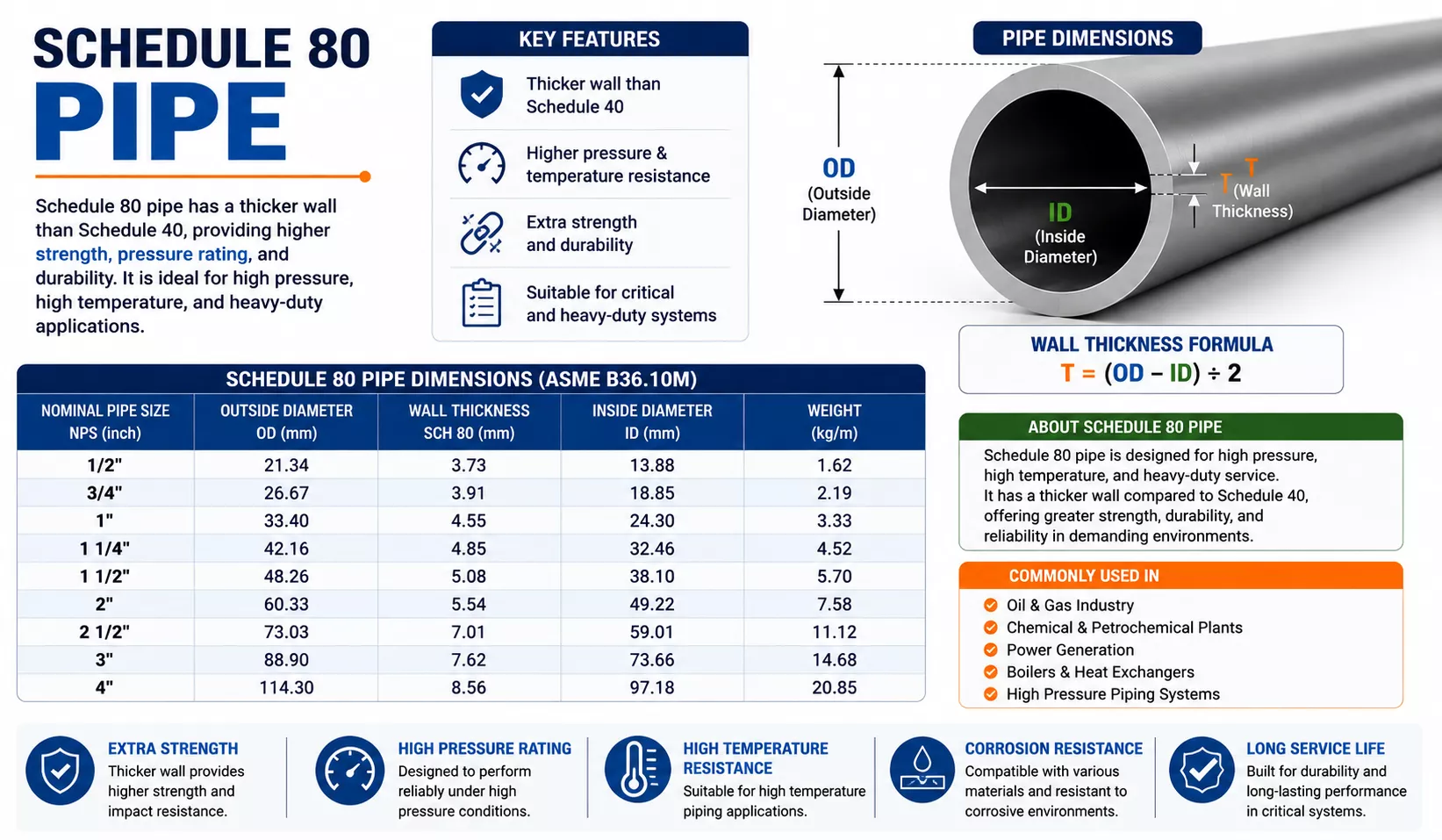
What Is Schedule 80 Pipe?
Schedule 80 Pipe is a standardized pipe wall-thickness designation used for specific nominal pipe sizes. For a given nominal size, Schedule 80 generally has a thicker wall than Schedule 40, which results in a smaller internal diameter when the outside diameter remains the same.
Schedule numbers are used to identify standardized dimensional series. The schedule number itself should not be interpreted as the wall thickness in millimetres. The actual wall thickness must be obtained from the applicable dimensional standard for the pipe material and nominal size.
Schedule 80 pipes are selected when the application requires a heavier wall than a lower schedule can provide. They are commonly used in industrial piping, process systems, pressure service and other applications where pipe-wall strength and durability are important.
What Does Schedule 80 Mean for Pipe?
The term Schedule 80 identifies a particular standardized wall-thickness series for a nominal pipe size. It does not mean that the pipe wall is 80 mm thick or that the pipe has a universal pressure rating.
For example, the wall thickness of a 2 inch Schedule 80 steel pipe is different from that of a 6 inch Schedule 80 steel pipe. This is why Schedule 80 pipe dimensions should always be checked by nominal size and the relevant dimensional standard.
In simple terms, a higher schedule generally indicates a thicker pipe wall for the same nominal size. A thicker wall can reduce the internal diameter and increase the pipe's weight per unit length.
Schedule 80 Pipe Dimensions
Schedule 80 Pipe Dimensions include nominal pipe size, outside diameter, wall thickness and calculated internal diameter. The exact dimensions depend on the material and dimensional standard being used.
For steel piping, commonly referenced dimensions are covered by ASME B36.10M, while stainless steel pipe dimensions are covered by ASME B36.19M. Plastic Schedule 80 piping uses different dimensional standards and should not be dimensioned using steel pipe tables.
The following steel pipe dimensions provide a useful reference for common Schedule 80 sizes:
| NPS | DN | Outside Diameter | Schedule | Wall Thickness |
|---|---|---|---|---|
| 1/2 | 15 | 21.3 mm | Schedule 80 | 3.73 mm |
| 3/4 | 20 | 26.7 mm | Schedule 80 | 3.91 mm |
| 1 | 25 | 33.4 mm | Schedule 80 | 4.55 mm |
| 1-1/4 | 32 | 42.2 mm | Schedule 80 | 4.85 mm |
| 1-1/2 | 40 | 48.3 mm | Schedule 80 | 5.08 mm |
| 2 | 50 | 60.3 mm | Schedule 80 | 5.54 mm |
| 3 | 80 | 88.9 mm | Schedule 80 | 7.62 mm |
| 4 | 100 | 114.3 mm | Schedule 80 | 8.56 mm |
| 6 | 150 | 168.3 mm | Schedule 80 | 10.97 mm |
Schedule 80 Pipe Thickness in mm
Schedule 80 Pipe Thickness in mm varies according to the nominal pipe size and applicable standard. There is no single Schedule 80 wall thickness that applies to every pipe size.
For example, common 80 Schedule Pipe Thickness Sizes range from approximately 3.73 mm wall thickness for 1/2 inch NPS to approximately 10.97 mm for 6 inch NPS. Larger pipe sizes have their own standardized wall thicknesses.
When specifying pipe, the nominal size and schedule should therefore be stated together. Material grade and applicable dimensional standard should also be confirmed before purchasing or fabrication.
Schedule 80 Pipe Thickness in mm Chart
The following Schedule 80 pipe thickness chart provides common reference dimensions for steel pipe. These values should be checked against the applicable edition of the dimensional standard before engineering, fabrication or pressure design.
| NPS | DN | OD | Schedule 80 Thickness |
|---|---|---|---|
| 1/2 Inch | 15 | 21.3 mm | 3.73 mm |
| 3/4 Inch | 20 | 26.7 mm | 3.91 mm |
| 1 Inch | 25 | 33.4 mm | 4.55 mm |
| 1-1/4 Inch | 32 | 42.2 mm | 4.85 mm |
| 1-1/2 Inch | 40 | 48.3 mm | 5.08 mm |
| 2 Inch | 50 | 60.3 mm | 5.54 mm |
| 3 Inch | 80 | 88.9 mm | 7.62 mm |
| 4 Inch | 100 | 114.3 mm | 8.56 mm |
| 6 Inch | 150 | 168.3 mm | 10.97 mm |
2 Inch Schedule 80 Pipe Thickness in mm
A commonly referenced 2 inch Schedule 80 steel pipe has an outside diameter of approximately 60.3 mm and a wall thickness of approximately 5.54 mm.
Using the nominal outside diameter and wall thickness, the theoretical internal diameter can be calculated as:
Internal Diameter = Outside Diameter − (2 × Wall Thickness)
For a 2 inch Schedule 80 steel pipe, this gives an approximate internal diameter of 49.22 mm before considering manufacturing tolerances.
6 Inch Schedule 80 Pipe Thickness in mm
A commonly referenced 6 inch Schedule 80 steel pipe has an outside diameter of approximately 168.3 mm and a wall thickness of approximately 10.97 mm.
Based on these nominal dimensions, the calculated internal diameter is approximately 146.36 mm. Actual manufactured dimensions can vary within the tolerances permitted by the applicable specification.
Schedule 80 Pipe ID and OD
In pipe terminology, OD means outside diameter and ID means internal diameter. For many standardized steel pipe sizes, the outside diameter is fixed for a particular nominal pipe size, while the wall thickness changes with the schedule.
The approximate internal diameter can be calculated using:
ID = OD − (2 × Wall Thickness)
Because Schedule 80 generally has a thicker wall than Schedule 40 for the same nominal size, its internal diameter is generally smaller.
Schedule 80 Pipe Pressure Rating
Schedule 80 does not have one universal pressure rating. The allowable pressure depends on factors such as pipe material, grade, outside diameter, wall thickness, operating temperature, design code, corrosion allowance, manufacturing specification and joining method.
Therefore, it is not appropriate to state that every Schedule 80 pipe is rated for one specific pressure. A pressure design calculation should be performed using the applicable material standard and engineering code.
For plastic Schedule 80 pipes, pressure capability is also influenced by the resin material, temperature, pipe dimensions and the applicable plastic piping standard.
Schedule 80 Steel Pipe
Schedule 80 steel pipe is available in carbon steel and stainless steel grades for different industrial applications. The thicker wall provides greater cross-sectional material than lower schedules and can be suitable for demanding mechanical and process conditions.
Stainless steel Schedule 80 pipe may be manufactured in grades such as 304, 304L, 316, 316L and other stainless grades, depending on the required corrosion resistance, temperature and service conditions.
Kamal Steels supplies stainless steel pipes and tubes in different grades, sizes, schedules and specifications for industrial applications.
Schedule 80 PVC and UPVC Pipe
Schedule 80 PVC pipe is a plastic pressure pipe with a thicker wall construction than lower schedule PVC pipe of the same nominal size. The terms pvc pipe schedule 80, 80 schedule pvc pipe, and schedule 80 pvc pipe are commonly used when referring to this type of plastic piping.
UPVC pipe Schedule 80 refers to unplasticized PVC piping manufactured in a Schedule 80 dimensional series where applicable. However, PVC and UPVC products should be selected using the manufacturer's dimensional data and the applicable plastic-pipe standard.
Plastic Schedule 80 pipe dimensions should not be copied from steel Schedule 80 tables. PVC/UPVC pipe has different dimensional requirements, material properties and pressure-rating methods.
Schedule 80 PVC and UPVC Pipe Reference
| Pipe Type | Schedule | Typical Selection | Key Consideration |
|---|---|---|---|
| PVC Pipe | Schedule 80 | Pressure piping and industrial services | Check pressure rating and temperature limits |
| UPVC Pipe | Schedule 80 | Industrial and utility applications | Confirm applicable standard and manufacturer data |
The exact outside diameter, wall thickness and pressure rating for PVC or UPVC Schedule 80 pipe should always be taken from the applicable product standard or manufacturer's technical datasheet.
Schedule 80 CPVC Pipe
Schedule 80 CPVC pipe is a chlorinated polyvinyl chloride piping product manufactured in a Schedule 80 dimensional series for applications where CPVC's temperature and chemical-resistance properties are suitable.
CPVC should not be treated as interchangeable with PVC simply because both can be available in Schedule 80. Their material properties, temperature capabilities, joining requirements and applicable standards can differ.
Before selecting Schedule 80 CPVC pipe, check the pipe manufacturer's pressure-temperature ratings, dimensions, joining system and chemical compatibility for the intended service.
Schedule 40 vs Schedule 80 Pipe
Schedule 40 vs Schedule 80 Pipe are different wall-thickness series. For the same nominal size and material system, Schedule 80 generally has a thicker wall than Schedule 40.
| Feature | Schedule 40 | Schedule 80 |
|---|---|---|
| Wall Thickness | Generally lower | Generally higher |
| Internal Diameter | Generally larger | Generally smaller |
| Pipe Weight | Generally lower | Generally higher |
| Material Usage | Lower | Higher |
| Typical Selection | General piping applications | Applications requiring heavier wall construction |
The actual pressure capability of either schedule must be determined from the material specification, operating temperature and applicable design requirements rather than from the schedule number alone.
Schedule 80 Pipe Standards
Schedule 80 pipe dimensions are defined through applicable dimensional standards rather than by the schedule number alone.
- ASME B36.10M: Dimensions for welded and seamless wrought steel pipe.
- ASME B36.19M: Dimensions for welded and seamless wrought stainless steel pipe.
- ASTM product specifications: Individual ASTM specifications may reference standardized pipe dimensions and define additional material and manufacturing requirements.
For PVC, UPVC and CPVC products, the applicable plastic-pipe standard and manufacturer's technical data should be used instead of applying steel pipe dimensions.
How to Select Schedule 80 Pipe
Selecting the correct Schedule 80 pipe requires more than choosing the schedule number. Consider the complete operating and dimensional requirements of the piping system.
- Determine nominal pipe size: Identify the required NPS or DN size.
- Select the material: Choose carbon steel, stainless steel, PVC, UPVC, CPVC or another suitable material.
- Confirm wall thickness: Check the applicable schedule and dimensional standard.
- Check operating pressure: Confirm the allowable pressure at the actual operating temperature.
- Consider corrosion and chemical exposure: Select a material compatible with the service fluid and environment.
- Verify applicable standards: Confirm the required ASTM, ASME or plastic-piping standard.
- Confirm end connections: Select threaded, plain, beveled, flanged or other required ends.
For industrial stainless steel applications, Kamal Steels can assist with selecting Schedule 80 pipe according to size, grade, specification, quantity and application requirements.
Frequently Asked Questions About Schedule 80 Pipe
Schedule 80 pipe is a standardized pipe wall-thickness series. For a given nominal size, it generally has a thicker wall than Schedule 40 pipe.
Schedule 80 identifies a particular wall-thickness series for a nominal pipe size. The number 80 does not mean that the pipe wall is 80 mm thick.
Schedule 80 generally has a thicker wall than Schedule 40 for the same nominal size. This usually results in greater pipe weight and a smaller internal diameter.
Schedule 80 thickness depends on the nominal pipe size and applicable standard. For example, common steel Schedule 80 thicknesses include approximately 5.54 mm for 2 inch pipe and 10.97 mm for 6 inch pipe.
A commonly referenced 2 inch Schedule 80 steel pipe has a wall thickness of approximately 5.54 mm and an outside diameter of approximately 60.3 mm.
A commonly referenced 6 inch Schedule 80 steel pipe has a wall thickness of approximately 10.97 mm and an outside diameter of approximately 168.3 mm.
Schedule 80 pipe is commonly used in industrial process piping, oil and gas, chemical processing, petrochemical, power, utility and other applications requiring a heavier wall pipe construction.
Schedule 80 steel pipe is steel pipe manufactured to a Schedule 80 dimensional series. It can be supplied in carbon steel or stainless steel grades depending on the application.
Schedule 80 PVC pipe is a plastic pipe manufactured in a Schedule 80 dimensional series. It is commonly used for pressure and industrial piping applications where PVC is suitable.
UPVC pipe Schedule 80 refers to unplasticized PVC pipe manufactured in a Schedule 80 dimensional series where applicable. Dimensions and pressure ratings should be confirmed from the applicable product standard or manufacturer.
Schedule 80 CPVC pipe is CPVC piping manufactured in a Schedule 80 dimensional series. It can be used where CPVC's temperature and chemical-resistance characteristics are appropriate for the service.
There is no single pressure rating for all Schedule 80 pipes. Allowable pressure depends on material, size, wall thickness, temperature, design code and other service conditions.
ASME B36.10M is commonly used for dimensions of wrought steel pipe, while ASME B36.19M covers wrought stainless steel pipe dimensions.
The load-carrying capacity of Schedule 80 steel pipe cannot be determined from the schedule alone. It depends on material grade, pipe size, span, loading condition, temperature, support arrangement and engineering design.
Schedule 80 PVC pipe is commonly manufactured in gray, although color can vary by manufacturer and product range. Pipe schedule should be identified from markings and technical specifications rather than color alone.
Schedule 80 PVC pipe pricing varies according to nominal size, length, manufacturer, material specification, quantity and location. A supplier quotation is required for an accurate current price.