
-
-
-
Girgaon, Mumbai - 400004
Schedule 80 Pipe Thickness in mm, Dimensions & Pipe Chart
Schedule 80 Pipe is a standardized pipe wall-thickness designation used for various piping products. For steel and stainless steel pipe, dimensional requirements are covered by standards such as ASME B36.10M and ASME B36.19M. Schedule 80 thermoplastic pipes such as PVC and CPVC use their own applicable dimensional and product standards.
Whether you are searching for schedule 80 pipe thickness in mm, sch 80 pipe dimensions, 80 NB pipe dimensions, 2 inch schedule 80 pipe thickness in mm, or looking to understand the difference between Schedule 40 vs Schedule 80, this guide provides complete information including dimensions, thickness charts, weight tables, applications, materials and buying recommendations.
The following chart shows standard Schedule 80 pipe thickness in mm according to ASME B36.10M and ASME B36.19M. These Schedule 80 pipe dimensions are widely used for carbon steel, stainless steel, alloy steel, PVC, CPVC and UPVC.
Get Schedule 80 Pipe Price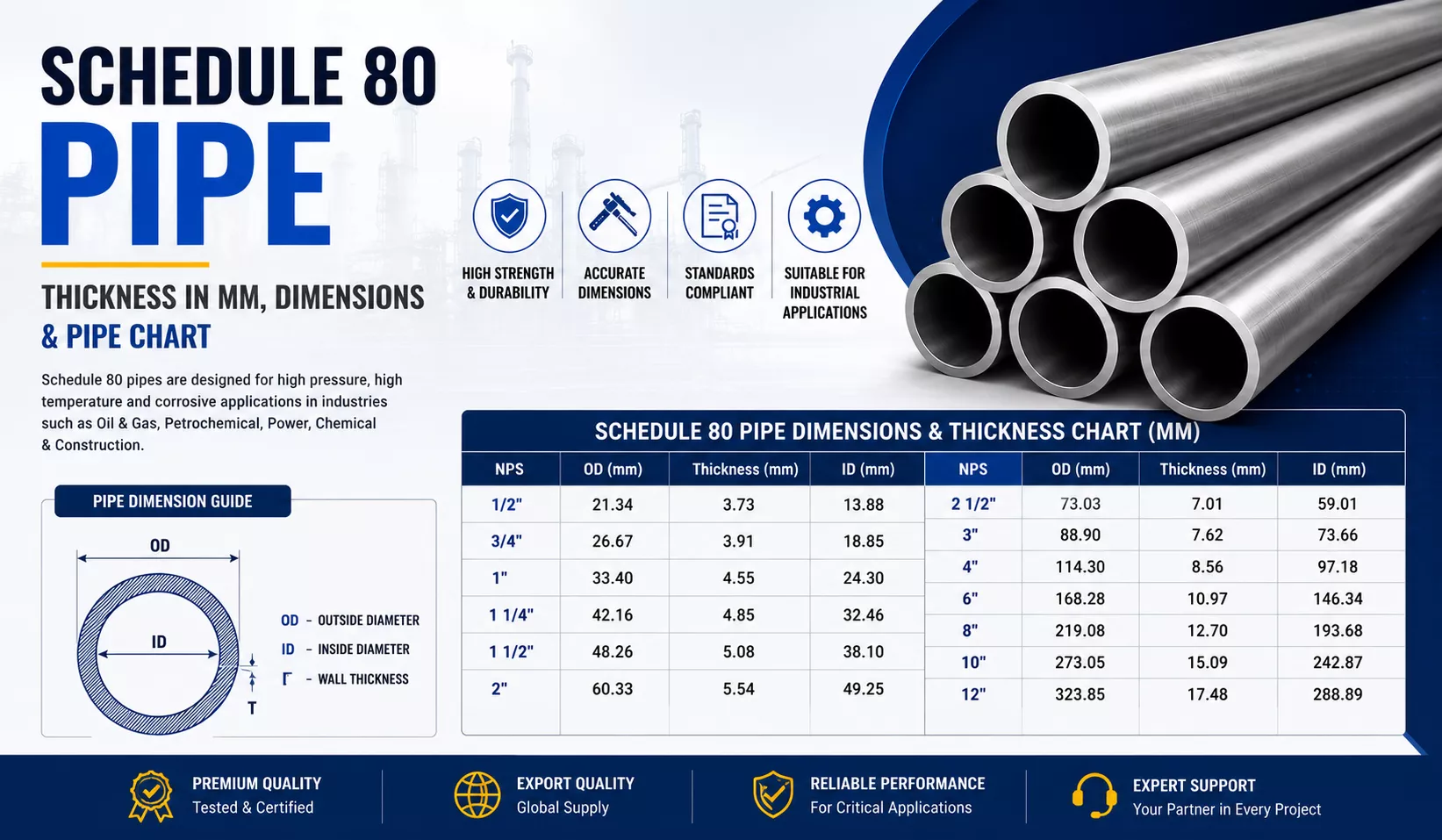
What is Schedule 80 Pipe?
Schedule 80 Pipe is a standardized pipe wall thickness classification defined by the American Society of Mechanical Engineers (ASME). The word "Schedule" refers to the wall thickness of a pipe rather than its outside diameter.
A Schedule 80 pipe generally has a thicker wall than a Schedule 40 pipe of the same nominal size, while the outside diameter remains standardized for the applicable steel pipe dimensional system. The thicker wall can provide greater pressure capacity, but the allowable pressure depends on material grade, temperature, dimensions, and the applicable design code.
Schedule 80 piping is commonly used in oil & gas, chemical processing, power plants, pharmaceutical facilities, marine industries, fire protection systems, pressure piping, and process engineering applications.
Key Features of Schedule 80 Pipe
Schedule 80 pipes are designed for demanding applications where increased wall thickness, pressure capacity, mechanical strength, and reliable service performance are required.
What Does SCH Mean in Pipe?
SCH stands for Schedule, which is the standardized designation used to define pipe wall thickness.
The schedule number does not represent the outside diameter. Instead, it indicates the wall thickness relative to the pipe size. As the schedule number increases, the wall thickness generally becomes greater.
| Pipe Schedule | Description |
|---|---|
| Schedule 10 | Thin Wall Pipe |
| Schedule 40 | Standard Wall Pipe |
| Schedule 80 | Heavy Wall |
| Schedule 160 | Extra Heavy Wall |
Schedule 80 Pipe Thickness in mm Chart
The following chart shows commonly referenced Schedule 80 pipe thickness in mm for steel and stainless steel pipe dimensions covered by ASME B36.10M and ASME B36.19M. For a given nominal pipe size, Schedule 80 generally has a thicker wall than Schedule 40, resulting in a smaller inside diameter. Pressure capacity must be determined from the material, temperature, dimensions, and applicable design code.
| Nominal Pipe Size | Outside Diameter (OD) (mm) | Schedule 80 Wall Thickness (mm) |
|---|---|---|
| 1/2" | 21.3 | 3.73 |
| 3/4" | 26.7 | 3.91 |
| 1" | 33.4 | 4.55 |
| 1-1/4" | 42.2 | 4.85 |
| 1-1/2" | 48.3 | 5.08 |
| 2" | 60.3 | 5.54 |
| 2-1/2" | 73.0 | 7.01 |
| 3" | 88.9 | 7.62 |
| 4" | 114.3 | 8.56 |
| 5" | 141.3 | 9.53 |
| 6" | 168.3 | 10.97 |
| 8" | 219.1 | 12.70 |
These Schedule 80 pipe dimensions are widely used for carbon steel, stainless steel, alloy steel, PVC, CPVC, and UPVC piping systems. Always verify the required dimensions and pressure ratings with the applicable ASME standard before selecting a pipe for your application.
Schedule 80 Pipe Dimensions Chart
The Schedule 80 pipe dimensions chart provides the standard outside diameter (OD), approximate inside diameter (ID), and wall thickness for commonly used steel pipe sizes. For a given nominal pipe size, the thicker Schedule 80 wall results in a smaller inside diameter than Schedule 40. Pressure capacity depends on the material, temperature, dimensions, and applicable design code.
| Nominal Pipe Size | Outside Diameter (OD) (mm) | Approx. Inside Diameter (ID) | Wall Thickness (mm) |
|---|---|---|---|
| 1 Inch | 33.4 | 24.3 mm | 4.55 mm |
| 2 Inch | 60.3 | 49.2 mm | 5.54 mm |
| 3 Inch | 88.9 | 73.7 mm | 7.62 mm |
| 4 Inch | 114.3 | 97.2 mm | 8.56 mm |
| 6 Inch | 168.3 | 146.4 mm | 10.97 mm |
These Schedule 80 pipe dimensions are based on ASME B36.10M and ASME B36.19M standards and are commonly used for carbon steel, stainless steel, alloy steel, PVC, CPVC, and UPVC piping systems across industrial, commercial, and high-pressure applications.
2 Inch Schedule 80 Pipe Thickness in mm
The 2 inch Schedule 80 pipe is one of the most commonly used heavy-wall pipe sizes for industrial applications requiring greater wall thickness and pressure capacity, subject to material and design conditions. It is widely used in chemical processing plants, oil & gas facilities, power plants, compressed air systems, water treatment plants, and process piping systems. According to ASME standards, a 2 inch Schedule 80 pipe has an outside diameter of 60.3 mm and a wall thickness of 5.54 mm.
| Specification | Value |
|---|---|
| Nominal Pipe Size | 2 Inch |
| Outside Diameter (OD) | 60.3 mm |
| Wall Thickness | 5.54 mm |
| Approx. Inside Diameter (ID) | 49.2 mm |
| Pipe Schedule | Schedule 80 |
| Applicable Standard | ASME B36.10M / ASME B36.19M |
Due to its thicker wall construction, the 2 inch Schedule 80 pipe offers greater strength and pressure-handling capability than Schedule 40 pipe while maintaining the same outside diameter.
80 NB to Inch Conversion
Many engineers, contractors, and buyers search for 80 NB to inch or DN80 to inch when selecting industrial piping. In standard pipe sizing, 80 NB (Nominal Bore) is equivalent to a 3 inch pipe. Although the nominal bore is 80 mm, the actual outside diameter is standardized according to ASME pipe dimensions.
80 NB = 3 Inch Pipe
The standard conversion details are given below:
The 80 NB to 3 inch nominal size relationship is commonly used for industrial pipe sizing. Actual outside diameter and wall thickness should be verified against the applicable material and dimensional standard, particularly when comparing steel pipe with thermoplastic Schedule 80 products.
80 NB Pipe Dimensions
The following table shows the standard dimensions for an 80 NB Schedule 80 pipe. These dimensions are based on ASME B36.10M and ASME B36.19M standards and are widely used in industrial piping systems.
| Parameter | Value |
|---|---|
| Nominal Bore (NB) | 80 NB |
| Equivalent Inch Size | 3 Inch |
| DN Size | DN80 |
| Outside Diameter (OD) | 88.9 mm |
| Wall Thickness (Schedule 80) | 7.62 mm |
| Approx. Inside Diameter (ID) | 73.7 mm |
| Applicable Standards | ASME B36.10M / ASME B36.19M |
The 80 NB Schedule 80 pipe is commonly used in high-pressure piping applications across oil & gas, petrochemical, power generation, water treatment, and process industries due to its heavy wall construction and excellent mechanical strength.
80 NB Schedule 80 Pipe Weight (Approx.)
The 80 NB pipe weight depends on the material grade, wall thickness, manufacturing process, and applicable tolerances. Since 80 NB is equivalent to a 3-inch nominal pipe size, the weight per meter varies slightly between carbon steel and stainless steel pipes. The following values are approximate and may differ based on the relevant ASTM or ASME standard.
| Material | Weight per Meter |
|---|---|
| Carbon Steel Sch 80 | 15.30 kg/m |
| Stainless Steel Sch 80 | 15.10 kg/m |
Schedule 40 vs Schedule 80 Pipe
The main difference between Schedule 40 and Schedule 80 pipe is wall thickness. For the same nominal pipe size, the outside diameter is generally the same, while Schedule 80 has a thicker wall and therefore a smaller inside diameter. The increased wall thickness also results in higher pipe weight and can provide greater pressure capacity, depending on the material, temperature, size, and applicable design requirements.
| Feature | Schedule 40 | Schedule 80 |
|---|---|---|
| Wall Thickness | Lower | Higher |
| Inside Diameter | Larger | Smaller |
| Weight | Lower | Higher |
| Pressure Capacity | Depends on material and design | Depends on material and design |
| Typical Selection | Depends on service requirements | Often selected where greater wall thickness is required |
| Material Cost | Typically lower | Typically higher |
Materials Available in Schedule 80 Pipe
Schedule 80 pipes are available in different materials for applications involving pressure, temperature, corrosion, and mechanical requirements. The suitable material and product standard depend on the service conditions and project specification.
Steel Pipes
Stainless Steel Pipes
Schedule 80 PVC Pipe
Schedule 80 PVC pipe is widely used in industrial piping systems that require higher pressure resistance than Schedule 40 PVC. While both schedules have the same outside diameter, Schedule 80 PVC features a thicker wall for improved strength, durability, and long-term performance in demanding applications.
Common Available Sizes
1/2 Inch
1 Inch
2 Inch
3 Inch
4 Inch
6 Inch
UPVC & CPVC Schedule 80 Pipe
UPVC, CPVC, and PVC Schedule 80 pipes are selected based on operating temperature, chemical compatibility, and fluid handling requirements. These materials offer excellent corrosion resistance, making them suitable for water supply, chemical processing, and industrial piping systems.
| Material | Typical Application |
|---|---|
| UPVC Schedule 80 | Water Supply, Chemical Transfer |
| CPVC Schedule 80 | Hot Water, Chemical Processing |
| PVC Schedule 80 | Industrial Fluid Handling |
Schedule 80 PVC pipe is a thermoplastic pipe designation used for applications requiring greater wall thickness than Schedule 40 PVC. Its dimensions, pressure ratings and temperature limitations are governed by the applicable PVC product standard and manufacturer data, not by ASME B36.10M or B36.19M steel pipe dimensions.
Applications of Schedule 80 Pipe
Schedule 80 pipes are used in applications where the required material, wall thickness, pressure capacity, temperature range, and applicable design code call for this pipe schedule. Common applications include process piping, oil & gas, petrochemical, chemical processing, power generation, water treatment, and other industrial systems.
Process Industries
Utility & Infrastructure
Advantages of Schedule 80 Pipe
Schedule 80 pipe has a thicker wall than lighter pipe schedules for the same nominal pipe size. This provides a greater wall cross-section and can offer increased mechanical robustness and pressure capacity potential, depending on the material, pipe size, temperature, and applicable design requirements.
Greater Wall Thickness
Smaller Internal Diameter
Greater Pressure Capacity Potential
Increased Mechanical Robustness
Wide Range of Pipe Sizes
Multiple Material Options
Seamless and Welded Options
Applicable International Standards
The actual performance benefits depend on the selected material, product specification, operating conditions and applicable design requirements.
Why Choose Kamal Steels for Schedule 80 Pipes?
Kamal Steels supplies Schedule 80 Pipes in applicable carbon steel, stainless steel and alloy steel specifications for industrial requirements. Established in 1984, the company supports product supply with applicable standards, Mill Test Certificates (MTC) and third-party inspection arrangements as required by the order.
Company Strength
Product Range
Quality Assurance
Customer Commitment
Manufacturing Standards
Schedule 80 pipe dimensions and product requirements are specified through applicable dimensional and material standards. ASME B36.10M covers dimensions for welded and seamless wrought steel pipe, while ASME B36.19M covers welded and seamless wrought stainless steel pipe. Product standards such as ASTM A53, ASTM A106, ASTM A312, ASTM A358, ASTM A790, and ASTM A928 define requirements for specific pipe products.
| Standard | Description |
|---|---|
| ASME B36.10M | Dimensions for Carbon Steel Pipes |
| ASME B36.19M | Dimensions for Stainless Steel Pipes |
| ASTM A53 | Carbon Steel Welded & Seamless Pipe |
| ASTM A106 | Seamless Carbon Steel Pipe |
| ASTM A312 | Stainless Steel Seamless & Welded Pipe |
| ASTM A358 | Electric Fusion Welded Stainless Steel Pipe |
| ASTM A790 | Duplex Stainless Steel Pipe |
| ASTM A928 | Duplex Stainless Steel Welded Pipe |
Schedule 80 Pipe Pressure Considerations
Schedule 80 pipe offers significantly higher pressure resistance than Schedule 40 because of its thicker wall construction. However, the exact pressure rating depends on pipe size, material grade, operating temperature, and the applicable design code.
Performance Benefits
Typical Applications
Available Schedule 80 Pipe Sizes
Schedule 80 pipes are available in a wide range of nominal pipe sizes. The table below shows commonly used NPS and NB size relationships for industrial pipe sizing. Actual availability, outside diameter, and wall thickness depend on the applicable material and product standard.
| Nominal Pipe Size (NPS) | Nominal Bore (NB) |
|---|---|
| 1/8" | 6 NB |
| 1/4" | 8 NB |
| 3/8" | 10 NB |
| 1/2" | 15 NB |
| 3/4" | 20 NB |
| 1" | 25 NB |
| 1¼" | 32 NB |
| 1½" | 40 NB |
| 2" | 50 NB |
| 2½" | 65 NB |
| 3" | 80 NB |
| 4" | 100 NB |
| 5" | 125 NB |
| 6" | 150 NB |
| 8" | 200 NB |
| 10" | 250 NB |
| 12" | 300 NB |
| 14" | 350 NB |
| 16" | 400 NB |
| 18" | 450 NB |
| 20" | 500 NB |
| 24" | 600 NB |
Types of Schedule 80 Pipe
Schedule 80 pipes are available in various manufacturing methods and material grades to meet the requirements of different industrial applications. The selection depends on operating pressure, temperature, corrosion resistance, and project specifications.
Manufacturing Types
Material Types
Pipe End Types
Schedule 80 pipes are supplied with different end preparations to suit various installation methods, including welding, threading, and mechanical connections.
Plain End (PE)
Used for socket-weld, fabrication, and other specified connections.
Bevel End (BE)
Used for butt-weld connections where a beveled pipe end is specified.
Threaded End (TE)
Suitable for threaded fittings where quick installation is required.
Inspection & Testing
Schedule 80 pipe can be inspected and tested according to the applicable ASTM or other product specification, purchase requirements, and customer inspection plan. Testing may include dimensional inspection, hydrostatic testing, PMI, ultrasonic testing, hardness testing, flattening testing, visual inspection, and other applicable examinations.
| Test Method | Purpose |
|---|---|
| Hydrostatic Test | Verifies pressure resistance and leak tightness. |
| PMI Test | Confirms material grade and chemical composition. |
| Ultrasonic Testing (UT) | Detects internal flaws and discontinuities. |
| Hardness Test | Measures material hardness and strength. |
| Eddy Current Test | Identifies surface and near-surface defects. |
| Flattening Test | Evaluates pipe ductility and weld quality. |
| Visual Inspection | Checks dimensions, finish, and workmanship. |
| Third-Party Inspection | Available according to customer requirements and the agreed inspection plan. |
Packaging & Delivery
Schedule 80 pipes can be packed according to the product type, destination, transportation method and customer requirements. Export orders can include end protection, bundle packing, waterproof wrapping, wooden cases, or other agreed packaging arrangements.
End Protection
Plastic end caps fitted to protect pipe ends.
Standard Packing
Bundle packing with waterproof wrapping for transit safety.
Export Packaging
Wooden boxes, fumigated cases and sea-worthy export packing.
Global Export Network
Worldwide Supply
Kamal Steels supplies and exports Schedule 80 Pipes for customers in India and international markets across the Middle East, Europe, North America, Asia and Africa. Export packaging and documentation can be arranged according to the order and destination requirements.
Major Export Destinations:
UAE • Saudi Arabia • Qatar • Oman • Kuwait • Bahrain • USA • Canada • United Kingdom • Germany • Australia • Singapore • Malaysia • South Africa
Frequently Asked Questions
Schedule 80 pipe is a heavy-wall pipe designed for higher pressure applications. It has the same outside diameter as Schedule 40 pipe but features a thicker wall, providing greater strength and pressure resistance.
A 2 inch Schedule 80 pipe has an outside diameter of 60.3 mm and a wall thickness of 5.54 mm.
80 NB is equivalent to a 3 inch nominal pipe size with an outside diameter of 88.9 mm.
The main difference is wall thickness. Schedule 80 pipe has thicker walls, making it stronger and capable of handling higher pressure than Schedule 40 while maintaining the same outside diameter.
Schedule 80 pipes are available in carbon steel, stainless steel, alloy steel, PVC, CPVC, UPVC, and other specialty materials for industrial applications.
They are widely used in oil & gas, petrochemical plants, refineries, chemical processing, water treatment, power generation, pharmaceutical industries, and high-pressure piping systems.
Yes. Schedule 80 pipes are available in seamless, welded, ERW, and EFW construction depending on the material grade and application requirements.
Yes. Kamal Steels supplies Schedule 80 pipes in applicable carbon steel, stainless steel and alloy steel specifications, with product documentation and inspection arrangements available according to customer requirements.