
-
-
-
Girgaon, Mumbai - 400004
Schedule 40 Pipe Thickness in mm & Inches: Complete Size Chart
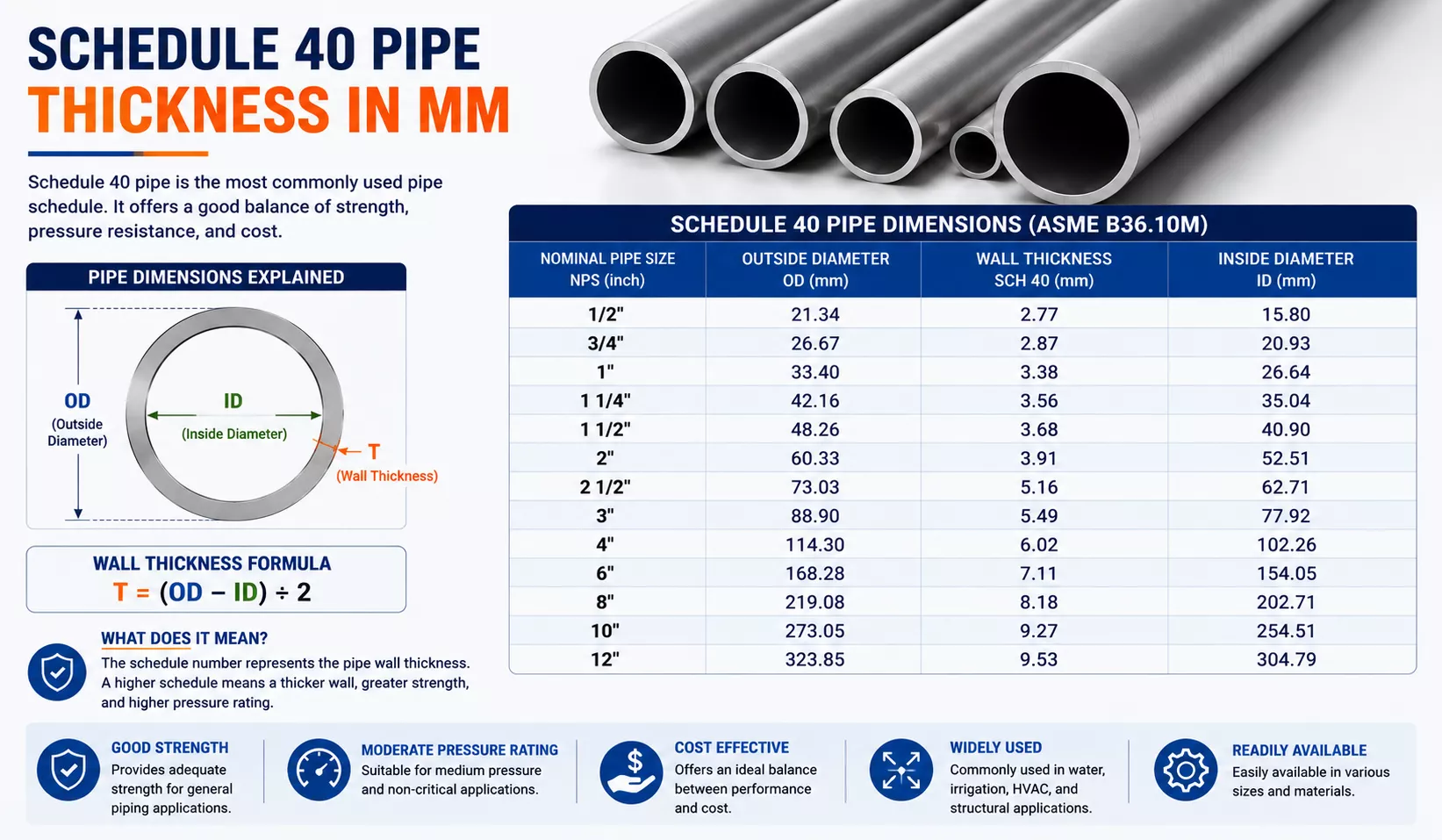
Schedule 40 Pipe Thickness varies according to the nominal pipe size. It is not one fixed thickness for every pipe. For example, a 2-inch Schedule 40 steel pipe has a nominal wall thickness of 3.91 mm (0.154 inch), while a 4-inch pipe has a wall thickness of 6.02 mm (0.237 inch).
Schedule 40 is one of the most commonly specified pipe schedules for steel piping. It is used in water lines, plumbing, construction, process piping, compressed air systems, and many general industrial applications.
This guide explains Schedule 40 pipe thickness in mm and inches, with NPS and DN equivalents, outside diameter (OD), approximate inside diameter (ID), pipe weight, material considerations, and commonly requested sizes.
What Is Schedule 40 Pipe Thickness?
Schedule 40 pipe thickness is the nominal wall thickness assigned to a particular nominal pipe size.
The important point is that Schedule 40 does not represent a single wall measurement. The thickness changes with the pipe's nominal size.
For example:
| Nominal Size | Schedule 40 Wall Thickness |
|---|---|
| 1 inch | 3.38 mm |
| 2 inch | 3.91 mm |
| 3 inch | 5.49 mm |
| 4 inch | 6.02 mm |
| 6 inch | 7.11 mm |
| 8 inch | 8.18 mm |
Therefore, when someone asks for the SCH 40 Pipe Thickness, the pipe size must also be specified.
The schedule should be considered together with the applicable pipe dimensional and product standard when selecting or ordering pipe.
What Does Schedule 40 Mean?
The term Schedule 40 identifies a standardized pipe wall-thickness designation.
For a given nominal pipe size, the outside diameter is standardized. Changing the schedule generally changes the wall thickness and therefore changes the available inside diameter.
For example, a 2-inch steel pipe has an outside diameter of 60.3 mm. A thicker schedule uses more of that diameter for the pipe wall, leaving a smaller internal opening.
This is why Schedule 80 pipe is generally thicker than Schedule 40 pipe of the same nominal size.
Schedule Number vs Pipe Size
It is important not to confuse the schedule with the pipe diameter.
- NPS identifies the nominal pipe size.
- DN provides a metric nominal designation.
- Schedule identifies the wall-thickness designation.
- OD is the standardized outside diameter.
- ID is the internal diameter after accounting for wall thickness.
Schedule 40 Pipe Thickness in mm and Inches
The following chart provides common Schedule 40 steel pipe dimensions, including NPS, DN, outside diameter, nominal wall thickness, and approximate inside diameter.
| NPS | DN | OD (mm) | Wall Thickness (mm) | Wall Thickness (in) | Approx. ID (mm) |
|---|---|---|---|---|---|
| 1/2" | DN15 | 21.3 | 2.77 | 0.109 | 15.8 |
| 3/4" | DN20 | 26.7 | 2.87 | 0.113 | 21.0 |
| 1" | DN25 | 33.4 | 3.38 | 0.133 | 26.6 |
| 1-1/4" | DN32 | 42.2 | 3.56 | 0.140 | 35.1 |
| 1-1/2" | DN40 | 48.3 | 3.68 | 0.145 | 40.9 |
| 2" | DN50 | 60.3 | 3.91 | 0.154 | 52.5 |
| 2-1/2" | DN65 | 73.0 | 5.16 | 0.203 | 62.7 |
| 3" | DN80 | 88.9 | 5.49 | 0.216 | 77.9 |
| 4" | DN100 | 114.3 | 6.02 | 0.237 | 102.3 |
| 5" | DN125 | 141.3 | 6.55 | 0.258 | 128.2 |
| 6" | DN150 | 168.3 | 7.11 | 0.280 | 154.1 |
| 8" | DN200 | 219.1 | 8.18 | 0.322 | 202.7 |
| 10" | DN250 | 273.0 | 9.27 | 0.365 | 254.5 |
| 12" | DN300 | 323.8 | 10.31 | 0.406 | 303.2 |
| 14" | DN350 | 355.6 | 11.13 | 0.438 | 333.3 |
| 16" | DN400 | 406.4 | 12.70 | 0.500 | 381.0 |
| 18" | DN450 | 457.2 | 14.27 | 0.562 | 428.7 |
| 20" | DN500 | 508.0 | 15.09 | 0.594 | 477.8 |
| 24" | DN600 | 610.0 | 17.48 | 0.688 | 575.0 |
Note: The inside diameter shown is approximate and is calculated from the outside diameter and nominal wall thickness. Actual manufactured dimensions can vary within the tolerances permitted by the applicable product standard.
Schedule 40 Pipe Dimensions
Schedule 40 Pipe Dimensions are normally described using NPS, DN, outside diameter, wall thickness, and inside diameter.
For example, a 2-inch Schedule 40 pipe has:
- NPS: 2 inch
- DN: DN50
- Outside diameter: 60.3 mm
- Wall thickness: 3.91 mm
- Approximate inside diameter: 52.5 mm
The basic relationship is:
Approximate ID = OD − (2 × Wall Thickness)
Using the 2-inch example:
60.3 − (2 × 3.91) = 52.48 mm
Therefore, the approximate internal diameter is 52.5 mm.
This relationship is useful when checking pipe dimensions, calculating flow areas, or estimating internal volume.
Schedule 40 Pipe Weight Chart
Pipe weight depends primarily on its dimensions and material density. For steel pipe, larger diameters and thicker walls generally result in greater weight per metre.
| NPS | DN | Approx. Weight (kg/m) |
|---|---|---|
| 1/2" | DN15 | 1.27 |
| 1" | DN25 | 2.50 |
| 2" | DN50 | 5.44 |
| 3" | DN80 | 11.29 |
| 4" | DN100 | 16.07 |
| 6" | DN150 | 28.26 |
| 8" | DN200 | 42.55 |
These are approximate theoretical values for carbon steel pipe. Actual pipe weight can vary because of material density, manufacturing tolerances, and product specifications.
For stainless steel, the weight will differ because stainless steel has a different material density.
Schedule 40 Pipe Size Chart
The Schedule 40 Pipe Size Chart provides the nominal pipe size, outside diameter, Schedule 40 wall thickness and approximate inside diameter of Schedule 40 pipes. The wall thickness varies according to the nominal pipe size and is standardized for each pipe size.
| Nominal Pipe Size (NPS) | DN | Outside Diameter (OD) mm | Schedule 40 Thickness mm | Schedule 40 Thickness inch | Approx. Inside Diameter mm |
|---|---|---|---|---|---|
| 1/8 inch | 6 | 10.3 | 2.41 | 0.095 | 5.48 |
| 1/4 inch | 8 | 13.7 | 2.24 | 0.088 | 9.22 |
| 3/8 inch | 10 | 17.1 | 2.31 | 0.091 | 12.48 |
| 1/2 inch | 15 | 21.3 | 2.77 | 0.109 | 15.76 |
| 3/4 inch | 20 | 26.7 | 2.87 | 0.113 | 20.96 |
| 1 inch | 25 | 33.4 | 3.38 | 0.133 | 26.64 |
| 1-1/4 inch | 32 | 42.2 | 3.56 | 0.140 | 35.08 |
| 1-1/2 inch | 40 | 48.3 | 3.68 | 0.145 | 40.94 |
| 2 inch | 50 | 60.3 | 3.91 | 0.154 | 52.48 |
| 2-1/2 inch | 65 | 73.0 | 5.16 | 0.203 | 62.68 |
| 3 inch | 80 | 88.9 | 5.49 | 0.216 | 77.92 |
| 4 inch | 100 | 114.3 | 6.02 | 0.237 | 102.26 |
| 5 inch | 125 | 141.3 | 6.55 | 0.258 | 128.20 |
| 6 inch | 150 | 168.3 | 7.11 | 0.280 | 154.08 |
| 8 inch | 200 | 219.1 | 8.18 | 0.322 | 202.74 |
| 10 inch | 250 | 273.0 | 9.27 | 0.365 | 254.46 |
| 12 inch | 300 | 323.8 | 10.31 | 0.406 | 303.18 |
| 14 inch | 350 | 355.6 | 11.13 | 0.438 | 333.34 |
| 16 inch | 400 | 406.4 | 12.70 | 0.500 | 381.00 |
| 18 inch | 450 | 457.0 | 14.27 | 0.562 | 428.46 |
| 20 inch | 500 | 508.0 | 15.09 | 0.594 | 477.82 |
| 24 inch | 600 | 610.0 | 17.45 | 0.688 | 575.10 |
Note: Schedule 40 pipe dimensions are standardized by nominal pipe size. The actual outside diameter remains associated with the nominal size, while the wall thickness determines the approximate inside diameter.
Schedule 40 Thickness by Pipe Size
| Schedule 40 Pipe Size | Pipe Thickness | Outside Diameter | Approx. Inside Diameter |
|---|---|---|---|
| 1 Inch Schedule 40 Pipe Thickness | 3.38 mm (0.133 inch) | 33.4 mm | 26.6 mm |
| 2 Inch Schedule 40 Pipe Thickness | 3.91 mm (0.154 inch) | 60.3 mm | 52.5 mm |
| 3 Inch Schedule 40 Pipe Thickness | 5.49 mm (0.216 inch) | 88.9 mm | 77.9 mm |
| 4 Inch Schedule 40 Pipe Thickness | 6.02 mm (0.237 inch) | 114.3 mm | 102.3 mm |
| 6 Inch Schedule 40 Pipe Thickness | 7.11 mm (0.280 inch) | 168.3 mm | 154.1 mm |
| 8 Inch Schedule 40 Pipe Thickness | 8.18 mm (0.322 inch) | 219.1 mm | 202.7 mm |
| 16 Inch Schedule 40 Pipe Thickness | 12.70 mm (0.500 inch) | 406.4 mm | 381.0 mm |
Schedule 40 vs Schedule 80
The main difference between Schedule 40 vs Schedule 80 is the wall thickness. For the same nominal pipe size, Schedule 80 generally has a thicker wall than Schedule 40.
| Feature | Schedule 40 | Schedule 80 |
|---|---|---|
| Wall thickness | Lower | Higher |
| Inside diameter | Larger | Smaller |
| Pipe weight | Lower | Higher |
| Material required | Less | More |
| Typical cost | Lower | Higher |
| Pressure capability | Application-dependent | Application-dependent |
A thicker schedule can provide greater pressure capability under otherwise comparable conditions, but pressure capacity should not be determined from the schedule alone.
Schedule 40 Pipe Pressure Rating
There is no single pressure rating that applies to every Schedule 40 pipe.
The allowable pressure depends on factors such as:
- Pipe material
- Material grade
- Pipe size
- Wall thickness
- Operating temperature
- Allowable stress
- Design code
- Corrosion allowance
- Joint or welding requirements
- Application
For example, the pressure capability of carbon steel Schedule 40 pipe cannot be assumed to be the same as PVC Schedule 40 pipe.
For pressure-service applications, always use the relevant design code and manufacturer's technical data rather than relying on a generic pressure value.
Applications of Schedule 40 Pipe
Schedule 40 pipe is commonly selected for applications where its dimensional and mechanical characteristics meet project requirements.
Typical applications include:
Used in water supply and distribution systems.
Used for various plumbing and building service applications.
Used for compressed-air distribution where suitable.
Used in industrial process piping systems.
Used for transporting fluids in industrial facilities.
Used in selected chemical processing applications.
Used in piping systems for oil and gas facilities.
Used in suitable refinery piping applications.
Used in selected power-generation piping systems.
Used in construction and building-service applications.
Used for fabrication and engineered piping assemblies.
Used in applicable fire-protection piping systems.
Used in suitable HVAC piping applications.
Used for various general engineering requirements.
The appropriate pipe material and schedule should always be selected according to the operating conditions and applicable design requirements.
Frequently Asked Questions
The wall thickness depends on the nominal pipe size. Common steel Schedule 40 values include 3.38 mm for 1 inch, 3.91 mm for 2 inch, 5.49 mm for 3 inch, 6.02 mm for 4 inch, 7.11 mm for 6 inch, and 8.18 mm for 8 inch.
Schedule 40 pipe thickness is the nominal wall thickness assigned to a particular nominal pipe size under the applicable dimensional standard. The thickness therefore changes with pipe size.
Schedule 80 is generally thicker than Schedule 40 for the same nominal pipe size. The thicker wall normally results in a smaller internal diameter and greater pipe weight.
A 4-inch Schedule 40 steel pipe has a nominal wall thickness of 6.02 mm (0.237 inch) and an outside diameter of 114.3 mm.
A 2-inch Schedule 40 steel pipe has a nominal wall thickness of 3.91 mm (0.154 inch) and an outside diameter of 60.3 mm.
A 6-inch Schedule 40 steel pipe has a nominal wall thickness of 7.11 mm (0.280 inch) and an outside diameter of 168.3 mm.
An 8-inch Schedule 40 steel pipe has a nominal wall thickness of 8.18 mm (0.322 inch) and an outside diameter of 219.1 mm.
DN40 is a nominal metric pipe designation corresponding approximately to NPS 1-1/2 inch. For standard steel pipe, its outside diameter is 48.3 mm.
No. DN40 is a nominal size designation and should not be interpreted as an exact 40 mm outside diameter.
A 2-inch Schedule 40 steel pipe has an outside diameter of 60.3 mm and a nominal wall thickness of 3.91 mm, resulting in an approximate inside diameter of 52.5 mm.
The value varies by pipe size. For example, 1 inch is 0.133 inch, 2 inch is 0.154 inch, 4 inch is 0.237 inch, 6 inch is 0.280 inch, and 8 inch is 0.322 inch nominal wall thickness.
The applicable thickness depends on the NPS and Schedule 40 designation under the relevant stainless steel pipe dimensional standard. For example, a 2-inch Schedule 40 stainless steel pipe has a nominal wall thickness of 3.91 mm.
For a 2-inch SS 316 Schedule 40 pipe, the nominal wall thickness is 3.91 mm. The dimensional requirement is separate from the grade's chemical and mechanical properties.
The thickness depends on the nominal size. Common values include 3.38 mm for 1 inch, 3.91 mm for 2 inch, 6.02 mm for 4 inch, and 7.11 mm for 6 inch.
No. Schedule 80 PVC generally has a thicker wall than Schedule 40 PVC for comparable sizes. PVC pressure and dimensional requirements should be checked against the applicable standard and manufacturer data.
It can be used for pressure service when its material, dimensions, temperature rating, design calculations, and applicable code requirements are suitable. Schedule 40 alone does not establish a universal pressure rating.