
-
-
-
Girgaon, Mumbai - 400004
Schedule 40 Pipe Dimensions: Thickness in Inches and MM
Schedule 40 Pipe Dimensions are among the most commonly referenced specifications in the piping industry. Whether you're an engineer, contractor, fabricator, or procurement professional, understanding Schedule 40 pipe sizes is essential for selecting the right piping system for industrial and commercial applications.
For a given nominal pipe size, Schedule 40 pipe has a standardized outside diameter, while the wall thickness is defined by the applicable schedule.. This standardization ensures compatibility with fittings, flanges, valves and other piping components across various industries.
A complete Schedule 40 Pipe Dimensions Chart, including outside diameter (OD), wall thickness in inches and millimeters, inside diameter (ID) and approximate weight. Whether you're searching for Schedule 40 pipe thickness in mm, Schedule 40 pipe dimensions in inches, or Sch 40 stainless steel pipe dimensions, this guide provides reliable technical information based on ASME B36.10M and ASME B36.19M standards.
Get Expert Assistance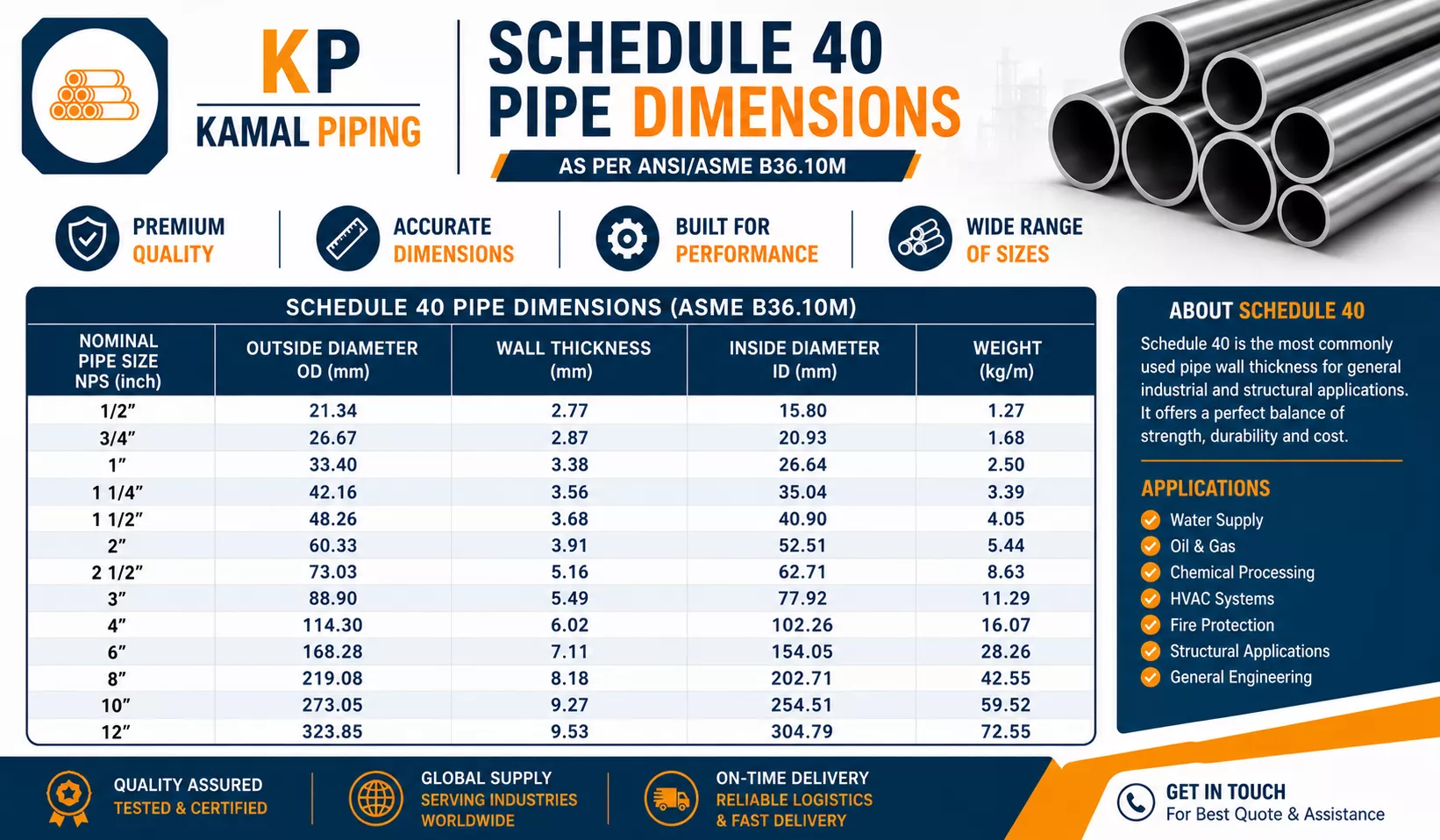
What Is Schedule 40 Pipe?
Schedule 40 (Sch 40) is a standardized pipe wall thickness classification. It specifies the wall thickness of a pipe for a given nominal pipe size rather than its actual diameter.
| Governing Standards |
ASME B36.10M – Carbon Steel Pipe Dimensions ASME B36.19M – Stainless Steel Pipe Dimensions |
|---|
The Schedule 40 dimensions in this table are based on ASME B36.10M. Stainless steel pipe is generally specified using ASME B36.19M Schedule 40S, where applicable. Dimensions should be checked against the applicable standard and purchase specification.
Many people assume Schedule 40 refers to the pipe diameter, but this is incorrect. The schedule indicates the pipe wall thickness associated with a particular nominal pipe size.
| Parameter | Description |
|---|---|
| Outside Diameter (OD) | Remains standardized for a given nominal pipe size. |
| Wall Thickness (WT) | Varies according to the applicable schedule and standard. |
| Inside Diameter (ID) | Changes according to the outside diameter and wall thickness. |
| Pressure Design | Wall thickness is one factor considered when determining pressure capability; allowable pressure depends on material, temperature and applicable design requirements. |
Why Schedule 40 Pipe Is Popular
Schedule 40 is commonly used across a wide range of industrial and commercial piping applications because it provides a practical combination of wall thickness, strength and flow area.
Its advantages include:
- Standardized dimensions
- Excellent mechanical strength
- Good pressure resistance
- High flow efficiency
- Easy fabrication and welding
- Worldwide availability
- Cost-effective installation
- Compatibility with standard fittings and flanges
Common Schedule 40 Pipe Dimensions Chart
The following Schedule 40 pipe dimensions include nominal pipe size (NPS), outside diameter (OD), wall thickness (WT), inside diameter (ID) and approximate weight. The dimensions in this table are based on ASME B36.10M Schedule 40.
| Nominal Pipe Size (NPS) |
Outside Diameter (OD) | Wall Thickness (WT) | Inside Diameter (ID) | Approx. Weight (lb/ft) |
|||
|---|---|---|---|---|---|---|---|
| in | mm | in | mm | in | mm | ||
| 1/2" | 0.840 | 21.34 | 0.109 | 2.77 | 0.622 | 15.80 | 0.85 |
| 3/4" | 1.050 | 26.67 | 0.113 | 2.87 | 0.824 | 20.93 | 1.13 |
| 1" | 1.315 | 33.40 | 0.133 | 3.38 | 1.049 | 26.64 | 1.68 |
| 1-1/4" | 1.660 | 42.16 | 0.140 | 3.56 | 1.380 | 35.05 | 2.27 |
| 1-1/2" | 1.900 | 48.26 | 0.145 | 3.68 | 1.610 | 40.89 | 2.72 |
| 2" | 2.375 | 60.33 | 0.154 | 3.91 | 2.067 | 52.50 | 3.66 |
| 2-1/2" | 2.875 | 73.03 | 0.203 | 5.16 | 2.469 | 62.71 | 5.79 |
| 3" | 3.500 | 88.90 | 0.216 | 5.49 | 3.068 | 77.93 | 7.58 |
| 4" | 4.500 | 114.30 | 0.237 | 6.02 | 4.026 | 102.26 | 10.79 |
| 5" | 5.563 | 141.30 | 0.258 | 6.55 | 5.047 | 128.19 | 14.62 |
| 6" | 6.625 | 168.28 | 0.280 | 7.11 | 6.065 | 154.05 | 18.97 |
| 8" | 8.625 | 219.08 | 0.322 | 8.18 | 7.981 | 202.72 | 28.55 |
| 10" | 10.750 | 273.05 | 0.365 | 9.27 | 10.020 | 254.51 | 40.48 |
| 12" | 12.750 | 323.85 | 0.406 | 10.31 | 11.938 | 303.23 | 53.52 |
Schedule 40 Pipe Thickness Chart
Schedule 40 pipe wall thickness is commonly specified in both imperial and metric units. Imperial dimensions remain the industry standard for engineering drawings, fabrication, and piping specifications, while metric measurements are widely used in international projects.
| Pipe Size | Wall Thickness (in) | Wall Thickness (mm) |
|---|---|---|
| 1/2" | 0.109 | 2.77 |
| 3/4" | 0.113 | 2.87 |
| 1" | 0.133 | 3.38 |
| 1-1/4" | 0.140 | 3.56 |
| 1-1/2" | 0.145 | 3.68 |
| 2" | 0.154 | 3.91 |
| 2-1/2" | 0.203 | 5.16 |
| 3" | 0.216 | 5.49 |
| 4" | 0.237 | 6.02 |
| 5" | 0.258 | 6.55 |
| 6" | 0.280 | 7.11 |
| 8" | 0.322 | 8.18 |
| 10" | 0.365 | 9.27 |
| 12" | 0.406 | 10.31 |
Understanding Schedule 40 Pipe Sizes
Many users confuse Nominal Pipe Size (NPS) with the actual pipe diameter.
Here's a simple explanation:
| Term | Explanation |
|---|---|
| NPS (Nominal Pipe Size) | Standard trade designation. |
| NB (Nominal Bore) | Metric naming convention used in many countries. |
| OD (Outside Diameter) | Actual external measurement. |
| WT (Wall Thickness) | Thickness of the pipe wall. |
| ID (Inside Diameter) | Flow passage inside the pipe. |
- Nominal Pipe Size: 2"
- Outside Diameter: 60.33 mm
- Wall Thickness: 3.91 mm
- Inside Diameter: 52.51 mm (approx.)
Understanding these values helps ensure compatibility with pipe fittings, flanges, valves, and supports.
Stainless Steel Grades for Schedule 40 Pipe
Stainless steel pipe dimensions are covered by ASME B36.19M, which uses schedule designations such as 5S, 10S, 40S and 80S. The applicable stainless steel schedule should be confirmed against the product specification.
- Stainless Steel 304
- Stainless Steel 304L
- Stainless Steel 316
- Stainless Steel 316L
- Stainless Steel 321
- Stainless Steel 310
- Stainless Steel 347H
- Duplex Stainless Steel
- Super Duplex Stainless Steel
Schedule 40 Pipe OD, ID and Wall Thickness
For each nominal pipe size, the outside diameter remains fixed while the wall thickness determines the approximate inside diameter. The inside diameter can be calculated from the nominal outside diameter and wall thickness, although actual dimensions can be affected by manufacturing tolerances.
Advantages of Schedule 40 Pipe
- Standardized international dimensions
- Excellent mechanical strength
- Good pressure handling capability
- Reliable corrosion resistance in stainless steel grades
- Easy welding, threading, and fabrication
- Compatible with standard fittings and flanges
- Cost-effective for general industrial service
- Available in carbon steel, stainless steel, alloy steel, duplex, and nickel alloys
- Suitable for high-volume industrial applications
Applications of Schedule 40 Pipe
- Water distribution systems
- Oil and gas pipelines
- Chemical processing plants
- Petrochemical facilities
- Power generation
- HVAC systems
- Fire protection systems
- Structural fabrication
- Marine engineering
- Food processing
- Pharmaceutical manufacturing
- Paper and pulp industries
- Sugar plants
- Fertilizer plants
- General industrial piping
Frequently Asked Questions
Schedule 40 is a standardized pipe wall thickness designation that specifies the wall thickness for a given nominal pipe size while maintaining a fixed outside diameter.
No. Schedule 40 refers only to the wall thickness. The outside diameter remains constant for each nominal pipe size, while the inside diameter changes depending on the wall thickness.
A 2-inch Schedule 40 pipe has a wall thickness of 0.154 inches (3.91 mm) according to ASME standards.
Carbon steel Schedule 40 pipe dimensions are covered by ASME B36.10M, while stainless steel Schedule 40 pipe dimensions follow ASME B36.19M.
Schedule 40 pipes are suitable for many low- and medium-pressure applications. Higher-pressure systems may require Schedule 80 or heavier wall pipes depending on the operating conditions.
Schedule 40 pipes are commonly manufactured in carbon steel, stainless steel, alloy steel, duplex stainless steel, super duplex stainless steel, and nickel alloy grades.
Schedule 40 pipes are widely used in oil and gas, chemical processing, water treatment, power plants, HVAC systems, pharmaceuticals, food processing, marine engineering, and general industrial piping.
Select the appropriate nominal pipe size based on the required flow rate, operating pressure, wall thickness, and compatibility with fittings, valves, and flanges.
Yes. Schedule 40 dimensions are commonly used for stainless steel pipes manufactured in grades such as SS 304, 304L, 316, 316L, 321, 310, 347H, Duplex, and Super Duplex for industrial applications.
A Schedule 40 pipe dimensions chart provides standardized outside diameter, wall thickness, inside diameter, and approximate weight, helping engineers, fabricators, and buyers select the correct pipe for their applications.