
-
-
-
Girgaon, Mumbai - 400004
Stainless Steel Pipe Grades Explained: 304, 316, 310 & More
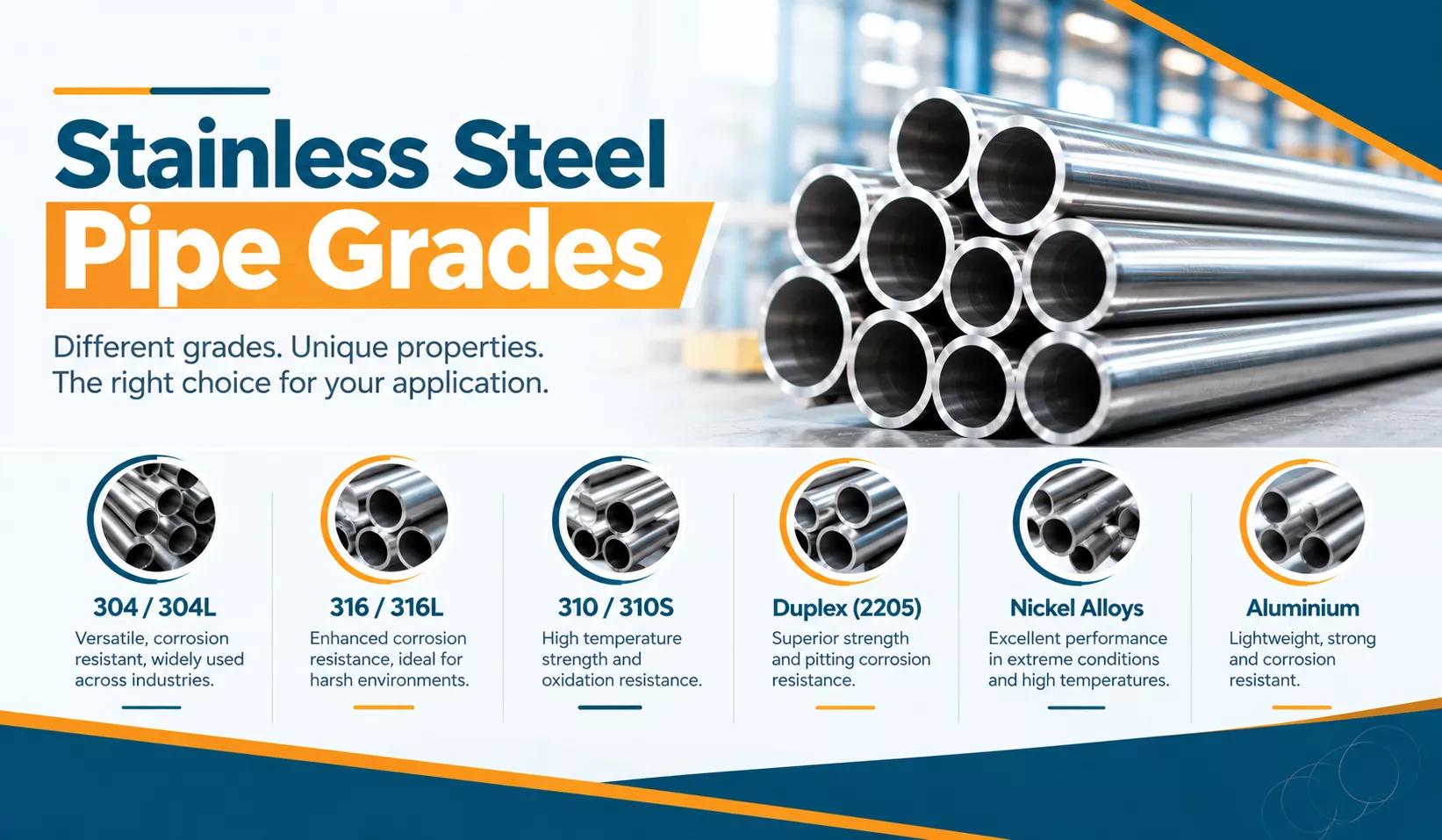
Stainless Steel Pipe Grades are classifications based on chemical composition and mechanical properties that influence a pipe's corrosion resistance, strength, weldability, and temperature performance. Common grades include SS 304, 304L, 316, 316L, 321, 347, 904L and 310S, along with duplex and super duplex stainless steels.
The right stainless steel pipe grade depends on the application, operating environment, temperature, corrosion exposure, pressure, fabrication requirements, and applicable material specification. SS 304 is widely used for general service and many food-processing applications, while SS 316 and 316L are often selected for chloride-containing and chemical environments. Grades such as 321 and 310S are used where elevated-temperature performance is important.
Stainless steel pipes are used across chemical processing, oil and gas, food processing, pharmaceuticals, power generation, marine applications, construction, and other industries. Their combination of corrosion resistance, strength, durability, and fabricability makes them suitable for demanding service conditions.
However, stainless steel pipes are not all the same. The grade determines the material's chemical composition and influences properties such as corrosion resistance, mechanical strength, weldability, and high-temperature performance. Selecting the correct grade is therefore important for equipment reliability, service life, safety, and overall project cost.
With grades such as 304, 304L, 316, 316L, 321, 347, 904L, 310S, Duplex 2205 and Super Duplex 2507 available for different requirements, choosing the right material requires careful consideration. Engineers need technically appropriate material selection, procurement teams need reliable specifications and documentation, and buyers need confidence that the supplied pipe matches the required grade and standard.
This guide explains commonly specified stainless steel pipe grades, compares their characteristics, discusses applications and standards and provides practical guidance for selecting and sourcing stainless steel pipes.
At Kamal Steels, we manufacture and stock a range of Stainless Steel Pipes and grades in seamless and welded forms for domestic and international requirements.
What Are Stainless Steel Pipe Grades?
A Stainless Steel Pipe Grade identifies a defined material composition and set of properties used to specify the stainless steel from which the pipe is manufactured. The grade is primarily determined by alloying elements such as chromium, nickel, molybdenum, carbon, titanium and niobium.
For example, SS 304 is an austenitic stainless steel commonly selected for general corrosion resistance and fabrication, while SS 316 contains molybdenum and generally provides improved resistance in chloride-containing environments compared with 304.
Stainless Steel Pipe grades are commonly grouped into metallurgical families such as:
- Austenitic: 304, 304L, 316, 316L, 321, 347, 904L and 310S.
- Ferritic: Chromium-based stainless steels with generally lower nickel content and magnetic characteristics.
- Duplex: Stainless steels containing both austenitic and ferritic phases, such as Duplex 2205.
- Super Duplex: Highly alloyed duplex grades such as Super Duplex 2507, developed for demanding corrosion and strength requirements.
The correct grade should be selected according to the service environment, corrosion exposure, temperature, pressure, mechanical requirements, fabrication process, applicable standard and required documentation.
Stainless Steel Pipe Grades Chart
The following chart provides a practical overview of commonly specified Stainless Steel Pipe Grades and their typical selection considerations.
| Grade | General Characteristics | Corrosion Resistance | Temperature Performance | Typical Applications |
|---|---|---|---|---|
| SS 304 | Common austenitic stainless steel with good formability and weldability. | Good general corrosion resistance. | Good for many general and elevated-temperature applications. | Food processing, water, architecture, fabrication and general process piping. |
| SS 304L | Low-carbon version of 304. | Good general corrosion resistance. | Suitable for many general service conditions. | Welded piping, food processing, chemical and general fabrication. |
| SS 316 | Austenitic Cr-Ni stainless steel with molybdenum addition. | Excellent; generally better chloride resistance than 304. | Good for many process and elevated-temperature applications. | Marine, chemical, pharmaceutical and process applications. |
| SS 316L | Low-carbon version of 316. | Excellent corrosion resistance. | Suitable for many general and process applications. | Pharmaceutical, chemical, marine, food and welded piping. |
| SS 321 | Titanium-stabilized austenitic stainless steel. | Good corrosion resistance. | Good elevated-temperature performance. | Heat exchangers, exhaust systems, aerospace and process piping. |
| SS 347 | Niobium-stabilized austenitic stainless steel. | Good corrosion resistance. | Good elevated-temperature performance. | High-temperature piping, heat exchangers and process equipment. |
| SS 904L | Highly alloyed austenitic stainless steel containing higher nickel, molybdenum and copper. | Very high resistance in many aggressive corrosive environments. | Selected primarily for corrosion resistance rather than very high-temperature service. | Chemical processing, acid handling and aggressive process environments. |
| SS 310S | High-chromium, high-nickel austenitic stainless steel. | Excellent oxidation resistance. | Excellent high-temperature performance. | Furnaces, heat treatment, thermal processing and high-temperature components. |
| Duplex 2205 | Austenitic-ferritic duplex stainless steel with high strength. | Excellent corrosion resistance, including good resistance to chloride stress corrosion cracking. | Good subject to design and service limitations. | Oil and gas, offshore, chemical processing and desalination. |
| Super Duplex 2507 | Highly alloyed duplex stainless steel with high strength and corrosion resistance. | Very high corrosion resistance for demanding environments. | Good subject to applicable design and service limits. | Offshore, seawater, desalination, chemical and oil and gas applications. |
Note: The chemical composition, mechanical properties and service capabilities of a grade depend on the applicable material specification and product form. Actual allowable temperature and pressure depend on factors such as design code, wall thickness, fabrication, environment and service conditions.
Stainless Steel Pipe Grade Equivalent Chart
Stainless steel grades are identified using different designation systems. The following table shows commonly referenced ASTM/UNS, EN and JIS designations for selected grades.
| Stainless Steel Grade | UNS | EN / Werkstoff | JIS |
|---|---|---|---|
| 304 | S30400 | 1.4301 | SUS304 |
| 304L | S30403 | 1.4307 / 1.4306 | SUS304L |
| 316 | S31600 | 1.4401 | SUS316 |
| 316L | S31603 | 1.4404 | SUS316L |
| 321 | S32100 | 1.4541 | SUS321 |
| 347 | S34700 | 1.4550 | SUS347 |
| 904L | N08904 | 1.4539 | — |
| 310S | S31008 | 1.4845 | SUS310S |
Important: ASTM, UNS, EN and JIS designations are not automatically interchangeable. Before substitution, verify the chemical composition, mechanical properties, dimensions, testing requirements, product form and certification requirements against the applicable standard and project specification.
SS 304 vs SS 316: What's the Difference?
SS 304 and SS 316 are two widely specified austenitic stainless steel pipe grades. The main difference is that 316 contains molybdenum, which generally improves resistance to chloride-containing and certain corrosive environments compared with 304.
| Factor | SS 304 | SS 316 |
|---|---|---|
| General corrosion resistance | Good | Excellent |
| Chloride resistance | Lower than 316 | Generally better than 304 |
| Common environments | General service, food processing, water and fabrication | Marine, chemical, pharmaceutical and chloride-containing environments |
| Selection consideration | Often economical for general corrosion-resistant service | Preferred when higher corrosion resistance is required |
SS 304 is often selected where general corrosion resistance, fabrication and cost are important. SS 316 is commonly considered for marine, coastal, chloride-containing and certain chemical environments.
Neither grade is immune to corrosion. Actual performance depends on factors including chloride concentration, temperature, contaminants, surface condition, exposure time and fabrication quality.
SS 316L Pipe Grade
SS 316L is the low-carbon version of 316 stainless steel. The lower carbon content reduces the risk of chromium carbide precipitation during welding, making 316L particularly useful for fabricated and welded piping where the specified material condition requires low carbon.
SS 316L pipe is commonly considered for:
- Pharmaceutical processing
- Chemical processing
- Food and beverage equipment
- Marine and coastal environments
- Process piping
- Welded piping systems
The required pipe specification, welding procedure, heat treatment and post-fabrication requirements should be verified for the application.
SS 321 vs SS 347
SS 321 and SS 347 are stabilized austenitic stainless steel grades commonly selected for elevated-temperature service. Both grades are designed to reduce the risk associated with chromium carbide precipitation following exposure to elevated temperatures.
| Grade | Stabilizing Element | Typical Selection |
|---|---|---|
| SS 321 | Titanium | Elevated-temperature piping, heat exchangers, exhaust and process equipment. |
| SS 347 | Niobium | High-temperature piping, heat exchangers and process applications. |
The choice between 321 and 347 depends on operating temperature, fabrication conditions, corrosion environment, applicable specification and project requirements.
SS 904L vs SS 310S
SS 904L and SS 310S are highly alloyed stainless steel grades, but they are generally selected for different service requirements.
| Grade | Main Strength | Typical Applications |
|---|---|---|
| SS 904L | High resistance to many aggressive corrosive environments due to its high alloy content. | Chemical processing, acid handling and demanding corrosion-service applications. |
| SS 310S | High chromium and nickel content providing strong oxidation resistance and high-temperature capability. | Furnaces, heat treatment, thermal processing and high-temperature equipment. |
In simple terms, 904L is primarily selected for demanding corrosion resistance, while 310S is commonly selected for high-temperature and oxidation service. Final selection must be based on the actual process environment and design requirements.
Duplex vs Austenitic Stainless Steel Pipe Grades
Duplex stainless steel contains both austenitic and ferritic phases. Compared with common austenitic grades such as 304 and 316, duplex grades generally provide higher strength together with strong corrosion resistance.
Duplex 2205, commonly associated with UNS S31803/S32205, is widely considered for applications where chloride corrosion resistance, resistance to stress corrosion cracking and higher mechanical strength are important. Super Duplex 2507 provides a still higher alloy level for demanding corrosion environments.
| Factor | Austenitic Grades | Duplex Grades |
|---|---|---|
| Examples | 304, 316, 321, 347 | 2205, 2507 |
| Microstructure | Primarily austenitic | Austenitic-ferritic |
| Strength | Generally lower than duplex grades | Generally higher |
| Chloride resistance | Depends on grade; 316 is commonly used for moderate chloride exposure | 2205 and 2507 provide enhanced resistance for demanding environments |
| Typical applications | General process, food, pharmaceutical, chemical and marine applications | Oil and gas, offshore, desalination, seawater and demanding chemical service |
Duplex stainless steel is not automatically the best choice for every piping system. Welding requirements, temperature limits, fabrication procedures, corrosion conditions and applicable design standards must be considered.
How to Choose the Best Stainless Steel Pipe Grade
The best stainless steel pipe grade depends on the actual service conditions rather than the grade name alone. Consider the following factors before specifying a pipe.
| Selection Factor | What to Consider |
|---|---|
| 1. Corrosive Environment | Identify the chemicals, chlorides, acids, moisture, seawater and other corrosive substances that the pipe will encounter. A grade suitable for general indoor service may not be suitable for aggressive chemical or marine exposure. |
| 2. Operating Temperature | Temperature affects corrosion behaviour, mechanical properties and oxidation resistance. Grades such as 321, 347 and 310S are considered for specific elevated-temperature applications. |
| 3. Pressure and Mechanical Requirements | Check the design pressure, operating conditions, required strength, wall thickness and applicable design code. Duplex grades can provide higher strength where the design permits their use. |
| 4. Welding and Fabrication | For welded piping, consider carbon content, welding procedures, post-weld requirements and the applicable product specification. Low-carbon grades such as 304L and 316L are commonly used where their specific properties are required. |
| 5. Applicable Pipe Standard | Specify the correct standard for the product form and application, such as ASTM A312 for applicable austenitic stainless steel pipe. Other standards apply to different materials, product forms and manufacturing methods. |
| 6. Testing and Certification | Project requirements can include chemical analysis, mechanical testing, hydrostatic or nondestructive testing, inspection and material test certificates. These requirements should be established before purchasing. |
| 7. Total Cost and Availability | Material cost is only one part of the decision. Availability, lead time, fabrication, testing, inspection, documentation and long-term service performance should also be considered. |
Stainless Steel Pipe Grade Selection by Application
| Application | SS Pipe Grades | Selection Considerations |
|---|---|---|
| Chemical Industry | 316, 316L, 904L | 316 and 316L are commonly considered for chemical process piping, while 904L can be considered for more aggressive corrosive environments depending on the specific chemicals, concentrations and temperatures. |
| Food and Pharmaceutical Industry | 304, 316L | 304 and 316L are widely used depending on the process requirements. Product cleanliness, surface finish, weld quality and hygienic design are important considerations in addition to the grade. |
| Marine and Seawater Applications | 316L, Duplex 2205, Super Duplex 2507 | 316L is commonly used for marine and coastal applications, while Duplex 2205 and Super Duplex 2507 are considered for more demanding chloride and seawater conditions. |
| High-Temperature Applications | 321, 347, 310S | 321, 347 and 310S are commonly considered for elevated-temperature applications. The appropriate grade depends on temperature, atmosphere, oxidation conditions, mechanical requirements and applicable design limits. |
| General Corrosion-Resistant Service | 304, 316, 316L | 304 is widely used for general corrosion-resistant applications. Where chloride exposure or higher corrosion resistance is important, 316 or 316L can be considered. |
Stainless Steel Pipe Standards and Specifications
The pipe grade and the pipe specification are related but are not the same thing. The material grade identifies the alloy, while the product specification establishes requirements such as manufacturing, dimensions, testing and mechanical properties.
| Pipe Standard | Coverage / Application |
|---|---|
| ASTM A312 | ASTM A312 covers applicable seamless, straight-seam welded and heavily cold-worked welded austenitic stainless steel pipe intended for high-temperature and general corrosive service. |
| ASTM A358 | ASTM A358 covers electric-fusion-welded austenitic chromium-nickel alloy steel pipe for high-temperature and general corrosive service, with requirements depending on the specified class. |
| ASTM A409 | ASTM A409 covers welded large-diameter austenitic steel pipe for corrosive or high-temperature service and certain low-pressure applications. |
Other standards and specifications can apply depending on the stainless steel grade, pipe manufacturing method, dimensions, end use, testing and project requirements.
Seamless vs Welded Stainless Steel Pipe
| Pipe Type | Manufacturing | Selection / Advantages |
|---|---|---|
| Seamless Stainless Steel Pipe | Seamless Stainless Steel Pipe is manufactured without a longitudinal welded joint, generally using processes involving billet piercing followed by rolling, sizing, drawing or other forming operations. | Seamless pipe is selected for applications where the applicable specification, pressure, temperature, diameter, wall thickness or project requirements call for a seamless product. |
| Welded Stainless Steel Pipe | Welded Stainless Steel Pipe is manufactured by forming strip, coil or plate and joining the material using a specified welding process. | Welded pipe can offer advantages in availability, larger diameters, manufacturing flexibility and cost for suitable applications. |
Seamless is not automatically superior to welded pipe. The correct choice depends on the applicable standard, pressure, temperature, diameter, wall thickness, service conditions and project specification.
What to Check When Buying Stainless Steel Pipes by Grade
Before purchasing stainless steel pipes, verify that the material and documentation match the project specification. Important points include:
- Grade: Confirm the required stainless steel grade and UNS designation where applicable.
- Pipe standard: Verify the applicable ASTM, ASME, EN, DIN or other specification.
- Size and wall thickness: Confirm outside diameter, schedule or specified wall thickness and length.
- Manufacturing method: Confirm seamless or welded construction.
- Chemical composition: Check the material test certificate against the applicable specification.
- Mechanical properties: Verify tensile strength, yield strength, elongation and other specified requirements.
- Testing: Confirm hydrostatic, nondestructive or other testing requirements.
- Inspection: Check whether third-party inspection or project-specific inspection is required.
- Documentation: Confirm MTC, EN 10204 3.1 certification and other required documents.
- Stock and availability: Check whether the required grade, size and quantity are available for the required delivery schedule.
Stainless Steel Pipe Pricing Factors
Stainless steel pipe pricing depends on more than the grade alone. Important cost factors include:
- Stainless steel grade
- Outside diameter and wall thickness
- Schedule or specified wall thickness
- Seamless or welded construction
- Quantity and required lengths
- Surface finish and end preparation
- Applicable ASTM, ASME, EN or other standards
- Testing and third-party inspection
- Custom sizes and special requirements
- Alloy market conditions
- Current stock and delivery requirements
Specialty grades such as 904L, Duplex 2205 and Super Duplex 2507 can have substantially different costs from common grades such as 304 and 316 because of alloy content, manufacturing requirements and availability.
For an accurate quotation, specify the grade, standard, size, schedule or wall thickness, quantity, length, finish, testing requirements and delivery location.
Sourcing Stainless Steel Pipes from India
India has an established stainless steel manufacturing, processing and distribution network serving domestic and international projects. When sourcing stainless steel pipes from India, buyers should evaluate the supplier based on manufacturing capability, stock, quality control, applicable certifications, testing, documentation and export experience.
For international orders, buyers should also confirm packing, marking, inspection, material certificates, shipping documentation and delivery requirements.
Kamal Steels, based in Mumbai, India, manufactures and stocks stainless steel pipes in a range of grades, sizes and specifications for domestic and international requirements. Product documentation and testing can be arranged according to applicable project and purchase requirements.
Frequently Asked Questions
Stainless steel pipe grades identify specific stainless steel compositions and property requirements. Common grades include 304, 304L, 316, 316L, 321, 347, 904L, 310S and duplex grades.
Commonly specified grades include SS 304, 304L, 316, 316L, 321, 347, 904L, 310S, Duplex 2205 and Super Duplex 2507. The appropriate grade depends on the service conditions and applicable specification.
Stainless steel pipes are available in different metallurgical families, including austenitic, ferritic, duplex and super duplex grades. Austenitic grades such as 304 and 316 are widely used, while duplex grades are considered for higher strength and demanding corrosion conditions.
There is no single strongest stainless steel pipe grade for every application. Duplex and super duplex stainless steels generally provide higher yield strength than common austenitic grades such as 304 and 316, but the appropriate grade depends on the complete design and service requirements.
Consider the corrosive environment, operating temperature, pressure, mechanical requirements, welding, applicable pipe standard, testing, certification and total project cost. The grade should be selected against the actual service conditions.
SS 304 and 316/316L are commonly used for different water applications. The correct grade depends on water chemistry, chloride content, temperature, treatment conditions and project requirements.
304L is the low-carbon version of 304. Its lower carbon content is useful for certain welded applications because it reduces the risk of chromium carbide precipitation during welding.
304 is commonly used for many outdoor applications, while 316 or 316L is often preferred for coastal or chloride-exposed environments. The actual environment should be evaluated before selecting the grade.
ASTM A312 TP316 refers to Type 316 austenitic stainless steel pipe manufactured to the applicable ASTM A312 requirements. The specification covers applicable seamless and welded pipe for high-temperature and general corrosive service.
The L generally indicates a low-carbon version of the stainless steel grade. For example, 316L has a lower carbon limit than 316, which is useful for certain welded applications.
No. Common austenitic stainless steel grades such as 304 and 316 are generally non-magnetic in the annealed condition, although cold working can increase magnetic response. Ferritic and duplex stainless steels generally exhibit magnetic behaviour.
Finding the Right Stainless Steel Pipe Grade for Your Application
Selecting the right stainless steel pipe grade requires more than comparing grade numbers. The material should be matched to the actual corrosion environment, operating temperature, pressure, mechanical requirements, fabrication method, pipe standard, testing and documentation requirements.
SS 304 and 304L are widely used for general corrosion-resistant service, while 316 and 316L are commonly considered where greater corrosion resistance is required. 321, 347 and 310S are used for specific elevated-temperature requirements, while 904L, Duplex 2205 and Super Duplex 2507 are considered for more demanding corrosion and service conditions.
At Kamal Steels, we manufacture and stock a range of stainless steel pipes in seamless and welded forms. We support material selection, specifications, testing and documentation requirements for domestic and international orders.
For your requirement, provide the stainless steel grade, pipe standard, size, schedule or wall thickness, quantity and required documentation so the appropriate material can be evaluated.