
-
-
-
Girgaon, Mumbai - 400004
Stainless Steel 304 Pipe Manufacturer in India
Stainless Steel 304 Pipe is an austenitic chromium-nickel stainless steel pipe used in industrial processing, water systems, food-processing equipment, construction and general fabrication. Its combination of corrosion resistance, formability and weldability makes it suitable for many applications when the operating environment is compatible with the material.
Kamal Steels handles enquiries for stainless steel 304 pipes based on the required grade, dimensions, wall thickness, manufacturing method and applicable product specification. Buyers can specify seamless or welded construction, nominal pipe size, schedule, length, inspection requirements and material documentation to help identify the appropriate product for their application.
Table of Contents
- Stainless Steel 304 Pipe Specifications
- Stainless Steel 304 Pipe Sizes Chart
- SS 304 Pipe Schedule and Wall Thickness
- Stainless Steel 304 Pipe Weight Chart
- Chemical Composition
- Mechanical Properties
- Types of Stainless Steel 304 Pipe
- Applications
- 304 vs 304L vs 316
- Surface Finish, Inspection and Certificates
- Price Factors
- Frequently Asked Questions
- Product Enquiry
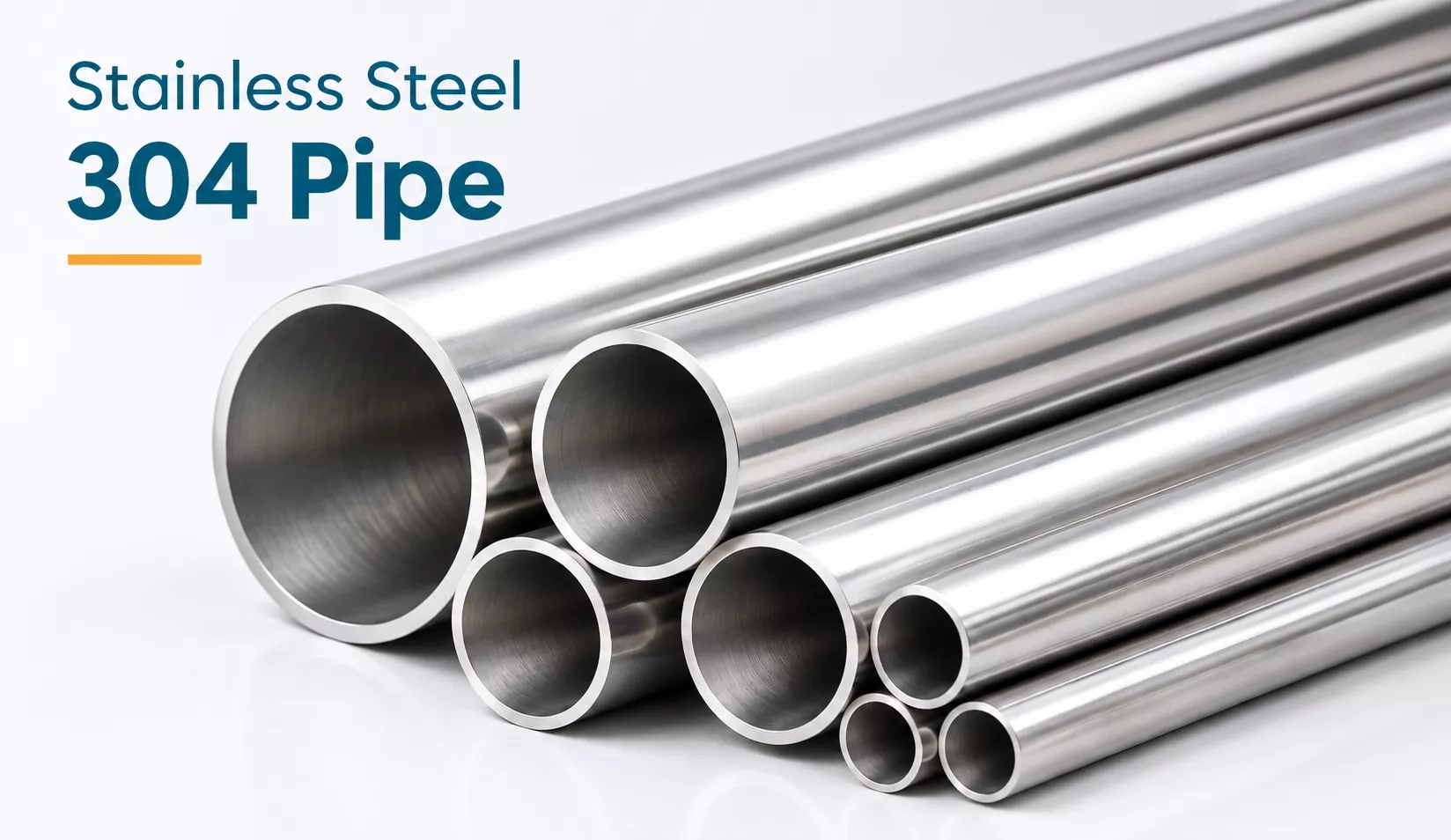
Stainless Steel 304 Pipe Specifications
Stainless Steel 304 pipe is commonly designated as Type 304 or TP304, depending on the applicable product specification. ASTM A312/A312M covers applicable seamless, straight-seam welded and heavily cold-worked welded austenitic stainless steel pipes for high-temperature and general corrosive service.
The material specification and dimensional standard should be selected according to the application, design code and purchase requirements.
| Parameter | Specification |
|---|---|
| Product Name | Stainless Steel 304 Pipe |
| Common Designation | SS 304 / Type 304 |
| UNS Number | S30400 |
| Werkstoff Number | 1.4301 |
| Material Family | Austenitic stainless steel |
| Chromium Content | 18.0–20.0% |
| Nickel Content | 8.0–10.5% |
| Maximum Carbon Content | 0.08% |
| Common Product Specification | ASTM A312/A312M, where applicable |
| ASME Designation | SA-312, where specified |
| Dimensional Standard | ASME B36.19M for applicable stainless steel pipe dimensions |
| Manufacturing Types | Seamless and welded, subject to the ordered specification |
| Size Identification | NPS, outside diameter and wall thickness |
| Ordering Information | Grade, standard, size, schedule, length, quantity and documentation |
A material specification defines requirements such as chemical composition and mechanical properties. A dimensional standard establishes nominal pipe dimensions and applicable wall-thickness series. Both must be considered when specifying a pipe.
For broader dimensional and standard information, see our Stainless Steel 304 Pipe Specifications page.
Stainless Steel 304 Pipe Sizes Chart
Stainless Steel 304 pipe is specified using nominal pipe size (NPS) and corresponding nominal diameter (DN) designations. The nominal size is not necessarily the measured outside diameter. Confirm the required dimensions against the applicable standard before ordering.
| Nominal Pipe Size (NPS) | Nominal Diameter (DN) | Outside Diameter (mm) |
|---|---|---|
| 1/8 inch | DN 6 | 10.3 |
| 1/4 inch | DN 8 | 13.7 |
| 3/8 inch | DN 10 | 17.1 |
| 1/2 inch | DN 15 | 21.3 |
| 3/4 inch | DN 20 | 26.7 |
| 1 inch | DN 25 | 33.4 |
| 1 1/4 inch | DN 32 | 42.2 |
| 1 1/2 inch | DN 40 | 48.3 |
| 2 inch | DN 50 | 60.3 |
| 2 1/2 inch | DN 65 | 73.0 |
| 3 inch | DN 80 | 88.9 |
| 4 inch | DN 100 | 114.3 |
| 5 inch | DN 125 | 141.3 |
| 6 inch | DN 150 | 168.3 |
| 8 inch | DN 200 | 219.1 |
| 10 inch | DN 250 | 273.1 |
| 12 inch | DN 300 | 323.9 |
Note: These are representative nominal outside diameters. Confirm the applicable dimensional standard, tolerances, size range and product availability before ordering.
When selecting a pipe, specify the nominal size and required wall thickness or schedule. Outside diameter, inside diameter and wall thickness are related but are not interchangeable measurements.
SS 304 Pipe Schedule and Wall Thickness
Pipe schedule identifies a wall-thickness series for a given nominal pipe size. Stainless steel pipe commonly uses schedules such as 5S, 10S, 40S and 80S under ASME B36.19M, where the relevant size and schedule are covered.
Schedule 10S generally has a thinner wall than Schedule 40S at the same nominal size. The difference varies by size, so the actual dimensions must be checked rather than inferred from the schedule name.
Schedule 10S vs Schedule 40S Pipe Dimensions
| NPS | Outside Diameter (mm) | Schedule 10S Wall Thickness (mm) | Schedule 40S Wall Thickness (mm) |
|---|---|---|---|
| 1/2 inch | 21.3 | 2.11 | 2.77 |
| 3/4 inch | 26.7 | 2.11 | 2.87 |
| 1 inch | 33.4 | 2.77 | 3.38 |
| 1 1/4 inch | 42.2 | 2.77 | 3.56 |
| 1 1/2 inch | 48.3 | 2.77 | 3.68 |
| 2 inch | 60.3 | 2.77 | 3.91 |
| 2 1/2 inch | 73.0 | 3.05 | 5.16 |
| 3 inch | 88.9 | 3.05 | 5.49 |
| 4 inch | 114.3 | 3.05 | 6.02 |
| 6 inch | 168.3 | 3.40 | 7.11 |
| 8 inch | 219.1 | 3.76 | 8.18 |
| 10 inch | 273.1 | 4.19 | 9.27 |
| 12 inch | 323.9 | 4.57 | 9.53 |
Technical note: Verify every listed value against the applicable edition of ASME B36.19M before publication. The schedule series does not include every possible size and wall-thickness combination.
How to Choose the Required Pipe Schedule
Schedule selection depends on design pressure, operating temperature, material properties, corrosion allowance, mechanical loads, applicable design code and project requirements.
A thicker wall generally reduces the internal diameter for the same outside diameter and increases the theoretical weight per metre. It does not, by itself, establish a safe operating pressure. Pressure suitability must be determined using the applicable design rules and actual operating conditions.
Stainless Steel 304 Pipe Weight Chart
The theoretical weight of stainless steel pipe can be estimated using its outside diameter and wall thickness. This calculation is useful for preliminary material estimates, transport planning and comparing pipe dimensions.
Approximate formula: Weight (kg/m) = 0.0249 × t × (D − t)
- D = outside diameter in millimetres
- t = wall thickness in millimetres
The formula assumes a material density of approximately 7,930 kg/m³. The resulting value is theoretical and may differ from actual measured weight.
SS 304 Pipe Weight Chart - Selected Schedule 40S Sizes
| NPS | Outside Diameter (mm) | Wall Thickness (mm) | Approximate Theoretical Weight (kg/m) |
|---|---|---|---|
| 1/2 inch | 21.3 | 2.77 | 1.28 |
| 3/4 inch | 26.7 | 2.87 | 1.70 |
| 1 inch | 33.4 | 3.38 | 2.53 |
| 1 1/4 inch | 42.2 | 3.56 | 3.43 |
| 1 1/2 inch | 48.3 | 3.68 | 4.08 |
| 2 inch | 60.3 | 3.91 | 5.49 |
| 2 1/2 inch | 73.0 | 5.16 | 8.71 |
| 3 inch | 88.9 | 5.49 | 11.42 |
| 4 inch | 114.3 | 6.02 | 16.22 |
| 6 inch | 168.3 | 7.11 | 28.53 |
Note: Recalculate each value using verified dimensional data before publication. Actual pipe weight can vary with manufacturing tolerances and material conditions.
The weight per metre is not the same as the price per metre. A quotation may also depend on manufacturing method, length, quantity, testing requirements, packaging and delivery terms.
Stainless Steel 304 Pipe Chemical Composition
Type 304 stainless steel contains chromium and nickel, which contribute to its austenitic structure and general corrosion resistance. The applicable product specification defines the permitted composition limits.
| Element | Typical TP304 Specification Limit (Weight %) |
|---|---|
| Carbon (C) | 0.08 maximum |
| Chromium (Cr) | 18.0–20.0 |
| Nickel (Ni) | 8.0–10.5 |
| Manganese (Mn) | 2.00 maximum |
| Silicon (Si) | 1.00 maximum |
| Phosphorus (P) | 0.045 maximum |
| Sulfur (S) | 0.030 maximum |
Note: Confirm these limits against the applicable edition of the ordered product specification. Actual heat analysis should be checked against the material test certificate supplied for the product.
Stainless Steel 304 Pipe Mechanical Properties
Mechanical properties are used to evaluate material compliance with applicable product and design requirements. The following are commonly specified minimum tensile and yield strength values for TP304 pipe under ASTM A312/A312M. Requirements for elongation, hardness and other tests depend on the applicable specification and test conditions.
| Mechanical Property | Typical Requirement or Description |
|---|---|
| Minimum Tensile Strength | 515 MPa |
| Minimum Yield Strength at 0.2% Offset | 205 MPa |
| Elongation | Verify the applicable requirement for specimen type and product conditions |
| Hardness | Subject to the applicable specification and test method |
| Material Classification | Austenitic stainless steel |
These minimum material properties should not be used alone to determine allowable operating pressure. Design calculations must follow the applicable design code and account for temperature, dimensions, joints and service conditions.
Types of Stainless Steel 304 Pipe
Stainless Steel 304 Seamless Pipe
Seamless pipe is manufactured without a longitudinal weld seam. It may be specified where the governing product specification, design code or application requires seamless construction.
When selecting stainless steel 304 seamless pipe, confirm the required size, wall thickness, product specification, testing requirements and dimensional tolerances. Seamless construction is not automatically necessary for every application; selection should follow the engineering requirements.
Learn more about Stainless Steel 304 Seamless Pipes.
Stainless Steel 304 Welded Pipe
Welded pipe is manufactured by forming stainless steel material and joining the seam using a specified welding process. It is used in a range of industrial and general piping applications.
Selection should account for the applicable product specification, weld quality requirements, inspection, dimensions and intended service. Do not assume that all welded products have the same manufacturing or inspection requirements.
304 Stainless Steel Round Pipe
Round stainless steel 304 pipe is commonly used for fluid transport and process piping. It is specified using nominal pipe size, outside diameter, wall thickness or schedule, length and applicable product standard.
For decorative, architectural or structural hollow sections, confirm whether a pipe specification or a separate tube or structural-section specification is required. Product form and dimensions should match the intended application.
Applications of SS 304 Pipe
Food Processing and Beverage Equipment
SS 304 pipe is used in selected food-processing and beverage installations where its corrosion resistance is appropriate. Suitability for hygienic or food-contact service depends on surface finish, fabrication, cleaning procedures, product chemistry and applicable hygiene or regulatory requirements.
Grade 304 alone does not guarantee suitability for every sanitary application. Specify any required internal finish, cleaning procedure, testing and compliance requirements.
Plumbing and Water Systems
Stainless steel 304 pipe may be suitable for certain water and plumbing applications. Water chemistry, chloride concentration, temperature, disinfection methods and local plumbing requirements affect material selection.
Where water chemistry or service conditions are aggressive, another material or grade may be more appropriate. Selection should be based on the actual operating environment.
Chemical and Industrial Processing
Grade 304 pipe is used for selected industrial process lines and equipment handling compatible substances. It is not suitable for every chemical environment.
Before specifying the material, consider chemical concentration, operating temperature, exposure duration, contaminants and the potential for pitting or crevice corrosion. Confirm material compatibility with process requirements.
Construction and General Fabrication
SS 304 is used in handrails, architectural components, fabrication and general industrial assemblies where its appearance, formability and corrosion resistance are useful.
For structural applications, verify the required product standard, dimensions, mechanical properties and applicable design requirements rather than assuming every stainless steel pipe is suitable for structural use.
Stainless Steel 304 vs 304L vs 316 Pipe
SS 304, 304L and 316 are austenitic stainless steel grades with different chemical composition limits and selection considerations. The appropriate grade depends on the operating environment, fabrication method and design requirements.
| Feature | SS 304 | SS 304L | SS 316 |
|---|---|---|---|
| UNS Designation | S30400 | S30403 | S31600 |
| Maximum Carbon Content under Common Product Requirements | 0.08% | 0.03% | 0.08% |
| Chromium Content | Typically 18–20% | Typically 18–20% | Typically 16–18% |
| Nickel Content | Typically 8–10.5% | Typically 8–12% | Typically 10–14% |
| Molybdenum | Not a defining alloying addition | Not a defining alloying addition | Typically 2–3% |
| Main Consideration | General-purpose corrosion resistance | Lower carbon content can help reduce sensitisation risk during welding | Molybdenum generally improves resistance to chloride-related corrosion compared with 304 |
| Selection Basis | Application and service conditions | Often considered for welded construction | Often considered where additional corrosion resistance is needed |
Note: Composition limits depend on the applicable product specification. None of these grades is suitable for every environment. Chlorides, temperature, crevices, surface condition and stress can affect corrosion performance.
Surface Finish, Inspection and Material Certificates
Surface finish, inspection and documentation requirements should be agreed when the product is specified. They can differ according to the product standard and intended application.
| Requirement | What Buyers Should Specify |
|---|---|
| Surface Finish | Required finish and any special internal or external finish |
| Dimensions | Outside diameter, wall thickness, length and tolerances |
| Product Specification | Applicable ASTM, ASME or other required standard |
| Chemical Analysis | Compliance with the ordered specification |
| Mechanical Testing | Applicable test requirements |
| Inspection | Required inspection and any third-party inspection |
| Material Documentation | Material Test Certificate (MTC) and required certificate type |
| Traceability | Heat number, marking and identification requirements |
| Packaging | Protection, bundling, marking and export packaging, if required |
EN 10204 Type 3.1 documentation may be specified where applicable and agreed for the order. Buyers should confirm the certificate type, inspection scope and testing requirements when requesting a quotation. These requirements should not be assumed to be included in every supply.
Stainless Steel 304 Pipe Price Factors
The price of stainless steel 304 pipe depends on its dimensions, product specification, manufacturing method and order requirements. A single price-per-metre figure cannot reliably represent every size and type.
| Price Factor | Effect on the Quotation |
|---|---|
| Pipe Size | Affects material quantity and weight |
| Wall Thickness or Schedule | Affects material consumption and theoretical weight |
| Seamless or Welded Construction | May affect manufacturing route and cost |
| Product Specification | Determines applicable material, testing and dimensional requirements |
| Length | Standard, cut or custom lengths can affect pricing |
| Order Quantity | Can affect production, handling and commercial terms |
| Inspection and Certificates | Additional requirements may affect cost |
| Packaging and Delivery | Domestic transport or export packing can affect the final quotation |
| Market Conditions | Stainless steel raw-material and processing costs can fluctuate |
For a meaningful quotation, provide the grade, nominal size, wall thickness or schedule, seamless or welded construction, required length, quantity, applicable standard, destination and documentation requirements.
For related pricing information, visit our Stainless Steel Pipe Price Per Kg in India guide.
Stainless Steel 304 Pipe FAQs
304 stainless steel pipe is used in food and beverage processing, water systems, chemical equipment, architectural installations, general industrial processing and fabrication. Its suitability depends on the fluid, temperature, cleaning method and corrosion conditions of the application.
Grade 304 contains chromium and nickel, while Grade 316 also contains molybdenum, which generally improves resistance to pitting and crevice corrosion in chloride-containing environments. Grade 304 is widely used for general applications, whereas Grade 316 may be more suitable for marine, chemical and other more corrosive environments.
304 stainless steel is commonly used in food processing and handling equipment. For food-contact piping, suitability also depends on the surface finish, hygienic design, cleaning procedures, product being handled and applicable food-contact requirements. Grade selection should be confirmed for the intended use.
The price of 304 stainless steel pipe depends on the outside diameter, wall thickness, schedule, seamless or welded construction, quantity, finish, testing requirements and prevailing raw material prices. Provide the required dimensions and quantity to obtain a quotation for your specification.
304 stainless steel pipe is specified in different nominal pipe sizes, outside diameters and wall thicknesses. The available range depends on the manufacturing method, applicable product standard and supply requirements. Confirm the required size, schedule or wall thickness, length and tolerance before ordering.
Annealed 304 stainless steel is generally considered non-magnetic, but cold working can make it noticeably magnetic. Weld areas may also show some magnetic attraction. A magnet test alone cannot reliably confirm the grade of a stainless steel pipe.
Yes. 304 stainless steel pipe can be welded using suitable procedures and equipment, including TIG or MIG welding where appropriate. The welding procedure, filler metal, joint preparation and post-weld cleaning should be selected according to the pipe specification and service requirements. Grade 304L may be preferred for some welded applications where lower carbon content is beneficial.
There is no single maximum operating temperature for every 304 stainless steel pipe application. Grade 304 has good oxidation resistance in air at elevated temperatures, but allowable service temperature depends on the load, environment, exposure duration, pressure and design code. Confirm the permissible temperature for the specific application before selecting the material.
Clean 304 stainless steel pipe with warm water, a mild detergent and a soft cloth or suitable non-abrasive brush. Rinse thoroughly and dry the surface. Avoid steel-wool contamination, harsh chloride-containing cleaners and unsuitable abrasive products. Industrial piping may require a cleaning procedure appropriate to the process and hygiene requirements.
304 stainless steel pipe provides good resistance to corrosion in many atmospheric, food-processing and general industrial environments. It can still suffer pitting, crevice corrosion or stress corrosion cracking under certain conditions, particularly where chlorides, elevated temperatures or tensile stresses are present. The operating environment should guide grade selection.
Enquire About Stainless Steel 304 Pipe
To request a quotation from Kamal Steels, provide the details relevant to your requirement:
- Grade: SS 304 / TP304
- Product type: seamless or welded
- Nominal pipe size or outside diameter
- Schedule or required wall thickness
- Applicable material and dimensional standards
- Required length and quantity
- Testing, inspection and material certificate requirements
- Delivery destination and packaging requirements
Providing these details helps clarify the required product specification and supports a more accurate quotation. Confirm product availability, manufacturing scope, lead time and documentation requirements for the specific order.