
-
-
-
Girgaon, Mumbai - 400004
Stainless Steel 316 Pipe Manufacturer in India
Kamal Steels is a manufacturer of Stainless Steel 316 Pipes for industrial applications requiring corrosion resistance in demanding environments. Stainless Steel 316 is an austenitic chromium-nickel-molybdenum grade that offers improved resistance to pitting and crevice corrosion compared with Grade 304 in many chloride-containing environments.
Our Stainless Steel 316 Pipes are intended for applications across chemical processing, marine equipment, pharmaceutical facilities, food processing, water treatment and petrochemical industries. Pipe dimensions, wall thicknesses and manufacturing methods are selected according to applicable standards and project requirements.
Stainless Steel 316 Pipes can be specified by ASTM A312/A312M TP316, where applicable, with dimensions, schedules, material testing and inspection documentation confirmed against the purchase order. Buyers should specify the required size, wall thickness, manufacturing method and testing requirements to ensure suitability for the intended service.
Table of Contents
- What Is Stainless Steel 316 Pipe?
- 316 vs 304 Stainless Steel
- ASTM Standards and Specifications
- Stainless Steel 316 Pipe Specifications
- 316 Stainless Steel Chemical Composition
- 316 Stainless Steel Pipe Sizes and Schedules
- Benefits of Stainless Steel 316 Pipe
- Applications of Stainless Steel 316 Pipe
- 316 Pipe Price and Weight Factors
- How to Choose a 316 Pipe Supplier
- Frequently Asked Questions
- Request a Quote
What Is Stainless Steel 316 Pipe?
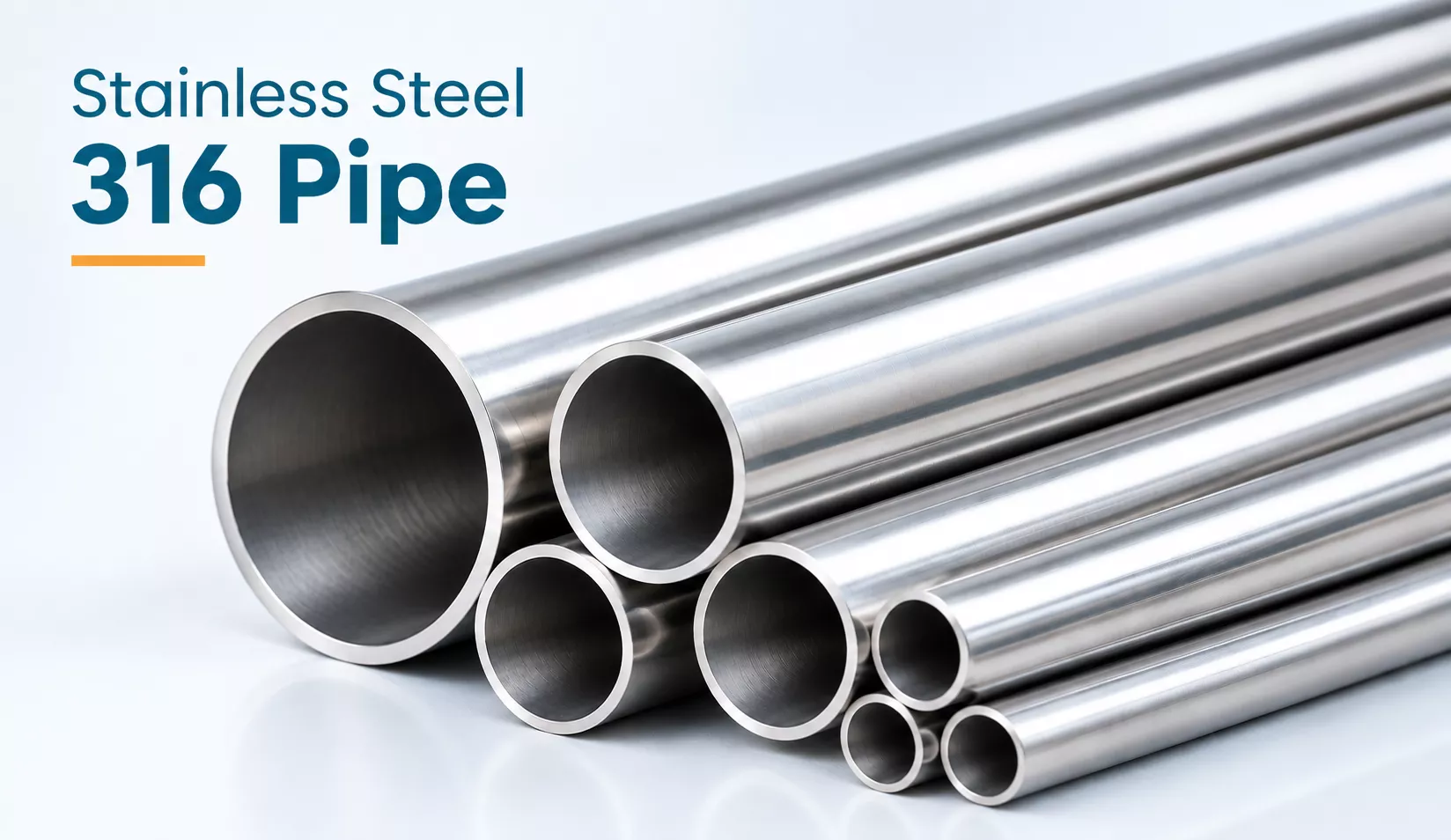
Stainless Steel 316 Pipe is manufactured from an austenitic stainless steel alloy containing chromium, nickel and molybdenum. The addition of molybdenum improves resistance to pitting and crevice corrosion in many chloride-containing environments compared with Grade 304.
Grade 316 is commonly specified for piping systems exposed to certain chemicals, moisture and corrosive operating conditions. It also offers good formability and weldability when appropriate fabrication procedures are followed.
Stainless Steel 316 Pipe is available in seamless and welded forms under applicable product specifications. The correct product depends on the service environment, design conditions, dimensional requirements and relevant engineering code.
316 vs 304 Stainless Steel: What's the Difference?
Stainless Steel 304 and 316 are both austenitic chromium-nickel grades. The main difference is that Grade 316 contains molybdenum, which generally improves resistance to pitting and crevice corrosion in chloride-containing environments.
| Comparison | Stainless Steel 304 | Stainless Steel 316 |
|---|---|---|
| Material type | Austenitic chromium-nickel stainless steel | Austenitic chromium-nickel-molybdenum stainless steel |
| Molybdenum | Not intentionally added as a principal alloying element | Typically 2.0–3.0% under common specifications |
| Chloride resistance | Suitable for many general environments; more limited in some chloride conditions | Generally improved resistance to pitting and crevice corrosion in many chloride environments |
| Common applications | General fabrication, food equipment and industrial systems | Chemical processing, marine-related equipment and selected corrosive services |
| Cost | Often lower, depending on market conditions | Often higher due to its alloy composition |
Grade 316 is not immune to chloride corrosion or stress corrosion cracking. The correct grade should be selected based on chloride concentration, temperature, chemical exposure, mechanical stress and operating conditions.
ASTM Standards for Stainless Steel 316 Pipe
ASTM A312/A312M TP316 is a commonly used product specification for seamless, straight-seam welded and heavily cold-worked austenitic stainless steel pipe intended for high-temperature and general corrosive service.
Depending on the application, other product standards may apply. For example, ASTM A358 covers certain electric-fusion-welded austenitic chromium-nickel alloy steel pipe for corrosive and high-temperature service. The applicable specification must match the product form and project requirements.
- Material grade: TP316 / UNS S31600, as applicable.
- Product specification: ASTM A312/A312M TP316 where specified.
- Dimensional standard: ASME B36.19M or another project-specified standard.
- Manufacturing method: Seamless or welded, as required.
- Inspection: Testing, inspection and documentation as required by the applicable specification and purchase order.
Material standards and dimensional standards serve different purposes. Confirm both, along with the required testing and certification, before placing an order.
Stainless Steel 316 Pipe Specifications
Stainless Steel 316 Pipe is specified by its material grade, product standard, manufacturing method, nominal size, schedule or wall thickness and required inspection documentation. The following chart provides a general specification overview.
| Specification | Details |
|---|---|
| Material Grade | Stainless Steel 316 |
| UNS Number | S31600 |
| Material Type | Austenitic Chromium-Nickel-Molybdenum Stainless Steel |
| Product Standard | ASTM A312/A312M TP316, where applicable |
| Dimensional Standard | ASME B36.19M or project-specified standard |
| Manufacturing Types | Seamless and Welded, subject to specification |
| Nominal Pipe Size | As specified by the customer |
| Wall Thickness | As per required schedule or specified dimensions |
| Pipe Length | As per purchase order and applicable standard |
| End Finish | Plain End, Bevelled End or other specified finish |
| Documentation | Material Test Certificate and other documents as specified |
Actual sizes, manufacturing options and availability should be confirmed against the purchase requirements. Chemical composition, mechanical properties, heat treatment and testing must comply with the applicable product specification.
316 Stainless Steel Chemical Composition
The chemical composition of Stainless Steel 316 is controlled by the applicable material specification. The table below gives common ASTM A312 TP316 composition limits for reference. Confirm the relevant standard edition and material test certificate for acceptance.
| Element | Typical Specification Limit (Weight %) |
|---|---|
| Carbon (C) | 0.08 maximum |
| Manganese (Mn) | 2.00 maximum |
| Silicon (Si) | 1.00 maximum |
| Phosphorus (P) | 0.045 maximum |
| Sulfur (S) | 0.030 maximum |
| Chromium (Cr) | 16.0–18.0 |
| Nickel (Ni) | 10.0–14.0 |
| Molybdenum (Mo) | 2.0–3.0 |
These are reference limits, not a substitute for material certification. The supplied material must be verified against the applicable standard and purchase specification.
316 Stainless Steel Pipe Sizes and Schedules
Stainless Steel 316 Pipe is specified in a range of nominal pipe sizes and wall thicknesses. Buyers should provide the nominal pipe size, schedule or exact wall thickness, length, quantity and dimensional standard when requesting a quotation.
| Size Category | Ordering Details |
|---|---|
| Small-bore pipe | Nominal pipe size, schedule and length |
| Medium-size pipe | Nominal pipe size, wall thickness and dimensional standard |
| Large-diameter pipe | Outside diameter, wall thickness, length and manufacturing method |
| Custom requirements | Project drawings, tolerances and inspection requirements |
Schedules such as 5S, 10S, 40S and 80S may be specified where applicable. Do not assume that a schedule designation has the same wall thickness at every nominal size. Confirm dimensions using the relevant dimensional standard.
Seamless vs Welded Stainless Steel 316 Pipe
Seamless pipe is manufactured without a longitudinal welded seam. Welded pipe is formed and joined using a welding process permitted by the applicable product specification. Selection depends on the service conditions, design requirements, dimensional needs and project specification.
Benefits of Stainless Steel 316 Pipe
Stainless Steel 316 Pipe offers a combination of corrosion resistance and fabrication properties for suitable industrial service conditions.
- Molybdenum alloying: Improves resistance to pitting and crevice corrosion in many chloride-containing environments compared with Grade 304.
- Fabrication properties: Supports common forming and welding processes when appropriate procedures are followed.
- Industrial applications: Can be specified for chemical processing, selected marine-related equipment, food processing, and other compatible services.
Grade 316 is not immune to seawater corrosion, chloride stress corrosion cracking, or attack from aggressive chemicals. Confirm suitability against operating temperature, chemical concentration, chloride levels, and design conditions.
Applications of Stainless Steel 316 Pipe
Stainless Steel 316 Pipe is used in industrial systems where its corrosion resistance and mechanical properties are suitable for the operating environment.
- Chemical processing: Process lines handling compatible chemicals and solutions.
- Marine equipment: Selected piping and equipment exposed to marine atmospheres or salt-bearing environments, subject to corrosion assessment.
- Pharmaceutical industry: Process equipment and piping where material traceability, cleanability and surface finish requirements are met.
- Food and beverage: Processing systems where the material and surface finish satisfy the applicable hygienic requirements.
- Water treatment: Selected water-handling systems, depending on chloride concentration and water chemistry.
- Petrochemical plants: Specified piping and process equipment for compatible operating conditions.
- Industrial fabrication: Tanks, equipment and pipe assemblies designed around Grade 316 properties.
For seawater, concentrated chlorides or aggressive chemical service, Grade 316 may not provide adequate corrosion resistance. An engineering review may identify a higher-alloy stainless steel or another corrosion-resistant alloy as a better choice.
316 Pipe Price and Weight Factors
The price of Stainless Steel 316 Pipe depends on dimensions, wall thickness, manufacturing method, order quantity, raw material costs, inspection requirements and delivery terms. Current pricing should be requested for the exact product specification and quantity.
Factors Affecting Stainless Steel 316 Pipe Price
- Pipe size and wall thickness: Influence material consumption and weight.
- Manufacturing method: Seamless and welded pipes can differ in price and lead time.
- Order quantity: Volume and production requirements can affect commercial terms.
- Testing and certification: Additional inspections and documentation may affect cost.
- Finishing and cutting: Special end preparation, cutting and other processing may add costs.
- Packaging and transportation: Packing, freight and export requirements contribute to total order cost.
Stainless Steel 316 Pipe Weight
Theoretical pipe weight can be estimated using outside diameter, wall thickness, length and an assumed material density. Actual weight may vary according to dimensional tolerances and manufacturing conditions. Confirm the dimensional standard and calculation basis before using weight figures for engineering or shipping.
For a quotation, provide the grade, nominal pipe size, schedule or wall thickness, length, quantity, product standard, testing requirements and delivery destination.
How to Choose a Stainless Steel 316 Pipe Supplier
When selecting a Stainless Steel 316 Pipe supplier, verify that the material meets your specified grade, dimensions, product standard and documentation requirements. A suitable supplier should be able to clarify the product specification and confirm realistic delivery terms.
- Material traceability: Check the grade designation, heat number and material test certificate.
- Standards compliance: Confirm the ASTM or ASME material specification and dimensional standard.
- Inspection requirements: Agree on testing, inspection and certification requirements before ordering.
- Product form and dimensions: Confirm seamless or welded construction, pipe size, schedule and length.
- Availability and lead time: Verify actual availability and delivery timing for the required quantity.
- Commercial terms: Review price basis, taxes, packaging, transportation and payment terms.
Kamal Steels can be contacted to discuss Stainless Steel 316 Pipe requirements. Share the technical specification and required dimensions so the supply options can be reviewed for your application.
Stainless Steel 316 Pipe FAQs
Stainless Steel 316 Pipe is made from an austenitic chromium-nickel-molybdenum stainless steel grade known for improved resistance to pitting and crevice corrosion in many chloride-containing environments compared with Grade 304.
Grade 316 contains molybdenum, which generally improves resistance to pitting and crevice corrosion in many chloride-containing environments compared with Grade 304. The right grade depends on the operating environment and design requirements.
ASTM A312/A312M TP316 is commonly specified for seamless and welded austenitic stainless steel pipe. The applicable product and dimensional standards should be confirmed against the project requirements.
Grade 316 is used in selected marine-related applications because molybdenum improves resistance to certain forms of chloride corrosion. However, it is not immune to seawater corrosion, so suitability depends on the specific exposure conditions.
Stainless Steel 316 Pipe is available in different nominal pipe sizes, outside diameters and wall thicknesses. Available options depend on the applicable dimensional standard, schedule, manufacturing method and supplier stock.
Stainless Steel 316 Pipe prices depend on pipe size, wall thickness, manufacturing method, order quantity, raw material prices, testing and inspection requirements, documentation, packaging and delivery.
Request a Quote for Stainless Steel 316 Pipe
Contact Kamal Steels with your Stainless Steel 316 Pipe requirements. Include the pipe size, schedule or wall thickness, seamless or welded construction, quantity, applicable ASTM or ASME Standard, inspection documentation and delivery location.
Providing complete technical details helps clarify your material requirements and supports a more accurate quotation.
Speak to Our Sales Team