
-
-
-
Girgaon, Mumbai - 400004
Stainless Steel 304 Pipe Specification
Stainless Steel 304 Pipe Specifications According to ASTM Standards
Stainless Steel 304 Pipe is an austenitic alloy containing 18% chromium and 8% nickel, widely used across industrial, food-grade and structural applications. It conforms to ASTM standards including A312, A358, A269, A213 and A778 and is available in seamless, welded and ERW forms across a full range of schedules and dimensions.
Few materials earn the kind of cross-industry trust that 304 stainless steel pipe has built over decades. From pharmaceutical processing lines to architectural railings, from dairy equipment to chemical transfer systems 304 SS pipe shows up wherever corrosion resistance, strength and hygiene matter.
But sourcing the right pipe means more than picking a grade. You need to understand the applicable ASTM standards, chemical composition, mechanical properties, schedule thicknesses and how 304 compares to its close relative, 304L. This guide covers all of it in one place.
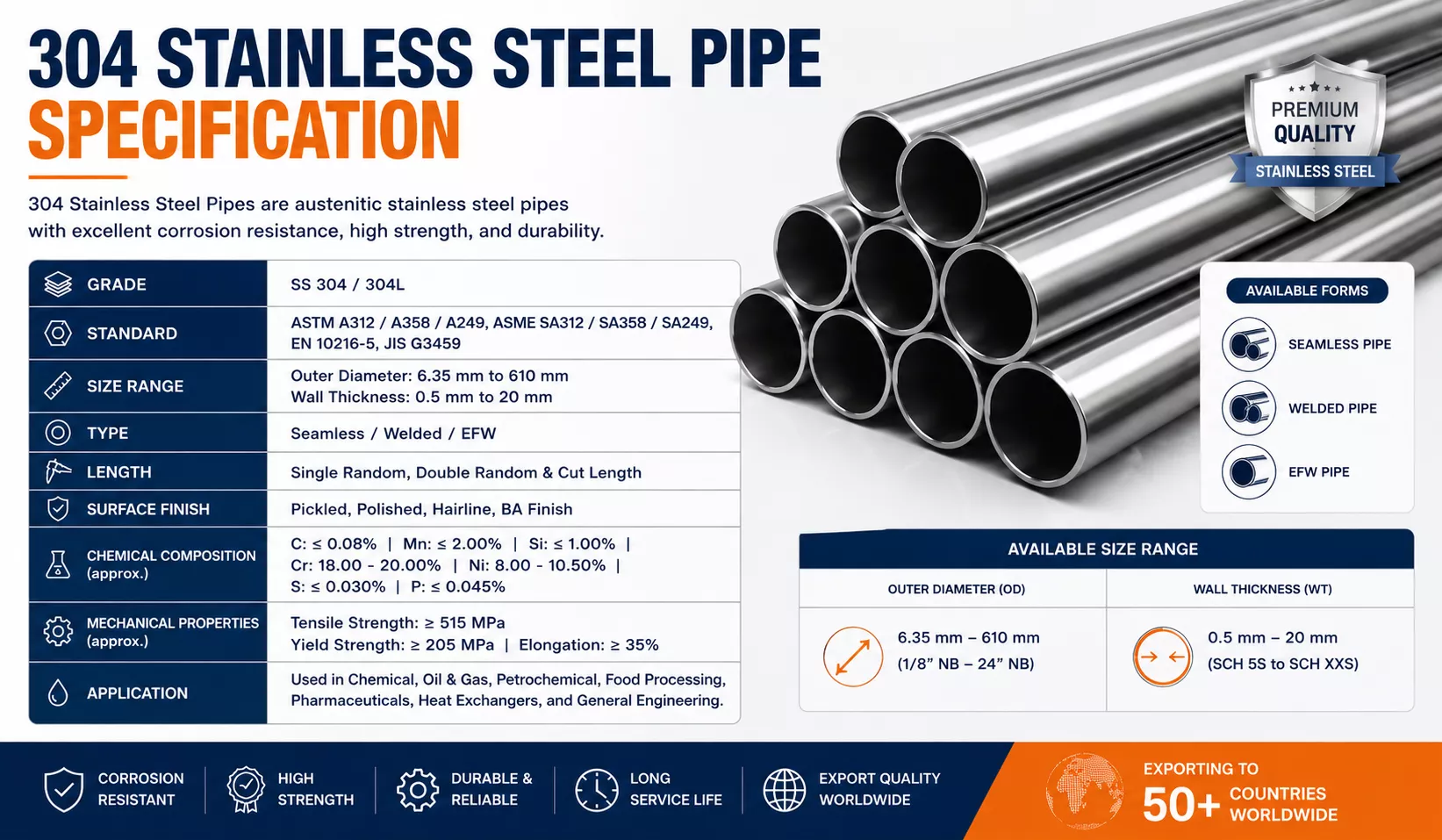
304 Stainless Steel Pipe Specifications
Before selecting a 304 stainless steel pipe, it is helpful to understand its key specifications. The table below summarizes the most important technical information, including material grade, standards, dimensions, temperature range, and available product forms.
| Material Grade | Stainless Steel 304 (SS 304) |
|---|---|
| UNS Number | S30400 |
| EN / DIN Grade | 1.4301 (X5CrNi18-10) |
| ASTM Standard | ASTM A312 TP304 |
| ASME Standard | ASME SA312 TP304 |
| Manufacturing Types | Seamless, Welded, ERW and EFW |
| Pipe Sizes | 1/8" NB to 24" NB and larger |
| Pipe Schedules | SCH 5S, 10S, 40S, 80S, 160 and XXS |
| Outside Diameter | 6 mm to 610 mm (standard range) |
| Wall Thickness | 0.5 mm to 50 mm |
| Length | Single Random, Double Random, 6 m, Custom Cut Lengths |
| Surface Finish | Annealed, Pickled, Bright Annealed (BA), Polished, Mirror Finish |
| Density | 7.93 g/cm³ |
| Melting Point | 1400°C – 1450°C |
| Operating Temperature | -196°C to 870°C |
| Magnetic Properties | Generally Non-Magnetic (May Become Slightly Magnetic After Cold Working) |
| Available Forms | Round Pipe, Square Pipe, Rectangular Pipe, Polished Pipe, Instrumentation Tube |
| Inspection & Testing | Hydro Test, PMI Test, Eddy Current Test, Ultrasonic Test, Flattening Test, Mill Test Certificate (EN 10204 3.1) |
ASTM A312 TP304 stainless steel pipe is one of the most widely specified stainless steel piping materials worldwide due to its excellent corrosion resistance, mechanical strength, weldability, and cost-effectiveness. It is extensively used in the food processing, pharmaceutical, petrochemical, power generation, water treatment, oil & gas, and construction industries.
Kamal Steels is one of India's trusted manufacturers, suppliers, stockists and exporters of 304 Stainless Steel Pipes, offering premium-quality SS 304 Seamless, SS 304 Welded and EFW pipes manufactured in accordance with international ASTM and ASME standards. We supply ASTM A312 TP304, ASTM A358, ASTM A269, ASTM A213, and other 304 stainless steel pipe specifications to meet the requirements of industrial, commercial, and engineering projects worldwide.
Our 304 stainless steel pipes are available in a wide range of sizes, schedules, wall thicknesses, and surface finishes, including Schedule 10S, 40S, and 80S. Designed for superior corrosion resistance, strength, and weldability, our SS 304 pipes are widely used in the oil & gas, petrochemical, food processing, pharmaceutical, chemical, power generation, water treatment, marine, construction, and infrastructure industries. Every pipe undergoes rigorous quality inspections and is supplied with Mill Test Certificates (EN 10204 3.1) to ensure compliance with international quality standards and long-term performance.
Email for QuoteWhat ASTM Standards Apply to 304 Stainless Steel Pipe?
Several ASTM standards govern the manufacturing and performance requirements of 304 stainless steel pipe. Each specification is intended for a specific pipe type and service application.
| ASTM Standard | Product Type | Typical Applications |
|---|---|---|
| ASTM A312 TP304 | Seamless & Welded Austenitic Stainless Steel Pipe | Chemical processing, petrochemical plants, food processing, water treatment, and high-temperature corrosive service. |
| ASTM A358 Grade 304 | Electric Fusion Welded Stainless Steel Pipe | High-pressure and high-temperature industrial piping systems. |
| ASTM A778 | Welded, Unannealed Stainless Steel Pipe | Low-pressure service, structural applications, and decorative installations. |
| ASTM A269 TP304 | Seamless & Welded Stainless Steel Tubing | Instrumentation, hydraulic systems, sanitary service, and general engineering. |
| ASTM A213 TP304 | Seamless Stainless Steel Boiler & Heat Exchanger Tubing | Boilers, superheaters, condensers, and heat exchangers. |
ASTM A312 TP304 is the most widely specified standard for 304 stainless steel pipe used in industrial applications. It covers both seamless and welded pipes intended for corrosive environments and elevated-temperature service. When purchasing stainless steel pipes, always verify whether the material complies with ASTM A312 or ASME SA312, as these standards are commonly required in engineering specifications, EPC projects, and international procurement documents.
Equivalent Grades of 304 Stainless Steel
304 stainless steel is manufactured according to various international standards. Although the designation may differ by country, the chemical composition and mechanical properties are largely equivalent.
| Standard | Equivalent Grade |
|---|---|
| ASTM / ASME | TP304 / SA312 TP304 |
| UNS | S30400 |
| EN | 1.4301 |
| DIN | X5CrNi18-10 |
| JIS | SUS304 |
| ISO | X5CrNi18-10 |
Chemical Composition of 304 Stainless Steel
304 stainless steel derives its excellent corrosion resistance, weldability, and mechanical strength from its balanced chemical composition. The following composition complies with the requirements of ASTM A312 TP304 and is widely used for industrial stainless steel pipes and tubes.
| Element | 304 (%) | 304L (%) |
|---|---|---|
| Carbon (C) | ≤ 0.08 | ≤ 0.03 |
| Chromium (Cr) | 18.00 – 20.00 | 18.00 – 20.00 |
| Nickel (Ni) | 8.00 – 10.50 | 8.00 – 12.00 |
| Manganese (Mn) | ≤ 2.00 | ≤ 2.00 |
| Silicon (Si) | ≤ 0.75 | ≤ 0.75 |
| Phosphorus (P) | ≤ 0.045 | ≤ 0.045 |
| Sulfur (S) | ≤ 0.030 | ≤ 0.030 |
| Nitrogen (N) | ≤ 0.10 | ≤ 0.10 |
The combination of approximately 18% chromium and 8% nickel gives 304 stainless steel its popular name, "18/8 stainless steel." This alloy composition forms a protective chromium oxide layer that provides outstanding resistance to corrosion, oxidation, and staining in a wide range of industrial environments.
Mechanical Properties of 304 SS Pipe
304 stainless steel pipe offers excellent strength, ductility, and toughness, making it suitable for pressure piping, chemical processing, food processing, pharmaceutical, and structural applications.
| Property | 304 | 304L |
|---|---|---|
| Tensile Strength (Minimum) | 515 MPa (75 ksi) | 485 MPa (70 ksi) |
| Yield Strength (Minimum) | 205 MPa (30 ksi) | 170 MPa (25 ksi) |
| Elongation (Minimum) | 35% | 35% |
| Hardness (Brinell) | ≤ 217 HB | ≤ 217 HB |
304 stainless steel pipe retains excellent mechanical properties across a broad operating temperature range. It performs reliably in cryogenic applications down to approximately -196°C and can withstand continuous service temperatures up to approximately 870°C. Its combination of strength, ductility, weldability and corrosion resistance makes it one of the most widely specified stainless steel pipe grades worldwide.
304 SS Pipe Schedule and Wall Thickness Chart
The pipe schedule determines the wall thickness of a 304 stainless steel pipe. A higher schedule number indicates a thicker wall, resulting in greater pressure resistance, increased weight, and a longer service life. The most commonly used schedules are Schedule 10, Schedule 40, and Schedule 80.
| Nominal Pipe Size (NPS) | Schedule 10 (mm) | Schedule 40 (mm) | Schedule 80 (mm) |
|---|---|---|---|
| 1/2" | 1.65 | 2.77 | 3.73 |
| 3/4" | 1.65 | 2.87 | 3.91 |
| 1" | 1.65 | 3.38 | 4.55 |
| 1-1/2" | 2.77 | 3.68 | 5.08 |
| 2" | 2.77 | 3.91 | 5.54 |
| 3" | 3.05 | 5.49 | 7.62 |
| 4" | 3.05 | 6.02 | 8.56 |
| 6" | 3.40 | 7.11 | 10.97 |
Schedule 40 (Sch 40) is the industry's most widely stocked and specified option because it offers an excellent balance between strength, corrosion resistance, pressure handling, and cost. Schedule 10 is commonly selected for low-pressure systems such as food processing, water distribution, and architectural applications where reducing weight is important. Schedule 80 is preferred for high-pressure pipelines, chemical processing plants, refineries, and demanding industrial services.
Weight Reference for 304 SS Pipe (Per Meter)
The weight of 304 stainless steel pipe varies according to its outside diameter and wall thickness. The following chart provides approximate weights for commonly used pipe schedules.
| Nominal Pipe Size (NPS) | Schedule 10 (kg/m) | Schedule 40 (kg/m) | Schedule 80 (kg/m) |
|---|---|---|---|
| 1/2" | 0.63 | 1.27 | 1.62 |
| 3/4" | 0.84 | 1.69 | 2.20 |
| 1" | 1.27 | 2.50 | 3.23 |
| 2" | 2.64 | 5.44 | 7.47 |
| 3" | 4.35 | 11.29 | 15.27 |
| 4" | 6.29 | 18.63 | 25.86 |
The above values are approximate and are calculated using the density of 304 stainless steel (7.93 g/cm³). Actual pipe weights may vary slightly depending on manufacturing tolerances specified by ASTM standards. Always verify the certified mill test certificate (MTC) or manufacturer's data sheet when precise shipping weight or engineering calculations are required.
- Schedule 10: HVAC systems, food & beverage, pharmaceutical, water treatment and low-pressure process lines.
- Schedule 40: General industrial piping, chemical plants, oil & gas, power generation and commercial applications.
- Schedule 80: High-pressure process piping, refineries, petrochemical plants, steam lines and critical industrial systems.
What Are the Main Applications of 304 Stainless Steel Pipe?
304 stainless steel pipe is one of the most versatile piping materials available today. Its excellent corrosion resistance, strength, hygienic surface, and ease of fabrication make it suitable for a wide range of industrial, commercial, and architectural applications.
| Industry | Typical Applications |
|---|---|
| Food & Beverage | Sanitary piping, dairy plants, breweries, beverage processing, bottling lines and food-grade equipment. |
| Chemical & Petrochemical | Transfer lines for mild acids, organic chemicals, solvents and process piping. |
| Pharmaceutical | Hygienic piping systems, sterile process equipment and cleanroom installations. |
| Architecture & Construction | Handrails, balustrades, structural supports, decorative square and rectangular tubes. |
| Heat Exchangers | ASTM A213 TP304 seamless tubes for condensers, boilers and heat exchangers. |
| Oil & Gas | Instrumentation tubing, offshore platforms, utility piping and process systems. |
| Water Treatment | Distribution pipelines, desalination plants and corrosion-resistant water systems. |
In architectural applications, 304 stainless steel square pipe and 304 stainless steel rectangular tube are widely used because they combine an attractive finish with excellent structural strength and long-term corrosion resistance.
Key Advantages of Using 304 Stainless Steel Pipe
304 stainless steel pipe remains the industry's most popular stainless steel grade due to its outstanding balance of performance, availability, and cost-effectiveness.
- Excellent Corrosion Resistance: Performs exceptionally well in atmospheric exposure, freshwater, food processing, and mildly corrosive chemical environments.
- Outstanding Weldability: Easily welded using standard austenitic stainless steel welding processes. For welded fabrications exposed to corrosive service, 304L is generally recommended.
- Superior Formability: Can be bent, rolled, fabricated, and machined into complex shapes without compromising strength.
- Hygienic Surface: The smooth, non-porous finish resists bacterial growth and is easy to clean, making it ideal for food, beverage, pharmaceutical, and medical industries.
- Wide Product Availability: Available globally in seamless, welded, ERW, round, square, rectangular, threaded, polished, and custom-fabricated forms.
- Long Service Life: Properly installed 304 stainless steel pipe can provide decades of reliable, low-maintenance service even in demanding industrial environments.
304 vs 304L Stainless Steel Pipe: Which Should You Choose?
The primary difference between 304 and 304L stainless steel pipe is the carbon content. Lower carbon improves weldability and minimizes carbide precipitation during welding, helping maintain corrosion resistance in the heat-affected zone.
| Feature | 304 | 304L |
|---|---|---|
| Carbon Content | ≤ 0.08% | ≤ 0.03% |
| Tensile Strength | Slightly Higher | Slightly Lower |
| Risk of Weld Sensitization | Moderate | Very Low |
| Post-Weld Annealing | Often Recommended | Generally Not Required |
| Cost | Slightly Lower | Slightly Higher |
| Dual Certification | Commonly supplied as ASTM A312 TP304/304L | |
- Choose 304 for non-welded components or when post-weld heat treatment (annealing) is planned.
- Choose 304L for welded piping systems where post-weld annealing is not practical, ensuring maximum corrosion resistance.
- Many manufacturers now supply ASTM A312 TP304/304L dual-certified pipe, which satisfies both chemical and mechanical requirements while simplifying procurement and inventory management.
For most modern industrial projects, dual-certified ASTM A312 TP304/304L stainless steel pipe is the preferred choice because it combines the strength of 304 with the improved weldability and corrosion resistance of 304L.
Request a Quote for Stainless Steel Pipes
Looking for high-quality Stainless Steel Pipes for your next project? Kamal Steels manufactures and supplies Seamless, Welded, ERW and EFW Stainless Steel Pipes in a wide range of grades, sizes and schedules to meet diverse industrial requirements.
Whether you need SS 304, SS 316, SS 321, SS 347 or SS 904L Pipes, our experienced team can assist you with product selection, technical specifications, pricing and delivery. We offer competitive quotations, ready stock, custom sizes and reliable worldwide shipping to ensure your project requirements are met efficiently.
Contact Kamal Steels today to request a customized quotation or learn more about our Stainless Steel Pipe solutions.
Frequently Asked Questions
304 stainless steel pipe is widely used in food processing, pharmaceutical manufacturing, chemical processing, water treatment, oil & gas, construction, and architectural applications because of its excellent corrosion resistance, strength, and hygienic properties.
ASTM A312 TP304 is the most commonly specified standard for seamless and welded austenitic stainless steel pipe. Other related specifications include ASTM A269, ASTM A213, ASTM A358, and ASTM A778 depending on the intended application.
The primary difference is carbon content. 304 contains up to 0.08% carbon, while 304L contains a maximum of 0.03%. The lower carbon content of 304L improves weldability and minimizes the risk of corrosion after welding.
Yes. 304 stainless steel pipe is commonly used in potable water systems because it is corrosion resistant, hygienic, non-reactive, and easy to maintain.
304 stainless steel pipes are available in Schedule 5S, Schedule 10S, Schedule 40S, Schedule 80S, Schedule 160, and XXS, depending on the required pressure rating and application.
Yes. 304 stainless steel offers excellent weldability using TIG, MIG, and other standard welding methods. For welded fabrications exposed to corrosive environments, 304L is generally the preferred choice.
304 stainless steel pipe can operate continuously at temperatures up to approximately 870°C and performs well in cryogenic applications down to about -196°C under suitable operating conditions.
Standard sizes typically range from 1/8 inch NB to 24 inch NB and above. Pipes are available in seamless, welded, ERW, round, square, and rectangular forms with various wall thicknesses and schedules.
Yes. Most manufacturers supply 304 stainless steel pipes with EN 10204 3.1 Mill Test Certificates (MTC), hydrostatic test reports, PMI reports, and third-party inspection certificates when requested.
When properly installed and maintained, 304 stainless steel pipe can provide more than 30–50 years of reliable service, depending on the operating environment, maintenance practices, and exposure to corrosive media.