
-
-
-
Girgaon, Mumbai - 400004
What Is ASTM Code? ASTM Codes and Standards Explained
When dealing with industrial materials such as stainless steel pipes, tubes, plates, fittings and other metal products, you may come across terms such as ASTM Code, ASTM Standard, ASTM Specification and ASTM Designation. These terms are used to identify technical requirements for specific materials, products, testing methods and applications.
So, What is ASTM code? The term is commonly used to refer to an ASTM standard or specification number that defines requirements for a particular material or product. Technically, ASTM International primarily develops and publishes standards and specifications rather than codes in the same sense as ASME engineering codes.
For example, ASTM A312 is a widely used specification for austenitic stainless steel pipe intended for high-temperature and general corrosive service. Understanding ASTM designations helps manufacturers, suppliers, engineers, inspectors, and buyers identify the correct material and product requirements.
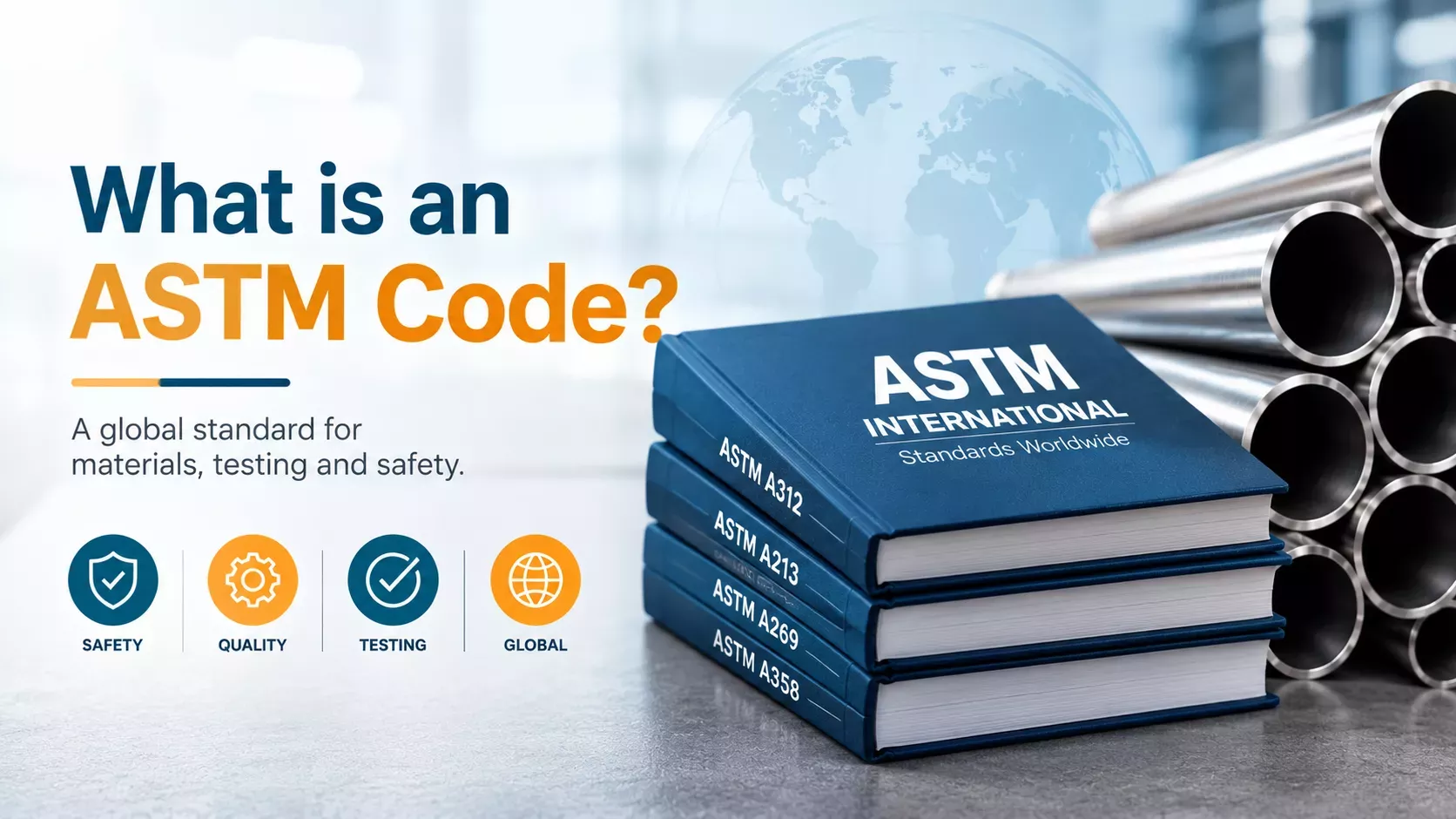
What Is ASTM Code?
An ASTM code is a commonly used term for an ASTM standard or specification designation assigned to a particular material, product, test method, or technical requirement.
For example, ASTM A312 identifies a specification covering certain austenitic stainless steel pipes. The designation allows manufacturers, suppliers, engineers, inspectors and purchasers to identify the applicable technical requirements for the product.
However, it is important to use the terminology correctly. ASTM International generally develops standards and specifications, while organizations such as ASME develop engineering codes as well as standards. Therefore, ASTM standard, ASTM specification, or ASTM designation is often more technically accurate than simply saying ASTM code.
The phrase ASTM code is nevertheless commonly searched and used in the industry, particularly when users are looking for an ASTM code list or asking what is the ASTM code for pipe.
What Does ASTM Stand For?
ASTM originally stood for American Society for Testing and Materials. The organization is now known as ASTM International.
ASTM International develops voluntary consensus standards covering materials, products, systems, services, testing methods and other technical requirements.
In engineering and manufacturing, ASTM standards are widely used to establish consistent requirements for:
- Chemical composition
- Mechanical properties
- Dimensions and tolerances
- Manufacturing processes
- Heat treatment
- Testing and inspection
- Product quality
- Performance requirements
- Acceptance criteria
Therefore, when someone asks “What does ASTM stand for?”, the historical full form is American Society for Testing and Materials, while the current organization operates as ASTM International.
Are ASTM Codes and ASTM Standards the Same?
In everyday industry discussions, the terms ASTM code and ASTM Standard may be used interchangeably. Technically, however, ASTM primarily publishes standards and specifications rather than codes in the same sense as engineering codes.
ASTM develops different types of standards, including specifications, test methods, practices, guides, classifications and terminology standards.
An ASTM specification generally establishes requirements that a particular material or product must satisfy. Depending on the specification, these requirements may cover material composition, manufacturing, mechanical properties, dimensions, heat treatment, testing, inspection and acceptance criteria.
Therefore, if a purchaser asks for an ASTM code, the correct technical designation should be identified according to the product, material, manufacturing method and intended application.
What Is the ASTM Code for Pipe?
There is no single ASTM code for all pipes. The applicable ASTM specification depends on the pipe material, manufacturing method, product type, service conditions and intended application.
For stainless steel pipes and tubes, several commonly referenced ASTM specifications include ASTM A312, ASTM A358, ASTM A269, ASTM A213, ASTM A249, ASTM A270, and ASTM A554.
| ASTM Specification | Product | Typical Application |
|---|---|---|
| ASTM A312 | Austenitic Stainless Steel Pipe | General, corrosive and high-temperature service |
| ASTM A358 | Welded Austenitic Stainless Steel Pipe | Corrosive and high-temperature applications |
| ASTM A213 | Seamless Alloy and Stainless Steel Boiler, Superheater and Heat-Exchanger Tubes | Boilers and heat exchangers |
| ASTM A269 | Austenitic Stainless Steel Tubing | General and corrosive service |
| ASTM A249 | Welded Austenitic Steel Boiler, Heat-Exchanger and Condenser Tubes | Heat exchangers and condensers |
| ASTM A270 | Sanitary Stainless Steel Tubing | Sanitary and hygienic applications |
| ASTM A554 | Welded Stainless Steel Mechanical Tubing | Mechanical and structural applications |
Therefore, the answer to “what is the ASTM code for pipe?” depends on the specific pipe and its application. ASTM A312, for example, is widely used for austenitic stainless steel pipe, while other ASTM specifications apply to different pipe and tube products.
ASTM Pipe Codes and Standards List
The following ASTM code list provides examples of commonly referenced ASTM specifications for stainless steel pipes and tubes.
| ASTM Code / Specification | Description |
|---|---|
| ASTM A312 | Seamless, welded, and heavily cold-worked austenitic stainless steel pipe |
| ASTM A213 | Seamless alloy and stainless steel boiler, superheater and heat-exchanger tubes |
| ASTM A249 | Welded austenitic steel boiler, heat-exchanger and condenser tubes |
| ASTM A269 | Seamless and welded austenitic stainless steel tubing |
| ASTM A358 | Electric-fusion-welded austenitic chromium-nickel alloy steel pipe |
| ASTM A554 | Welded stainless steel mechanical tubing |
| ASTM A270 | Seamless and welded austenitic stainless steel sanitary tubing |
This is a practical reference list rather than a complete list of all ASTM specifications related to piping. ASTM publishes numerous standards covering different materials, products, testing methods, and applications.
ASTM Codes for Stainless Steel Pipes and Tubes
ASTM specifications are particularly important in the stainless steel piping industry because different pipe and tube products require different technical requirements.
ASTM A312 Stainless Steel Pipe
ASTM A312 covers seamless, welded, and heavily cold-worked austenitic stainless steel pipe intended for high-temperature and general corrosive service.
Common grades associated with ASTM A312 include TP304, TP304L, TP304H, TP316, TP316L, TP316H, TP321, TP321H, TP347, and TP347H.
ASTM A312 stainless steel pipe is commonly used in process piping, chemical processing, petrochemical applications, and other industrial environments where corrosion resistance and elevated-temperature performance are required.
ASTM A358 Stainless Steel Pipe
ASTM A358 covers electric-fusion-welded austenitic chromium-nickel alloy steel pipe for corrosive or high-temperature service.
The specification includes different classes based on manufacturing, welding, heat treatment and testing requirements.
ASTM A269 Stainless Steel Tubing
ASTM A269 covers seamless and welded austenitic stainless steel tubing intended for general corrosive service and low- or high-temperature applications where the applicable requirements are met.
It is commonly encountered in instrumentation, processing and general industrial tubing applications.
ASTM A213 Stainless Steel Tube
ASTM A213 covers seamless alloy and stainless steel boiler, superheater and heat-exchanger tubes.
It is commonly used in applications involving elevated temperatures and demanding heat-transfer service conditions.
How to Read an ASTM Code
An ASTM designation generally contains the ASTM prefix followed by a letter and identifying number.
For example:
ASTM A312
- ASTM identifies the standards organization.
- A is part of the ASTM designation system and identifies the relevant category.
- 312 identifies the particular ASTM specification.
A complete ASTM designation may also include a revision year or other information depending on how the document is referenced.
For purchasing and engineering purposes, it is important to identify the complete applicable specification and relevant edition or revision requirements rather than relying only on the basic ASTM number.
What Information Does an ASTM Specification Define?
An ASTM specification can establish detailed requirements that manufacturers and suppliers must meet for a particular material or product.
Chemical Composition
Depending on the specification, chemical composition requirements may establish limits for elements such as:
- Carbon
- Chromium
- Nickel
- Molybdenum
- Manganese
- Silicon
- Phosphorus
- Sulfur
Mechanical Properties
Applicable mechanical requirements may include:
- Tensile strength
- Yield strength
- Elongation
- Hardness
Manufacturing Requirements
Depending on the product, an ASTM specification may establish requirements for:
- Seamless manufacturing
- Welding
- Cold working
- Heat treatment
- Forming
Testing and Inspection
Applicable testing and inspection requirements may include:
- Hydrostatic testing
- Mechanical testing
- Flattening testing
- Flaring testing
- Nondestructive examination
- Intergranular corrosion testing
- Visual inspection
The exact requirements always depend on the individual ASTM specification and product being supplied.
ASTM Code vs ASTM Specification
| Term | Meaning |
|---|---|
| ASTM Code | Common industry/search term for an ASTM designation or specification |
| ASTM Standard | Technical document developed through ASTM's consensus standards process |
| ASTM Specification | Standard establishing requirements for a specific material or product |
| ASTM Test Method | Standardized method for performing a particular test |
| ASTM Designation | Identifying number and letter assigned to an ASTM document |
For technical documents, engineering specifications, purchase orders, and inspection records, using the exact ASTM standard or specification designation is generally preferable to using the generic phrase “ASTM code.”
ASTM Code vs ASME Code: What Is the Difference?
ASTM code vs ASME Code is a common comparison because both organizations are widely referenced in engineering, manufacturing and piping projects. However, ASTM and ASME have different primary roles.
| Point | ASTM | ASME |
|---|---|---|
| Organization | ASTM International | American Society of Mechanical Engineers |
| Main Focus | Materials, products, testing methods and technical standards | Engineering codes and standards |
| Common Use | Material and product requirements | Design, construction and engineering requirements |
| Pipe Example | ASTM A312 | ASME B31.3 |
| Material Reference | ASTM material specifications | ASME material requirements and referenced specifications |
| Piping | Material and product specifications | Piping design and construction requirements |
For example, ASTM A312 specifies requirements for certain austenitic stainless steel pipe, while ASME B31.3 establishes requirements for process piping design and construction. They therefore serve different purposes and may be used together on the same engineering project.
For a detailed comparison, read our guide: ASTM vs ASME: What Is the Difference?
Why Are ASTM Codes and Standards Important?
ASTM standards help create consistency between manufacturers, suppliers, engineers, inspectors and purchasers. They provide a common technical basis for evaluating materials and products.
For stainless steel pipes and tubes, an applicable ASTM specification can help establish:
- Required material grade
- Chemical composition
- Mechanical properties
- Manufacturing requirements
- Heat treatment
- Testing requirements
- Inspection requirements
- Dimensional requirements
- Acceptance criteria
This makes ASTM standards important for quality control and material selection across industries such as oil and gas, petrochemical, chemical processing, power generation, pharmaceutical, food processing, marine and general engineering.
How Do You Select the Correct ASTM Code for a Pipe?
The correct ASTM specification should not be selected based only on the material grade. Several technical factors need to be considered before specifying a pipe.
- Product type: Determine whether the requirement is for pipe, tube, fitting, plate, or another product form.
- Manufacturing method: Identify whether the product is seamless, welded, ERW, EFW, or manufactured by another process.
- Material grade: Confirm the required grade, such as 304, 316L, 321, or 347.
- Service conditions: Consider temperature, pressure, corrosion, and operating environment.
- Application: Identify whether the product is intended for process piping, heat exchangers, boilers, sanitary service, mechanical applications, or another use.
- Testing requirements: Determine the applicable hydrostatic, mechanical, nondestructive, or other testing requirements.
- Project requirements: Check applicable engineering codes, purchase specifications, customer requirements and inspection requirements.
For example, simply specifying a “316 stainless steel pipe” may not be sufficient to determine the correct ASTM specification. The product form, manufacturing method, application, dimensions, testing requirements, and service conditions should also be considered.
ASTM Code List for Common Stainless Steel Products
The following table provides a quick ASTM code list for commonly used stainless steel pipes and tubes.
| Product | Common ASTM Specification |
|---|---|
| Stainless Steel Pipe | ASTM A312 |
| Welded Stainless Steel Pipe | ASTM A358 |
| Stainless Steel Boiler & Heat-Exchanger Tube | ASTM A213 |
| Stainless Steel Tubing | ASTM A269 |
| Welded Heat-Exchanger Tube | ASTM A249 |
| Stainless Steel Sanitary Tube | ASTM A270 |
| Stainless Steel Mechanical Tubing | ASTM A554 |
This table is a quick reference only. The applicable ASTM specification should always be confirmed according to the exact product form, material grade, manufacturing process, application and project requirements.
Key Takeaways
- ASTM originally stood for American Society for Testing and Materials and is now known as ASTM International.
- ASTM code is a commonly used term, while ASTM standard or ASTM specification is generally more technically precise.
- There is no single ASTM code for all pipes.
- ASTM A312 is one of the commonly referenced specifications for austenitic stainless steel pipe.
- ASTM specifications can define material, manufacturing, testing, dimensional, and acceptance requirements.
- ASTM and ASME are separate organizations with different primary areas of focus.
- The correct ASTM specification depends on the product, material, manufacturing method, application and service requirements.
Frequently Asked Questions
An ASTM Code is a commonly used term for an ASTM standard or specification designation. ASTM International primarily develops standards and specifications for materials, products, testing methods and related technical requirements rather than codes in the same sense as ASME engineering codes.
There is no single ASTM Code for all pipes. The applicable ASTM specification depends on the pipe material, product type, manufacturing method, and application. For example, ASTM A312 is commonly used for austenitic stainless steel pipe, while ASTM A358 covers certain welded stainless steel pipe.
ASTM originally stood for American Society for Testing and Materials. The organization is now known as ASTM International and develops voluntary consensus standards for materials, products, systems, services and testing methods.
ASTM originally stood for American Society for Testing and Materials. Today, the organization is officially known as ASTM International. The term ASTM code is commonly used to refer to an ASTM standard or specification designation.
ASTM codes and standards is a commonly used phrase referring to ASTM technical standards and specifications. These documents establish requirements for materials, products, testing methods, manufacturing processes, dimensions, performance and other technical applications.
An ASTM Code List is a reference list of ASTM designations for different materials, products, testing methods and applications. Common stainless steel piping specifications include ASTM A312, ASTM A213, ASTM A249, ASTM A269, ASTM A270, ASTM A358 and ASTM A554.
ASTM primarily develops standards and specifications. Therefore, referring to an ASTM document as an ASTM standard or ASTM specification is generally more technically precise than calling it an ASTM code. The term ASTM code is nevertheless commonly used in industry and search queries.
The term ASTM Code is commonly used to describe an ASTM designation, while ASTM Standard is the more technically accurate terminology for an ASTM technical document. ASTM standards may include specifications, test methods, practices, guides, classifications and terminology standards.
ASTM primarily develops standards and specifications for materials, products, and testing, while ASME develops engineering Codes and Standards for areas such as piping, pressure vessels, boilers and mechanical components. ASTM material specifications and ASME Codes may be used together on the same engineering project.
No. ASTM A312 is an ASTM specification covering certain austenitic stainless steel pipe. It is not an ASME Code. ASME publishes separate Codes and Standards that may reference applicable material specifications.
ASTM A312 is used for seamless, welded, and heavily cold-worked austenitic stainless steel pipe intended for high-temperature and general corrosive service. It is commonly specified for industrial applications such as process piping, chemical processing and petrochemical service.
The appropriate ASTM specification should be selected based on the product type, material grade, manufacturing method, operating conditions, intended application, dimensions, testing requirements and applicable project specifications. The complete ASTM specification and relevant edition should be verified before procurement.