
-
-
-
Girgaon, Mumbai - 400004
What is The Difference Between ASTM and ASME
ASTM and ASME are two widely recognized organizations involved in developing technical standards used across manufacturing, engineering, construction, piping, pressure equipment and other industrial applications. Because both names frequently appear on material specifications, pipes, tubes, valves, pressure vessels and engineering documents, the terms ASTM vs ASME and ASME vs ASTM can sometimes cause confusion.
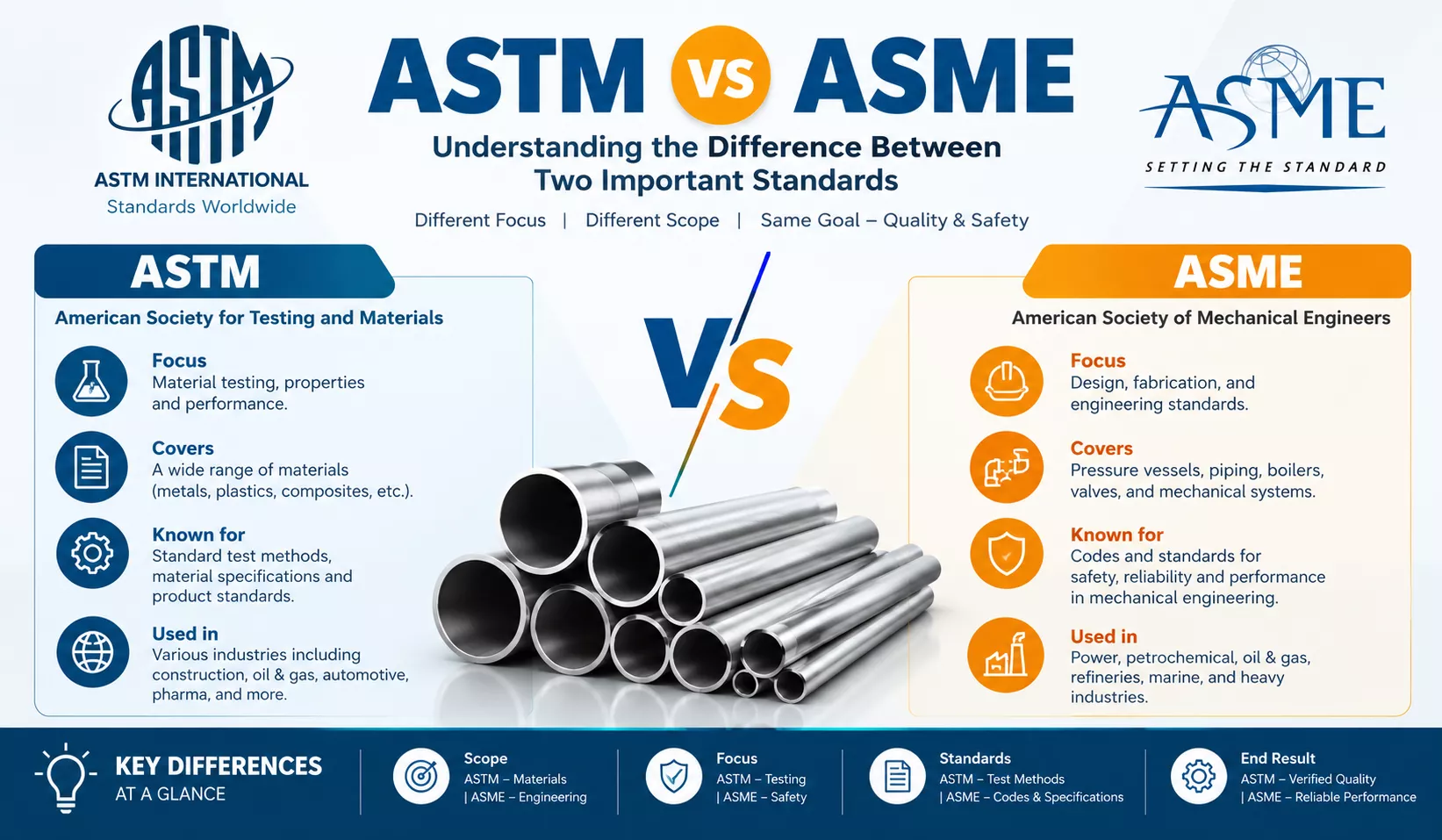
The main difference is that ASTM International develops technical standards covering materials, products, testing methods and related requirements, while ASME (American Society of Mechanical Engineers) develops engineering codes and standards, particularly for mechanical systems, pressure equipment, piping and related applications.
Understanding the Difference Between ASTM and ASME is important when selecting materials, interpreting specifications, purchasing stainless steel pipes and tubes, or determining which engineering code or standard applies to a particular project.
What Is ASTM?
ASTM refers to ASTM International, a globally recognized standards organization that develops and publishes consensus standards for materials, products, systems, services, and test methods. ASTM standards are used across manufacturing, engineering, construction, metallurgy, chemical processing, oil and gas, power generation, aerospace, and many other industries.
ASTM standards and specifications are particularly important when a project needs clearly defined requirements for a material or manufactured product. Depending on the applicable specification, these requirements can cover chemical composition, mechanical properties, manufacturing method, heat treatment, dimensions, tolerances, testing, inspection, marking, and product quality.
The phrase ASTM full form in mechanical engineering generally refers to ASTM International and its role in developing technical standards used for engineering materials, components, manufacturing processes, and testing methods. Mechanical engineers commonly encounter ASTM specifications when selecting or purchasing metals, pipes, tubes, plates, bars, forgings, and other products.
In piping applications, the ASTM full form in piping also refers to ASTM International. ASTM specifications are widely used for stainless steel, carbon steel, alloy steel, nickel alloy, and other metallic pipes and tubes. Examples include ASTM A312, ASTM A213, ASTM A269, and ASTM A358.
Historically, ASTM stood for American Society for Testing and Materials. The organization is now known as ASTM International.
What Is ASME?
ASME stands for American Society of Mechanical Engineers. It is a professional engineering organization that develops and publishes codes, standards, and technical documents for mechanical engineering and industrial applications.
ASME means American Society of Mechanical Engineers. Its codes and standards cover a wide range of engineering subjects, including pressure vessels, boilers, process piping, power piping, pipe flanges, fittings, welding, nondestructive examination, and other mechanical engineering applications.
The full form of ASME is American Society of Mechanical Engineers.
The ASME full form in mechanical engineering is therefore American Society of Mechanical Engineers. ASME documents provide engineering requirements that can relate to design, construction, fabrication, examination, testing, and qualification of mechanical equipment and systems.
In piping, the ASME full form in piping is also American Society of Mechanical Engineers. Engineers may use ASME documents such as ASME B31.1, ASME B31.3, ASME B16.5, and ASME B16.9, depending on the piping system or component involved.
ASME therefore has a different primary role from ASTM, although the two organizations' documents can be used together within the same engineering project.
ASTM vs ASME: What Is the Difference?
The main difference between ASTM and ASME is the purpose of their technical documents. ASTM International develops standards and specifications for materials, products, testing methods, and related technical requirements. ASME develops engineering codes and standards covering areas such as piping systems, pressure equipment, mechanical components, fabrication, examination, and other engineering applications.
In simple terms, an ASTM specification commonly establishes requirements for a material or manufactured product, while an ASME Code or Standard establishes engineering requirements for a system, component, equipment, or application, depending on the specific document.
This explains the difference between ASME and ASTM and the difference between ASTM and ASME without treating them as competing organizations. They perform different functions and can complement each other.
| Comparison | ASTM | ASME |
|---|---|---|
| Organization | ASTM International | American Society of Mechanical Engineers |
| Primary Focus | Materials, products, specifications and test methods | Mechanical engineering codes and standards |
| Typical Requirements | Chemical composition, mechanical properties, manufacturing, testing and inspection | Design, construction, fabrication, examination and engineering requirements |
| Piping Examples | ASTM A312, ASTM A213, ASTM A269 | ASME B31.3, ASME B31.1, ASME B16.5 |
| Typical Role | Defines requirements for applicable materials and products | Defines requirements for applicable engineering systems and components |
| Relationship | ASTM specifications may be referenced by engineering requirements | ASME documents may reference applicable material specifications |
For example, a stainless steel pipe may need to satisfy an applicable ASTM product specification, while the piping system in which it is installed may be designed and constructed according to the relevant ASME Code. The exact requirements depend on the project and application.
What Are ASTM Standards?
What is the ASTM Standards provide standardized technical requirements and test methods for materials, products, systems, and other applications. In the metal and piping industry, ASTM specifications are commonly used to establish consistent requirements for the manufacture, testing, inspection, and supply of engineering products.
Depending on the specific ASTM document, requirements may address:
- Chemical composition
- Mechanical properties
- Manufacturing process
- Heat treatment
- Dimensions and tolerances
- Testing and inspection
- Surface requirements
- Marking and certification
For stainless steel piping, commonly encountered ASTM specifications include ASTM A312 for applicable stainless steel pipe, ASTM A213 for applicable boiler, superheater, and heat-exchanger tubes, ASTM A269 for applicable general-service stainless steel tubing, and ASTM A358 for applicable electric-fusion-welded austenitic stainless steel pipe.
The applicable ASTM specification should always be selected according to the material grade, product form, service conditions, manufacturing method, and project requirements.
What Are ASME Standards?
What Is the ASME Standards are technical documents developed by ASME for specific mechanical engineering subjects, components, dimensions, processes, and applications. In piping, ASME standards are commonly encountered for components and dimensional requirements.
In the context of ASME vs ASTM, ASME standards generally address engineering requirements for specific components, systems, dimensions, and applications, while ASTM standards and specifications commonly establish requirements for materials, products, and test methods. For example, ASME B16.5 covers pipe flanges and flanged fittings, whereas ASTM A312 covers applicable austenitic stainless steel pipe requirements.
| ASME Standard | Application |
|---|---|
| ASME B16.5 | Pipe Flanges and Flanged Fittings |
| ASME B16.9 | Factory-Made Wrought Butt-Welding Fittings |
| ASME B36.19M | Stainless Steel Pipe Dimensions |
ASME standards should not automatically be treated as material specifications. Their purpose depends on the individual document. For example, ASME B16.5 addresses flanges and flanged fittings, while ASME B36.19M addresses stainless steel pipe dimensions.
ASTM vs ASME Material Specifications
Understanding ASTM vs ASME Material Specifications is important when specifying industrial pipes, tubes, and other metal products. ASTM specifications commonly establish requirements for the material and product, whereas ASME documents can establish engineering requirements or identify materials suitable for particular applications.
| Aspect | ASTM | ASME |
|---|---|---|
| Primary Purpose | Material and product requirements | Engineering codes and standards |
| Chemical Composition | May establish composition requirements for the specified product | May reference or incorporate applicable material requirements |
| Mechanical Properties | May establish required tensile, yield and elongation properties | May establish engineering requirements involving material performance |
| Manufacturing | May define manufacturing and heat-treatment requirements | May establish fabrication and construction requirements |
| Testing | May define product tests and acceptance requirements | May establish examination and testing requirements for applicable systems or equipment |
| Example | ASTM A312 | ASME B31.3 |
It is therefore more accurate to compare the specific ASTM specification with the specific ASME Code or Standard required for a project rather than treating ASTM and ASME as interchangeable material-designation systems.
ASTM and ASME Standards for Pipes and Tubes
ASTM and ASME documents are both widely encountered in industrial piping, but they can serve different purposes. ASTM specifications are commonly used to define requirements for pipes and tubes, while ASME Codes and Standards address piping-system design, components, dimensions, fabrication, and other engineering requirements depending on the document.
| Document | Document Type | Typical Application |
|---|---|---|
| ASTM A312 | ASTM Specification | Applicable austenitic stainless steel pipe |
| ASTM A213 | ASTM Specification | Applicable alloy-steel and stainless steel boiler, superheater and heat-exchanger tubes |
| ASTM A269 | ASTM Specification | Applicable austenitic stainless steel tubing for general service |
| ASME B16.5 | ASME Standard | Pipe flanges and flanged fittings |
| ASME B16.9 | ASME Standard | Factory-made wrought butt-welding fittings |
| ASME B36.19M | ASME Standard | Stainless steel pipe dimensions |
| ASME B31.3 | ASME Code | Process piping |
When specifying a pipe, engineers should identify the applicable material specification, grade, product form, dimensions, schedule or wall thickness, testing requirements, and the engineering code applicable to the piping system.
ASTM vs ASME Examples in Stainless Steel Piping
A practical example helps explain the difference between ASTM and ASME in a real piping application.
Consider a stainless steel process piping system. The pipe may be specified to meet ASTM A312, which establishes requirements applicable to the pipe product. The overall process piping system may then be designed and constructed according to ASME B31.3, where that Code applies.
Other components can have their own applicable standards. For example, ASME B16.5 applies to pipe flanges and flanged fittings within its scope, while ASME B16.9 applies to factory-made wrought butt-welding fittings.
| Project Item | Example Requirement | Purpose |
|---|---|---|
| Stainless Steel Pipe | ASTM A312 | Pipe material and product requirements |
| Process Piping System | ASME B31.3 | Process piping engineering requirements |
| Flanges | ASME B16.5 | Flange and flanged-fitting requirements |
| Butt-Welding Fittings | ASME B16.9 | Applicable fitting requirements |
This illustrates why ASTM vs ASME is not necessarily an either-or decision. Different standards and codes can apply to different products, components, and stages of the same project.
ASTM vs ASME vs ANSI
ASTM vs ASME vs ANSI is a comparison of three organizations that have different roles within the standards environment. They should not be treated as interchangeable organizations.
| Organization | Primary Role | Common Engineering Relevance |
|---|---|---|
| ASTM | Develops consensus standards and specifications | Materials, products, testing and related technical requirements |
| ASME | Develops engineering codes and standards | Mechanical engineering, piping, pressure equipment and components |
| ANSI | Coordinates and accredits the U.S. voluntary consensus standards system | Standards development and accreditation framework |
The roles can overlap within the broader standards ecosystem, but each organization has its own responsibilities. Therefore, ASTM vs ASME vs ANSI should be understood as a comparison of their functions rather than a comparison of three equivalent technical standards.
How Do ASTM and ASME Work Together?
ASTM and ASME work together in many engineering projects because material and product requirements are often different from system-level engineering requirements.
An ASTM specification can establish requirements applicable to a pipe or tube, including its material, manufacturing, mechanical properties, testing, and other product requirements. An ASME Code may then establish requirements for the design and construction of the piping system or equipment in which that product is used.
For example, a project could specify an applicable ASTM stainless steel pipe specification while using an ASME piping Code for the overall piping system. Applicable ASME standards may also be used for components such as flanges, fittings, and dimensions.
The exact combination of requirements depends on the product, material grade, service conditions, design parameters, project specification, applicable Code, and regulatory requirements.
When Is ASTM and ASME Used?
ASTM and ASME are used for different but complementary requirements in engineering and industrial applications. ASTM standards and specifications are commonly used for materials, products, manufacturing, and testing, while ASME Codes and Standards are used for engineering systems, piping, components, pressure equipment, fabrication, and related applications.
| Application | ASTM | ASME |
|---|---|---|
| Stainless Steel Pipes and Tubes | Defines applicable material and product requirements | Provides applicable engineering, dimensional, component, or piping-system requirements |
| Carbon and Alloy Steel Products | Defines applicable material, manufacturing and testing requirements | Provides applicable engineering and construction requirements |
| Nickel and Nickel Alloy Products | Provides applicable material and product specifications | May be referenced within applicable equipment or piping requirements |
| Chemical Composition | May establish composition requirements for the specified product | May reference applicable material requirements |
| Mechanical Properties | May establish required mechanical properties | May establish engineering requirements involving material performance |
| Heat Treatment | May establish applicable heat-treatment requirements | May include or reference requirements depending on the document |
| Testing and Inspection | May define product tests and acceptance requirements | May establish examination, inspection, and testing requirements for applicable systems or equipment |
| Dimensions and Tolerances | May specify product dimensions and tolerances | Provides dimensional requirements for applicable components and piping standards |
| Process Piping | Provides applicable material and product specifications | ASME B31.3 provides requirements for process piping |
| Power Piping | Provides applicable material and product specifications | ASME B31.1 provides requirements for power piping |
| Pressure Vessels | Provides applicable material specifications | ASME BPVC provides applicable construction requirements |
| Pipe Flanges and Fittings | May provide applicable material specifications | ASME B16.5 and other applicable ASME standards cover piping components |
| Welding Qualifications | May define applicable material or product requirements | ASME Section IX covers welding, brazing, and fusing qualifications |
| Nondestructive Examination | May provide applicable product test methods | ASME Section V covers nondestructive examination requirements |
In practical applications, ASTM and ASME requirements can therefore appear together on the same project. The material specification identifies the applicable product requirements, while the relevant ASME Code or Standard addresses the engineering requirements applicable to the system or component.
ASTM vs ASME: Which Is Better?
There is no universal answer to whether ASTM or ASME is better. They serve different purposes, so the correct document depends on the material, product, equipment, piping system, service conditions, and project requirements.
ASTM is particularly important when defining requirements for a material or manufactured product. ASME is particularly important when engineering codes or standards are required for piping systems, pressure equipment, components, fabrication, examination, or related mechanical applications.
For this reason, the question of ASTM vs ASME should normally be approached by identifying the specific requirement rather than selecting one organization over the other.
For example, a project may require a stainless steel pipe to meet an applicable ASTM specification and also require the piping system to comply with an applicable ASME Code. Both requirements can be important, but they address different aspects of the project.
Frequently Asked Questions
ASTM primarily develops standards and specifications for materials, products, and testing methods, while ASME develops engineering codes and standards for piping, pressure equipment, mechanical components, and related engineering applications.
ASME means American Society of Mechanical Engineers. It develops engineering codes, standards, and technical documents for mechanical engineering and industrial applications.
The full form of ASME is American Society of Mechanical Engineers.
ASTM full form in mechanical engineering refers to ASTM International. ASTM standards and specifications are widely used for engineering materials, products, components, manufacturing, and testing requirements.
ASME full form in mechanical engineering is American Society of Mechanical Engineers. ASME develops codes and standards used in mechanical engineering, pressure equipment, piping, and related applications.
ASTM full form in piping refers to ASTM International. ASTM specifications are widely used to define requirements for pipes, tubes, fittings, and other piping materials.
ASME full form in piping is American Society of Mechanical Engineers. ASME develops Codes and Standards covering piping systems, components, dimensions, pressure equipment, and related engineering requirements.
No. ASTM and ASME are separate organizations with different primary purposes. ASTM commonly develops material and product standards and specifications, while ASME develops engineering codes and standards. Their documents can be used together.
ASME standards are technical documents developed by ASME for specific engineering subjects, components, dimensions, processes, and applications. Examples include ASME B16.5, ASME B16.9, and ASME B36.19M.
ASTM primarily develops standards and specifications for materials, products, testing methods, and related technical requirements. Referring to an ASTM specification as an "ASTM code" is generally less precise than calling it an ASTM standard or specification.
Yes. ASTM material or product specifications and ASME Codes or Standards are frequently used together when their respective requirements apply to a project.
ASTM A312 and ASME SA312 are closely related designations, but they should not simply be treated as interchangeable without checking the applicable ASME requirements, material listing, and project specification.
ASTM vs ASME vs ANSI compares organizations with different roles. ASTM develops standards and specifications, ASME develops mechanical engineering codes and standards, and ANSI coordinates and accredits the U.S. voluntary consensus standards system.
Neither ASTM nor ASME is universally better. The applicable document depends on whether the requirement concerns a material or product, an engineering system, a piping component, pressure equipment, or another specific application.