
-
-
-
Girgaon, Mumbai - 400004
What Are ASME Material Specifications?
ASME Material Specifications: Complete Guide
ASME Material Specifications identify material and product requirements referenced within the ASME Boiler and Pressure Vessel Code and related engineering requirements. They define or reference requirements such as material grade, chemical composition, mechanical properties, manufacturing, heat treatment, testing and inspection.
For stainless steel pipes, tubes, and nickel alloy products, ASME specifications are commonly identified using SA and SB designations. These specifications are closely related to ASTM standards and help ensure that materials meet the requirements of specific engineering and pressure-service applications.
Kamal Steels supplies stainless steel pipes and tubes in various grades, sizes, and product forms according to applicable ASME and ASTM material specifications for industrial, commercial and export requirements.
| ASME Material Requirement | What It Covers |
|---|---|
| Material Grade & Chemical Composition | Defines the required material grade and applicable chemical composition limits. |
| Mechanical Properties & Testing | Covers required strength, mechanical properties, testing methods and acceptance criteria. |
| Manufacturing & Heat Treatment | Specifies applicable manufacturing processes, forming methods and heat-treatment requirements. |
| Dimensions & Product Requirements | Defines product form, dimensions, sizes, wall thickness and other applicable requirements. |
| Inspection, Documentation & Traceability | Covers inspection, certification, material identification, documentation and traceability. |
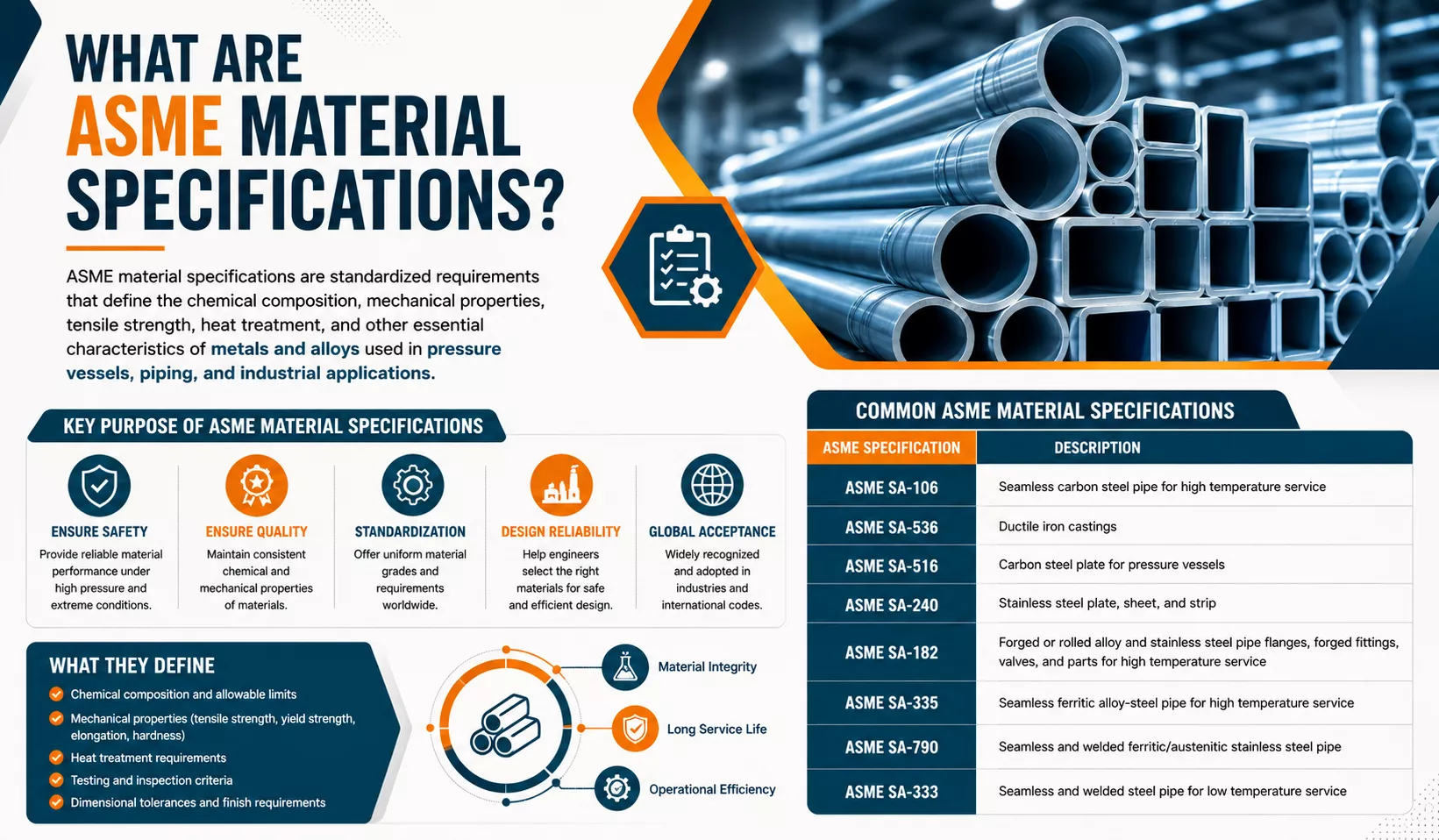
How ASME Relates to ASTM
ASTM develops material and product standards, while ASME uses many ASTM specifications within its Boiler and Pressure Vessel Code and related requirements. As a result, the same material specification may be referenced using both ASTM and ASME designations.
Where an ASTM Specification is adopted or listed by ASME, it may appear under the corresponding SA or SB designation. The applicable ASME edition, specification, grade, product form, and supplementary requirements should always be verified for the specific project.
| ASTM Specification | ASME Specification |
|---|---|
| ASTM A312 | ASME SA312 |
| ASTM A213 | ASME SA213 |
| ASTM A269 | ASME SA269 |
| ASTM A249 | ASME SA249 |
| ASTM A358 | ASME SA358 |
| ASTM A270 | ASME SA270 |
| ASTM A554 | ASME SA554 |
| ASTM B163 | ASME SB163 |
| ASTM B167 | ASME SB167 |
ASME Material Specification Chart
The following chart summarizes commonly referenced ASME material specifications for stainless steel pipes, tubes, and selected nickel alloy products.
| ASME Specification | Product / Material Coverage | Common Applications |
|---|---|---|
| ASME SA312 | Stainless Steel Process Pipe | Process and industrial piping |
| ASME SA213 | Boiler & Heat-Exchanger Tubes | Boilers and heat exchangers |
| ASME SA269 | General Stainless Steel Tubing | General service and instrumentation |
| ASME SA270 | Sanitary Stainless Steel Tubing | Food, pharmaceutical, and sanitary applications |
| ASME SA554 | Stainless Steel Mechanical Tubing | Mechanical and structural applications |
| ASME SB163 | Nickel Alloy Heat-Exchanger Tubes | Heat exchangers and condensers |
| ASME SB167 | Nickel Alloy Seamless Pipe & Tube | High-temperature and corrosion-resistant applications |
Kamal Steels supplies stainless steel pipes and tubes in various grades, sizes, and product forms according to applicable customer and project requirements. Buyers should confirm the required specification, grade, size, manufacturing type, testing, and documentation before placing an order.
How to Choose the Right ASME Material Specification
Selecting the correct ASME material specification requires consideration of the product type, material grade, manufacturing method, service conditions, testing requirements, and project specifications. The following factors can help buyers, engineers, and procurement teams identify the appropriate specification.
-
01. Product Type
Identify whether the requirement is for a pipe, tube, fitting, plate, or another product form.
-
02. Material Grade
Select the required stainless steel, alloy steel, nickel alloy, or other specified material grade.
-
03. Manufacturing Method
Confirm whether seamless, welded, cold-worked, or another manufacturing form is required.
-
04. Service Conditions
Consider operating temperature, pressure, corrosion, fluid characteristics, and application requirements.
-
05. Testing Requirements
Review the required mechanical, chemical, nondestructive, hydrostatic, and other applicable tests.
-
06. Project Specification
Confirm the required ASME/ASTM specification, applicable edition, supplementary requirements, and project standards.
Why ASME Material Specifications Are Important
Using the correct material specification helps ensure that the supplied product meets the required technical, manufacturing, testing, and documentation requirements. This is particularly important for industrial piping, pressure equipment, heat exchangers, and other critical applications.
Material & Manufacturing
- Material identification
- Chemical composition requirements
- Mechanical property requirements
- Manufacturing requirements
- Heat treatment requirements
Quality & Compliance
- Testing and inspection
- Material traceability
- Quality documentation
- Project specification compliance
- Engineering requirements
Frequently Asked Questions
An ASME material specification may define requirements related to material grade, chemical composition, mechanical properties, manufacturing, heat treatment, dimensions, testing, inspection, and certification. The exact requirements depend on the applicable specification and product form.
ASME material specifications help establish consistent technical requirements for materials used in industrial piping and other engineering applications. They help buyers and engineers identify suitable material grades, product forms, testing requirements, and documentation for the intended service.
SA and SB are ASME material specification designations used for different groups of materials and products. SA specifications commonly cover ferrous materials such as stainless steels, while SB specifications are commonly associated with nickel and nickel-alloy materials. The applicable specification should be confirmed for the required product and grade.
Whether an ASTM specification can be used depends on the applicable ASME Code, project specification, material requirement, and purchasing requirements. When ASME compliance is specified, the applicable ASME designation and edition should be verified rather than assuming that the ASTM designation alone is sufficient.
Start by identifying the pipe material, grade, product form, manufacturing method, service conditions, required testing, and applicable project or code requirements. These factors help determine whether specifications such as SA312 or another ASME material specification is appropriate.
Yes. Depending on the specification and product, requirements may include chemical analysis, mechanical testing, hydrostatic testing, nondestructive examination, dimensional inspection, and other specified tests. The applicable specification should be reviewed for the exact testing requirements.
Material certification requirements depend on the applicable specification, ASME Code, project specification, and purchaser requirements. Documentation may include material test certificates, chemical and mechanical test results, inspection records, and traceability information.
Yes. Different ASME material specifications apply to different product forms such as pipes, tubes, plates, and other materials. For example, a specification suitable for stainless steel process pipe may differ from one used for boiler or heat-exchanger tubing.
Yes. The applicable edition can affect the requirements referenced by a specification. Buyers should confirm the required ASME edition, specification, material grade, supplementary requirements, and project standards before placing an order.
Yes. Kamal Steels can assist customers with stainless steel pipes and tubes based on the required material grade, ASME/ASTM specification, dimensions, manufacturing type, testing requirements, certification, and project specifications. Customers should provide their technical requirements for proper product selection.