
-
-
-
Girgaon, Mumbai - 400004
Stainless Steel Tubes Manufacturers in India
Kamal Steels is a Stainless Steel Tube Manufacturer, Stockist and Exporter in India, supplying Stainless Steel Tubes for industrial, engineering and project requirements. Established in 1984, we offer Stainless Steel Tubing in different grades, sizes, wall thicknesses, manufacturing types and specifications to meet the requirements of various applications.
Our range includes Seamless Stainless Steel Tubes and welded tubes in commonly required grades such as 304, 304L, 316, 316L, 321, 310, 310S, 347, 904L, duplex and super duplex grades, subject to the applicable specification and availability. Customers can specify the required stainless steel tube size, grade, wall thickness, length, finish and standard according to their application.
As SS Tube Manufacturers in India and Stainless Steel Tube Suppliers, Kamal Steels supports requirements for heat exchanger tubes, instrumentation tubes, mechanical tubing, process tubing and other industrial tube applications. We also supply tubes according to applicable ASTM and ASME Specifications, with material documentation and inspection requirements arranged according to the order.
Our Stainless Steel Tubes are supplied to EPC contractors, fabricators, engineering companies, distributors and industrial buyers in India and international markets. Whether the requirement is for standard Stainless Steel Tube Sizes or a project-specific specification, the selection is based on the required material grade, dimensions, manufacturing method, applicable standard and intended service.
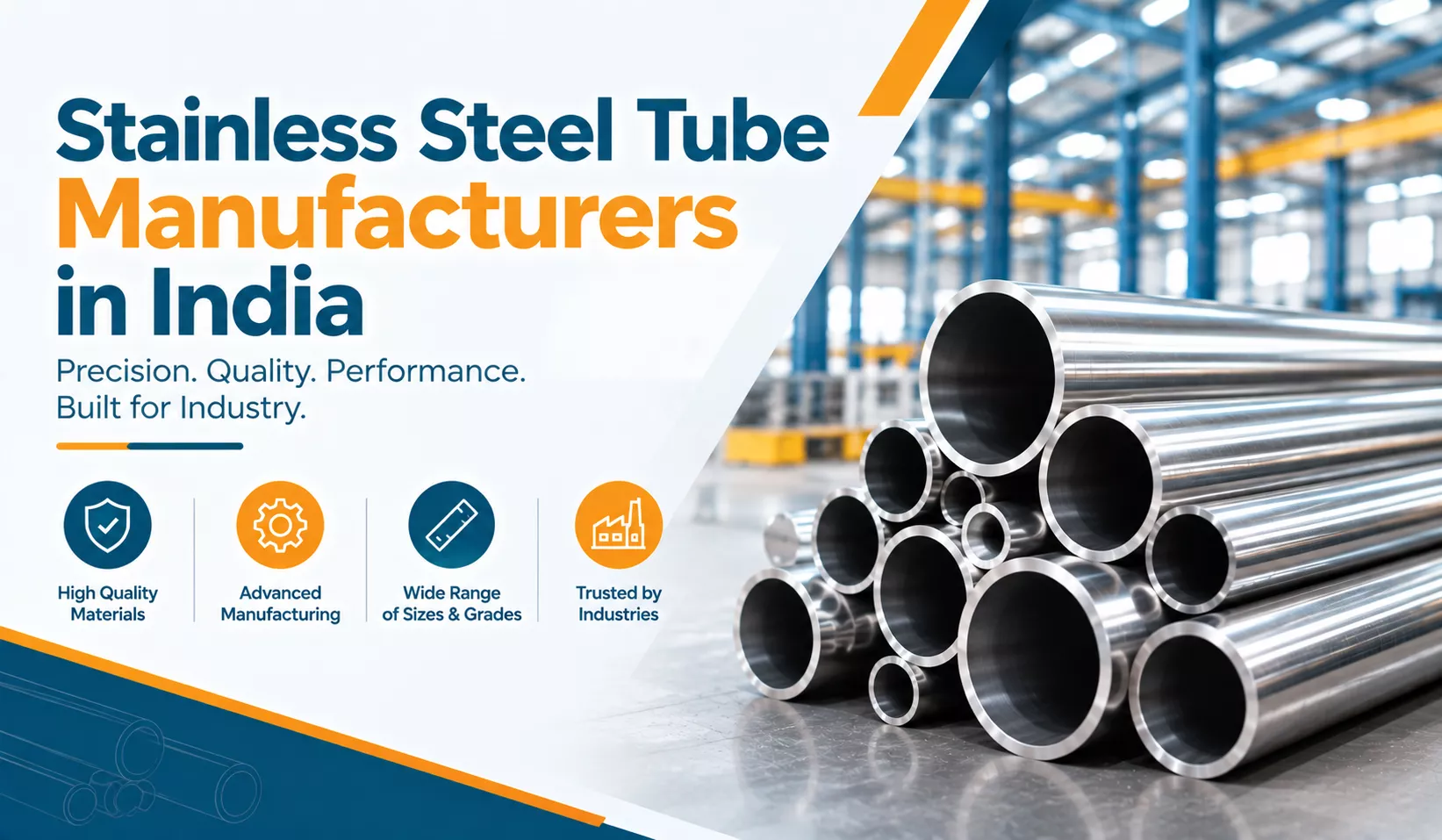
What Is a Stainless Steel Tube?
A Stainless Steel Tube is a hollow cylindrical or shaped product manufactured from stainless steel and used for fluid transfer, heat exchange, structural fabrication, instrumentation and other engineering applications. Stainless steel contains chromium as a key alloying element, which provides corrosion resistance through the formation of a passive surface layer.
Stainless steel tubes are available in different grades, outside diameters, wall thicknesses, lengths, manufacturing methods and surface finishes. Depending on the required service conditions, buyers can select Seamless Stainless Steel Tubes, welded tubes, square tubes, rectangular tubes or coiled tubes.
The correct tube is selected according to factors such as material grade, dimensions, pressure or temperature requirements, corrosion environment, manufacturing standard, surface finish and application.
What Is Stainless Steel Tube Made Of?
Stainless steel tubes are made from stainless steel alloys containing iron, chromium and other alloying elements. Chromium is essential to stainless steel's corrosion-resistant behavior, while elements such as nickel, molybdenum, carbon, manganese, silicon and nitrogen are used in different grades to achieve specific properties.
For example, 304 stainless steel is an austenitic grade containing chromium and nickel, while 316 stainless steel also contains molybdenum, which improves resistance to certain corrosive environments.
The exact chemical composition depends on the applicable material specification and grade. Therefore, a stainless steel tube should be identified by its grade and applicable specification rather than simply by the general term "stainless steel."
Stainless Steel Tube Manufacturers in India
Kamal Steels supplies stainless steel tubes in India for industrial, engineering, fabrication and process applications. Our stainless steel tube range covers commonly required austenitic grades and other stainless steel materials according to product type, specification and availability.
As a stainless steel tube manufacturer and supplier in India, Kamal Steels focuses on matching tube grade, dimensions, manufacturing type and documentation with the customer's technical requirements.
Depending on the requirement, stainless steel tubes can be supplied with relevant material documentation such as Mill Test Certificates (MTC) and EN 10204 3.1 documentation, where applicable.
When purchasing stainless steel tubes, the important information to confirm includes:
- Stainless steel grade
- Seamless or welded construction
- Outside diameter and wall thickness
- Tube length
- Applicable ASTM or ASME specification
- Surface finish
- Testing and inspection requirements
- Required material documentation
Stainless Steel Tube Specifications
Stainless steel tube specifications define the applicable standard, grade, manufacturing type, dimensions, wall thickness, length and surface requirements of the tube. The specification depends on the type of stainless steel tube and its intended application.
| Specification | Details |
|---|---|
| Material | Stainless Steel |
| Grades | 304, 304L, 316, 316L, 321, 321H, 310, 310S, 347, 347H, 904L, Duplex and Super Duplex |
| Manufacturing Type | Seamless and Welded |
| Outside Diameter | As per required size and applicable specification |
| Wall Thickness | As per required dimensions and applicable specification |
| Length | Standard or cut length as specified by the customer |
| Standards | ASTM, ASME and other applicable international specifications |
| Surface Finish | As required by the applicable specification and customer requirement |
| End Type | Plain End, Beveled End or as specified |
| Testing | As required by the applicable product specification |
Types of Stainless Steel Tubes
Stainless steel tubes can be classified according to their manufacturing method, cross-sectional shape, dimensions and intended application.
| Tube Type | Typical Characteristics | Common Applications |
|---|---|---|
| Stainless Steel Seamless Tubes | Manufactured without a longitudinal welded seam | Heat exchangers, process systems and demanding service applications |
| Stainless Steel Welded Tubes | Manufactured from strip or sheet with a welded longitudinal seam | Fabrication, process equipment, structural and general industrial use |
| Stainless Steel Square Tube | Square cross-section | Structural fabrication, architectural and mechanical applications |
| Stainless Steel Coil Tube | Long continuous tube supplied in coil form | Heat transfer, instrumentation and specialized process systems |
Stainless Steel Tube Grades
Different stainless steel grades provide different combinations of corrosion resistance, strength, temperature resistance, weldability and fabrication characteristics.
| Grade | Family | General Characteristics |
|---|---|---|
| 304 / 304L | Austenitic | General-purpose corrosion resistance and good fabrication characteristics |
| 316 / 316L | Austenitic | Improved resistance to many chloride-containing environments compared with 304 |
| 321 / 321H | Austenitic | Stabilized grades used for elevated-temperature applications |
| 310 / 310S | Austenitic | High-temperature service characteristics |
| 347 / 347H | Austenitic | Niobium-stabilized grades used for elevated-temperature service |
| 904L | Austenitic | High-alloy stainless steel with strong corrosion resistance in demanding environments |
| S31803 / S32205 | Duplex | Combination of austenitic and ferritic structure with high strength and corrosion resistance |
| S32750 | Super Duplex | High-alloy duplex grade for demanding corrosion-resistant applications |
Stainless Steel Tube Sizes
Stainless Steel Tube Sizes are generally specified by the outside diameter (OD), wall thickness and length. Depending on the tube type and applicable specification, the inside diameter (ID), dimensional tolerances and surface finish can also be important.
Stainless steel tubes are available in dimensions expressed in millimetres or inches. The available size range depends on the manufacturing method, stainless steel grade, applicable ASTM or ASME specification and intended application.
| Size Parameter | What It Specifies |
|---|---|
| Outside Diameter (OD) | The external diameter of the stainless steel tube. |
| Inside Diameter (ID) | The internal diameter available for flow or other functional requirements. |
| Wall Thickness | The thickness of the stainless steel tube wall. |
| Length | The supplied tube length, which can be specified as a standard or cut length according to the order requirement. |
| Dimensional Tolerance | The permitted variation in specified tube dimensions according to the applicable product specification. |
Stainless Steel Tube Weight Chart
The stainless steel tube weight chart provides theoretical weight per metre based on the tube's outside diameter and wall thickness. Actual weight can vary according to the stainless steel grade, dimensional tolerances and manufacturing requirements.
| Tube Size (NPS) | Outside Diameter (mm) | Wall Thickness (mm) | Approx. Weight (kg/m) |
|---|---|---|---|
| 1/2" | 21.3 | 1.65 | 0.81 |
| 3/4" | 26.7 | 1.65 | 1.03 |
| 1" | 33.4 | 1.65 | 1.30 |
| 1 1/4" | 42.2 | 1.65 | 1.67 |
| 1 1/2" | 48.3 | 1.65 | 1.93 |
| 2" | 60.3 | 1.65 | 2.42 |
| 2 1/2" | 73.0 | 2.11 | 3.76 |
| 3" | 88.9 | 2.11 | 4.59 |
| 4" | 114.3 | 2.11 | 5.95 |
| 5" | 141.3 | 2.77 | 9.61 |
| 6" | 168.3 | 2.77 | 11.51 |
| 8" | 219.1 | 2.77 | 15.09 |
| 10" | 273.0 | 3.40 | 23.00 |
| 12" | 323.8 | 4.00 | 32.00 |
Note: The values above are theoretical estimates for reference. Stainless steel tube weight varies with grade density, outside diameter, wall thickness and applicable dimensional tolerances. For procurement or engineering calculations, use the actual specified dimensions and grade-specific density.
Stainless Steel Tube Weight Formula
For a round stainless steel tube, theoretical weight can be calculated from the outside diameter, wall thickness and material density. A general calculation is based on the cross-sectional area of the tube multiplied by the material density.
Weight per metre (kg/m) = π × (OD − t) × t × Density ÷ 1000
Where:
- OD = Outside diameter in mm
- t = Wall thickness in mm
- Density = Stainless steel density in g/cm³
For example, stainless steel grades such as 304 and 316 have slightly different densities, so the most accurate theoretical weight should use the density applicable to the specified grade.
Stainless Steel Tube Standards
Stainless steel tube standards define requirements for manufacturing, chemical composition, mechanical properties, dimensions, tolerances, testing and inspection. The applicable specification depends on the tube type, material grade, manufacturing method and intended service.
Common specifications used for stainless steel tubes include ASTM standards for seamless, welded, heat-exchanger, mechanical and general-purpose tubing. Some products can also be supplied to ASME requirements where the applicable ASME specification adopts or references the corresponding ASTM material specification.
| Standard | Typical Tube Type | Common Applications |
|---|---|---|
| ASTM A213 | Seamless ferritic and austenitic alloy-steel boiler, superheater and heat-exchanger tubes | Heat exchangers, boilers and high-temperature service |
| ASTM A269 | Seamless and welded austenitic stainless steel tubing for general corrosion-resistant service | General industrial, process and equipment applications |
| ASTM A249 | Welded austenitic steel boiler, superheater, heat-exchanger and condenser tubes | Heat exchangers, condensers and process equipment |
| ASTM A554 | Welded stainless steel mechanical tubing | Mechanical, structural, architectural and decorative applications |
Stainless Steel Tube Suppliers in India
Choosing a stainless steel tube supplier in India involves more than checking price and availability. The supplier should be able to identify the required grade, dimensions, specification, manufacturing type and documentation.
Kamal Steels supplies stainless steel tubes for customers requiring different grades, sizes and specifications. Product availability depends on the required material, dimensions, quantity and applicable standard.
For procurement, it is useful to provide the complete technical requirement rather than requesting only "stainless steel tube." This reduces the risk of receiving a product that does not match the intended service conditions.
What Are Stainless Steel Tubes Used For?
Stainless steel tubes are used where corrosion resistance, cleanliness, durability, mechanical performance or controlled dimensions are required.
Common uses include:
- Heat exchangers and heat-transfer equipment
- Process equipment
- Instrumentation systems
- Food and beverage equipment
- Chemical processing equipment
- Pharmaceutical equipment
- Oil and gas equipment
- Automotive components
- Structural and architectural fabrication
- General engineering applications
Stainless Steel Tube Applications
| Industry | Typical Tube Applications |
|---|---|
| Chemical Processing | Process lines, equipment and heat-transfer systems |
| Petrochemical | Process equipment and instrumentation systems |
| Oil and Gas | Instrumentation, process equipment and selected service systems |
| Pharmaceutical | Clean process and fluid-handling equipment |
| Food and Beverage | Hygienic equipment and process tubing |
| Power Generation | Heat exchangers, boilers and related equipment |
| Automotive | Exhaust, fluid-handling and fabricated components |
| Construction and Architecture | Railings, frames, supports and decorative fabrication |
Stainless Steel Tubes vs Stainless Steel Pipes
Stainless steel tubes and stainless steel pipes are not simply interchangeable terms. Their dimensional systems, specifications and intended applications can differ.
| Feature | Stainless Steel Tube | Stainless Steel Pipe |
|---|---|---|
| Typical dimensional basis | Often specified by outside diameter and wall thickness | Commonly identified by nominal pipe size and schedule |
| Common uses | Heat transfer, instrumentation, mechanical and fabrication applications | Fluid and process piping systems |
| Shape | Round, square, rectangular and other forms | Primarily circular |
| Specifications | Depend on tube type and application | Depend on piping service and applicable pipe specification |
The correct product should therefore be selected according to the engineering specification rather than treating "tube" and "pipe" as identical products.
Frequently Asked Questions About Stainless Steel Tubes
A stainless steel tube is a hollow product manufactured from a corrosion-resistant stainless steel alloy. It is available in different grades, sizes, wall thicknesses, manufacturing methods and finishes for industrial, mechanical, structural and process applications.
Stainless steel tubes are made from stainless steel alloys based primarily on iron and chromium, with elements such as nickel, molybdenum, carbon, manganese, silicon and nitrogen added according to the grade.
Stainless steel tubes are used in heat exchangers, process equipment, instrumentation, chemical processing, food and beverage equipment, pharmaceutical systems, automotive components, structural fabrication and other engineering applications.
Common grades include 304, 304L, 316, 316L, 321, 321H, 310, 310S, 347, 347H and 904L. Duplex grades such as S31803, S32205 and S32750 are also used for applications requiring higher strength and corrosion resistance.
Seamless stainless steel tubes are manufactured without a longitudinal welded seam, while welded tubes are formed from stainless steel strip, sheet or plate and joined along the longitudinal seam. The appropriate type depends on the product specification and application.
Stainless steel tube sizes are commonly specified using outside diameter and wall thickness, with dimensions available in millimetres or inches depending on the product and applicable standard.
A stainless steel tube weight chart provides theoretical or reference weights for tubes based on dimensions such as outside diameter and wall thickness. Actual supplied weight depends on dimensions, density and applicable manufacturing tolerances.
Stainless steel tube can be bent using suitable tube-bending equipment and tooling selected according to grade, tube dimensions and bend radius. Correct tooling and controlled forming conditions help prevent cracking, wrinkling and excessive flattening.
Stainless steel tube can be mechanically polished using progressively finer abrasives and suitable finishing methods. The required surface finish should be specified according to the intended application.
Stainless steel tube can be drilled using a sharp suitable drill, controlled cutting conditions and appropriate support. Avoiding excessive rubbing is important because stainless steel can work-harden.
Stainless steel tubes can be cut using suitable tube cutters, saws, abrasive cutting equipment or other industrial cutting methods selected according to tube dimensions and the required edge condition.
Kamal Steels supplies stainless steel tubes in India in different grades, dimensions, manufacturing types and specifications, subject to product requirements and availability.