
-
-
-
Girgaon, Mumbai - 400004
Stainless Steel Heat Exchanger Tube Manufacturer in India
Kamal Steels supplies stainless steel tubing products for industrial applications. Buyers sourcing Stainless Steel Heat Exchanger Tubes can enquire about grades such as SS 304, 304L, 316 and 316L, along with dimensions, wall thicknesses, applicable specifications and current availability.
Heat exchanger tubes transfer thermal energy between fluids while keeping them separate. The right tube material and construction depend on operating temperature, pressure, fluid chemistry, corrosion exposure and the requirements of the equipment design.
Before requesting a quotation, specify the required grade, ASTM standard, outside diameter, wall thickness, length, quantity and testing or documentation requirements. These details help establish whether the requested tubes are suitable for the intended service and can be supplied to the project specification.
What Are Stainless Steel Heat Exchanger Tubes?
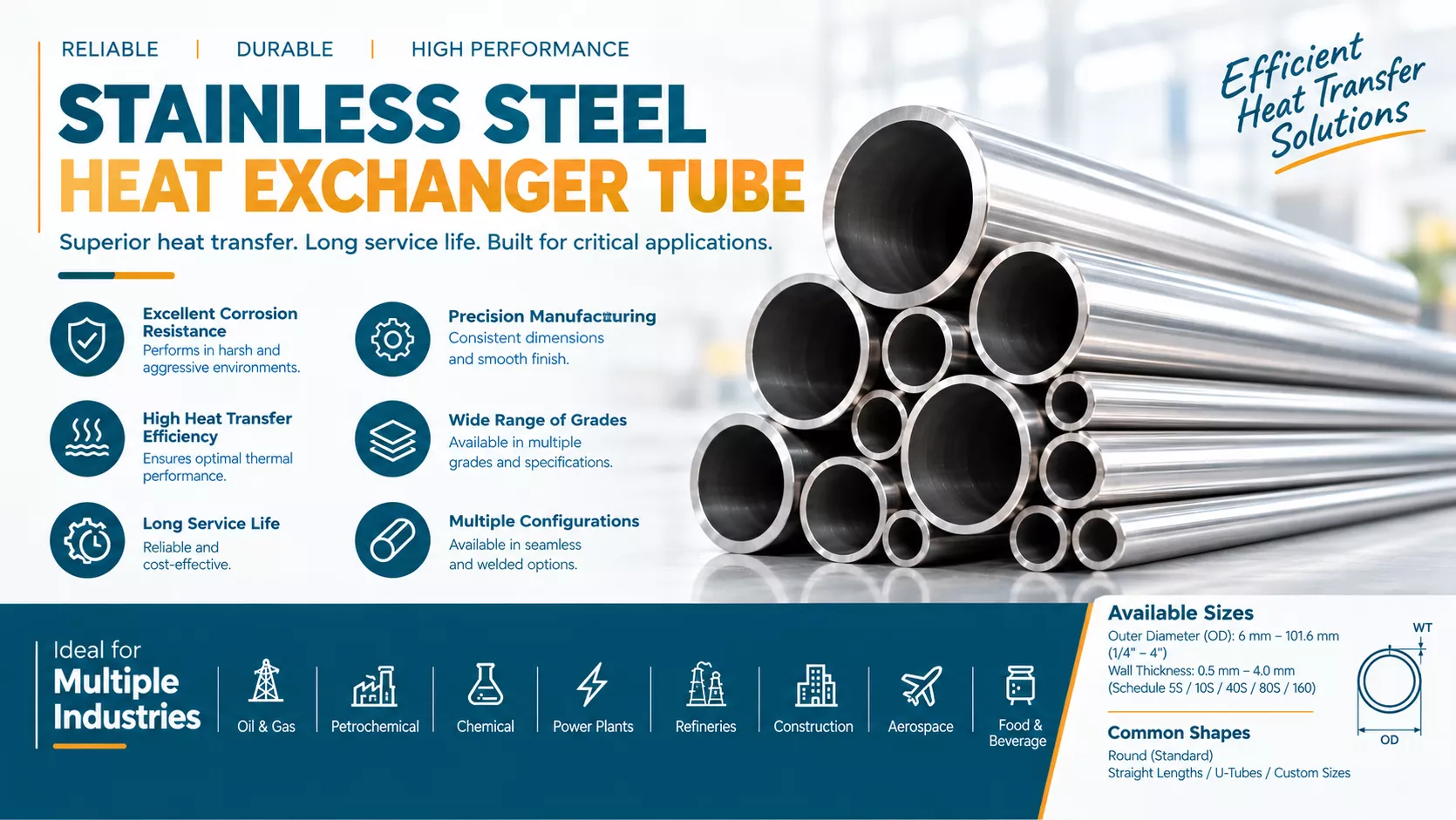
Stainless Steel Heat Exchanger Tube are hollow cylindrical components designed to transfer heat between two fluids without allowing them to mix. Depending on the equipment design, one fluid flows inside the tubes while another flows around their outer surfaces.
Heat passes through the tube wall from the hotter fluid to the cooler fluid. The direction of heat transfer depends on the temperature difference between the two fluids.
Stainless steel is a popular choice for this application because it contains chromium, which helps form a protective oxide layer on the surface. Depending on the grade, additional elements such as nickel, molybdenum and nitrogen can improve corrosion resistance, toughness or other properties.
How Do Heat Exchanger Tubes Work?
In a typical shell-and-tube heat exchanger, a bundle of tubes is installed inside a larger cylindrical shell. One fluid travels through the tubes, while the other flows through the shell around them. The tube walls separate the fluids and provide the surface through which heat is transferred.
Overall heat transfer performance depends on several factors, including the temperature difference between the fluids, tube surface area, wall thickness, flow velocity, material properties and the presence of deposits.
Stainless steel heat exchanger tubes are used in equipment such as shell-and-tube exchangers, condensers, coolers and certain boiler systems.
Key Advantages of Stainless Steel Heat Exchanger Tubes
1. Corrosion Resistance
Corrosion resistance is one of the main reasons stainless steel is selected for industrial heat exchanger applications. Chromium forms a thin, protective passive film that helps limit oxidation and corrosion under suitable service conditions.
Grades containing molybdenum, such as 316 and 316L, generally offer improved resistance to chloride-related pitting and crevice corrosion compared with 304 and 304L in many environments. The appropriate grade depends on the actual fluid composition, temperature and operating conditions.
2. Mechanical Strength and Durability
Heat exchanger tubes must withstand operating pressure, temperature changes, fluid movement and mechanical stresses. Stainless steel grades offer useful combinations of strength, toughness and ductility for a wide range of service conditions.
Correct tube dimensions, wall thickness, manufacturing quality and installation are essential to achieving the required performance. Material selection should account for the equipment design pressure and operating temperature.
3. Performance at Elevated Temperatures
Certain stainless steel grades maintain useful mechanical properties and oxidation resistance at elevated temperatures. Grades such as 321 may be considered for some applications involving thermal cycling, while other alloy compositions may be suitable for specific high-temperature services.
The maximum allowable operating conditions depend on the grade, product specification, tube dimensions and applicable design code. Stainless steel should not be treated as universally suitable for every high-temperature application.
4. Heat Transfer Performance
Heat transfer depends on more than the thermal conductivity of the tube material. Tube wall thickness, surface area, fluid velocity, flow arrangement and fouling resistance all influence the overall heat transfer coefficient.
Although stainless steel has lower thermal conductivity than copper, it can provide an effective balance of corrosion resistance, mechanical strength, durability and lifecycle cost in demanding industrial environments.
5. Long-Term Operating Value
A properly selected stainless steel tube can help reduce corrosion-related maintenance and premature replacement in compatible service conditions. These benefits can contribute to lower lifecycle costs, particularly where equipment downtime, maintenance labour and replacement work are expensive.
Actual service life varies with fluid chemistry, temperature, pressure, cleaning practices and operating conditions. Material selection should therefore be based on the complete application rather than purchase price alone.
Common Industrial Applications of Stainless Steel Heat Exchanger Tubes
Stainless steel heat exchanger tubing is used across industries where thermal control, product quality and equipment reliability are important.
1. HVAC and Commercial Cooling
Heat exchanger tubes are used in chillers, cooling equipment and selected heating and air-conditioning systems. Stainless steel may be suitable where water chemistry, cleaning requirements or corrosion exposure justify its use.
2. Chemical Processing
Chemical plants use heat exchangers to heat, cool, condense or recover heat from process fluids. Corrosion resistance is especially important when handling aggressive chemicals, although the exact grade must be chosen according to the chemicals involved, their concentrations and temperatures.
3. Power Generation
Power plants use tubular heat exchangers in applications such as condensers, feedwater systems and selected boiler-related equipment. The tube specification must match the service conditions and the requirements of the applicable equipment design code.
4. Oil, Gas and Petrochemical Processing
Refineries and petrochemical facilities rely on heat exchangers for process heating, cooling and condensation. Stainless steel and higher-alloy tubing may be considered where temperature, pressure and corrosion requirements make them appropriate.
5. Food and Pharmaceutical Processing
In suitable systems, stainless steel tubing supports hygienic processing, cleaning and product-contact requirements. The grade, surface finish, fabrication quality and relevant sanitary standards must be selected according to the specific process.
Types and Designs of Heat Exchanger Tubes
The required tube design depends on the exchanger configuration, available space, thermal duty, operating pressure and maintenance requirements.
| Tube Design or Construction | Typical Application | Key Consideration |
|---|---|---|
| Straight Tubes | Shell-and-tube heat exchangers and condensers | Can simplify certain inspection and cleaning operations |
| U-Bend Tubes | U-tube heat exchangers | Accommodate thermal expansion and allow a compact tube bundle |
| Finned Tubes | Air-cooled heat exchangers and gas-side heating or cooling | Increase external surface area for heat transfer |
| Seamless Tubes | Selected high-pressure and demanding services | Manufactured without a longitudinal weld seam |
| Welded Tubes | Applications covered by the applicable welded-tube specification | Manufacturing quality, weld integrity and specification compliance are important |
Seamless vs. Welded Stainless Steel Heat Exchanger Tubes
Seamless tubes are manufactured without a longitudinal weld seam. They may be specified for heat exchanger applications where the applicable material standard and equipment design require seamless construction.
Welded tubes are manufactured by forming stainless steel strip or plate and joining the edges along a longitudinal seam. They may be suitable for applications covered by the relevant welded-tube specification and where the design and inspection requirements permit welded construction.
Neither construction is automatically the better choice for every application. Selection should be based on the required ASTM or ASME specification, grade, operating conditions, inspection requirements and equipment design. Confirm the permitted manufacturing method before ordering.
How to Select the Right Tube Design
- The type of heat exchanger and its configuration.
- The required heat transfer area and thermal duty.
- Operating pressure and temperature.
- Fluid compatibility and corrosion exposure.
- Tube bundle layout, bend requirements and available space.
- Inspection, cleaning and maintenance access.
- Applicable manufacturing and testing specifications.
Stainless Steel Heat Exchanger Tube Grades and Industry Standards
Choosing the correct stainless steel grade is essential for reliable heat exchanger performance. Different grades offer different levels of corrosion resistance, strength and temperature suitability.
Common Stainless Steel Heat Exchanger Tube Grades
| Grade | Key Characteristics | Typical Selection Considerations |
|---|---|---|
| SS 304 | Austenitic stainless steel with good general corrosion resistance and formability in many environments. | General-purpose services where the process fluid and operating conditions are compatible with Grade 304. |
| SS 304L | Low-carbon version of Grade 304. | Applications where reduced risk of weld-related sensitisation is important. |
| SS 316 | Molybdenum-bearing austenitic stainless steel with improved resistance to pitting and crevice corrosion in many environments compared with Grade 304. | Applications requiring improved corrosion resistance, subject to fluid chemistry, chloride concentration and temperature. |
| SS 316L | Low-carbon version of Grade 316. | Suitable services where corrosion resistance and welded fabrication requirements influence grade selection. |
| SS 321 | Titanium-stabilised austenitic stainless steel. | Certain elevated-temperature applications, subject to the applicable design and material requirements. |
| Duplex Stainless Steel | Duplex grades generally offer higher strength than common austenitic grades and can provide good resistance to specific forms of corrosion. | Demanding services where the selected duplex grade is suitable for the fluid, temperature and design requirements. |
The appropriate grade depends on the process fluid, concentration of corrosive species, temperature, pressure, cleaning chemicals and equipment design. No stainless steel grade is suitable for every service environment. Confirm the material grade against the applicable tube specification and project requirements before ordering.
Important ASTM and ASME Specifications
- ASTM A213/A213M : Covers seamless ferritic and austenitic alloy-steel boiler, superheater and heat-exchanger tubes within the scope of the specification.
- ASTM A249/A249M : Covers welded austenitic steel boiler, superheater, heat-exchanger and condenser tubes within the scope of the specification.
- ASTM A269/A269M : Covers seamless and welded austenitic stainless steel tubing for general service. ASTM A789/A789M covers seamless and welded ferritic-austenitic stainless steel tubing for general service. Confirm the applicable standard against the equipment design, operating conditions and project specification before ordering.
- ASTM A789/A789M: Covers seamless and welded ferritic-austenitic stainless steel tubing for general service, including applicable duplex grades. Verify the selected grade and the project's requirements before specifying this standard.
- ASME Boiler and Pressure Vessel Code: Applicable code sections may establish material, design, fabrication, inspection and testing requirements for pressure equipment. The relevant requirements depend on the equipment type and project specification.
These standards are not interchangeable. The required specification depends on the tube material, manufacturing method, intended service and equipment design. Confirm the exact standard and grade stated in the purchase order or engineering documents before sourcing replacement or new tubes.
Material Test Certificates (MTCs), heat-number traceability and inspection documents can be requested according to the purchase order and applicable product specification. Please confirm document availability with Kamal Steels when requesting a quotation.
Stainless Steel vs. Alternative Heat Exchanger Tube Materials
Stainless steel is not the only material used in heat exchangers. Copper, carbon steel and titanium may also be appropriate, depending on the operating environment and design requirements.
| Material | Main Advantages | Limitations | Typical Selection Factors |
|---|---|---|---|
| Stainless Steel | Corrosion resistance, strength and durability | Lower thermal conductivity than copper | Balanced mechanical and corrosion performance |
| Copper | High thermal conductivity and good formability | May be unsuitable for certain aggressive fluids and conditions | Efficient heat transfer in compatible applications |
| Carbon Steel | Often economical and offers useful mechanical strength | More susceptible to corrosion in many environments | Compatible fluids and suitable corrosion-control measures |
| Titanium | Excellent corrosion resistance in many seawater and chloride-rich environments | Higher material and fabrication costs | Severe corrosion conditions where the alloy is justified |
Material selection should account for the complete operating environment, not just thermal conductivity or initial purchase price. The lowest-cost material may not provide the lowest total cost over the equipment's operating life.
Even corrosion-resistant heat exchanger tubes require inspection and appropriate maintenance. Deposits, scale, biological growth and corrosion products can reduce heat transfer performance and increase pressure drop.
- Routine inspections: Monitor leakage, corrosion, vibration and changes in operating performance.
- Performance monitoring: Track inlet and outlet temperatures, pressure drop and other relevant operating parameters.
- Appropriate cleaning: Select mechanical or chemical cleaning methods compatible with the tube grade and deposits.
- Corrosion monitoring: Investigate pitting, crevice corrosion and other damage where service conditions create a risk.
- Operating-condition reviews: Check whether flow rates, temperatures and fluid chemistry remain within the equipment's design limits.
A maintenance plan tailored to the actual service can help identify developing problems before they cause major failures. Cleaning procedures should follow equipment-manufacturer recommendations and avoid chemicals or methods that could damage the tubing.
Installation Considerations and Best Practices
Correct installation is important for achieving the expected thermal performance and service life of stainless steel heat exchanger tubes.
Important Factors Before Installation
- Tube sizing: Confirm outside diameter, wall thickness, length and tolerances against the exchanger drawings and specification.
- Fluid flow: Review flow rate and design conditions because velocity affects heat transfer, pressure drop, erosion and fouling.
- Material compatibility: Verify that the selected grade suits both process fluids and operating temperatures.
- Welding and fabrication: Use qualified procedures and suitable filler materials where welding is required. Avoid contamination from carbon steel tools.
- Tube alignment and expansion: Follow the equipment manufacturer's requirements for tube installation, support, expansion and alignment.
- Inspection and documentation: Verify material identification, dimensional compliance, required testing and traceability.
Installation Planning Checklist
- Confirm the applicable ASTM/ASME specification.
- Verify grade, outside diameter and wall thickness.
- Review operating pressure and temperature.
- Check process-fluid compatibility.
- Confirm seamless or welded construction requirements.
- Review welding, bending and fabrication procedures.
- Verify inspection, testing and MTC requirements.
- Ensure cleaning and commissioning procedures are appropriate.
For pressure equipment, installation and commissioning should be carried out by qualified personnel in accordance with the equipment design, applicable codes and project requirements.
Future Trends in Heat Exchanger Technology
Heat exchanger technology continues to evolve as industries seek better energy efficiency, reliability and reduced operating costs.
Developments include improved surface geometries, enhanced tube designs, corrosion-resistant alloys and manufacturing techniques that support application-specific performance. Surface treatments and coatings may be useful in certain services, but their suitability depends on temperature, fluid compatibility, durability and the possibility of coating degradation.
Digital monitoring is also becoming more important. Temperature sensors, flow measurements, pressure monitoring and predictive maintenance systems can help operators identify performance changes and plan maintenance more effectively.
As energy-efficiency requirements and environmental considerations become increasingly important, appropriate material selection and exchanger design can help facilities improve heat recovery and reduce avoidable downtime.
Stainless Steel Heat Exchanger Tubes FAQs
Stainless steel heat exchanger tubes transfer heat between fluids without mixing them. They are used in compatible shell-and-tube exchangers, condensers, coolers and other thermal-processing equipment across power generation, chemical processing, oil and gas, HVAC and food-processing industries.
There is no single best grade for every application. SS 304 and 304L suit many general-purpose services, while SS 316 and 316L may provide improved corrosion resistance in certain environments. SS 321 and duplex stainless steels may be considered for specific temperature, strength or corrosion requirements. The final selection should be based on fluid chemistry, temperature, pressure and applicable standards.
Both are austenitic stainless steel grades. SS 316 contains molybdenum, which generally improves resistance to pitting and crevice corrosion in many chloride-containing environments compared with SS 304. However, neither grade is immune to every corrosive environment.
Seamless tubes are manufactured without a longitudinal weld seam. Welded tubes are manufactured by joining the edges of formed stainless steel strip or plate. The appropriate choice depends on the required standard, operating conditions, inspection requirements and project specification.
ASTM A213 and ASTM A249 are commonly relevant to specified seamless and welded boiler, superheater, heat-exchanger and condenser tube applications. ASTM A269 and ASTM A789/A789M may also be relevant for their defined service scopes. Always confirm the applicable standard and grade against the equipment specification.
Selection involves the outside diameter, wall thickness, length, required heat transfer area, operating pressure, flow conditions and exchanger design. Use the equipment drawings and applicable design requirements rather than choosing a tube size based only on nominal dimensions.
Service life varies with the stainless steel grade, process-fluid chemistry, temperature, pressure, tube design, cleaning practices and operating conditions. Appropriate material selection, inspection and maintenance help reduce the risk of premature failure, but no fixed lifespan applies to all installations.
Inspect tubes regularly, monitor exchanger performance, remove deposits using compatible cleaning methods and investigate signs of leakage or corrosion. Follow the equipment manufacturer's maintenance recommendations and avoid cleaning chemicals that may damage the selected grade.
Choose the Right Stainless Steel Heat Exchanger Tubes for Your Project
Selecting the right stainless steel heat exchanger tubes involves more than choosing a material grade. Tube construction, dimensions, wall thickness, fluid compatibility, operating pressure, temperature and applicable manufacturing standards all contribute to reliable performance.
Kamal Steels supplies stainless steel piping and tubing products for industrial applications. When evaluating heat exchanger tube requirements, buyers should confirm the required grade, specification, dimensions, construction method, testing and documentation for their project.
Whether you are sourcing SS 304, SS 316, SS 316L or another suitable grade, a clearly defined technical specification helps streamline procurement and reduce the risk of material mismatch.
Looking for stainless steel heat exchanger tubes for an upcoming project? Contact Kamal Steels to discuss your material requirements and request a quotation.
Request a Quote from Kamal Steels