
-
-
-
Girgaon, Mumbai - 400004
What Is Pipe Schedule? Understanding Pipe Schedules, Charts & Thickness
Pipe Schedule is a standardized designation used to identify the wall-thickness series of a pipe for a specific nominal pipe size (NPS). Common schedules include SCH 10, SCH 40, SCH 80 and SCH 160, while stainless steel pipes also use designations such as SCH 10S, SCH 40S and SCH 80S.
Pipe schedules are important when selecting pipes for different pressure, temperature, mechanical and process conditions. However, the schedule number itself is not a direct measurement of wall thickness in millimeters. The actual thickness depends on the nominal pipe size and the applicable dimensional standard.
Kamal Steels explains what pipe schedule means, how pipe schedules relate to wall thickness, how to read a pipe schedule chart, and the differences between common schedules such as Schedule 40 and Schedule 80. It also covers stainless steel pipe schedules, pipe schedule thickness charts in mm and the relevant ASME standards.
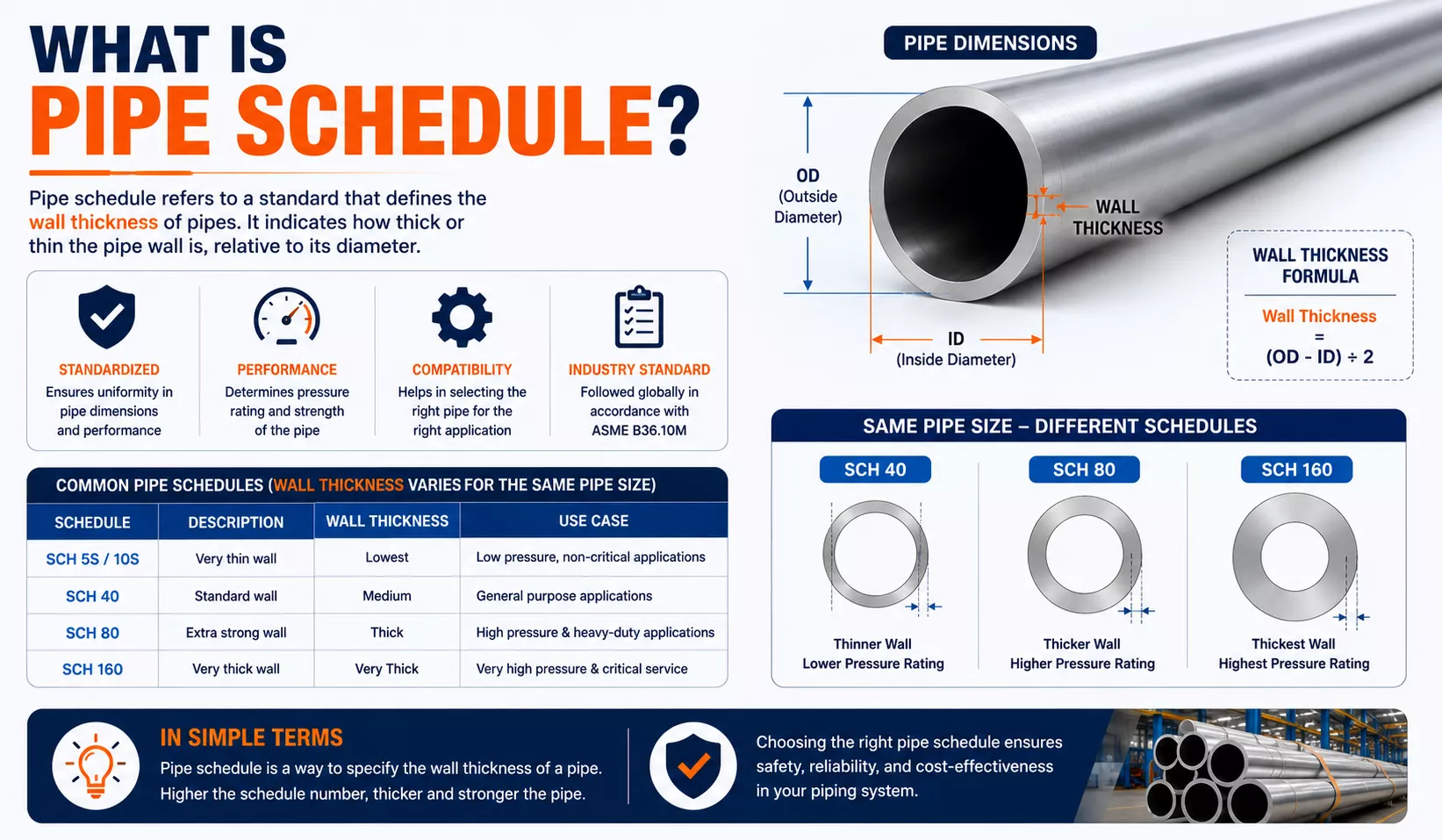
What Is Pipe Schedule?
Pipe schedule refers to a standardized wall-thickness designation assigned to a pipe based on its nominal pipe size (NPS). It provides a consistent way to specify pipe wall-thickness series without stating the thickness directly in the schedule number.
For example, Schedule 40 and Schedule 80 are two commonly used pipe schedules. For the same nominal pipe size, Schedule 80 generally has a thicker wall than Schedule 40, resulting in a smaller internal diameter when the outside diameter remains the same.
The actual wall thickness associated with a schedule is determined from the applicable dimensional standard and nominal pipe size. For stainless steel pipe, dimensions are commonly specified using ASME B36.19M, while carbon and alloy steel pipe dimensions are commonly covered by ASME B36.10M.
Therefore, a pipe schedule should not be treated as a universal thickness value in millimeters. The correct wall thickness must always be checked against the relevant pipe size and dimensional standard.
What Does Schedule Mean in Pipe?
When asking what is schedule in pipe, the term "schedule" refers to a standardized designation used to identify the wall-thickness series of a pipe for a specific nominal pipe size (NPS). It helps specify the appropriate pipe wall thickness for different pressure, temperature, and service conditions.
The schedule number itself is not a direct measurement of wall thickness. For the same nominal pipe size, different schedules can have different wall thicknesses. For example, Schedule 40 and Schedule 80 are commonly used pipe schedules, with Schedule 80 generally having a thicker wall than Schedule 40 for the same NPS.
Key Concepts of Pipe Schedules
Several important concepts should be understood when working with pipe schedules:
- NPS: Nominal Pipe Size identifies the standardized pipe size.
- Schedule: Identifies a standardized wall-thickness series.
- Outside Diameter: The standardized external diameter of the pipe.
- Wall Thickness: The actual thickness of the pipe wall.
- Inside Diameter: The approximate internal diameter after accounting for wall thickness.
- Dimensional Standard: Determines the applicable dimensions for the pipe.
A pipe schedule therefore cannot be interpreted independently of NPS. The same schedule designation can correspond to different wall thicknesses for different nominal pipe sizes.
Common Pipe Schedules
Pipes are available in several schedule designations depending on size, material and application requirements. Some of the commonly encountered designations are listed below.
| Pipe Schedule | Designation | General Description |
|---|---|---|
| Schedule 5 | SCH 5 | Very light wall series |
| Schedule 10 | SCH 10 | Light wall series |
| Schedule 20 | SCH 20 | Light to medium wall series |
| Schedule 30 | SCH 30 | Medium wall series |
| Schedule 40 | SCH 40 | Common standard wall series |
| Schedule 60 | SCH 60 | Medium to heavy wall series |
| Schedule 80 | SCH 80 | Heavy wall series |
| Schedule 100 | SCH 100 | Heavy wall series |
| Schedule 120 | SCH 120 | Heavy wall series |
| Schedule 140 | SCH 140 | Very heavy wall series |
| Schedule 160 | SCH 160 | Very heavy wall series |
| Double Extra Strong | XXS | Extra-heavy wall series |
Standard Pipe Schedule Chart
A standard pipe schedule chart shows the commonly used schedule designations for steel pipes. The pipe schedule chart below provides a quick reference to the major schedule series used in piping applications.
| Pipe Schedule | Schedule Designation | General Wall Series |
|---|---|---|
| Schedule 5 | SCH 5 | Very light wall |
| Schedule 10 | SCH 10 | Light wall |
| Schedule 20 | SCH 20 | Light to medium wall |
| Schedule 30 | SCH 30 | Medium wall |
| Schedule 40 | SCH 40 | Standard wall series |
| Schedule 60 | SCH 60 | Medium to heavy wall |
| Schedule 80 | SCH 80 | Heavy wall |
| Schedule 100 | SCH 100 | Heavy wall |
| Schedule 120 | SCH 120 | Heavy wall |
| Schedule 140 | SCH 140 | Very heavy wall |
| Schedule 160 | SCH 160 | Very heavy wall |
| XXS | Double Extra Strong | Extra-heavy wall |
The schedule designation is not itself a millimetre measurement. To determine the actual wall thickness, the nominal pipe size and applicable dimensional standard must also be considered.
Pipe Schedule and Thickness Chart in mm
A pipe schedule chart in mm connects a schedule designation with the actual wall thickness for a particular nominal pipe size. This type of pipe schedule and thickness chart is useful when checking pipe dimensions for engineering, fabrication and procurement.
| NPS | DN | Outside Diameter (mm) | SCH 10 (mm) | SCH 40 (mm) | SCH 80 (mm) | SCH 160 (mm) |
|---|---|---|---|---|---|---|
| 1/2 | 15 | 21.3 | 2.11 | 2.77 | 3.73 | 4.78 |
| 3/4 | 20 | 26.7 | 2.11 | 2.87 | 3.91 | 5.56 |
| 1 | 25 | 33.4 | 2.77 | 3.38 | 4.55 | 6.35 |
| 1-1/4 | 32 | 42.2 | 2.77 | 3.56 | 4.85 | 6.35 |
| 1-1/2 | 40 | 48.3 | 2.77 | 3.68 | 5.08 | 7.14 |
| 2 | 50 | 60.3 | 2.77 | 3.91 | 5.54 | 8.74 |
This pipe schedule thickness chart shows how the wall thickness generally increases with the schedule for the same nominal pipe size. The exact dimensions should always be checked against the applicable dimensional standard.
Stainless Steel Pipe Schedule Chart (SS Pipe Schedule Chart)
A stainless steel pipe schedule chart identifies the schedule designations commonly used for stainless steel piping. Stainless steel pipe dimensions are standardized under ASME B36.19M.
An SS pipe schedule chart commonly includes designations such as 5S, 10S, 40S and 80S. The S suffix is used to distinguish stainless steel pipe dimensions from the dimensions covered by ASME B36.10M.
| Stainless Steel Schedule | Designation | General Wall Series |
|---|---|---|
| Schedule 5S | SCH 5S | Light wall stainless steel pipe |
| Schedule 10S | SCH 10S | Light wall stainless steel pipe |
| Schedule 40S | SCH 40S | Medium to heavy wall series |
| Schedule 80S | SCH 80S | Heavy wall stainless steel pipe |
Stainless steel schedules should not automatically be assumed to have exactly the same dimensions as carbon or alloy steel schedules with the same number. The applicable requirements of ASME B36.19M should be checked when specifying stainless steel pipe dimensions.
What Is Schedule 40 Pipe?
Schedule 40 Pipe, commonly abbreviated as SCH 40, is one of the most widely used pipe schedule designations. It represents a standardized wall-thickness series for a particular nominal pipe size.
Schedule 40 pipe is commonly used in general industrial piping, process systems, water lines, construction, mechanical services and other applications where its specified dimensions and pressure requirements are suitable.
The actual wall thickness of Schedule 40 pipe changes with the nominal pipe size. Therefore, SCH 40 should not be considered a single fixed thickness in millimetres.
What Is Schedule 80 Pipe?
Schedule 80 Pipe, abbreviated as SCH 80, is a heavier wall pipe schedule than Schedule 40 for the same nominal pipe size.
Because of its greater wall thickness, Schedule 80 pipe can provide a greater pressure-containing wall than a lower schedule of the same size, subject to material, temperature, design code and other engineering requirements.
Schedule 80 pipes are commonly specified in demanding industrial and process applications where the required design conditions call for the corresponding wall thickness.
What Is the Difference Between Schedule 40 and Schedule 80 Pipe?
The main difference between Schedule 40 and Schedule 80 Pipe is the wall-thickness series. For the same nominal pipe size, Schedule 80 generally has a thicker wall than Schedule 40.
| Feature | Schedule 40 | Schedule 80 |
|---|---|---|
| Wall Series | Standard wall series | Heavier wall series |
| Wall Thickness | Lower than SCH 80 for the same NPS | Higher than SCH 40 for the same NPS |
| Inside Diameter | Generally larger | Generally smaller |
| Weight | Generally lower | Generally higher |
| Typical Selection | General piping applications | Applications requiring a heavier wall |
How Does Pipe Schedule Relate to Wall Thickness?
Pipe schedule and wall thickness are closely related, but they are not the same thing. The schedule is a standardized designation, while wall thickness is the actual measured thickness of the pipe wall.
For a given NPS, moving from a lower schedule to a higher schedule generally increases the wall thickness. This also affects the internal diameter and pipe weight.
The approximate relationship between outside diameter, wall thickness and inside diameter can be expressed as:
Inside Diameter = Outside Diameter − (2 × Wall Thickness)
The actual dimensions should be obtained from the applicable dimensional standard rather than calculated from the schedule number alone.
Pipe Schedule Standards: ASME B36.10M and ASME B36.19M
Pipe dimensions are standardized through recognized dimensional standards. Two important standards used for steel and stainless steel pipe dimensions are ASME B36.10M and ASME B36.19M.
| Standard | Application | Pipe Type |
|---|---|---|
| ASME B36.10M | Standardization of dimensions for steel pipe | Welded and seamless wrought steel pipe |
| ASME B36.19M | Standardization of dimensions for stainless steel pipe | Welded and seamless wrought stainless steel pipe |
When specifying stainless steel pipe, the applicable stainless steel dimensional requirements should be considered rather than assuming that all dimensions are identical to carbon or alloy steel pipe with the same schedule number.
How to Select the Right Pipe Schedule?
Selecting the correct pipe schedule requires more than choosing a higher or lower schedule number. The pipe must be suitable for the design conditions and applicable specification.
- Nominal Pipe Size: Determine the required NPS.
- Design Pressure: Consider the required operating and design pressure.
- Design Temperature: Check the temperature conditions of the application.
- Material Grade: Select the appropriate carbon steel, stainless steel or alloy material.
- Dimensional Standard: Verify the applicable ASME dimensional standard.
- Corrosion Requirements: Consider corrosion allowance and service conditions where applicable.
- Code and Project Requirements: Follow the applicable piping code, engineering specification and project requirements.
For industrial applications, pipe schedule selection should be confirmed by the responsible engineer or according to the project's applicable design code and specifications.
Pipe Schedule Chart PDF
A Pipe Schedule Chart can be useful for engineers, fabricators, procurement teams and piping professionals who need a convenient reference for schedule designations and pipe dimensions.
When using a PDF pipe schedule chart, always check the edition of the referenced standard and confirm whether the chart applies to carbon/alloy steel pipe or stainless steel pipe. For stainless steel dimensions, ASME B36.19M should be considered where applicable.
A downloadable pipe schedule chart can be provided by Kamal Steels as a quick reference for commonly requested pipe schedule and thickness information.
Frequently Asked Questions About Pipe Schedule
Pipe schedule is a standardized designation used to identify the wall-thickness series of a pipe for a specific Nominal Pipe Size (NPS). Common pipe schedules include SCH 10, SCH 40, SCH 80 and SCH 160. The actual wall thickness depends on the nominal pipe size and the applicable dimensional standard.
When asking what is schedule in pipe, the term "schedule" refers to a standardized wall-thickness designation assigned to a particular nominal pipe size. It helps identify the applicable pipe wall-thickness series for different pressure, temperature and service requirements.
Pipe schedule is not a measurement in millimeters. It is a designation that corresponds to a specific wall thickness for a given nominal pipe size. For example, a 2-inch Schedule 40 steel pipe has an approximate wall thickness of 3.91 mm, while the thickness for other pipe sizes is different.
Pipe schedule is a wall-thickness designation, not a direct physical measurement. The actual wall thickness is specified according to the nominal pipe size and applicable dimensional standard. Therefore, the same schedule number can correspond to different wall thicknesses for different NPS sizes.
Schedule 40 is a common example of a pipe schedule. For instance, a 2-inch Schedule 40 steel pipe has an outside diameter of approximately 60.33 mm and a wall thickness of approximately 3.91 mm. The corresponding dimensions change with the nominal pipe size.
There is no single universal formula that converts a schedule number directly into pipe wall thickness. The schedule designation is based on standardized dimensions for each nominal pipe size. For calculating the internal diameter, the geometric relationship ID = OD − (2 × Wall Thickness) can be used when the outside diameter and wall thickness are known.
A pipe schedule calculator is a tool that can help identify or compare pipe dimensions based on inputs such as nominal pipe size and schedule. A proper calculation should reference the applicable dimensional standard rather than treating the schedule number as a direct wall-thickness value.
A pipe schedule and thickness chart shows the relationship between nominal pipe size, pipe schedule, outside diameter and corresponding wall thickness. Such charts are commonly used to compare schedules such as SCH 10, SCH 40, SCH 80 and SCH 160 and to select the appropriate pipe dimensions.
Generally, for the same nominal pipe size, a higher pipe schedule indicates a thicker wall. For example, Schedule 80 generally has a thicker wall than Schedule 40 for the same NPS. However, the exact wall thickness must always be checked against the applicable dimensional standard.
No. Pipe schedule and wall thickness are not the same thing. Schedule is a standardized designation, while wall thickness is the actual physical thickness of the pipe wall, normally expressed in millimeters or inches. The wall thickness associated with a schedule varies according to the nominal pipe size.
Schedule 40 and Schedule 80 are standardized pipe wall-thickness designations. For the same nominal pipe size, Schedule 80 generally has a thicker wall than Schedule 40. This typically results in a smaller internal diameter and higher pipe weight for Schedule 80.
The main difference is the wall thickness. For the same nominal pipe size, Schedule 80 generally has a thicker wall than Schedule 40. This means Schedule 80 generally has a smaller internal diameter and greater weight. The appropriate schedule should be selected according to the design pressure, temperature, material and service requirements.
ASME B36.10M is commonly used for the dimensions of welded and seamless wrought steel pipe. For stainless steel pipe, dimensions are generally covered by ASME B36.19M. The applicable standard should be confirmed based on the pipe material and required specification.
A stainless steel pipe schedule identifies a standardized wall-thickness series for a specific nominal pipe size. Stainless steel pipes commonly use designations such as 5S, 10S, 40S and 80S. Stainless steel pipe dimensions are generally covered by ASME B36.19M.
Schedule 40 is one of the most commonly encountered pipe schedules for general piping applications. However, the most suitable schedule depends on the nominal pipe size, material, design pressure, temperature and applicable piping standard.