
-
-
-
Girgaon, Mumbai - 400004
Stainless Steel Grades Chart
A Stainless Steel Grades Chart provides a quick reference for understanding and comparing different stainless steel grades according to their chemical composition, properties, corrosion resistance, strength and common uses. Stainless steel is available in several grades, and each grade is designed to provide a particular combination of performance characteristics for different service conditions.
Common grades such as 304, 304L, 316, 316L, 321, 310, 410 and 430 are used across a wide range of industries and applications. The differences between these grades are mainly related to their alloying elements, metallurgical structure, mechanical properties, resistance to corrosion and heat, weldability and fabrication requirements.
This stainless steel grade chart covers commonly referenced stainless steel grades, their basic characteristics, major alloying elements, properties, and typical applications. It also explains the main types of stainless steel, grade composition, hardness, grade comparisons and factors to consider when selecting a suitable grade for a specific application.
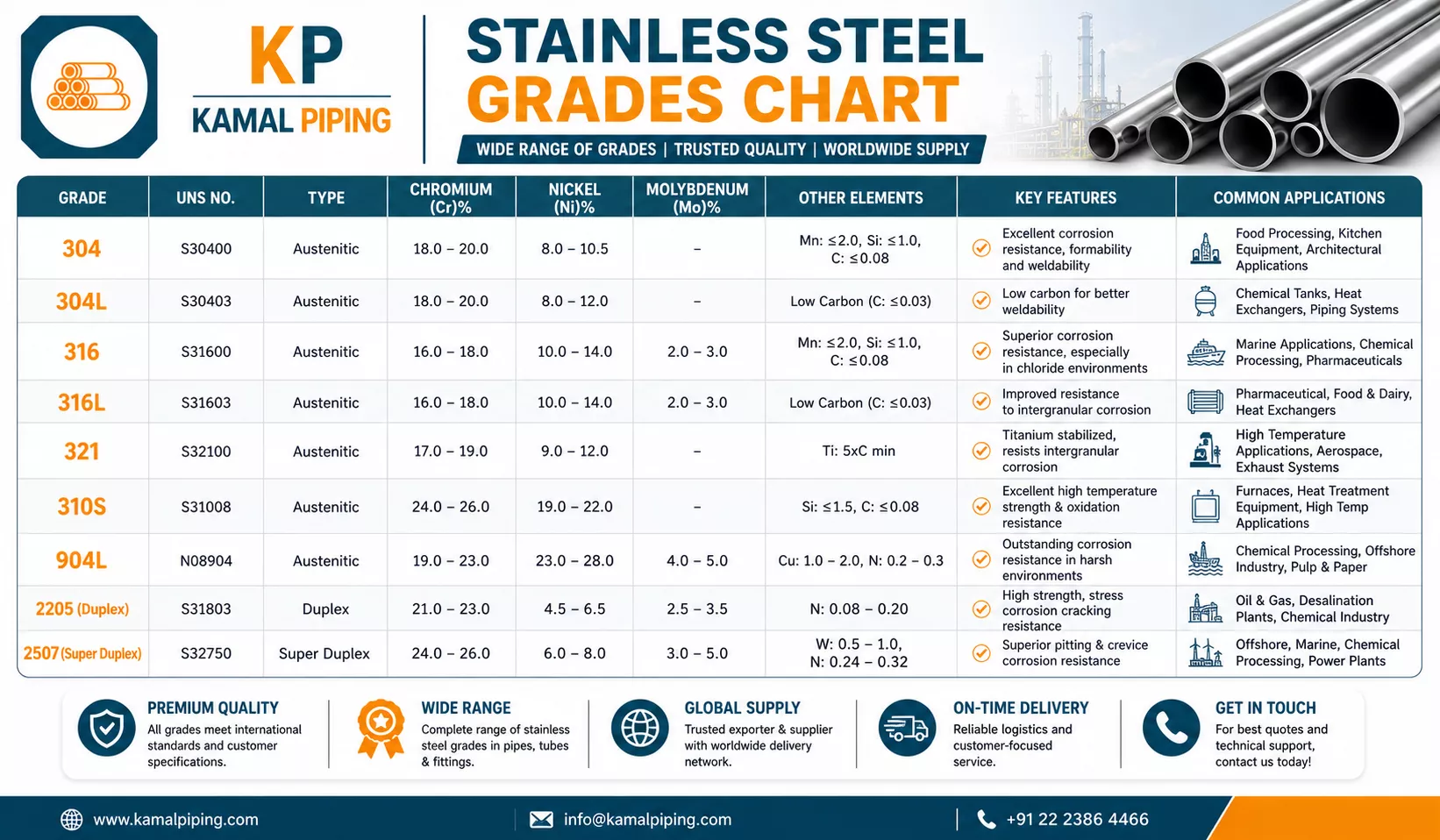
What Are Stainless Steel Grades?
Stainless steel grades are standardized classifications that identify different stainless steel alloys based on their chemical composition and performance characteristics. Each grade contains varying amounts of chromium, nickel, molybdenum, carbon, and other alloying elements, which influence properties such as corrosion resistance, mechanical strength, hardness, weldability, formability, and high-temperature performance.
Understanding these grade differences helps engineers and buyers choose the right stainless steel for applications ranging from piping systems and pressure vessels to food processing equipment, marine components, chemical plants, and architectural structures.
Stainless Steel Grades Chart
| Grade | Type | Key Properties | Common Uses |
|---|---|---|---|
| 304 | Austenitic | Excellent corrosion resistance, good weldability, widely used general-purpose grade. | Food equipment, tanks, piping, kitchen items. |
| 304L | Austenitic | Lower carbon version of 304, better for welding. | Welded fabrication, chemical equipment. |
| 316 | Austenitic | Better corrosion resistance than 304, especially in chloride environments. | Marine, chemical, pharmaceutical, process industries. |
| 316L | Austenitic | Low-carbon version of 316, improved weldability. | Piping, tanks, marine and sanitary applications. |
| 321 | Austenitic | Good high-temperature strength and stability. | Heat exchangers, exhaust systems. |
| 310 | Austenitic | High-temperature resistance. | Furnaces, heat treatment equipment. |
| 409 | Ferritic | Economical, moderate corrosion resistance, used where heat resistance matters. | Automotive exhaust systems. |
| 410 | Martensitic | Higher hardness and strength, lower corrosion resistance than 304/316. | Cutlery, shafts, valves, fasteners. |
| 430 | Ferritic | Good formability, moderate corrosion resistance, magnetic. | Appliances, trim, decorative parts. |
Note: The selection of stainless steel grade depends on corrosion resistance requirements, operating temperature, mechanical strength, fabrication needs, and the intended industrial application.
Stainless Steel Grade List
The following table lists some of the most commonly used stainless steel grades along with their type and typical applications.
| Grade | Type | Typical Applications |
|---|---|---|
| 201 | Austenitic | Kitchenware, decorative applications, food service equipment |
| 202 | Austenitic | Architectural components, utensils, structural applications |
| 301 | Austenitic | Springs, railway equipment, structural components |
| 302 | Austenitic | Fasteners, springs, wire products |
| 303 | Austenitic | Machined components, shafts, fittings |
| 304 | Austenitic | Food processing, piping, tanks, architectural applications |
| 304L | Austenitic | Welded fabrication, pressure vessels, process piping |
| 310 | Austenitic | Furnaces, heat treatment equipment, high-temperature service |
| 316 | Austenitic | Marine equipment, chemical plants, pharmaceutical industries |
| 316L | Austenitic | Sanitary piping, offshore structures, process equipment |
| 321 | Austenitic | Heat exchangers, exhaust systems, aerospace components |
| 409 | Ferritic | Automotive exhaust systems |
| 410 | Martensitic | Valves, cutlery, shafts, fasteners |
| 430 | Ferritic | Home appliances, decorative trim, kitchen equipment |
| 446 | Ferritic | High-temperature furnace components |
| Duplex | Duplex | Oil & gas, desalination, offshore platforms |
| Super Duplex | Duplex | Seawater systems, chemical processing, offshore applications |
Note: The appropriate stainless steel grade should be selected based on corrosion resistance, operating temperature, mechanical properties, fabrication requirements, and the intended service environment.
Types of Stainless Steel
Stainless steel is broadly classified into five main types based on its metallurgical structure and properties:
- Austenitic: 304, 316, 321 and 310; known for good corrosion resistance and weldability.
- Ferritic: 409, 430 and 446; generally magnetic with good corrosion and oxidation resistance.
- Martensitic: 410 and related grades; known for higher hardness and strength.
- Duplex: 2205 and 2507; combines high strength with good corrosion resistance.
- Precipitation-Hardening: 17-4 PH and related grades; developed for high strength and useful corrosion resistance.
The appropriate Stainless Steel Type and grade depends on the required corrosion resistance, strength, temperature, fabrication method, and service conditions.
Stainless Steel Composition Chart
A stainless steel composition chart is useful for comparing the primary alloying elements found in different stainless steel grades. The chemical composition directly influences corrosion resistance, mechanical strength, weldability, and high-temperature performance.
| Grade | Chromium (Cr) % | Nickel (Ni) % | Molybdenum (Mo) % | Notes |
|---|---|---|---|---|
| 304 | 18.00–20.00 | 8.00–11.00 | — | General-purpose austenitic grade. |
| 316 | 16.00–18.00 | 10.00–14.00 | 2.00–3.00 | Better chloride resistance than 304. |
| 409 | 10.50–11.75 | Low | — | Ferritic grade used for automotive exhaust systems. |
| 430 | 16.00–18.00 | Very Low | — | Ferritic, magnetic, suitable for appliances and decorative applications. |
Note: Actual chemical composition may vary slightly depending on the applicable ASTM, ASME, EN, or JIS specification and manufacturer tolerances.
Stainless Steel Properties
Stainless steel offers an excellent combination of corrosion resistance, mechanical strength, durability, and ease of fabrication. These characteristics make it one of the most widely used engineering materials across industrial, commercial, and architectural applications.
- Corrosion Resistance – Performs well in moisture, chemicals, and harsh environments.
- High Strength – Provides excellent mechanical properties for demanding applications.
- Clean Appearance – Attractive finish with low maintenance requirements.
- Heat Resistance – Suitable grades can withstand elevated temperatures.
- Formability & Weldability – Austenitic grades are easy to fabricate and weld.
These properties make stainless steel an ideal material for piping systems, construction, food processing, automotive components, marine equipment, pharmaceutical manufacturing, and chemical processing plants.
Stainless Steel Hardness
Stainless steel hardness varies depending on the grade, microstructure, and heat treatment condition. While austenitic stainless steels such as 304 and 316 are valued for their excellent corrosion resistance and formability, martensitic grades like 410 can be heat treated to achieve significantly higher hardness and wear resistance.
SS304 Hardness in HRC
Stainless Steel 304 is not designed for high-hardness applications. In its annealed condition, it offers moderate hardness with excellent ductility and weldability, making it ideal for fabrication, food processing equipment, piping systems, and chemical processing applications.
Users often search for SS304 hardness in HRC when comparing its mechanical properties with hardened martensitic grades such as Stainless Steel 410.
Hardness of Stainless Steel
The hardness of stainless steel depends on its metallurgical family and whether the material has been heat treated.
- Austenitic Grades (304, 316): Lower hardness with excellent corrosion resistance, ductility, and weldability.
- Ferritic Grades (409, 430): Moderate hardness, good formability, and magnetic properties.
- Martensitic Grades (410): Highest hardness after heat treatment, offering superior wear resistance and mechanical strength.
Stainless Steel Grade Comparison
Different stainless steel grades provide different combinations of corrosion resistance, strength, heat resistance, weldability, and fabrication properties. The following comparisons highlight some commonly considered grades and stainless steel families.
| Comparison | Main Difference | Typical Selection Consideration |
|---|---|---|
| 304 vs 316 | 316 contains molybdenum, which improves resistance to chloride-containing environments compared with 304. | 304 for general applications; 316 where higher corrosion resistance is required. |
| 304L vs 316L | Both are low-carbon grades; 316L provides better resistance in many chloride-containing environments. | Selection depends mainly on the service environment and required corrosion resistance. |
| Austenitic vs Ferritic | Austenitic grades generally offer excellent formability and corrosion resistance, while ferritic grades are generally magnetic and have different alloying and mechanical characteristics. | Choose according to corrosion resistance, fabrication, magnetic properties, temperature, and strength requirements. |
| Austenitic vs Duplex | Duplex stainless steels combine austenitic and ferritic structures and generally provide higher strength than common austenitic grades. | Duplex grades are considered when high strength and corrosion resistance are both important. |
There is no single best stainless steel grade for every application. The final selection should consider the operating environment, temperature, mechanical requirements, fabrication process, product form, and applicable material specification.
Steel Grades Chart vs Stainless Steel Grades Chart
A steel grades chart or material grade chart includes various categories of steel such as carbon steel, alloy steel, tool steel, and stainless steel. In contrast, a stainless steel grades chart focuses exclusively on stainless steel families and their properties.
| Steel Grades Chart | Stainless Steel Grades Chart |
|---|---|
| Includes carbon, alloy, tool, and stainless steels. | Includes only stainless steel grades. |
| Covers a broad range of engineering materials. | Focuses on corrosion-resistant stainless steels. |
| Used for general material selection. | Used for selecting the appropriate stainless steel grade. |
| Compares mechanical and structural materials. | Compares composition, corrosion resistance, and applications. |
Understanding this difference helps engineers, buyers, and fabricators choose the most suitable material based on application requirements.
How to Select the Right Stainless Steel Grade
Selecting the right stainless steel grade requires considering the service environment, required mechanical properties, temperature, fabrication method, and applicable standards. A grade that performs well in one application is not automatically suitable for another, so material selection should be based on the actual operating conditions.
Key factors to consider when selecting a stainless steel grade include:
- Corrosion resistance: Consider exposure to moisture, chemicals, chlorides, acids, and other corrosive environments.
- Strength requirements: Select a grade based on the required tensile strength, yield strength, hardness, and design conditions.
- Temperature: Check the material's suitability for the minimum and maximum operating temperatures.
- Weldability: For fabricated components, consider whether the selected grade is suitable for the required welding process and service conditions.
- Formability and machining: Consider forming, bending, machining, cutting, and other manufacturing requirements.
- Product form: The applicable requirements can differ for pipe, tube, sheet, plate, bar, fittings, and other product forms.
- Applicable specification: Verify the relevant ASTM, ASME, EN, ISO, or other applicable material specification for the required product.
- Application requirements: Match the grade to the actual equipment, process, industry, and service environment rather than selecting a grade based only on its name.
For example, 304 stainless steel is widely used where general corrosion resistance and fabrication properties are required, while 316 stainless steel is often selected when improved resistance to chloride-containing environments is important. Higher-alloy grades, duplex stainless steels, and heat-resistant grades are considered when the service conditions require additional performance.
For engineering and procurement purposes, the final selection should be checked against the required chemical composition, mechanical properties, dimensions, testing requirements, and product specification. This helps ensure that the selected stainless steel grade is appropriate for its intended service.
Frequently Asked Questions
A stainless steel grades chart is a reference table that compares different stainless steel grades based on their composition, properties, corrosion resistance, and common applications. It helps users select the most suitable grade for a specific project.
Stainless Steel 316 contains molybdenum, which provides better resistance to chlorides and corrosive environments than Stainless Steel 304. Grade 304 is widely used for general-purpose applications, while 316 is preferred for marine and chemical industries.
Among common commercial grades, Stainless Steel 316 and 316L offer better corrosion resistance than 304. Duplex and Super Duplex stainless steels provide even higher resistance in aggressive environments.
Martensitic grades such as Stainless Steel 410 can be heat treated to achieve much higher hardness than austenitic grades like 304 or 316, making them suitable for wear-resistant applications.
The main stainless steel families are Austenitic, Ferritic, Martensitic, Duplex, and Precipitation Hardening stainless steels. Each type offers different combinations of strength, corrosion resistance, and mechanical properties.
The most commonly used grades include 304, 304L, 316, 316L, 321, 310, 409, 410, 430, Duplex, and Super Duplex stainless steels for industrial and commercial applications.
Grade selection depends on factors such as corrosion resistance, operating temperature, mechanical strength, fabrication requirements, weldability, and the intended service environment.
Stainless steel grades are widely used in chemical processing, food and beverage industries, pharmaceuticals, marine engineering, oil and gas, power generation, construction, automotive, and water treatment applications.
It depends on the grade. Austenitic grades such as 304 and 316 are generally non-magnetic in the annealed condition, while ferritic grades like 430 and martensitic grades like 410 are magnetic.
Yes. Many manufacturers and technical resources provide stainless steel grades charts in PDF format for quick reference, allowing users to compare composition, properties, and applications offline.