
-
-
-
Girgaon, Mumbai - 400004
What Are the Types of Stainless Steel?
Stainless Steel is a family of corrosion-resistant iron-based alloys containing chromium as the principal alloying element responsible for the formation of a protective passive surface layer. Depending on chemical composition, microstructure and heat treatment, stainless steels are classified into different metallurgical families with distinct mechanical, corrosion-resistant, magnetic and fabrication characteristics.
The main types of stainless steel are austenitic, ferritic, martensitic and duplex stainless steel. Precipitation-hardening stainless steels are also commonly treated as a separate stainless steel family because they develop high strength through controlled heat treatment.
Within these stainless steel types are many individual grades, such as 304, 316, 321, 410, 430, 2205 and 2507. The appropriate grade depends on factors such as corrosion resistance, temperature, strength, weldability, magnetic behavior and the intended application.
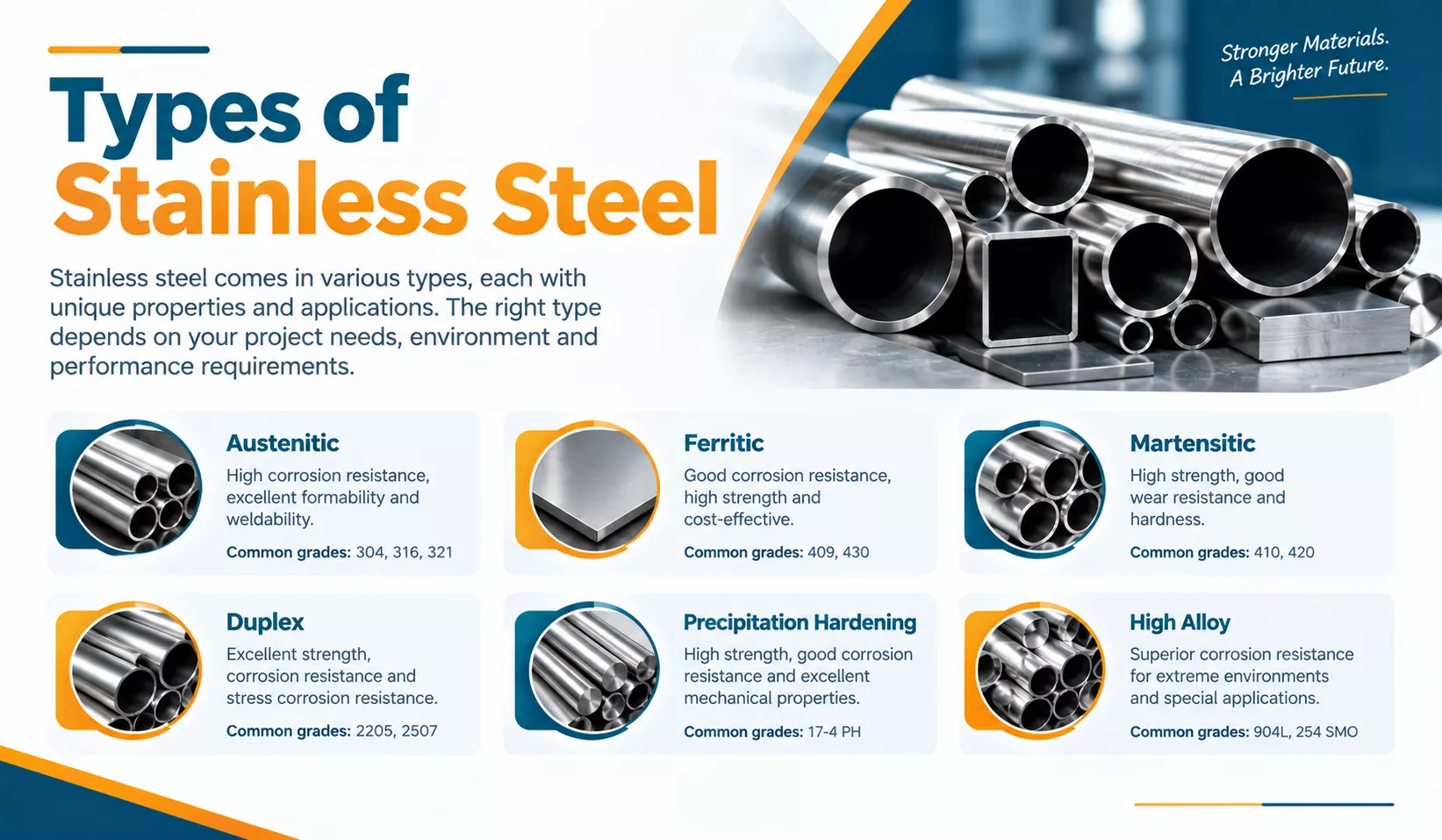
Types of Stainless Steel
| Stainless Steel Type | Typical Characteristics | Common Grades |
|---|---|---|
| Austenitic | Excellent corrosion resistance, good formability and weldability; generally non-magnetic in the annealed condition | 304, 304L, 316, 316L, 321, 347, 310 |
| Ferritic | Magnetic, good corrosion resistance and resistance to stress corrosion cracking in suitable environments | 409, 430, 446 |
| Martensitic | Heat treatable, high hardness and strength; generally magnetic | 410, 420, 440A |
| Duplex | Combination of austenitic and ferritic structures with high strength and strong resistance to chloride-related corrosion | 2205, 2507 |
| Precipitation Hardening | High strength achieved through precipitation-hardening heat treatment while retaining useful corrosion resistance | 17-4 PH, 15-5 PH |
How Many Types of Stainless Steel Are There?
There is no single number that applies to every classification system. When stainless steel is grouped according to its primary metallurgical structure, the commonly recognized families are austenitic, ferritic, martensitic and duplex stainless steels. Precipitation-hardening stainless steel is also widely identified as a separate family.
This is why searches for “what are the 4 types of stainless steel?” and “what are the 5 types of stainless steel?” can produce different answers. A four-family classification generally refers to the principal structural groups, while a five-family classification adds precipitation-hardening stainless steel as a distinct category.
There are also specialized classifications and subgroups within these families. Therefore, the number of stainless steel types and grades should not be confused with the number of individual commercial grades.
Classification of Stainless Steel
Stainless steel classification is primarily based on metallurgical structure, which is influenced by alloy composition and processing. The major stainless steel types can be summarized as follows:
- Austenitic stainless steel: Primarily austenitic structure with high chromium and nickel or other austenite-stabilizing elements.
- Ferritic stainless steel: Chromium-containing stainless steels with a ferritic structure and generally magnetic behavior.
- Martensitic stainless steel: Stainless steels that can be hardened through heat treatment to achieve higher strength and hardness.
- Duplex stainless steel: Stainless steels containing a combination of austenitic and ferritic phases.
- Precipitation-hardening stainless steel: Stainless steels designed to achieve high strength through controlled precipitation-hardening treatments.
Within each category, individual grades are identified by designation systems such as the AISI/SAE numbering system, UNS designations and applicable ASTM or other material specifications.
Austenitic Stainless Steel
Austenitic stainless steel is the largest and most widely used stainless steel family. These alloys typically contain substantial chromium together with nickel or other elements that stabilize the austenitic structure.
Austenitic stainless steels are known for their corrosion resistance, formability, weldability and toughness. Most common grades are generally non-magnetic in the fully annealed condition, although cold working can introduce some magnetic response in certain grades.
Common Austenitic Stainless Steel Grades
| Grade | General Characteristics | Typical Applications |
|---|---|---|
| 304 | General-purpose corrosion resistance with good formability and weldability | Food equipment, process equipment, piping, tanks and architectural applications |
| 304L | Low-carbon version of 304, commonly selected for welded fabrication | Process equipment, piping and fabricated structures |
| 316 | Improved resistance to many chloride and chemical environments due to molybdenum addition | Chemical processing, marine and pharmaceutical equipment |
| 316L | Low-carbon version of 316 with strong weldability characteristics | Process piping, pharmaceutical and chemical equipment |
| 321 | Titanium-stabilized grade for elevated-temperature service and welded applications | High-temperature piping, aerospace and process equipment |
| 347 | Niobium-stabilized austenitic stainless steel for elevated-temperature applications | Heat exchangers, high-temperature piping and process equipment |
| 310 / 310S | High chromium and nickel grades designed for elevated-temperature environments | Furnaces, heat-treatment equipment and high-temperature components |
Ferritic Stainless Steel
Ferritic stainless steel has a ferritic crystal structure and is generally magnetic. These stainless steels are primarily chromium-based and normally contain lower nickel levels than conventional austenitic grades.
Ferritic grades offer useful corrosion resistance, good resistance to oxidation and, depending on grade and environment, good resistance to stress corrosion cracking. Their properties vary significantly between individual grades.
Common Ferritic Stainless Steel Grades
| Grade | General Characteristics | Typical Applications |
|---|---|---|
| 409 | Ferritic stainless steel commonly used where oxidation and heat resistance are required | Automotive exhaust systems |
| 430 | General-purpose ferritic stainless steel with good corrosion resistance and magnetic behavior | Appliances, architectural components and decorative applications |
| 446 | High-chromium ferritic stainless steel for high-temperature environments | High-temperature equipment and furnace components |
Martensitic Stainless Steel
Martensitic stainless steel is characterized by a martensitic structure and is generally capable of being hardened through heat treatment. These grades are selected when higher strength, hardness and wear resistance are important.
Martensitic stainless steels are generally magnetic. Their corrosion resistance is typically lower than that of highly alloyed austenitic grades, although corrosion performance varies according to the specific grade and service environment.
Common Martensitic Stainless Steel Grades
| Grade | General Characteristics | Typical Applications |
|---|---|---|
| 410 | Heat-treatable martensitic stainless steel with useful strength and corrosion resistance | Valves, pumps, fasteners and mechanical components |
| 420 | Higher carbon martensitic grade capable of achieving higher hardness | Cutlery, surgical instruments and wear-resistant components |
| 440A | High-carbon martensitic stainless steel with high hardness after heat treatment | Cutlery, bearings and wear-resistant components |
Duplex Stainless Steel
Duplex stainless steel contains both austenitic and ferritic phases. This mixed microstructure gives duplex grades a combination of properties associated with both stainless steel families.
Duplex stainless steels provide higher strength than many conventional austenitic grades and strong resistance to several forms of corrosion, including chloride-related stress corrosion cracking in suitable environments.
Common Duplex Stainless Steel Grades
| Grade | UNS Designation | General Characteristics |
|---|---|---|
| Duplex 2205 | S31803 / S32205 | Widely used duplex grade offering high strength and good corrosion resistance |
| Super Duplex 2507 | S32750 | Higher alloy duplex grade for demanding corrosion-resistant applications |
| Super Duplex | S32760 | High-alloy duplex stainless steel designed for demanding corrosive environments |
Precipitation-Hardening Stainless Steel
Precipitation-hardening stainless steel, also called PH stainless steel, is designed to achieve high strength through a controlled heat-treatment process that forms strengthening precipitates within the alloy.
These grades combine useful corrosion resistance with high mechanical strength and are used where a combination of strength, dimensional stability and corrosion performance is required.
Examples of Precipitation-Hardening Stainless Steel
- 17-4 PH: Common precipitation-hardening stainless steel used for high-strength components.
- 15-5 PH: PH stainless steel used in applications requiring high strength and useful corrosion resistance.
Types of Stainless Steel Grades
The terms stainless steel type and stainless steel grade describe different levels of classification. A type identifies the broader metallurgical family, while a grade identifies a specific alloy composition and associated requirements.
| Type | Example Grades | Common Characteristics |
|---|---|---|
| Austenitic | 304, 304L, 316, 316L, 321, 347, 310S | Corrosion resistance, weldability, formability and toughness |
| Ferritic | 409, 430, 446 | Magnetic structure, chromium-based corrosion and oxidation resistance |
| Martensitic | 410, 420, 440A | Heat treatability, strength and hardness |
| Duplex | 2205, 2507 | High strength and corrosion resistance with mixed ferritic-austenitic structure |
| Precipitation Hardening | 17-4 PH, 15-5 PH | High strength developed through precipitation-hardening treatment |
Which Types of Stainless Steel Are Magnetic?
Ferritic and martensitic stainless steels are generally magnetic because of their crystal structures. Duplex stainless steels are also magnetic because they contain a significant ferritic phase.
Most fully annealed common austenitic stainless steels, such as 304 and 316, are generally considered non-magnetic. However, cold working can increase magnetic response in some austenitic stainless steels by producing deformation-induced martensite.
| Stainless Steel Type | Typical Magnetic Behavior | Examples |
|---|---|---|
| Austenitic | Generally non-magnetic when annealed; cold working can produce magnetic response | 304, 316, 321 |
| Ferritic | Magnetic | 409, 430 |
| Martensitic | Magnetic | 410, 420 |
| Duplex | Magnetic | 2205, 2507 |
| Precipitation Hardening | Depends on grade and metallurgical condition | 17-4 PH, 15-5 PH |
Difference Between the Different Types of Stainless Steel
| Property | Austenitic | Ferritic | Martensitic | Duplex | PH Stainless Steel |
|---|---|---|---|---|---|
| Typical Structure | Austenitic | Ferritic | Martensitic | Ferritic + Austenitic | Varies by grade |
| Magnetic Behavior | Generally non-magnetic when annealed | Magnetic | Magnetic | Magnetic | Depends on grade |
| Corrosion Resistance | Generally high | Moderate to high depending on grade | Moderate to good depending on grade | High | Good to high depending on grade |
| Strength | Good | Moderate | High after heat treatment | High | Very high after suitable treatment |
| Typical Uses | Piping, food, chemical and pharmaceutical equipment | Appliances, automotive and architectural components | Cutlery, valves and mechanical components | Oil & gas, chemical and marine applications | Aerospace, high-strength mechanical components |
How to Choose the Right Type of Stainless Steel?
Selecting the correct type of stainless steel requires more than choosing a grade based only on its chromium content. The material should be evaluated according to the actual service conditions and applicable engineering requirements.
- Corrosion environment: Identify exposure to chlorides, acids, alkalis, moisture and other process chemicals.
- Temperature: Consider both operating and design temperatures.
- Strength: Determine the required tensile strength, yield strength, hardness and mechanical performance.
- Weldability: Consider welding requirements and post-weld service conditions.
- Magnetic requirements: Confirm whether magnetic or generally non-magnetic behavior is required.
- Fabrication: Consider forming, machining, welding and heat-treatment requirements.
- Applicable specification: Select a grade that complies with the required ASTM, ASME, EN, UNS or other applicable material specification.
- Application: Match the material to the actual process, equipment or component requirements.
For stainless steel pipes and tubes, material selection should also consider the required pipe type, nominal size, outside diameter, wall thickness, schedule, length, manufacturing standard, testing and documentation.
Which Stainless Steel Types Are Used for Pipes?
Different stainless steel families are used for pipe and tube products depending on the application and applicable specification. Austenitic stainless steel pipes, particularly grades such as 304 and 316, are widely used for general corrosion-resistant piping and process applications.
Duplex and Super Duplex stainless steel pipes are selected for applications requiring higher strength and enhanced resistance to demanding corrosive environments. Other stainless steel families are used for specific temperature, mechanical or application requirements.
Kamal Steels supplies stainless steel pipe and tube products in various grades, dimensions and specifications according to project and customer requirements.
Frequently Asked Questions About Stainless Steel Types
The four commonly recognized major types of stainless steel are austenitic, ferritic, martensitic and duplex stainless steel. Precipitation-hardening stainless steel is also commonly classified as a separate fifth family.
The five commonly discussed stainless steel families are austenitic, ferritic, martensitic, duplex and precipitation-hardening stainless steel. The exact classification can vary depending on the classification system used.
Stainless steel is commonly divided into four major structural families: austenitic, ferritic, martensitic and duplex. Precipitation-hardening stainless steel is often treated as a fifth family. Each family contains numerous individual grades.
The main different types of stainless steel include austenitic, ferritic, martensitic, duplex and precipitation-hardening stainless steel. Each type has different properties, grades and applications.
Ferritic, martensitic and duplex stainless steels are generally magnetic. Austenitic stainless steels are generally non-magnetic when fully annealed, although cold working can produce magnetic response in some grades.
Stainless steel grades are grouped into metallurgical families such as austenitic, ferritic, martensitic, duplex and precipitation-hardening stainless steel. Examples include 304 and 316 in the austenitic family, 430 in the ferritic family, 410 in the martensitic family and 2205 in the duplex family.
Austenitic stainless steel is the most widely used stainless steel family. Grades such as 304 and 316 are common choices because of their combination of corrosion resistance, formability, weldability and toughness.
A stainless steel type refers to a broad metallurgical family, while a grade identifies a specific alloy composition and material designation. For example, austenitic is a stainless steel type, while 304 and 316 are individual grades within that family.
Annealed 304 stainless steel is generally considered non-magnetic. However, cold working, forming or other processing can produce some magnetic response.
Fully annealed 316 stainless steel is generally non-magnetic. Cold working can increase magnetic response in some 316 material.
Duplex stainless steel contains both ferritic and austenitic phases. This microstructure provides high strength and strong corrosion resistance, including resistance to chloride-related stress corrosion cracking in suitable service conditions.
The main types of SS material are austenitic, ferritic, martensitic, duplex and precipitation-hardening stainless steel. Common grades include SS 304, SS 316, SS 430, SS 410 and Duplex 2205.
“Types of stainless steel” का हिंदी अर्थ “स्टेनलेस स्टील के प्रकार” है। स्टेनलेस स्टील के प्रमुख प्रकार ऑस्टेनिटिक, फेरिटिक, मार्टेंसिटिक, डुप्लेक्स और प्रीसिपिटेशन-हार्डनिंग स्टेनलेस स्टील हैं।