
-
-
-
Girgaon, Mumbai - 400004
Steel Pipe Weight Calculation Formula
The Steel Pipe Weight Calculation Formula is used to calculate the approximate weight of a steel pipe based on its outside diameter, wall thickness and material density. Knowing the weight per meter or per foot is useful for material estimation, transportation planning, project costing, fabrication, structural calculations and inventory management.
For a commonly used steel pipe calculation, when the outside diameter and wall thickness are measured in millimetres, the formula is:
Steel Pipe Weight (kg/m) = (OD − WT) × WT × 0.02466
Where:
- OD = Outside Diameter of the pipe in mm
- WT = Wall Thickness in mm
- 0.02466 = Commonly used constant for steel pipe weight estimation
- Weight = Approximate weight in kg per meter
This guide explains the Steel Pipe Weight Calculation Formula, how the 0.02466 constant is used, how to calculate pipe weight in kg/m and kg/ft and how material density can affect the final result.
The formula is useful for estimating the theoretical weight of carbon steel, mild steel and similar steel pipes. For stainless steel and other alloys, a density-based calculation may be more appropriate because material density varies by grade.
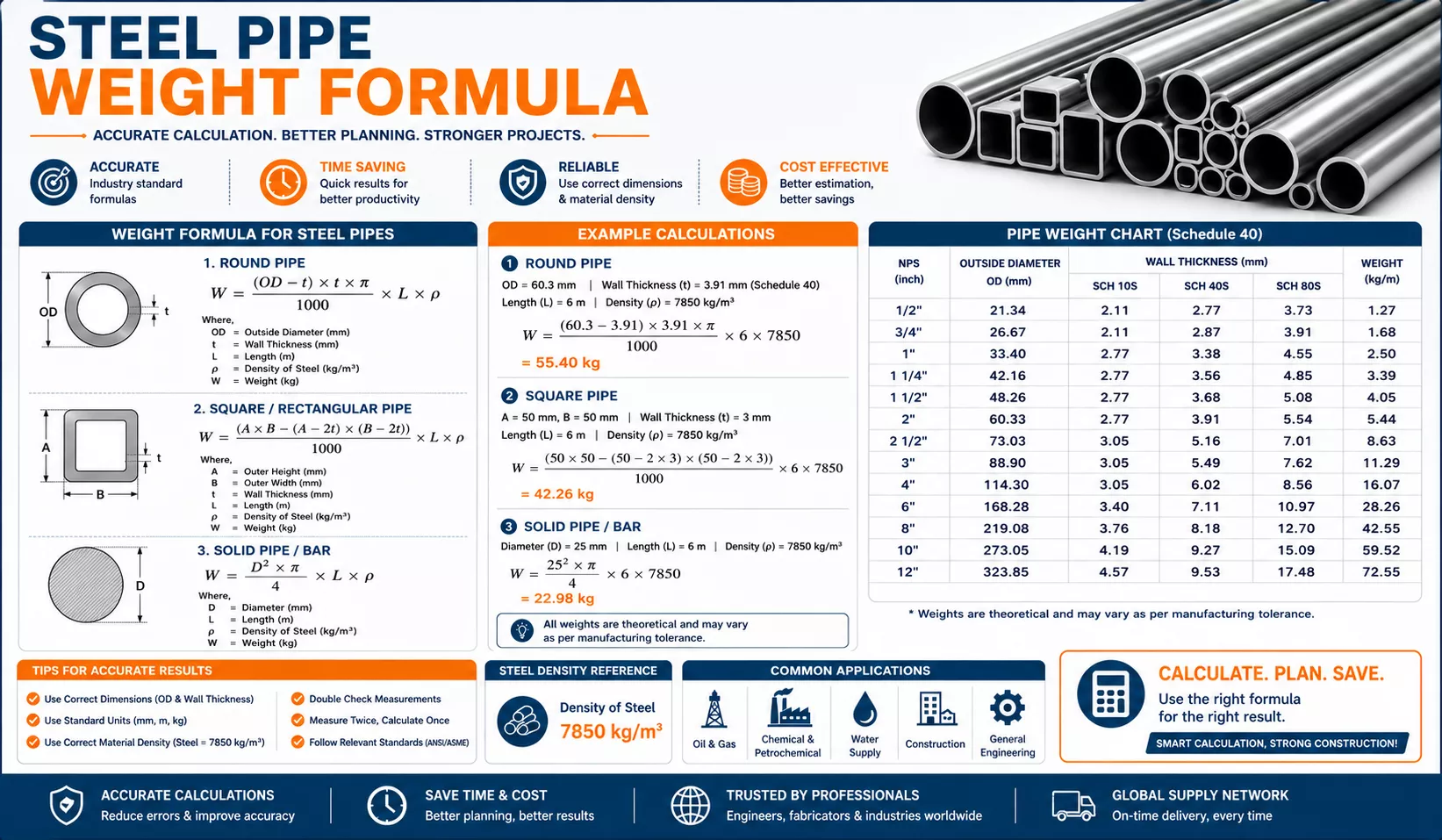
Steel Pipe Weight Calculation Formula
The commonly used formula for calculating the weight per meter of a steel pipe is:
Weight (kg/m) = (OD − WT) × WT × 0.02466
This formula is widely used for estimating the theoretical weight of carbon steel, mild steel, and similar steel pipes when dimensions are provided in millimetres.
Formula Variables
| Symbol | Meaning | Unit |
|---|---|---|
| OD | Outside Diameter | mm |
| WT | Wall Thickness | mm |
| ID | Inside Diameter | mm |
| Weight | Pipe Weight per Unit Length | kg/m |
| 0.02466 | Steel Weight Constant | — |
The inside diameter can first be estimated using:
ID = OD − (2 × WT)
The formula is based on the cross-sectional area of the pipe wall and the commonly used density of steel.
Steel Pipe Weight Formula 0.02466
The 0.02466 constant is commonly used in the steel pipe weight formula when the outside diameter and wall thickness are expressed in millimetres and the result is required in kilograms per meter.
The formula is:
Weight (kg/m) = (OD − WT) × WT × 0.02466
The constant incorporates the geometric relationship of a circular pipe and the commonly used density of carbon steel.
Therefore, the formula provides a convenient way to calculate the steel pipe weight per meter without performing the complete density and volume conversion every time.
However, it should be treated as a theoretical estimation. Actual pipe weight can vary because of manufacturing tolerances, material density, dimensions, and applicable product standards.
How to Calculate Steel Pipe Weight
To calculate the weight of a steel pipe, you need three main pieces of information:
- Outside Diameter (OD)
- Wall Thickness (WT)
- Pipe Length
First, calculate the theoretical weight per meter using:
Weight (kg/m) = (OD − WT) × WT × 0.02466
Then multiply the calculated weight per meter by the required pipe length:
Total Weight (kg) = Weight per Meter × Length
Example: Steel Pipe Weight Calculation
Suppose a steel pipe has the following dimensions:
| Parameter | Value |
|---|---|
| Outside Diameter (OD) | 60.3 mm |
| Wall Thickness (WT) | 3.91 mm |
| Pipe Length | 6 meters |
Step 1: Calculate the weight per meter.
Weight = (60.3 − 3.91) × 3.91 × 0.02466
Weight ≈ 5.44 kg/m
Step 2: Calculate the weight of a 6-meter pipe.
Total Weight = 5.44 × 6
Total Weight ≈ 32.64 kg
Therefore, the approximate theoretical weight of the 6-meter pipe is 32.64 kg.
Steel Pipe Weight Formula in Kg
When calculating steel pipe weight in kilograms, the most important distinction is whether you need weight per meter or total pipe weight.
| Calculation | Formula |
|---|---|
| Weight Per Meter | (OD − WT) × WT × 0.02466 |
| Total Pipe Weight | (OD − WT) × WT × 0.02466 × Length |
For weight per meter:
Weight (kg/m) = (OD − WT) × WT × 0.02466
For total pipe weight:
Total Weight (kg) = (OD − WT) × WT × 0.02466 × Length
When OD and wall thickness are measured in millimetres and length is measured in meters, the result is expressed in kilograms.
This makes the formula useful for estimating the weight of individual pipes, bundles, and larger quantities of material.
Steel Pipe Weight Per Meter Formula
The steel pipe weight per meter formula is:
Weight per meter (kg/m) = (OD − WT) × WT × 0.02466
For example, consider a steel pipe with the following dimensions:
| Parameter | Value |
|---|---|
| Outside Diameter | 114.3 mm |
| Wall Thickness | 6.02 mm |
| Length | 1 meter |
Calculation:
Weight = (114.3 − 6.02) × 6.02 × 0.02466
Weight ≈ 16.08 kg/m
This provides an approximate theoretical weight per meter. For purchasing and shipping calculations, the exact product specification and manufacturer's weight tolerance should also be considered.
Steel Pipe Weight Per Foot Formula
When pipe dimensions are in inches and the required result is in pounds per foot, a commonly used formula for steel pipe is:
Weight (lb/ft) = 10.69 × (OD − WT) × WT
Where OD and WT are measured in inches.
For example:
| Parameter | Value |
|---|---|
| Outside Diameter (OD) | 2 inches |
| Wall Thickness (WT) | 0.154 inches |
Weight ≈ 10.69 × (2 − 0.154) × 0.154
Weight ≈ 3.04 lb/ft
For accurate procurement calculations, always verify the dimensional units and applicable material standard before using a conversion formula.
Mild Steel Pipe Weight Calculation Formula
The mild steel pipe weight calculation formula can be expressed as:
Weight (kg/m) = (OD − WT) × WT × 0.02466
Where OD and WT are measured in millimetres.
Mild steel pipes are commonly used in construction, fabrication, water systems, structural applications, and general engineering.
Example
For a mild steel pipe with:
| Parameter | Value |
|---|---|
| Outside Diameter (OD) | 100 mm |
| Wall Thickness (WT) | 5 mm |
Weight = (100 − 5) × 5 × 0.02466
Weight ≈ 11.71 kg/m
The actual weight should be confirmed against the applicable pipe dimensions and material specification.
Carbon Steel Pipe Weight Calculation Formula
The carbon steel pipe weight formula is commonly expressed as:
Weight (kg/m) = (OD − WT) × WT × 0.02466
This formula provides an approximate weight based on the pipe dimensions and a standard carbon steel density assumption.
For a carbon steel pipe with an OD of 168.3 mm and wall thickness of 7.11 mm:
Weight = (168.3 − 7.11) × 7.11 × 0.02466
Weight ≈ 28.29 kg/m
For engineering and procurement purposes, the exact dimensional standard, material grade, and density should be checked.
Stainless Steel Pipe Weight Calculation Formula
Stainless steel has a different density from carbon steel, so using the carbon steel constant of 0.02466 may not provide the most appropriate theoretical result for stainless steel.
A general calculation based on material density is:
Weight = Volume × Material Density
For a pipe:
Weight per meter = π/4 × (OD² − ID²) × Density
| Term | Meaning |
|---|---|
| OD | Outside Diameter |
| ID | Inside Diameter |
| Density | Material density |
| Dimensions | Must be converted consistently before calculation |
The simplified formula can also be written using OD and wall thickness:
ID = OD − 2WT
Therefore:
Weight per meter = π/4 × [OD² − (OD − 2WT)²] × Density
This approach is more flexible because different stainless steel grades can have different densities.
Common stainless steel grades include 304, 304L, 316, 316L, 310, 310S, 321, and 347.
Steel Pipe Weight Calculation Formula Using OD and Wall Thickness
The most important dimensions for a basic steel pipe weight calculation are:
- Outside Diameter (OD)
- Wall Thickness (WT)
- Length
The simplified formula is:
Weight (kg/m) = (OD − WT) × WT × 0.02466
If the total pipe length is known:
Total Weight (kg) = Weight per Meter × Total Length
This calculation is particularly useful when the pipe size and schedule are known but a quick weight estimate is required.
Steel Pipe Weight Formula: OD, ID and Wall Thickness
The relationship between OD, ID, and wall thickness is:
WT = (OD − ID) / 2
Or:
ID = OD − (2 × WT)
For example, if:
| Parameter | Value |
|---|---|
| Outside Diameter (OD) | 60.3 mm |
| Wall Thickness (WT) | 3.91 mm |
Then:
ID = 60.3 − (2 × 3.91)
ID = 52.48 mm
Once the dimensions are known, the pipe weight can be estimated using the appropriate material density or standard formula.
Steel Pipe Weight Chart
The following examples show approximate theoretical weights for commonly used steel pipe dimensions.
| NPS | OD (mm) | Wall Thickness (mm) | Approx. Weight (kg/m) |
|---|---|---|---|
| 1/2" | 21.3 | 2.77 | 1.26 |
| 3/4" | 26.7 | 2.87 | 1.69 |
| 1" | 33.4 | 3.38 | 2.51 |
| 1-1/2" | 48.3 | 3.68 | 4.05 |
| 2" | 60.3 | 3.91 | 5.44 |
| 3" | 88.9 | 5.49 | 11.32 |
| 4" | 114.3 | 6.02 | 16.08 |
| 6" | 168.3 | 7.11 | 28.29 |
| 8" | 219.1 | 8.18 | 42.61 |
| 10" | 273.0 | 9.27 | 60.30 |
| 12" | 323.8 | 9.53 | 73.92 |
These values are approximate theoretical calculations. Actual pipe weights can differ depending on the material grade, manufacturing tolerance, dimensional standard, and product specification.
Steel Pipe Weight Calculator
A Steel Pipe Weight Calculator is a convenient tool for estimating the theoretical weight of a steel pipe based on its dimensions, material, and length. It can help engineers, fabricators, buyers, and procurement teams quickly estimate pipe weight for material planning, costing, transportation, and inventory purposes.
Depending on the calculator, the following information may be required:
| Input | Description | Typical Unit |
|---|---|---|
| Outside Diameter (OD) | The outside diameter of the pipe used to determine the overall pipe dimensions. | mm / inch |
| Wall Thickness (WT) | The thickness of the pipe wall, which directly affects the amount of metal and pipe weight. | mm / inch |
| Pipe Length | The required pipe length used to calculate the total weight of the pipe. | m / ft |
| Material | The material or grade selected for the calculation, such as carbon steel, mild steel, or stainless steel. | Material grade |
| Unit of Measurement | The measurement system used for dimensions and the required weight output. | Metric / Imperial |
After entering the required dimensions and material information, the calculator can provide the estimated weight per meter and total pipe weight.
Total Weight (kg) = Weight per Meter (kg/m) × Length (m)
The calculated value is generally a theoretical estimate. Actual pipe weight may vary depending on material density, dimensional tolerances, manufacturing specifications, and the applicable product standard.
For a quick calculation of steel pipes, tubes, bars, plates, sheets, and other metal products, use the Kamal Steels Metal Weight Calculator .
Steel Pipe Weight Calculation Formula in Excel
The steel pipe weight calculation formula in Excel can be used to calculate the theoretical weight of individual pipes or multiple pipe sizes quickly. By entering the outside diameter, wall thickness, and pipe length into separate cells, Excel can automatically calculate the weight per meter and total pipe weight.
Excel Input and Calculation Table
| Excel Cell | Input / Calculation | Value / Formula | Unit |
|---|---|---|---|
| A2 | Outside Diameter (OD) | 60.3 | mm |
| B2 | Wall Thickness (WT) | 3.91 | mm |
| C2 | Pipe Length | 6 | m |
| D2 | Weight per Meter | =(A2-B2)*B2*0.02466 | kg/m |
| E2 | Total Pipe Weight | =(A2-B2)*B2*0.02466*C2 | kg |
Steel Pipe Weight Formula in Excel
If Cell A2 contains the outside diameter in millimetres and Cell B2 contains the wall thickness in millimetres, use the following Excel formula to calculate theoretical weight per meter:
=(A2-B2)*B2*0.02466
The result will be the approximate steel pipe weight per meter in kg/m.
Steel Pipe Total Weight Formula in Excel
If Cell C2 contains the pipe length in meters, multiply the calculated weight per meter by the total length:
=(A2-B2)*B2*0.02466*C2
This formula returns the approximate total pipe weight in kilograms.
Example Calculation in Excel
For a steel pipe with an outside diameter of 60.3 mm, wall thickness of 3.91 mm, and length of 6 meters:
Weight per Meter = (60.3 − 3.91) × 3.91 × 0.02466
Weight per Meter ≈ 5.44 kg/m
Total Weight = 5.44 × 6
Total Weight ≈ 32.64 kg
Excel can be particularly useful for calculating the weight of multiple pipe sizes, preparing material estimation sheets, comparing quantities, and planning transportation or procurement requirements.
The calculated values are theoretical estimates. Actual pipe weight may vary depending on material density, dimensional tolerances, manufacturing specifications, and the applicable product standard.
Why Calculate Steel Pipe Weight?
Calculating the weight of a steel pipe before purchasing, fabrication, or installation helps engineers, fabricators, buyers, and procurement teams plan material requirements and project logistics more effectively.
| Purpose | How Pipe Weight Calculation Helps |
|---|---|
| Material Estimation | Helps estimate the total quantity and weight of steel required for a project. |
| Cost Calculation | Provides useful weight information for material costing and quotation preparation. |
| Transportation Planning | Helps estimate vehicle loading requirements and transportation capacity. |
| Shipping Weight Estimation | Supports preliminary shipping and logistics planning based on estimated material weight. |
| Structural Calculations | Provides pipe weight information required for certain structural and support calculations. |
| Crane and Lifting Planning | Helps estimate lifting loads and select suitable handling equipment. |
| Inventory Management | Helps track and estimate the quantity of pipe material held in stock. |
| Project Budgeting | Supports preliminary material budgeting and project cost estimation. |
| Procurement Planning | Helps buyers compare required quantities and estimated weights when preparing purchase requirements. |
For industrial projects, accurate weight information can help reduce unexpected transportation costs, material quantity discrepancies, and procurement errors.
Theoretical Weight vs Actual Pipe Weight
The steel pipe weight formula provides a theoretical weight based on nominal dimensions and an assumed material density. The actual weight of a manufactured pipe may differ slightly because of dimensional and manufacturing variations.
| Factor | Theoretical Weight | Actual Pipe Weight |
|---|---|---|
| Basis of Calculation | Calculated using nominal dimensions and assumed material density. | Based on the actual manufactured pipe dimensions and material. |
| Wall Thickness | Uses the specified or nominal wall thickness. | May vary within the tolerance permitted by the applicable standard. |
| Outside Diameter | Uses the specified nominal outside diameter. | Actual OD may vary within the specified dimensional tolerance. |
| Material Density | Uses an assumed or specified material density for calculation. | Actual material composition can cause slight variations in density. |
| Pipe Length | Calculated using the specified or nominal length. | Actual length may vary according to manufacturing tolerances and supply conditions. |
| Surface Finish | Usually does not account for variations in surface condition or finishing. | Surface treatment and finishing may have a minor effect on actual weight. |
| Applicable Standard | Based on the dimensions and assumptions used in the calculation. | Manufactured according to the tolerances and requirements of the applicable product standard. |
Therefore, calculated pipe weights should generally be used for estimation, costing, transportation planning, and material calculations. When an exact product weight is required, refer to the applicable product specification, certified mill test report, or actual weighing of the supplied pipe.
Conclusion
The steel pipe weight formula provides a convenient way to estimate the weight of steel pipes from their outside diameter and wall thickness.
For commonly used carbon and mild steel calculations:
Weight (kg/m) = (OD − WT) × WT × 0.02466
For total pipe weight:
Total Weight (kg) = Weight per Meter × Length
For stainless steel and other materials, a density-based calculation may be more appropriate because material densities differ.
Understanding the steel pipe weight calculation formula, weight per meter, weight per foot, and the effect of OD, wall thickness, length, and material density can help engineers, fabricators, procurement teams, and buyers make better material and logistics decisions.
For a faster calculation, use the Kamal Steels Metal Weight Calculator to estimate the theoretical weight of pipes, tubes, bars, plates, sheets, and other metal products.
Frequently Asked Questions
The commonly used steel pipe weight formula is Weight (kg/m) = (OD − WT) × WT × 0.02466, where OD is the outside diameter and WT is the wall thickness in millimetres.
The 0.02466 constant is commonly used to estimate the theoretical weight per meter of carbon steel and mild steel pipes when the outside diameter and wall thickness are measured in millimetres.
To calculate steel pipe weight per meter, subtract the wall thickness from the outside diameter, multiply the result by the wall thickness, and then multiply by 0.02466. The result is the approximate weight in kg/m.
First calculate the weight per meter using the steel pipe weight calculation formula. Then multiply the weight per meter by the total pipe length: Total Weight (kg) = Weight per Meter × Length.
The basic calculation requires the pipe's outside diameter (OD), wall thickness (WT), and length. Material grade and density should also be considered when a more specific theoretical weight is required.
When OD and wall thickness are measured in millimetres, the commonly used steel pipe weight formula in kg is Weight (kg/m) = (OD − WT) × WT × 0.02466. This gives the approximate weight per meter.
A commonly used mild steel pipe weight calculation formula is Weight (kg/m) = (OD − WT) × WT × 0.02466, with OD and WT measured in millimetres. The result is a theoretical estimate.
The 0.02466 constant is primarily used for carbon and mild steel weight estimation. For stainless steel pipe weight calculation, a density-based formula is generally more appropriate because stainless steel grades can have different material densities.
Pipe dimensions directly affect weight. The inside diameter can be calculated using ID = OD − (2 × WT). A larger outside diameter or greater wall thickness generally increases the amount of metal and therefore increases pipe weight per meter.
Yes. A Steel Pipe Weight Calculator can simplify the calculation by using the outside diameter, wall thickness, length, and material to estimate weight per meter and total pipe weight. You can also use the Kamal Steels Metal Weight Calculator for quick theoretical weight calculations.