
-
-
-
Girgaon, Mumbai - 400004
Pipe Dimensions Chart
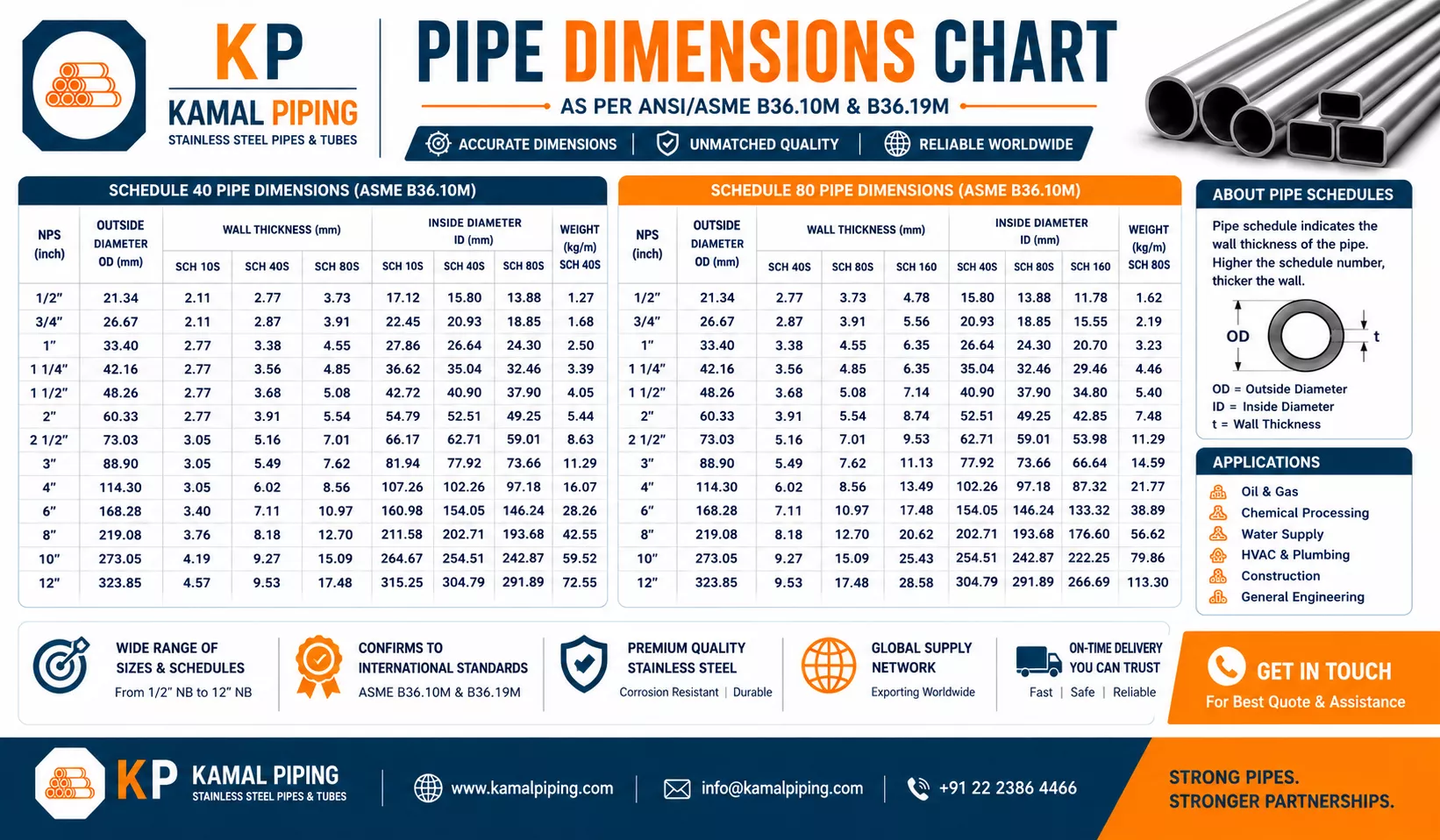
A Pipe Dimensions Chart is an essential reference for engineers, fabricators, contractors, procurement professionals and industrial buyers who need to select the correct pipe for a piping system. It provides important information such as Nominal Pipe Size (NPS), DN, Outside Diameter (OD), Inside Diameter (ID), wall thickness and pipe schedule.
Selecting the correct pipe dimensions is important for ensuring proper fitting, flow capacity, pressure performance, mechanical strength and compatibility with valves, flanges, fittings and other piping components.
Kamal Steels supplies stainless steel pipes and tubes in different grades, sizes, schedules, specifications and configurations for applications across oil & gas, chemical processing, petrochemical, power generation, pharmaceutical, food processing, marine, refinery, and other industries.
What Are Pipe Dimensions?
Pipe dimensions are the standardized measurements and designations used to identify the size and wall thickness of a pipe.
The most important pipe dimensions include:
- Nominal Pipe Size (NPS)
- Diameter Nominal (DN)
- Outside Diameter (OD)
- Inside Diameter (ID)
- Wall Thickness
- Pipe Schedule
- Pipe Length
The actual dimensions of a pipe depend on its nominal size, schedule, material specification and the applicable dimensional standard.
Pipe Dimensions Chart
The following chart provides commonly used pipe sizes with their nominal diameter, outside diameter, and selected wall thicknesses.
| NPS | DN | OD (mm) | SCH 10 (mm) | SCH 40 (mm) | SCH 80 (mm) |
|---|---|---|---|---|---|
| 1/2" | 15 | 21.3 | 2.11 | 2.77 | 3.73 |
| 3/4" | 20 | 26.7 | 2.11 | 2.87 | 3.91 |
| 1" | 25 | 33.4 | 2.77 | 3.38 | 4.55 |
| 1-1/4" | 32 | 42.2 | 2.77 | 3.56 | 4.85 |
| 1-1/2" | 40 | 48.3 | 2.77 | 3.68 | 5.08 |
| 2" | 50 | 60.3 | 2.77 | 3.91 | 5.54 |
| 2-1/2" | 65 | 73.0 | 3.05 | 5.16 | 7.01 |
| 3" | 80 | 88.9 | 3.05 | 5.49 | 7.62 |
| 4" | 100 | 114.3 | 3.05 | 6.02 | 8.56 |
| 5" | 125 | 141.3 | 3.40 | 6.55 | 9.52 |
| 6" | 150 | 168.3 | 3.40 | 7.11 | 10.97 |
| 8" | 200 | 219.1 | 3.76 | 8.18 | 12.70 |
| 10" | 250 | 273.0 | 4.19 | 9.27 | 15.09 |
| 12" | 300 | 323.8 | 4.57 | 9.53 | 17.48 |
| 14" | 350 | 355.6 | 4.78 | 9.53 | 12.70 |
| 16" | 400 | 406.4 | 4.78 | 9.53 | 12.70 |
| 18" | 450 | 457.2 | 4.78 | 9.53 | 14.27 |
| 20" | 500 | 508.0 | 5.54 | 9.53 | 15.09 |
| 24" | 600 | 609.6 | 6.35 | 9.53 | 17.48 |
Dimensions shown are representative reference values. Always verify the exact dimensional requirements against the applicable standard and purchase specification before ordering.
Understanding NPS in Pipe Dimensions
NPS stands for Nominal Pipe Size. It is a standard designation used to identify pipe sizes in inch-based piping systems.
An important point is that NPS does not necessarily represent the actual outside or inside diameter of the pipe.
For example, a 2-inch NPS pipe has an outside diameter of approximately 60.3 mm. Its inside diameter changes according to the selected wall thickness or schedule.
Therefore, a pipe purchase specification should normally include more than just the NPS. The required material grade, pipe type, schedule or wall thickness, standard, and quantity should also be specified.
What Is DN in Pipe Size?
DN means Diameter Nominal and is a metric-based nominal pipe designation.
Some commonly used NPS-to-DN equivalents are:
| NPS | DN |
|---|---|
| 1/2" | DN 15 |
| 3/4" | DN 20 |
| 1" | DN 25 |
| 1-1/4" | DN 32 |
| 1-1/2" | DN 40 |
| 2" | DN 50 |
| 2-1/2" | DN 65 |
| 3" | DN 80 |
| 4" | DN 100 |
| 6" | DN 150 |
| 8" | DN 200 |
| 10" | DN 250 |
| 12" | DN 300 |
| 16" | DN 400 |
| 20" | DN 500 |
| 24" | DN 600 |
Difference Between Pipe Size and Pipe Dimensions
Pipe size and pipe dimensions are closely related, but they do not mean exactly the same thing. Pipe size generally refers to the nominal designation used to identify a pipe, while pipe dimensions provide detailed information about its physical measurements.
| Pipe Size | Pipe Dimensions |
|---|---|
| Refers to the nominal designation of a pipe. | Provides detailed physical measurements of the pipe. |
| Usually identified by NPS or DN. | Includes OD, ID, wall thickness, schedule, and weight. |
| Examples include NPS 2, NPS 4, and NPS 6. | Provides measurements associated with the selected pipe size. |
| Does not directly indicate the actual inside diameter. | ID depends on the outside diameter and wall thickness. |
| Used primarily to identify the nominal pipe size. | Used for engineering, fabrication, installation, and procurement. |
For example, a 2-inch NPS pipe has a nominal size of 2 inches, but its actual inside diameter depends on the selected wall thickness or schedule. Therefore, the nominal pipe size alone is not sufficient to determine the complete pipe dimensions.
When selecting a pipe, it is important to consider the NPS or DN, outside diameter, inside diameter, wall thickness, schedule, material grade, pipe type, and applicable standard.
Pipe Dimensions for Stainless Steel Pipes
Stainless steel pipes are widely used where corrosion resistance, durability, hygiene, and temperature performance are important. They are available in different grades, sizes, wall thicknesses, schedules, and pipe constructions depending on the application.
Common Stainless Steel Pipe Grades
| Stainless Steel Grade | Common Characteristics | Typical Applications |
|---|---|---|
| SS 304 | Good corrosion resistance and general-purpose performance | Food processing, chemical, architectural, and general industrial applications |
| SS 304L | Low-carbon grade with good corrosion resistance and weldability | Welded piping, chemical processing, and fabrication applications |
| SS 316 | Improved corrosion resistance, particularly in chloride-containing environments | Marine, chemical processing, pharmaceutical, and industrial applications |
| SS 316L | Low-carbon version of 316 with excellent weldability and corrosion resistance | Pharmaceutical, food processing, marine, and chemical applications |
| SS 310 | High-temperature performance and oxidation resistance | Furnaces, heat treatment equipment, and high-temperature applications |
| SS 310S | Low-carbon grade with good high-temperature and oxidation resistance | Heat treatment, furnace components, and high-temperature processing |
| SS 321 | Stabilized stainless steel with good resistance to intergranular corrosion | High-temperature piping, aerospace, chemical, and thermal applications |
| SS 347 | Stabilized grade with good high-temperature performance | Power generation, petrochemical, heat exchangers, and high-temperature services |
Depending on the application and specification, stainless steel pipes can be supplied as seamless or welded pipes in different sizes, wall thicknesses, schedules, and lengths.
Stainless Steel Pipe Dimension Standards
| Standard | Application |
|---|---|
| ASME B36.19M | Dimensions of stainless steel pipe |
| ASME B36.10M | Dimensions of welded and seamless wrought steel pipe |
When selecting stainless steel pipe dimensions, the required NPS or DN, outside diameter, wall thickness, schedule, material grade, pipe type, and applicable standard should be confirmed according to the project requirements.
Seamless vs Welded Pipe Dimensions
Pipe dimensions alone do not determine whether a pipe is seamless or welded. Both types can be available in different sizes, wall thicknesses, schedules, grades, and lengths according to the applicable product specification.
| Feature | Seamless Pipes | Welded Pipes |
|---|---|---|
| Manufacturing | Manufactured without a longitudinal welded seam. | Manufactured by forming the material and joining the edges through welding. |
| Pipe Dimensions | Available in various nominal sizes and wall thicknesses according to the applicable specification. | Available in various sizes and wall thicknesses according to the applicable specification. |
| Pressure Applications | Commonly selected for demanding pressure and mechanical service requirements. | Suitable for many industrial piping and process applications depending on the specification. |
| Temperature Applications | Used in applications requiring demanding temperature performance when specified appropriately. | Used across a wide range of temperature conditions depending on material, welding procedure, and standard. |
| Common Applications | Oil & gas, petrochemical, power generation, chemical processing, and high-pressure systems. | Process piping, water systems, construction, chemical processing, and general industrial applications. |
| Cost Consideration | May have a higher material cost depending on size, grade, specification, and manufacturing requirements. | Can provide an economical solution for many industrial applications. |
| Selection | Selected based on pressure, temperature, mechanical requirements, applicable standard, and service conditions. | Selected based on application requirements, welding specification, applicable standard, and service conditions. |
The choice between seamless and welded pipe should be based on the applicable standard, design requirements, operating pressure, temperature, material grade, service conditions, and project specification rather than dimensions alone.
How to Select the Correct Pipe Dimensions
Choosing the correct pipe dimensions requires more than selecting a nominal size. The pipe should be selected according to the piping system, operating conditions, material requirements, applicable standards, and project specifications.
Consider the following factors when selecting the correct pipe dimensions:
| Factor | What to Consider |
|---|---|
| Nominal Pipe Size | Determine the required NPS or DN based on the piping system, flow requirements, and connection dimensions. |
| Outside Diameter | Verify the OD where compatibility with fittings, flanges, clamps, supports, and fabricated components is important. |
| Wall Thickness | Select the required wall thickness based on pressure, temperature, corrosion allowance, mechanical requirements, and applicable design codes. |
| Pipe Schedule | Select the applicable schedule or specified wall thickness according to the engineering requirements. |
| Material Grade | Choose a suitable grade based on corrosion resistance, temperature, strength, fabrication, and service requirements. |
| Pipe Type | Specify whether the application requires seamless, welded, ERW, or another pipe construction. |
| Applicable Standard | Confirm the applicable ASTM, ASME, EN, or other project standard before ordering. |
| Length and Quantity | Specify the required pipe length, quantity, and delivery requirements. |
Why Accurate Pipe Dimensions Matter
Accurate pipe dimensions are essential for successful installation, proper component compatibility, and reliable operation of industrial piping systems.
Incorrect pipe dimensions can result in several problems, including:
| Problem | Potential Impact |
|---|---|
| Improper Fitting Connections | Incorrect dimensions can cause compatibility problems with fittings, flanges, valves, and other components. |
| Reduced Flow Area | An incorrect inside diameter can affect flow capacity, fluid velocity, and pressure drop. |
| Installation Difficulties | Incorrect dimensions can create problems during fabrication, assembly, and installation. |
| Incorrect Weight Calculations | Incorrect dimensions can lead to inaccurate material weight and transportation estimates. |
| Increased Material Costs | Selecting an unsuitable wall thickness or pipe size can result in unnecessary material consumption. |
| Compatibility Problems | Incorrect OD, ID, or wall thickness may affect compatibility with connected piping components. |
| Potential Design Issues | Incorrect pipe dimensions can affect pressure performance, structural requirements, and overall system design. |
For industrial procurement, confirming the complete pipe specification before placing an order helps reduce the risk of receiving unsuitable material. The required size, OD, wall thickness or schedule, material grade, pipe type, applicable standard, length, and quantity should be clearly specified.
Pipe Dimensions for Industrial Applications
Correct pipe dimensions are important in many industries where pipe size, wall thickness, material grade, and manufacturing method must match the requirements of the application.
| Industry | Typical Pipe Dimension Considerations |
|---|---|
| Oil & Gas | Pipe size, wall thickness, pressure rating, material grade, and service conditions. |
| Petrochemical | Pipe dimensions, corrosion resistance, pressure, temperature, and material compatibility. |
| Chemical Processing | Internal diameter, corrosion resistance, wall thickness, and chemical compatibility. |
| Power Generation | Pipe size, wall thickness, temperature, pressure, and mechanical strength. |
| Pharmaceutical | Pipe dimensions, surface requirements, hygiene, material grade, and cleanability. |
| Food Processing | Internal diameter, hygienic design, material grade, surface finish, and flow requirements. |
| Marine | Pipe size, corrosion resistance, wall thickness, and resistance to marine environments. |
| Refineries | Pressure, temperature, corrosion resistance, pipe schedule, and material grade. |
| Fertilizer | Pipe dimensions, corrosion resistance, temperature, pressure, and chemical compatibility. |
| Sugar | Pipe size, material grade, flow capacity, corrosion resistance, and hygienic requirements. |
| Heat Exchangers | Tube or pipe dimensions, wall thickness, heat transfer requirements, and material grade. |
| Construction | Pipe size, wall thickness, structural requirements, load conditions, and installation requirements. |
| Water Treatment | Pipe size, internal diameter, flow rate, corrosion resistance, and operating pressure. |
Different applications may require different combinations of pipe size, wall thickness, material grade, schedule, and manufacturing method. The appropriate dimensions should therefore be selected according to the system design and applicable standards.
Pipe Dimensions and Flow Capacity
Pipe dimensions directly influence fluid flow. In particular, the inside diameter (ID) determines the approximate cross-sectional area available for fluid to pass through the pipe.
For a circular pipe, the flow area can be calculated using the following formula:
Flow Area = π × ID² / 4
This relationship shows that even a relatively small change in inside diameter can produce a noticeable change in the available flow area.
Therefore, engineers should consider the required flow rate, fluid properties, velocity, pressure drop, inside diameter, and overall system design when selecting pipe dimensions.
Pipe dimensions should not be selected solely on the basis of nominal pipe size. The required wall thickness, schedule, material, and operating conditions should also be evaluated.
Pipe Dimensions and Pipe Weight
Pipe dimensions also affect the weight of the material. A pipe with a larger outside diameter or greater wall thickness generally contains more metal and therefore weighs more per unit length.
Pipe weight calculations can be useful for:
| Application | How Pipe Weight Information Helps |
|---|---|
| Material Estimation | Helps estimate the total quantity and material requirement for a project. |
| Transportation Planning | Helps estimate shipment weight, handling requirements, and transportation needs. |
| Project Costing | Supports material cost estimation based on pipe dimensions and quantity. |
| Structural Calculations | Provides pipe weight information for support and structural design considerations. |
| Inventory Management | Helps track material quantities and estimate stock requirements. |
For a quick estimation, users can also use a Metal Weight Calculator based on material density and pipe dimensions.
Pipe Dimensions Chart vs Pipe Schedule Chart
A Pipe Dimensions Chart and a Pipe Schedule Chart are both useful references for engineers, fabricators, procurement teams, and industrial buyers, but they provide different types of information.
| Feature | Pipe Dimensions Chart | Pipe Schedule Chart |
|---|---|---|
| Main Purpose | Provides an overview of pipe sizes and physical dimensions. | Shows the relationship between pipe size, schedule, and wall thickness. |
| Pipe Size | Includes NPS and DN designations. | Organizes schedule information according to nominal pipe size. |
| Outside Diameter | Provides OD information for the selected pipe size. | May include OD as a reference depending on the chart. |
| Inside Diameter | Can show ID based on OD and wall thickness. | Primarily determined from pipe size and schedule-related wall thickness. |
| Wall Thickness | Provides wall thickness information for selected schedules. | Focuses specifically on wall thickness associated with each schedule. |
| Best Used For | General pipe selection, engineering, fabrication, and procurement. | Selecting or comparing pipe schedules and wall thicknesses. |
Both charts are useful during engineering, fabrication, installation, and procurement. For detailed schedule information, refer to the relevant Pipe Schedule Chart for the required pipe standard and material.
Common Pipe Sizes
Some commonly used nominal pipe sizes include:
1/2", 3/4", 1", 1-1/4", 1-1/2", 2", 2-1/2", 3", 4", 5", 6", 8", 10", 12", 14", 16", 18", 20", and 24".
Larger sizes are also available for specific industrial applications.
The required pipe size should be determined based on system design, flow requirements, pressure conditions, connection dimensions, and applicable engineering standards.
What Information Should You Provide When Ordering Pipes?
When requesting a quotation for industrial pipes, providing complete specifications helps suppliers identify the correct product and prepare an accurate quotation.
A typical pipe inquiry should include:
| Specification | Information to Provide |
|---|---|
| Pipe Type | Seamless / Welded |
| Nominal Size / NPS | Required nominal pipe size |
| DN | Required Diameter Nominal designation, where applicable |
| OD | Required outside diameter, if applicable |
| Wall Thickness / Schedule | Required wall thickness or pipe schedule |
| Material Grade | Required stainless steel or alloy grade |
| Applicable Standard | ASTM, ASME, EN, or other applicable specification |
| Pipe Length | Required standard, random, fixed, or custom length |
| Quantity | Required number of pipes, pieces, or total length |
| End Finish | Required end preparation or finish |
| Testing Requirements | Required inspection, testing, or certification |
| Inspection Requirements | Third-party inspection or other project-specific requirements |
| Delivery Location | Destination and delivery requirements |
For stainless steel pipes, also specify the required grade, such as SS 304, SS 304L, SS 316, SS 316L, SS 310, SS 310S, SS 321, or SS 347, depending on the application.
Why Choose Kamal Steels for Stainless Steel Pipes?
Kamal Steels is an experienced supplier of stainless steel pipes and tubes serving industrial customers in India and international markets.
The company can support requirements for different pipe specifications, dimensions, materials, and industrial applications.
| Requirement | Available Options / Support |
|---|---|
| Stainless Steel Grades | Different stainless steel grades according to application and specification |
| Pipe Sizes | Different nominal sizes and dimensional requirements |
| Wall Thicknesses | Various wall thicknesses according to applicable specifications |
| Pipe Schedules | Different schedules based on project requirements |
| Pipe Construction | Seamless and welded pipe options |
| Industrial Applications | Oil & gas, chemical, petrochemical, power, pharmaceutical, marine, and other industries |
| Testing & Inspection | Testing, inspection, and documentation according to applicable requirements |
When requesting a quotation, customers can provide their required pipe size, grade, schedule, standard, quantity, and application to help determine the appropriate specification.
Conclusion
A Pipe Dimensions Chart is an essential reference for understanding pipe sizes and selecting the correct dimensions for industrial applications. NPS and DN provide nominal size designations, while OD, ID, wall thickness, and schedule provide more detailed information about the pipe.
The correct pipe should always be selected according to the required size, wall thickness, material grade, manufacturing method, operating pressure, temperature, corrosion conditions, applicable standards, and project specifications.
For stainless steel and industrial pipe requirements, Kamal Steels can assist with different grades, sizes, schedules, and pipe configurations based on project requirements.
Frequently Asked Questions
A Pipe Dimensions Chart provides standard information about pipe sizes, including NPS, DN, outside diameter, inside diameter, wall thickness, and schedule.
NPS stands for Nominal Pipe Size. It is a standard designation commonly used to identify pipe sizes in inch-based piping systems.
DN stands for Diameter Nominal. It is a metric-based nominal designation used to identify pipe sizes. DN is a nominal designation and does not represent the exact measured diameter of the pipe.
A standard NPS 2 pipe has an outside diameter (OD) of approximately 60.3 mm.
A simplified formula for calculating pipe inside diameter is: ID = OD − (2 × Wall Thickness). The exact dimensions should be verified against the applicable pipe standard.
Pipe schedule generally changes the wall thickness. For a given standard nominal size, the outside diameter often remains fixed while increasing wall thickness reduces the inside diameter.
Common pipe schedules include SCH 5, SCH 10, SCH 20, SCH 40, SCH 80, SCH 120, and SCH 160. Stainless steel pipes may also use designations such as 10S, 40S, and 80S.
ASME B36.19M is commonly used for dimensions of stainless steel pipe, depending on the product and applicable specification.
Seamless pipes are manufactured without a longitudinal welded seam, while welded pipes are produced by forming material and joining the edges through welding. The appropriate pipe type depends on the application and applicable specification.
Provide the NPS/DN, material grade, pipe type, schedule or wall thickness, applicable standard, length, quantity, and any testing or inspection requirements. This information helps ensure the correct pipe specification is supplied.