
-
-
-
Girgaon, Mumbai - 400004
Difference between ERW Pipe and Seamless Pipe – Complete Comparison
ERW Pipe vs Seamless Pipe: Understanding the Key Differences
Steel Pipes play a critical role in industries such as oil and gas, petrochemicals, power plants, construction, water treatment, infrastructure and manufacturing. Among the most commonly used options, ERW pipe and seamless pipe differ mainly in how they are made and where they perform best.
ERW pipe is typically more economical and dimensionally consistent, while seamless pipe is generally preferred for high-pressure, high-temperature and critical-service applications.
Whether you're an engineer, contractor, procurement specialist, project consultant, or industrial buyer, selecting the right pipe can significantly impact project performance, safety and budget. This comprehensive guide compares ERW steel pipes and seamless steel pipes based on manufacturing process, strength, pressure handling capability, surface finish, dimensional accuracy, corrosion resistance, industrial applications, advantages and overall cost.
Get Expert Assistance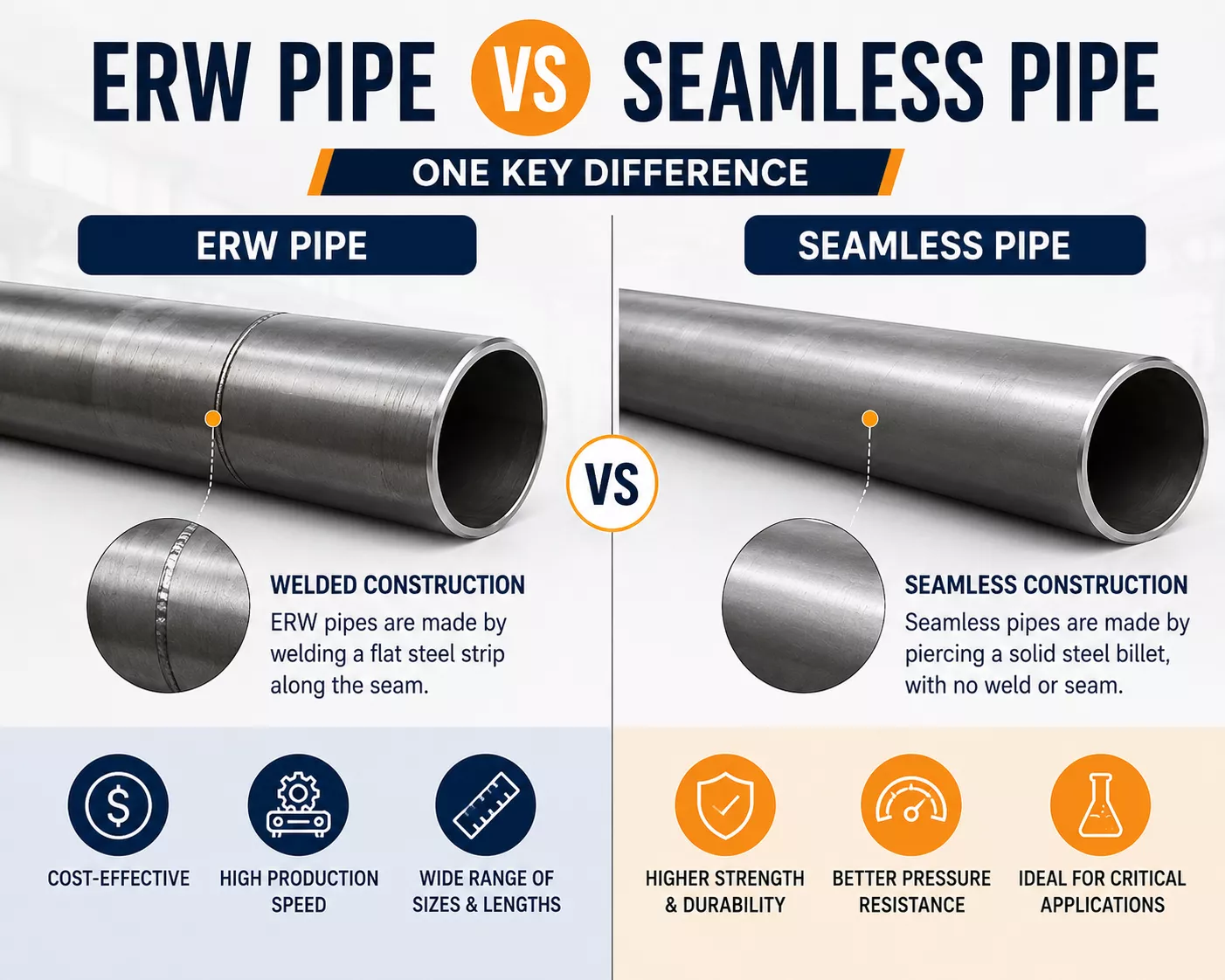
What is ERW Pipe?
ERW Pipe stands for Electric Resistance Welded Pipe. It is one of the most widely used types of steel pipes in industries that require cost-effective, dimensionally accurate, and reliable piping solutions.
ERW pipes are manufactured by rolling a flat steel strip or coil into a cylindrical shape and joining the edges through electrical resistance welding. During the welding process, high-frequency electric current generates heat at the pipe edges, creating a strong bond without the need for filler metal. Modern manufacturing technology ensures a consistent weld seam, excellent surface finish, and precise dimensions.
Due to their economical production process and uniform wall thickness, ERW steel pipes are commonly used in water transportation, structural applications, construction projects, and low to medium-pressure industrial systems.
Common ERW Pipe Materials
- Carbon Steel ERW Pipes
- Stainless Steel ERW Pipes
- Alloy Steel ERW Pipes
- Galvanized ERW Pipes
- MS (Mild Steel) ERW Pipes
Typical Applications of ERW Pipes
- Water distribution pipelines
- Structural and construction projects
- Firefighting and sprinkler systems
- Scaffolding and support structures
- Fencing and handrails
- HVAC and mechanical systems
- Oil and gas transportation (moderate pressure)
- Low and medium-pressure industrial services
What is a Seamless Pipe?
A Seamless Pipe is a steel pipe manufactured without any welded joint or seam. Unlike ERW pipes, seamless pipes are produced from a solid round steel billet, resulting in a continuous and uniform pipe structure throughout its length.
The manufacturing process begins by heating a solid steel billet to high temperatures. The billet is then pierced through the center to create a hollow tube, which is further elongated, rolled, and sized until the required dimensions and wall thickness are achieved.
Since seamless pipes do not contain a weld seam, they offer superior strength, better pressure resistance, and enhanced reliability under extreme operating conditions. For this reason, seamless steel pipes are commonly selected for critical applications involving high pressure, high temperature, corrosive media, and demanding industrial environments.
Common Seamless Pipe Materials
- Stainless Steel Seamless Pipes
- Carbon Steel Seamless Pipes
- Alloy Steel Seamless Pipes
- Duplex & Super Duplex Steel Pipes
- Nickel Alloy Pipes
- Monel Pipes
- Inconel Pipes
- Hastelloy Pipes
- Titanium Pipes
Typical Applications of Seamless Pipes
- Oil and Gas Industry
- Petrochemical Plants
- Power Generation Facilities
- Refineries and Process Plants
- Offshore Platforms
- Heat Exchangers and Condensers
- Boiler Tubes and Pressure Vessels
- Hydraulic and High-Pressure Systems
- Chemical Processing Industries
- High-Temperature Service Applications
Because of their superior mechanical properties and ability to withstand extreme operating conditions, seamless pipes are often the preferred choice for critical industrial applications where safety and performance are paramount.
Get Best PriceHow ERW Pipes Are Manufactured
The manufacturing of ERW (Electric Resistance Welded) pipes involves transforming flat steel coils into high-quality welded pipes through a highly automated and precise production process. This method ensures excellent dimensional accuracy, uniform wall thickness, smooth surface finish, and reliable weld strength.
Manufacturing Process
- Steel Coil Selection: High-quality steel coils are selected according to the required grade and specification.
- Coil Slitting: Steel coils are slit into strips of the required width based on the desired pipe diameter.
- Pipe Forming: The steel strip is gradually rolled into a tubular shape using forming rollers.
- Electric Resistance Welding: The strip edges are heated using high-frequency electrical resistance to create a strong weld.
- Weld Seam Formation: A continuous longitudinal weld seam is formed without the use of filler material.
- Weld Bead Removal: Excess weld material is removed from the pipe surface to improve finish and performance.
- Sizing and Straightening: The welded pipe is sized and straightened to achieve precise dimensions and roundness.
- Testing and Inspection: Pipes undergo hydrostatic, ultrasonic, dimensional, and visual inspections to ensure quality and compliance with industry standards.
ERW Pipe Manufacturing Flow Chart
| Steel Coil Selection | → | Coil Slitting | → | Pipe Forming |
| Electric Resistance Welding | → | Weld Seam Formation | → | Weld Bead Removal |
| Sizing & Straightening | → | Testing & Inspection | → | Finished ERW Pipe |
Modern ERW manufacturing technology produces pipes with excellent dimensional accuracy, smooth internal and external surfaces, and consistent mechanical properties, making them ideal for construction, water transmission, structural, and industrial applications.
How Seamless Pipes Are Manufactured
The manufacturing of seamless pipes involves producing a pipe from a solid steel billet without any welding or joining process. This results in a continuous pipe structure with uniform strength throughout its length, making seamless pipes ideal for high-pressure, high-temperature, and critical industrial applications.
Manufacturing Process
- Solid Steel Billet Selection: High-quality carbon steel, stainless steel, alloy steel, or nickel alloy billets are selected according to the required specifications.
- Billet Heating: The solid billet is heated to a high temperature in a furnace to make it suitable for hot working and deformation.
- Rotary Piercing Process: The heated billet passes through a rotary piercing mill where a mandrel creates a hole through the center of the billet.
- Hollow Shell Formation: The piercing operation transforms the solid billet into a hollow tubular shell.
- Elongation and Rolling: The hollow shell is elongated and rolled through multiple rolling mills to achieve the required diameter and wall thickness.
- Sizing and Calibration: The pipe is accurately sized and calibrated to meet dimensional tolerances and product specifications.
- Heat Treatment: Various heat treatment processes such as annealing, normalizing, or quenching and tempering are performed to improve mechanical properties.
- Inspection and Testing: Pipes undergo hydrostatic testing, ultrasonic testing, dimensional inspection, visual examination and quality checks before dispatch.
Seamless Pipe Manufacturing Flow Chart
| Steel Billet Selection | → | Billet Heating | → | Rotary Piercing |
| Hollow Shell Formation | → | Elongation & Rolling | → | Sizing & Calibration |
| Heat Treatment | → | Inspection & Testing | → | Finished Seamless Pipe |
Because seamless pipes are manufactured without a welded seam, they offer superior pressure resistance, excellent mechanical strength, and enhanced reliability in demanding applications such as oil & gas, petrochemical plants, refineries, power generation facilities, boilers, and heat exchangers.
ERW Pipe vs Seamless Pipe: Quick Comparison
ERW (Electric Resistance Welded) pipes and seamless pipes are both widely used in industrial piping systems. The choice depends on factors such as operating pressure, temperature, application, budget, and project specifications. The comparison table below highlights the key differences between ERW and seamless pipes.
| Comparison Factor | ERW Pipe | Seamless Pipe |
|---|---|---|
| Manufacturing Process | Manufactured by forming steel strip or coil and joining the edges using electric resistance welding. | Manufactured from a solid steel billet by piercing and hot rolling without a welded seam. |
| Weld Seam | Present | None |
| Pressure Rating | Suitable for low to high-pressure applications depending on the grade and standard. | Preferred for high-pressure and severe service applications. |
| Temperature Resistance | Suitable for most industrial operating temperatures. | Better suited for extreme temperatures and demanding operating conditions. |
| Mechanical Strength | Excellent strength for general industrial, structural, and process piping. | High strength with no weld seam, making it ideal for critical services. |
| Dimensional Accuracy | Excellent consistency in wall thickness and outside diameter. | Good dimensional accuracy with slight variations depending on the manufacturing process. |
| Surface Finish | Smooth and uniform finish. | May require additional finishing depending on the manufacturing method. |
| Available Sizes | Available in a wide range of diameters, including large sizes. | Generally available in smaller to medium diameters, with large sizes being more expensive. |
| Cost | More economical due to an efficient manufacturing process. | Higher manufacturing cost compared to ERW pipes. |
| Availability | Readily available in most grades, sizes, and schedules. | Availability depends on size, grade, and manufacturing capacity. |
| Typical Applications | Water supply, structural applications, oil & gas transmission, fire fighting, HVAC, and general process piping. | Refineries, petrochemical plants, power generation, boilers, heat exchangers, high-pressure pipelines, and critical process industries. |
| Best Choice | Ideal for cost-effective projects with standard pressure requirements. | Best suited for high-pressure, high-temperature, and safety-critical applications. |
Summary: ERW pipes are generally preferred for cost-sensitive projects requiring excellent dimensional accuracy and large-volume production, while seamless pipes are the preferred choice for high-pressure, high-temperature, and safety-critical applications where maximum reliability is required.
ERW Pipe vs Seamless Pipe Strength Comparison
One of the most frequently asked questions when comparing steel pipes is: Which is stronger, ERW Pipe or Seamless Pipe?
In general, seamless pipes offer higher strength because they are manufactured without a welded seam. The absence of a weld eliminates a potential weak point, making seamless pipes more suitable for demanding applications involving high pressure, high temperature, and cyclic loading.
However, modern ERW manufacturing technology has significantly improved weld quality, making ERW pipes highly reliable for a wide range of industrial and structural applications.
Why Seamless Pipes Are Stronger
- No welded seam throughout the pipe length.
- Uniform mechanical properties.
- Better performance under extreme pressure.
- Improved reliability in critical applications.
Winner: Seamless Pipe ✓
Recommended For:
- High-pressure service
- Critical process lines
- Offshore applications
- Boiler systems
Pressure Handling Capability
Pressure rating is one of the most important factors when selecting between ERW and seamless pipes.
ERW Pipes
Suitable For:
- Water distribution systems
- Low-pressure steam lines
- Structural applications
- General process piping
Seamless Pipes
Suitable For:
- High-pressure systems
- Hydraulic systems
- Refineries
- Petrochemical plants
Winner: Seamless Pipe ✓
Corrosion Resistance Comparison
Corrosion resistance depends primarily on the material grade rather than the manufacturing process.
For example:
- SS 304 ERW Pipe
- SS 304 Seamless Pipe
Both generally provide similar corrosion resistance under normal operating conditions.
However, in highly corrosive environments, seamless pipes eliminate potential concerns associated with weld seam corrosion and are often preferred for critical applications.
Advantages
ERW Pipe Advantages
- Smooth surface finish
- Uniform appearance
- Better dimensional consistency
Seamless Pipe Advantages
- No weld seam
- Superior structural integrity
- Uniform internal structure
Dimensional Accuracy
ERW pipes are manufactured from steel coils using highly precise forming and sizing equipment. As a result, they generally provide tighter dimensional tolerances than seamless pipes.
Benefits of ERW Pipes
- Better OD tolerance
- Better wall thickness control
- More consistent dimensions
Winner: ERW Pipe ✓
Cost Comparison
Cost is often the deciding factor for procurement teams and project managers.
ERW Pipes
- Lower production cost
- Faster manufacturing process
- Lower raw material waste
Seamless Pipes
- More complex manufacturing
- Higher energy consumption
- Higher production cost
Typical Price Difference
| Pipe Type | Relative Cost |
|---|---|
| ERW Pipe | 100% |
| Seamless Pipe | 120% – 180% |
Winner: ERW Pipe ✓
Talk to Our ExpertsIndustrial Applications
Industrial Applications of ERW Pipes
- Water Supply Systems
- Irrigation Projects
- Structural Fabrication
- Building Construction
- Fire Protection Systems
- Mechanical Applications
- HVAC Systems
Industrial Applications of Seamless Pipes
- Oil & Gas Industry
- Offshore Platforms
- Refineries
- Petrochemical Plants
- Nuclear Facilities
- High-Pressure Boilers
- Heat Exchangers
Advantages of ERW Pipes
- Cost-effective
- Excellent dimensional accuracy
- Smooth surface finish
- Readily available
- Suitable for large-diameter applications
- Lower lead times
Advantages of Seamless Pipes
- No weld seam
- Higher pressure resistance
- Better mechanical strength
- Superior performance at high temperatures
- Preferred for critical industrial services
- Longer service life in demanding conditions
How to Choose Between ERW and Seamless Pipes
Choose ERW Pipes If:
- Budget is a priority.
- Pressure requirements are moderate.
- Structural applications are involved.
- Large quantities are required.
Choose Seamless Pipes If:
- High pressure is involved.
- High-temperature service exists.
- Critical industrial applications are present.
- Safety and reliability are top priorities.
ERW vs Seamless Pipe: Final Verdict
Both ERW and seamless pipes play important roles across modern industries. ERW pipes provide a cost-effective solution for structural and medium-pressure applications, while seamless pipes offer superior strength and reliability for critical operating conditions.
For high-pressure oil & gas, petrochemical, refinery, boiler, and power generation systems, seamless pipes remain the preferred choice. For water transmission, construction, fabrication, and general industrial applications, ERW pipes provide excellent performance at a lower cost.
Get Technical SupportFrequently Asked Questions
No. Seamless pipes are generally stronger because they do not contain a welded seam. Their uniform structure provides better mechanical strength and reliability under high-pressure and high-temperature conditions.
Seamless pipes are preferred for high-pressure applications because they offer superior pressure resistance and structural integrity compared to welded pipes.
Seamless pipes require a more complex manufacturing process involving billet piercing, elongation, rolling, sizing, and heat treatment. This increases production costs compared to ERW pipes.
Yes. Modern ERW pipes are widely used in oil and gas transportation, gathering systems, and process piping applications, provided they meet project specifications and pressure requirements.
ERW pipes are often preferred for construction projects because they offer excellent dimensional accuracy, smooth surface finish, wide availability, and lower cost.
ERW pipes are manufactured by welding steel strips into a tubular shape, whereas seamless pipes are produced from solid steel billets without any welded seam.
ERW pipes generally provide better dimensional accuracy, tighter tolerances, and more consistent wall thickness due to their automated manufacturing process.
Corrosion resistance mainly depends on the material grade rather than the manufacturing method. Stainless Steel 304, 316, Duplex, and Nickel Alloy pipes offer excellent corrosion resistance in both ERW and seamless forms.
ERW pipes are commonly used in water supply, construction, structural fabrication, HVAC systems, and general industrial piping. Seamless pipes are preferred in oil & gas, refineries, petrochemical plants, power generation, boilers, and offshore applications.
When properly selected, installed, and maintained, both ERW and seamless pipes can provide decades of reliable service. The actual lifespan depends on material grade, operating conditions, pressure, temperature, and environmental factors.
Looking for High-Quality ERW and Seamless Pipes?
Kamal Steels is a leading manufacturer, supplier, and exporter of ERW Pipes, Seamless Pipes, Stainless Steel Pipes, Duplex Steel Pipes, and Nickel Alloy Pipes. Contact our team today for pricing, stock availability, and expert technical support.