
-
-
-
Girgaon, Mumbai - 400004
ERW Pipe Weight Chart
An ERW Pipe Weight Chart shows the approximate or nominal weight of Electric Resistance Welded steel pipes according to pipe size, outside diameter, wall thickness and pipe class. Pipe weight is generally expressed in kg per metre (kg/m) and is useful for material estimation, purchasing, transportation, fabrication and project costing.
For MS ERW pipes, weight mainly depends on the outside diameter, wall thickness and steel density. For pipes manufactured to IS 1239, the applicable class and dimensional requirements should also be checked. This guide covers MS ERW pipe weight, ERW pipe weight per metre, B Class and C Class pipe weight, IS 1239 weight charts, calculation formulas and related GI and stainless steel ERW pipe references.
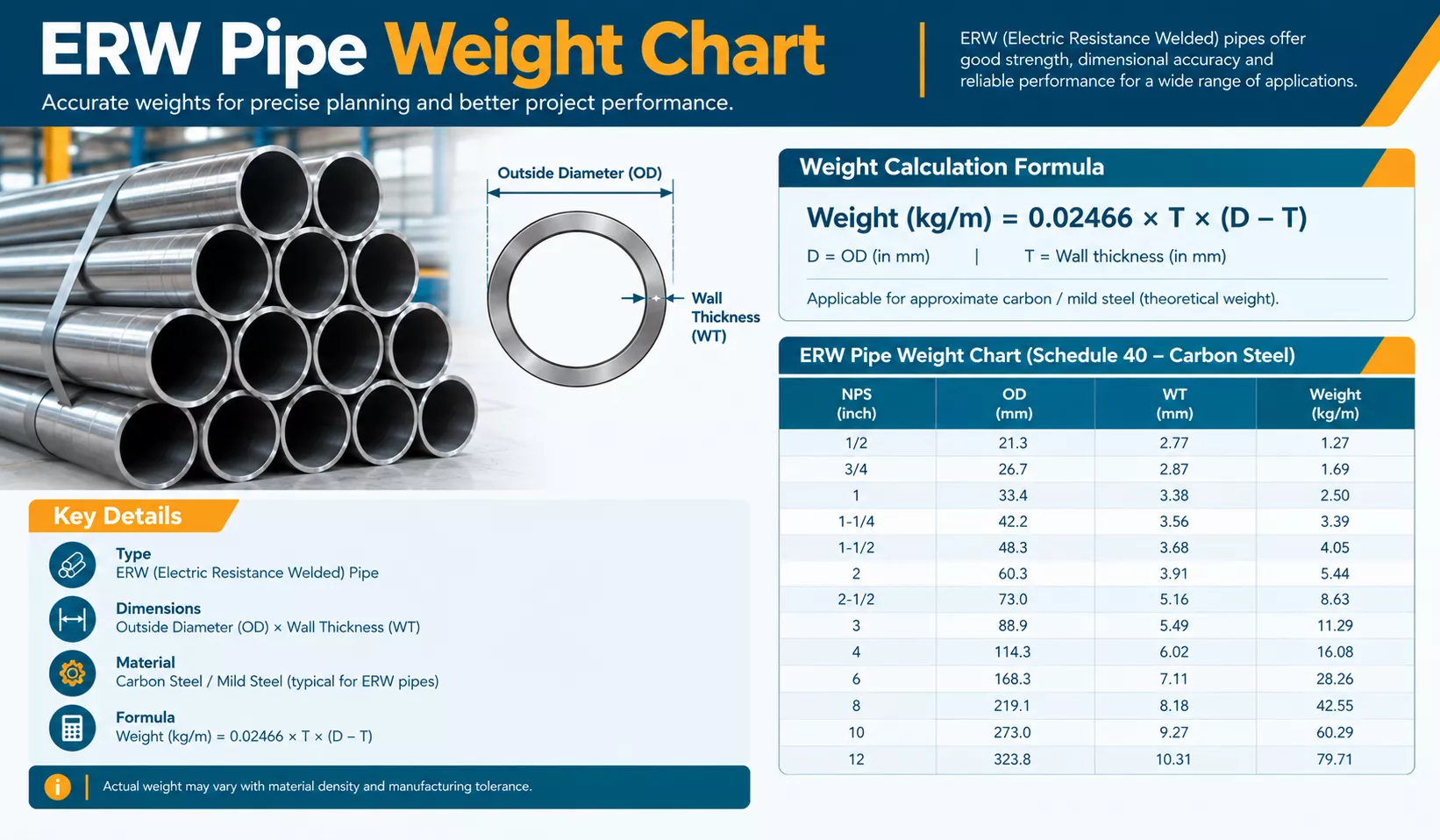
What Is the Weight of an ERW Pipe?
The weight of an ERW pipe depends mainly on its outside diameter, wall thickness and material density. A larger pipe or a pipe with a thicker wall normally has a higher weight per metre.
For MS ERW pipes, weight can be calculated from the outside diameter and wall thickness. For pipes manufactured to a specific standard such as IS 1239, the applicable dimensions and nominal mass should be used.
Pipe weight is normally expressed as kg/m. To calculate the total weight of a required quantity, multiply the weight per metre by the total pipe length.
ERW Pipe Weight Chart in KG
The following chart provides representative theoretical weights for MS ERW pipe dimensions. These values are calculated using nominal dimensions and a steel density of approximately 7.85 g/cm³. For standard-specific procurement, always verify the applicable dimensional table.
| Outside Diameter | Wall Thickness | Approx. Weight kg/m |
|---|---|---|
| 20 mm | 1.5 mm | 0.684 |
| 25 mm | 1.5 mm | 0.887 |
| 32 mm | 1.5 mm | 1.146 |
| 40 mm | 1.5 mm | 1.453 |
| 50 mm | 1.5 mm | 1.814 |
| 50 mm | 2.0 mm | 2.368 |
| 65 mm | 2.0 mm | 3.059 |
| 80 mm | 2.0 mm | 3.849 |
| 100 mm | 2.0 mm | 4.834 |
| 100 mm | 2.5 mm | 6.008 |
| 100 mm | 3.0 mm | 7.069 |
| 125 mm | 2.5 mm | 7.568 |
| 150 mm | 2.5 mm | 9.062 |
| 150 mm | 3.0 mm | 10.835 |
| 200 mm | 3.0 mm | 14.602 |
| 200 mm | 4.0 mm | 19.346 |
| 250 mm | 4.0 mm | 24.077 |
| 300 mm | 4.0 mm | 28.809 |
Note: The values above are theoretical calculations based on nominal dimensions. They are not a substitute for a standard-specific nominal mass table or manufacturer's certified dimensional data.
MS ERW Pipe Weight Chart
An MS ERW pipe weight chart provides the approximate weight of mild steel Electric Resistance Welded pipes according to their dimensions.
The two most important dimensional factors are outside diameter and wall thickness. Increasing either dimension generally increases the amount of steel in each metre of pipe.
| Outside Diameter | Wall Thickness | Approx. Weight kg/m |
|---|---|---|
| 50 mm | 2.0 mm | 2.368 |
| 50 mm | 3.0 mm | 3.478 |
| 75 mm | 2.5 mm | 4.480 |
| 80 mm | 3.0 mm | 5.732 |
| 100 mm | 2.0 mm | 4.834 |
| 100 mm | 3.0 mm | 7.069 |
| 100 mm | 4.0 mm | 9.279 |
| 150 mm | 2.5 mm | 9.062 |
| 150 mm | 3.0 mm | 10.835 |
| 200 mm | 3.0 mm | 14.602 |
| 200 mm | 4.0 mm | 19.346 |
MS ERW Pipe Size and Weight Chart
Pipe size alone does not determine the exact weight of an MS ERW pipe. The outside diameter and wall thickness must also be known.
| Parameter | Importance for Weight |
|---|---|
| Nominal Size | Identifies the pipe size |
| Outside Diameter | Used in the weight calculation |
| Wall Thickness | Directly affects kg/m |
| Material | Determines density |
| Pipe Class | Defines applicable dimensional requirements |
| Length | Determines total pipe weight |
| Standard | Defines applicable dimensional and mass requirements |
ERW Pipe Weight Per Meter
ERW pipe weight per metre is the mass of one metre of pipe and is normally expressed in kg/m.
For example, if an MS ERW pipe weighs 8 kg/m and the required length is 60 metres:
Total weight = 8 × 60 = 480 kg
For multiple pipes, multiply the weight per metre by the length of each pipe and then by the quantity.
Total weight = Weight per metre × Pipe length × Quantity
How to Calculate ERW Pipe Weight
The theoretical weight of an ERW pipe can be calculated from the cross-sectional area of the steel wall and the density of the material.
Step 1: Identify the Outside Diameter
Outside diameter, or OD, is the external diameter of the pipe.
Step 2: Identify the Wall Thickness
Wall thickness is the thickness of the pipe wall.
Step 3: Calculate the Inside Diameter
ID = OD − (2 × Wall Thickness)
Step 4: Calculate the Cross-Sectional Area
Area = π/4 × (OD² − ID²)
Step 5: Apply Material Density
The cross-sectional area is multiplied by the appropriate material density to calculate theoretical mass per unit length.
ERW Pipe Weight Formula
The general theoretical formula for calculating pipe weight is:
Weight per metre = π/4 × (OD² − ID²) × Density
For a quick MS steel pipe calculation using dimensions in millimetres, the commonly used formula is:
Weight kg/m ≈ 0.02466 × T × (D − T)
Where:
- D = Outside diameter in mm
- T = Wall thickness in mm
- 0.02466 = Approximate constant based on steel density
ERW Pipe Weight Calculation Example
Consider an MS ERW pipe with an outside diameter of 100 mm and wall thickness of 3 mm.
Using the quick formula:
Weight = 0.02466 × 3 × (100 − 3)
Weight ≈ 7.18 kg/m
Therefore, for a 6-metre length:
7.18 × 6 = 43.08 kg
For 100 pipes:
43.08 × 100 = 4,308 kg
This gives an estimated total theoretical weight of approximately 4.31 tonnes.
Actual supplied weight can differ because manufactured dimensions and mass are subject to applicable tolerances.
ERW C Class Pipe Weight Chart
In the IS 1239 classification commonly used for steel tubes, C Class corresponds to Heavy. The C Class pipe has a greater specified wall thickness than the corresponding lighter classes for many sizes and therefore generally has a higher kg/m.
The exact weight should be taken from the applicable dimensional table rather than assigning one generic weight to every C Class pipe.
MS ERW Pipe C Class Weight
MS ERW pipe C Class weight depends on the nominal bore, outside diameter and heavy-class wall thickness. The following reference values are based on the commonly published IS 1239 Part 1:2004 dimensional table.
| Nominal Bore | Outside Diameter | C Class Thickness | Approx. Weight kg/m |
|---|---|---|---|
| 3 mm / 1/8" | 10.32 mm | 2.65 mm | 0.493 |
| 6 mm / 1/4" | 13.49 mm | 2.90 mm | 0.769 |
| 10 mm / 3/8" | 17.10 mm | 2.90 mm | 1.02 |
| 15 mm / 1/2" | 21.43 mm | 3.25 mm | 1.45 |
| 20 mm / 3/4" | 27.20 mm | 3.25 mm | 1.90 |
| 25 mm / 1" | 33.80 mm | 4.05 mm | 2.97 |
| 32 mm / 1 1/4" | 42.90 mm | 4.05 mm | 3.84 |
| 40 mm / 1 1/2" | 48.40 mm | 4.05 mm | 4.43 |
| 50 mm / 2" | 60.30 mm | 4.47 mm | 6.17 |
| 65 mm / 2 1/2" | 76.20 mm | 4.47 mm | 7.90 |
| 80 mm / 3" | 88.90 mm | 4.85 mm | 10.10 |
| 100 mm / 4" | 114.30 mm | 5.40 mm | 14.40 |
| 125 mm / 5" | 139.70 mm | 5.40 mm | 17.80 |
| 150 mm / 6" | 165.10 mm | 5.40 mm | 21.20 |
These values should be treated as a standard-reference chart and checked against the applicable edition and purchase specification before commercial use.
ERW B Class Pipe Weight Chart
In IS 1239 terminology, B Class corresponds to Medium. B Class pipe weight is determined by the nominal bore, outside diameter and specified medium-class wall thickness.
The following reference chart covers commonly used sizes:
| Nominal Bore | Outside Diameter | B Class Thickness | Approx. Weight kg/m |
|---|---|---|---|
| 3 mm / 1/8" | 10.32 mm | 2.00 mm | 0.407 |
| 6 mm / 1/4" | 13.49 mm | 2.35 mm | 0.517 |
| 10 mm / 3/8" | 17.10 mm | 2.35 mm | 0.852 |
| 15 mm / 1/2" | 21.43 mm | 2.65 mm | 1.122 |
| 20 mm / 3/4" | 27.20 mm | 2.65 mm | 1.580 |
| 25 mm / 1" | 33.80 mm | 3.25 mm | 2.440 |
| 32 mm / 1 1/4" | 42.90 mm | 3.25 mm | 3.140 |
| 40 mm / 1 1/2" | 48.40 mm | 3.25 mm | 3.610 |
| 50 mm / 2" | 60.30 mm | 3.65 mm | 5.100 |
| 65 mm / 2 1/2" | 76.20 mm | 3.65 mm | 6.610 |
| 80 mm / 3" | 88.90 mm | 4.05 mm | 8.470 |
| 100 mm / 4" | 114.30 mm | 4.50 mm | 12.10 |
| 125 mm / 5" | 139.70 mm | 4.85 mm | 16.20 |
| 150 mm / 6" | 165.10 mm | 4.85 mm | 19.20 |
IS 1239 ERW Pipe Weight Chart
IS 1239 Part 1 covers steel tubes, including requirements for dimensions and nominal mass. The standard tables distinguish tube classes and provide dimensional information such as outside diameter, wall thickness and mass. BIS currently lists IS 1239 Part 1:2004 as the specification for steel tubes in its testing records.
For ERW pipe purchasing, the relevant class, size, dimensions and end condition should be confirmed rather than using a generic online weight chart.
IS 1239 B Class Pipe Weight Chart
The IS 1239 B Class, or Medium, reference is useful for estimating the nominal mass of MS ERW steel tubes. The following values correspond to the commonly published Part 1:2004 dimensional table.
| NB | OD | Thickness | Weight kg/m |
|---|---|---|---|
| 3 mm | 10.32 mm | 2.00 mm | 0.407 |
| 6 mm | 13.49 mm | 2.35 mm | 0.517 |
| 10 mm | 17.10 mm | 2.35 mm | 0.852 |
| 15 mm | 21.43 mm | 2.65 mm | 1.122 |
| 20 mm | 27.20 mm | 2.65 mm | 1.580 |
| 25 mm | 33.80 mm | 3.25 mm | 2.440 |
| 32 mm | 42.90 mm | 3.25 mm | 3.140 |
| 40 mm | 48.40 mm | 3.25 mm | 3.610 |
| 50 mm | 60.30 mm | 3.65 mm | 5.100 |
| 65 mm | 76.20 mm | 3.65 mm | 6.610 |
| 80 mm | 88.90 mm | 4.05 mm | 8.470 |
| 100 mm | 114.30 mm | 4.50 mm | 12.10 |
| 125 mm | 139.70 mm | 4.85 mm | 16.20 |
| 150 mm | 165.10 mm | 4.85 mm | 19.20 |
IS 1239 C Class Pipe Weight Chart
IS 1239 C Class, or Heavy, pipe has the heavier wall thickness specified for the corresponding sizes. This produces a higher nominal mass per metre than the corresponding B Class dimensions for the same nominal bore.
| NB | OD | Thickness | Weight kg/m |
|---|---|---|---|
| 3 mm | 10.32 mm | 2.65 mm | 0.493 |
| 6 mm | 13.49 mm | 2.90 mm | 0.769 |
| 10 mm | 17.10 mm | 2.90 mm | 1.02 |
| 15 mm | 21.43 mm | 3.25 mm | 1.45 |
| 20 mm | 27.20 mm | 3.25 mm | 1.90 |
| 25 mm | 33.80 mm | 4.05 mm | 2.97 |
| 32 mm | 42.90 mm | 4.05 mm | 3.84 |
| 40 mm | 48.40 mm | 4.05 mm | 4.43 |
| 50 mm | 60.30 mm | 4.47 mm | 6.17 |
| 65 mm | 76.20 mm | 4.47 mm | 7.90 |
| 80 mm | 88.90 mm | 4.85 mm | 10.10 |
| 100 mm | 114.30 mm | 5.40 mm | 14.40 |
| 125 mm | 139.70 mm | 5.40 mm | 17.80 |
| 150 mm | 165.10 mm | 5.40 mm | 21.20 |
Factors Affecting ERW Pipe Weight
1. Outside Diameter
A larger outside diameter generally increases the cross-sectional area of the pipe wall and therefore increases weight per metre.
2. Wall Thickness
Wall thickness is one of the most important factors. A thicker wall contains more steel and therefore has a higher kg/m.
3. Material
MS, GI, SS 304 and SS 316 have different material densities, so identical dimensions can have different theoretical weights.
4. Pipe Class
For IS 1239 pipes, Light, Medium and Heavy classifications have different dimensional requirements, which affect nominal mass.
5. Pipe Length
Pipe length does not change kg/m, but it directly affects the total weight of an individual pipe or complete order.
6. Manufacturing Tolerance
Actual manufactured dimensions can vary within the tolerances permitted by the applicable specification.
7. Galvanizing
In GI ERW pipe, the zinc coating contributes to the finished product mass.
Jindal ERW Pipe Weight Chart
The term Jindal ERW pipe weight chart generally refers to manufacturer-specific dimensions and published pipe weights.
When comparing manufacturer data, always compare the same nominal size, outside diameter, wall thickness, material, class and standard. The manufacturer's name does not itself determine theoretical pipe weight.
GI ERW Pipe Weight Chart
A GI ERW pipe weight chart is used for galvanized steel pipes. The underlying steel tube dimensions determine most of the weight, while the zinc coating adds additional mass to the finished product.
For commercial procurement, use the manufacturer's published weight and the applicable galvanized pipe specification rather than assuming that a bare MS calculation is the final finished weight.
SS 304 ERW Pipe Weight Chart
An SS 304 ERW pipe weight chart follows the same basic dimensional principle as an MS ERW pipe chart, but the density of stainless steel is different.
SS 304 pipe weight depends on outside diameter, wall thickness, grade, length and manufacturing tolerances. Therefore, an MS weight constant should not simply be copied into an SS 304 calculation.
SS 316 ERW Pipe Weight Chart
SS 316 ERW pipe weight is also determined primarily by dimensions and material density.
When calculating SS 316 pipe weight, confirm the grade, outside diameter, wall thickness, length and applicable product specification before using the value for purchasing or costing.
Welded MS Square Pipe Weight Chart
A round ERW pipe and a square welded tube have different cross-sectional shapes. Therefore, a round ERW pipe weight chart should not be used directly for square or rectangular tubes.
A welded MS square pipe weight chart should consider:
- Outside width
- Outside height
- Wall thickness
- Material density
- Pipe length
ERW Pipe Weight Chart PDF
An ERW pipe weight chart PDF can be useful for engineers, buyers, fabricators and project estimators who need an offline reference.
A useful PDF should clearly identify:
- Nominal pipe size
- Outside diameter
- Wall thickness
- Pipe class
- Weight in kg/m
- Material
- Applicable standard
- Whether the values are theoretical or nominal
Theoretical vs Actual ERW Pipe Weight
A pipe weight chart may show theoretical or nominal mass rather than the exact weight of every manufactured pipe.
| Weight Type | Meaning |
|---|---|
| Theoretical Weight | Calculated from nominal dimensions and material density |
| Nominal Mass | Mass specified in the applicable standard |
| Actual Weight | Mass of the manufactured pipe |
For estimation and costing, theoretical or nominal values are useful. For final commercial quantities, actual manufactured dimensions, tolerances and product documentation should be considered.
ERW Pipe Weight Chart Quick Reference
| Search Requirement | What to Check |
|---|---|
| ERW pipe weight chart | OD + wall thickness + material |
| ERW pipe weight in kg | kg/m or total length |
| ERW pipe weight per metre | kg/m |
| MS ERW pipe weight chart | MS + OD + wall thickness |
| MS ERW pipe size and weight chart | Size + OD + thickness + kg/m |
| MS ERW pipe C Class weight | IS 1239 Heavy/C Class dimensions |
| ERW B Class pipe weight chart | IS 1239 Medium/B Class dimensions |
| ERW C Class pipe weight chart | IS 1239 Heavy/C Class dimensions |
| IS 1239 ERW pipe weight chart | NB + OD + class + nominal mass |
| Jindal ERW pipe weight chart | Manufacturer + exact dimensions |
| GI ERW pipe weight chart | Steel tube + zinc coating |
| SS 304 ERW pipe weight chart | SS 304 + dimensions + density |
| SS 316 ERW pipe weight chart | SS 316 + dimensions + density |
| Welded MS square pipe weight chart | Width + height + thickness |
ERW Pipe Weight Chart FAQs
An ERW pipe weight chart shows the approximate weight of electric resistance welded pipes according to pipe size, outside diameter, wall thickness and weight per metre. For MS ERW pipes, the weight varies with the pipe dimensions, class and applicable specification.
The weight of an MS ERW pipe per metre depends mainly on its outside diameter and wall thickness. A larger diameter or thicker wall generally results in a higher kg/m value. The exact weight should be checked against the required pipe size and specification.
ERW pipe weight can be estimated from the outside diameter, wall thickness and material density. For a steel pipe, the theoretical weight per metre is commonly calculated using the difference between the outside and inside cross-sectional areas multiplied by steel density. Actual supplied weight can vary slightly because of manufacturing tolerances.
The MS ERW pipe weight chart in kg lists the approximate weight of mild steel ERW pipes by size and wall thickness. Weight is commonly expressed as kg per metre, allowing buyers to estimate total material weight for a required pipe length.
An ERW C Class pipe weight chart gives the weight of applicable ERW pipes manufactured to the heavy class requirements of the relevant specification. C Class pipes generally have greater wall thickness than lighter classes, so their weight per metre is usually higher for the same nominal size.
B Class and C Class ERW pipes can have different wall thicknesses for the same nominal size. Because pipe weight increases with wall thickness, a C Class pipe generally weighs more per metre than a corresponding B Class pipe. The applicable standard and pipe dimensions should be checked before selecting the weight.
An IS 1239 ERW pipe weight chart provides dimensional and weight information for applicable steel tubes and pipes covered by IS 1239. The weight depends on nominal size, outside diameter, wall thickness and class. Buyers should refer to the applicable edition and table of the standard for specification-based requirements.
The weight of a 1-inch MS ERW pipe depends on its outside diameter, wall thickness and class. Therefore, nominal size alone cannot determine the exact kg/m value. The required specification and thickness should be checked against the ERW pipe weight chart.
A 2-inch MS ERW pipe can have different weights per metre depending on its wall thickness and class. A thicker-wall pipe will generally have a higher kg/m value. The exact weight should be selected from the applicable size and thickness requirements.
Yes. ERW pipe size affects weight because a larger outside diameter generally requires more steel per metre. Wall thickness also has a major effect, so two ERW pipes with the same nominal size can have different weights when their thicknesses are different.
Yes. Wall thickness directly affects ERW pipe weight. For the same outside diameter, increasing the wall thickness increases the amount of steel in the pipe and therefore increases its weight per metre.
MS ERW pipe weight in kg per metre varies according to pipe diameter and wall thickness. The ERW pipe weight chart can be used to compare different sizes and thicknesses and estimate the total weight required for a specific pipe length.
Not necessarily. Pipes manufactured to the same nominal dimensions should have similar theoretical weights, but actual supplied weight can vary within permitted dimensional and manufacturing tolerances. The applicable standard, dimensions and actual material supplied should be considered when calculating project weight.
Yes. Once the pipe weight per metre is known, the approximate total weight can be calculated by multiplying the kg/m value by the total pipe length in metres. For example, a pipe weighing 10 kg/m over 20 metres would have an estimated weight of 200 kg.
MS ERW pipes can be sourced from manufacturers, stockists and suppliers in India. Buyers should provide the required nominal size, outside diameter, wall thickness, class, standard, quantity and length when requesting a quotation. Kamal Steels can assist with MS ERW pipe requirements based on the specified dimensions and application.
Conclusion
An ERW pipe weight chart helps buyers, engineers, fabricators and project planners estimate pipe weight from size and wall thickness. For MS ERW pipe, the most important factors are outside diameter, wall thickness, material density and applicable standard.
For IS 1239 ERW pipes, B Class refers to Medium and C Class refers to Heavy. The correct nominal bore, outside diameter, wall thickness and nominal mass should be checked before using the chart for procurement or commercial calculations.
Kamal Steels supplies and stocks stainless steel, duplex and special alloy pipes and tubes. For MS ERW requirements, buyers should provide the required size, wall thickness or class, applicable standard, quantity and length so that the appropriate product and weight can be confirmed.