
-
-
-
Girgaon, Mumbai - 400004
ASTM A312 vs ASTM A213
ASTM A312 vs ASTM A213: Key Differences Explained
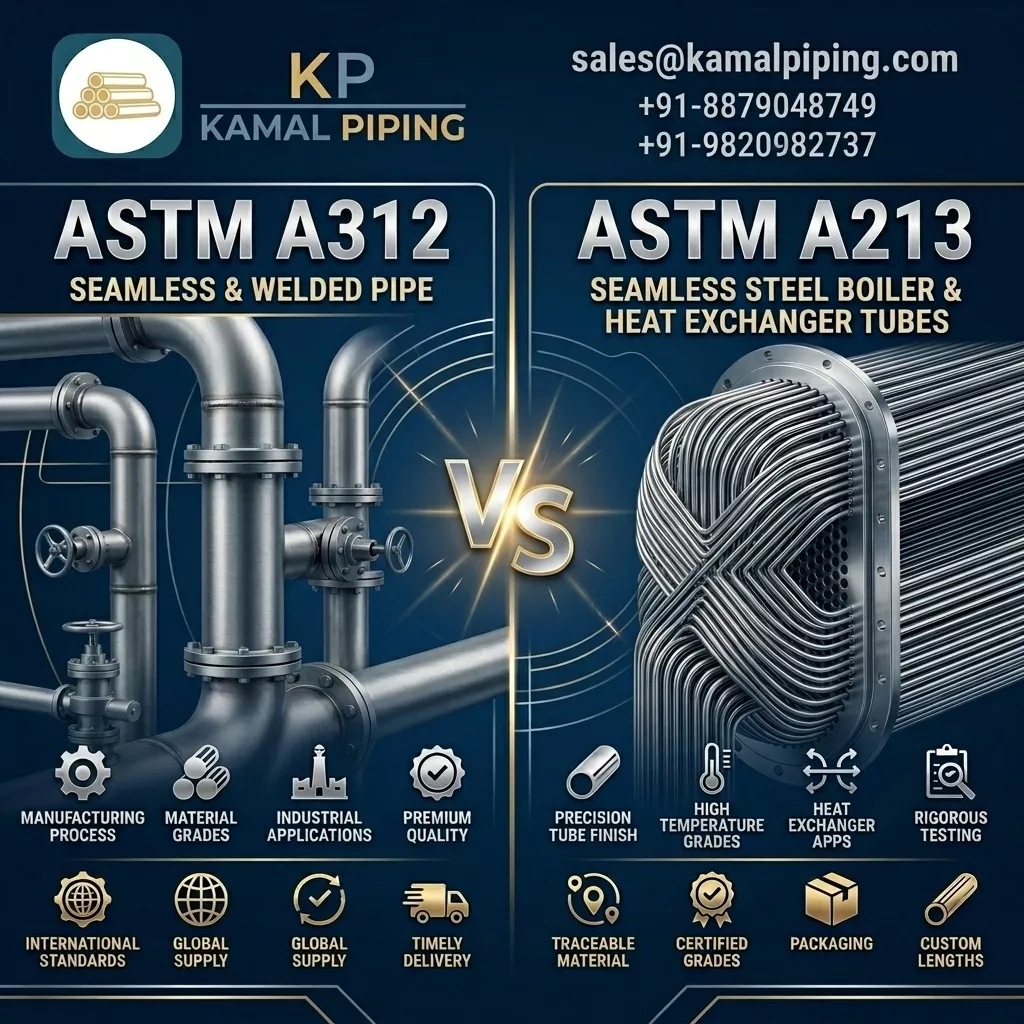
ASTM A312 covers seamless and welded austenitic stainless steel pipes used for general corrosive and high-temperature service, while ASTM A213 covers seamless ferritic and austenitic alloy steel tubes built for boilers, superheaters and heat exchangers. The main difference is application: A312 is for piping that transports fluids, while A213 is for tubing that transfers heat.
If you work in oil and gas, power generation, or chemical processing, you've probably seen both ASTM A312 and ASTM A213 listed on material specifications. They look similar at first glance both cover stainless steel, both include grades like TP304 and TP316 and both appear in heavy industrial projects. But choosing the wrong one can cost you time, money and performance.
This guide breaks down the real differences between ASTM A312 and ASTM A213. You'll learn what each standard covers, where each is used, how they're made and tested and how to pick the right one for your project. We'll also answer the most common questions buyers ask before placing an order.
At Kamal Steels, we supply both ASTM A312 stainless steel pipes and ASTM A213 stainless steel tubes to clients across India and overseas. Here's everything you need to know before you buy.
What is ASTM A312?
ASTM A312 Pipe is the standard specification for seamless, welded and heavily cold-worked austenitic stainless steel pipes. These pipes are designed for high-temperature and general corrosive service. The equivalent ASME designation is SA312.
The standard is built around piping that carries fluids and gases. Because of this, ASTM A312 pipes come in larger diameters and are measured by Nominal Pipe Size (NPS) and schedule.
Common ASTM A312 Grades
- TP304 and TP304L
- TP316 and TP316L
- TP321 and TP347
- TP310 and TP317
ASTM A312 pipes can be seamless or welded, which gives buyers flexibility based on pressure needs and budget. Seamless pipes handle higher pressures, while welded pipes are often more cost-effective for large projects.
These pipes are widely used in oil and gas, water treatment, chemical plants and high-temperature process lines. If you need ASTM A312 TP316 seamless pipe or ASTM A312 TP304L welded pipe, the grade and form should match your operating pressure and the corrosiveness of the medium.
What is ASTM A213?
ASTM A213 Tube is the standard specification for seamless ferritic and austenitic alloy steel boiler, superheater and heat-exchanger tubes. The equivalent ASME designation is SA213.
Unlike ASTM A312, this standard focuses on tubes used to transfer heat. ASTM A213 tubes are manufactured in seamless form only. They come in smaller diameters and are measured by outside diameter and wall thickness, which is critical for precise heat transfer applications.
Common ASTM A213 Grades
- TP304 and TP304L
- TP316 and TP316L
- TP321 and TP347
- T11, T22 and T91
The inclusion of ferritic alloy grades such as T11 and T22 sets ASTM A213 apart. These grades are engineered to withstand the extreme temperatures found in power plant boilers and superheaters, where standard stainless steel grades may not provide sufficient performance.
ASTM A213 tubes are commonly used as boiler tubes, superheater tubes and heat exchanger tubes in power plants, refineries, petrochemical facilities and process industries.
What is the Difference Between ASTM A312 and ASTM A213?
The simplest way to understand the difference is this: ASTM A312 is for pipes, and ASTM A213 is for tubes. However, there are several important distinctions related to application, manufacturing process, dimensions and material requirements.
| Feature | ASTM A312 | ASTM A213 |
|---|---|---|
| Product Type | Pipes | Tubes |
| Primary Use | Fluid and Gas Transport | Heat Transfer |
| Manufacturing | Seamless and Welded | Seamless Only |
| Material | Austenitic Stainless Steel | Ferritic and Austenitic Alloy Steel |
| Measurement | Nominal Pipe Size (NPS) & Schedule | Outside Diameter & Wall Thickness |
| Typical Diameter | Larger | Smaller |
| Key Applications | Oil & Gas, Chemical, Water Treatment | Boilers, Superheaters, Heat Exchangers |
Pipes manufactured under ASTM A312 are intended to transport liquids, gases, and process media from one location to another. In contrast, ASTM A213 tubes are engineered primarily for heat transfer applications where precise dimensional control is critical.
ASTM A213 tubes have tighter tolerances on wall thickness and outside diameter because even minor variations can affect thermal efficiency and performance in boilers, condensers and heat exchangers. ASTM A312 pipes prioritize pressure handling, corrosion resistance and reliable fluid flow in industrial piping systems.
Where are ASTM A312 and ASTM A213 Used?
Although ASTM A312 and ASTM A213 are both widely used in industrial applications, each standard is designed for different operating requirements. ASTM A312 pipes are primarily used for fluid transportation, while ASTM A213 tubes are engineered for heat transfer systems. In some industries, both standards may be used within the same facility for different purposes.
Applications of ASTM A312 Pipes
ASTM A312 stainless steel pipes are the preferred choice for transporting liquids, gases, and process media in corrosive and high-temperature environments. Their availability in both seamless and welded forms makes them suitable for a wide range of industrial piping systems.
- Oil and gas pipelines and process lines
- Chemical and petrochemical plants
- Water treatment and desalination systems
- Pulp and paper processing facilities
- High-temperature steam and gas service
Because ASTM A312 covers both seamless and welded pipe construction, it is widely used in applications ranging from high-pressure offshore pipelines to large-scale industrial process piping networks.
Applications of ASTM A213 Tubes
ASTM A213 tubes are specifically designed for heat transfer applications where dimensional accuracy, thermal efficiency, and high-temperature performance are critical. These seamless tubes are commonly used in equipment that operates under extreme temperature and pressure conditions.
- Boiler tubes in thermal power plants
- Superheater and reheater tubes
- Heat exchanger tubes in refineries
- Condenser tubes
- Process tubing in chemical plants
Ferritic alloy grades such as T11, T22, and T91 are extensively used in power generation facilities where elevated temperatures and pressures demand materials with excellent creep strength and thermal stability.
What are the Material Composition and Manufacturing Differences?
Material composition is one of the most important differences between ASTM A312 and ASTM A213. While both standards include austenitic stainless steel grades, ASTM A213 also covers ferritic alloy steels designed for high-temperature service.
Material Composition Differences
ASTM A312 primarily covers austenitic stainless steel pipes. Popular grades such as TP304 and TP316 contain chromium and nickel, which provide excellent corrosion resistance and durability in aggressive environments.
- TP304 and TP304L offer excellent corrosion resistance and general-purpose performance.
- TP316 and TP316L contain molybdenum for improved resistance to chlorides and chemical attack.
- TP321 and TP347 provide enhanced performance at elevated temperatures.
ASTM A213 includes both austenitic stainless steel grades and ferritic alloy steel grades. The ferritic grades are specifically engineered to withstand high temperatures and pressures commonly found in boilers and power generation equipment.
- T11 contains approximately 1.25% chromium and 0.5% molybdenum.
- T22 contains approximately 2.25% chromium and 1% molybdenum.
- T91 offers superior creep strength for advanced high-temperature applications.
Unlike austenitic stainless steels, these ferritic alloy grades prioritize elevated-temperature strength, creep resistance, and long-term reliability rather than maximum corrosion resistance.
Manufacturing Differences
The manufacturing methods specified by ASTM A312 and ASTM A213 also differ significantly due to their intended applications.
| Manufacturing Feature | ASTM A312 | ASTM A213 |
|---|---|---|
| Available Forms | Seamless and Welded | Seamless Only |
| Production Method | Billet Piercing or Strip Welding | Billet Piercing Only |
| Primary Focus | Fluid Transport | Heat Transfer Efficiency |
| Dimensional Accuracy | Standard Pipe Tolerances | Tighter Tube Tolerances |
ASTM A312 seamless pipes are produced by piercing a solid billet, while welded pipes are manufactured by forming and welding stainless steel strip. This flexibility allows buyers to select either higher-strength seamless pipes or more economical welded pipes depending on project requirements.
ASTM A213 tubes are manufactured exclusively in seamless form. Heat-transfer equipment requires uniform wall thickness and consistent mechanical properties throughout the tube. Eliminating weld seams reduces potential weak points and helps ensure reliable performance under high temperature and pressure conditions.
How are ASTM A312 and ASTM A213 Tested?
Both ASTM A312 and ASTM A213 require comprehensive testing to ensure quality, safety, and performance. However, the testing requirements differ because each standard is designed for different operating conditions. ASTM A312 focuses on pressure containment and corrosion resistance, while ASTM A213 emphasizes dimensional accuracy and performance in high-temperature heat-transfer applications.
ASTM A312 Testing Requirements
ASTM A312 stainless steel pipes undergo a series of mechanical, hydrostatic, and corrosion-related tests to verify their suitability for fluid and gas transportation systems.
- Hydrostatic testing for leak resistance and pressure integrity
- Tensile strength and yield strength testing
- Flattening and flaring tests
- Intergranular corrosion testing
- Non-destructive examination (NDE) for welded pipes
These tests help ensure that ASTM A312 pipes can safely withstand internal pressure, corrosive environments, and demanding industrial service conditions.
ASTM A213 Testing Requirements
ASTM A213 tubes are subjected to stringent testing procedures because they operate in boilers, superheaters, condensers, and heat exchangers where high temperatures and thermal cycling are common.
- Hydrostatic testing or non-destructive electric testing
- Tensile and hardness testing
- Flattening, flaring, and reverse-flattening tests
- Grain size measurement and metallurgical evaluation
- Strict wall thickness and dimensional verification
Since ASTM A213 tubes are used for heat transfer, testing places greater emphasis on dimensional consistency, grain structure, and material stability at elevated temperatures.
| Testing Feature | ASTM A312 | ASTM A213 |
|---|---|---|
| Hydrostatic Testing | Required | Required or NDE Alternative |
| Tensile Testing | Required | Required |
| Hardness Testing | Limited | Required for Certain Grades |
| Corrosion Testing | Major Focus | Application Dependent |
| Grain Size Evaluation | Not Typically Required | Required |
| Dimensional Verification | Standard Pipe Tolerances | Strict Tube Tolerances |
Because ASTM A213 tubes experience continuous thermal expansion and contraction, testing focuses heavily on grain structure, wall thickness accuracy, and dimensional consistency. ASTM A312 pipes, on the other hand, place greater emphasis on hydrostatic pressure testing and corrosion resistance to ensure safe fluid transport.
Both standards require Mill Test Certificates (MTCs) that document chemical composition, mechanical properties, inspection results, and compliance with the applicable ASTM specification. Buyers should always request MTCs when purchasing ASTM A312 pipes or ASTM A213 tubes to verify material quality and traceability.
What are the Advantages and Disadvantages of Each Standard?
Understanding the strengths and limitations of ASTM A312 and ASTM A213 helps engineers, procurement teams, and project managers select the most suitable material for their applications. Each standard is optimized for specific operating conditions and offers unique benefits.
ASTM A312 Advantages
- Available in both seamless and welded forms, providing cost flexibility.
- Wide range of stainless steel grades for different corrosive environments.
- Suitable for large-diameter and high-volume piping projects.
- Excellent corrosion resistance in austenitic stainless steel grades.
ASTM A312 Disadvantages
- Welded pipes may not be ideal for the most critical high-pressure applications.
- Limited to austenitic stainless steel grades and does not include ferritic alloy steels.
ASTM A213 Advantages
- Excellent performance under high temperature and pressure conditions.
- Includes ferritic alloy grades specifically designed for boiler service.
- Tight dimensional tolerances improve heat transfer efficiency.
- Seamless construction eliminates weld-related weak points.
ASTM A213 Disadvantages
- Seamless-only manufacturing generally results in higher costs.
- Smaller diameters restrict usage to tubing applications.
- Not intended for general fluid and gas transportation systems.
How do You Choose Between ASTM A312 and ASTM A213?
Selecting the right specification depends entirely on your application, operating conditions, and performance requirements. The following guidelines can help simplify the decision-making process.
- Choose ASTM A312 if you need to transport fluids or gases through piping systems in industries such as oil and gas, petrochemical processing, water treatment, and chemical manufacturing.
- Choose ASTM A213 if your application involves heat transfer equipment such as boilers, superheaters, condensers, or heat exchangers where dimensional precision and thermal performance are critical.
- Consider the material grade carefully. For chloride-rich and marine environments, TP316 and TP316L provide enhanced corrosion resistance. For high-temperature boiler service, ferritic grades such as T11 and T22 are often the preferred choice.
- Evaluate the manufacturing form. If cost optimization is important and operating pressures are moderate, welded ASTM A312 pipes can offer significant savings. For critical heat-transfer applications, seamless ASTM A213 tubes remain the industry standard.
When in doubt, provide your supplier with details such as operating temperature, pressure, fluid type, and environmental conditions. This information helps ensure the correct material specification is selected for long-term performance and reliability.
Buy ASTM A312 Pipes and ASTM A213 Tubes from Kamal Steels
Kamal Steels is a trusted manufacturer, supplier, and exporter of ASTM A312 stainless steel pipes and ASTM A213 stainless steel tubes. We maintain ready stock of popular grades including TP304, TP304L, TP316, TP316L, TP321, and TP347, along with ferritic alloy tube grades such as T11 and T22.
Whether you require ASTM A312 TP316 seamless pipes, ASTM A312 TP316L welded pipes, or ASTM A213 TP304 boiler tubes, we supply certified materials with complete Mill Test Certificates (MTCs) and quality documentation.
As a leading stainless steel pipe manufacturer and exporter in India, based in Mumbai, we serve customers across India and export to the UAE, Saudi Arabia, Qatar, Oman, Kuwait, and other international markets.
Our experienced team can help you select the right grade, specification, size, and manufacturing type based on your project requirements, ensuring reliable performance and cost-effective procurement.
Frequently Asked Questions
ASTM A312 is the standard specification for seamless and welded austenitic stainless steel pipes used in high-temperature and general corrosive service. It covers grades such as TP304, TP316, TP321, and TP347. The ASME equivalent specification is SA312.
ASTM A213 is the standard specification for seamless ferritic and austenitic alloy steel tubes used in boilers, superheaters, and heat exchangers. It includes stainless steel grades like TP304 and TP316, as well as ferritic alloy grades such as T11 and T22. The ASME equivalent specification is SA213.
ASTM A312 covers pipes used for transporting fluids and gases, while ASTM A213 covers tubes designed for heat-transfer applications. ASTM A312 products can be seamless or welded, whereas ASTM A213 tubes are manufactured in seamless form only. ASTM A213 also includes ferritic alloy steel grades for high-temperature service.
ASTM A312 pipes are available in both seamless and welded forms. Seamless pipes are preferred for higher-pressure applications, while welded pipes provide a cost-effective solution for large-scale industrial projects.
ASTM A213 tubes are manufactured exclusively in seamless form. Heat-transfer equipment requires uniform wall thickness and consistent mechanical properties, making seamless construction the preferred option.
ASTM A312 covers austenitic stainless steel grades including TP304, TP304L, TP316, TP316L, TP321, TP347, TP310, and TP317, among others.
ASTM A213 covers austenitic stainless steel grades such as TP304, TP304L, TP316, TP316L, TP321, and TP347, along with ferritic alloy steel grades including T11, T22, and T91.
Kamal Steels is a leading Mumbai-based manufacturer, supplier, and exporter of ASTM A312 stainless steel pipes and ASTM A213 stainless steel tubes. We supply material across India and export to the UAE, Saudi Arabia, Qatar, Oman, Kuwait, and other international markets. Contact us for pricing, availability, and technical assistance.