
-
-
-
Girgaon, Mumbai - 400004
Difference Between Seamless and Welded Steel Pipes
Understanding Difference Between Seamless and Welded Steel Pipes
Steel pipes play a critical role in modern industries, serving as essential components in oil and gas pipelines, petrochemical plants, power generation facilities, construction projects, water treatment systems, and manufacturing operations. Among the various types available, Seamless Steel Pipes and Welded Steel Pipes are the most widely used due to their versatility, durability, and performance.
While both types are designed to transport fluids, gases, and structural loads, they differ significantly in their manufacturing process, mechanical properties, pressure-bearing capabilities, cost and suitability for specific applications. Seamless pipes are produced without a welded joint, offering enhanced strength and reliability for demanding environments, whereas welded pipes are manufactured from steel plates or coils and provide a cost-effective solution with excellent dimensional accuracy.
Choosing between Seamless Steel Pipes and Welded Steel Pipes is not simply a matter of price—it depends on factors such as operating pressure, temperature, corrosion resistance, project specifications and budget requirements. Understanding these differences can help engineers, procurement teams, contractors, and project managers make informed decisions that improve performance, safety, and long-term value.
kamal Steels explore the key differences between seamless and welded steel pipes, their advantages, limitations and the applications where each type performs best.
Get Expert Assistance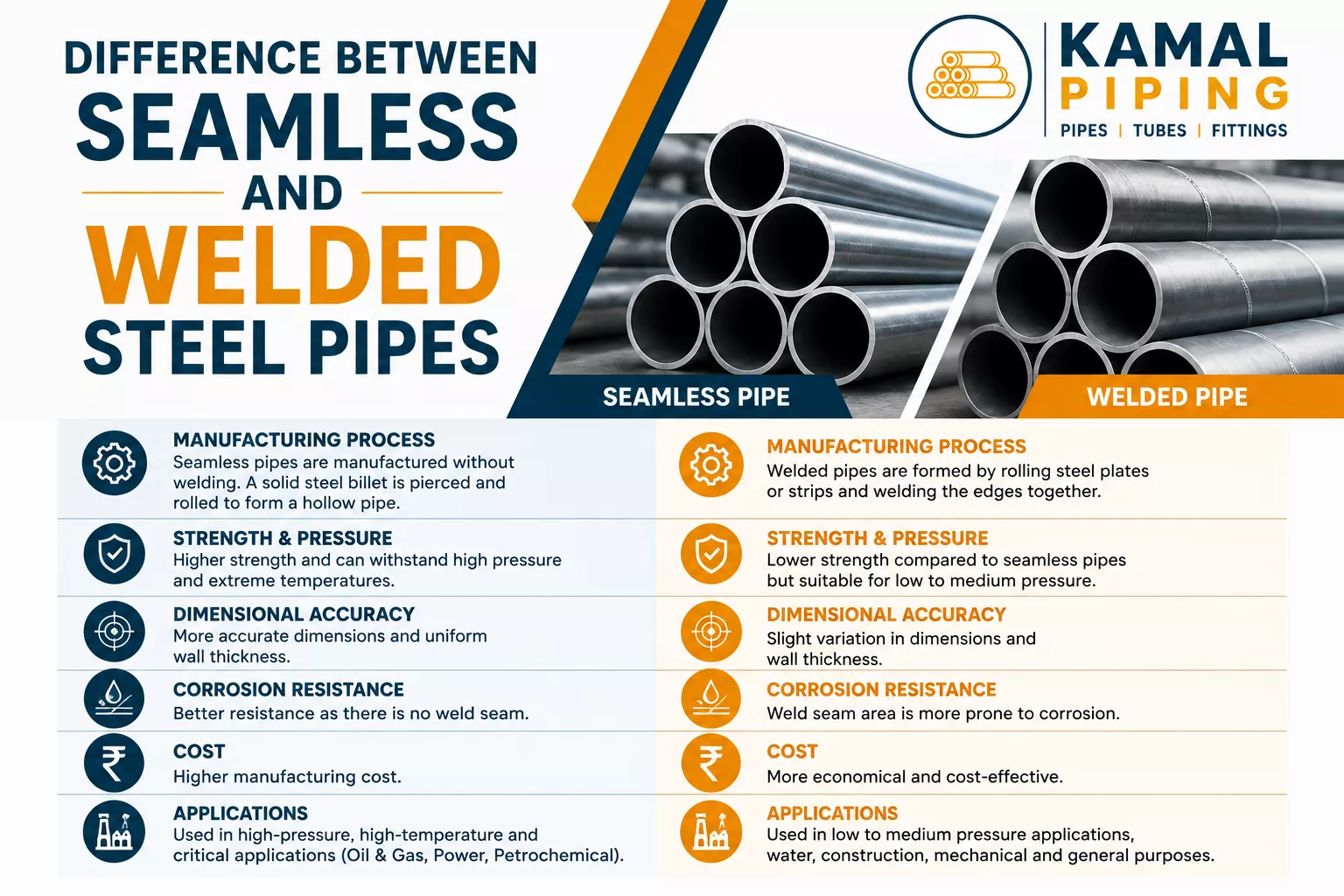
What is a Seamless Steel Pipe?
A Seamless Steel Pipe is manufactured from a solid steel billet through piercing and rolling processes without any welding joint. Because there is no welded seam, seamless pipes provide excellent structural integrity, high pressure resistance and superior reliability in critical applications.
- No welding seam
- Higher pressure handling capability
- Uniform structure throughout the pipe
- Preferred for critical process industries
- Suitable for high temperature applications
What is a Welded Steel Pipe?
A Welded Steel Pipe is manufactured by forming steel plates or coils into a cylindrical shape and joining the edges using welding processes such as ERW, EFW or SAW. Modern welded pipes offer excellent dimensional accuracy and cost-effective performance for many industrial applications.
- Manufactured from steel plate or coil
- Produced with a longitudinal weld seam
- Available in larger diameters
- More economical than seamless pipes
- Suitable for medium to high-pressure services
Seamless Pipe vs Welded Pipe Comparison Chart
| Parameter | Seamless Steel Pipe | Welded Steel Pipe |
|---|---|---|
| Manufacturing Process | Made from solid billet | Made from steel plate or coil |
| Weld Joint | No | Yes |
| Pressure Rating | Higher | Moderate to High |
| Strength | Higher | Good |
| Dimensional Accuracy | Good | Excellent |
| Available Sizes | Limited Large Sizes | Wide Range Including Large Diameter |
| Production Cost | Higher | Lower |
| Delivery Time | Longer | Faster |
| Industrial Applications | Critical Services | General & Industrial Services |
How Seamless and Welded Steel Pipes Are Manufactured
Understanding the manufacturing process is essential when comparing seamless vs welded steel pipes. Both products are widely used across industrial applications, but their production methods significantly impact strength, pressure resistance, cost and application suitability.
How Seamless Steel Pipes Are Manufactured
- Selection of high-quality solid steel billets
- Heating the billet at elevated temperatures
- Rotary piercing to create a hollow shell
- Pipe elongation and rolling process
- Sizing and dimensional calibration
- Heat treatment and surface finishing
- Hydrostatic testing and quality inspection
How Welded Steel Pipes Are Manufactured
- Steel coil or plate preparation
- Roll forming into cylindrical shape
- Edge welding using ERW, EFW or SAW process
- Weld seam heat treatment
- Sizing and straightening
- Surface finishing
- Inspection, testing and certification
Advantages of Seamless Steel Pipes
Seamless steel pipes are manufactured without a welded joint, making them suitable for critical applications requiring high pressure and superior structural integrity.
- No welded seam throughout the pipe body
- Higher pressure handling capability
- Superior mechanical strength
- Excellent fatigue resistance
- Reduced risk of leakage
- Suitable for critical process systems
- Reliable performance in extreme temperatures
- Long service life
- Preferred for oil & gas and boiler applications
- High dimensional accuracy
Advantages of Welded Steel Pipes
Modern welded steel pipes provide excellent performance and are widely used due to their cost-effectiveness and availability in larger diameters.
- Lower manufacturing cost
- Available in large diameters
- Excellent dimensional consistency
- Faster production cycle
- Readily available stock
- Cost-effective for large projects
- Suitable for structural applications
- Ideal for water transmission systems
- Good corrosion resistance
- Easy fabrication and installation
Pressure Handling Comparison
One of the most common questions is: Which pipe is better, seamless or welded? The answer depends on the operating conditions.
Seamless steel pipes generally withstand higher internal pressures because they do not contain a welded joint. Welded steel pipes are highly reliable and suitable for medium to high-pressure applications when manufactured according to ASTM and ASME standards.
Corrosion Resistance Comparison
Both seamless and welded pipes offer excellent corrosion resistance when manufactured using high-quality Stainless Steel Pipes and Welded Pipes. These materials provide excellent resistance to corrosion, oxidation, and aggressive chemicals, making them suitable for applications in the chemical, petrochemical, marine, power generation, and water treatment industries.
- Stainless Steel 304
- Stainless Steel 304L
- Stainless Steel 316
- Stainless Steel 316L
- Duplex Stainless Steel 2205
- Super Duplex Stainless Steel 2507
Modern welding technology ensures welded pipes provide corrosion resistance comparable to seamless pipes for most industrial applications.
Seamless Pipe vs Welded Pipe Cost Comparison
| Factor | Seamless Pipe | Welded Pipe |
|---|---|---|
| Manufacturing Cost | Higher | Lower |
| Availability | Moderate | High |
| Lead Time | Longer | Faster |
| Large Diameter Production | Limited | Excellent |
| Project Cost | Higher | Economical |
| Pressure Capability | Higher | Moderate to High |
Common ASTM Standards for Steel Pipes
Seamless Pipe Standards
- ASTM A106
- ASTM A53
- ASTM A312
- ASTM A335
- ASTM A790
Welded Pipe Standards
- ASTM A312
- ASTM A358
- ASTM A778
- ASTM A928
- ASTM A671
Industries Using Seamless and Welded Steel Pipes
- Oil & Gas Industry
- Petrochemical Plants
- Chemical Processing Facilities
- Power Generation Plants
- Marine & Offshore Projects
- Water Treatment Plants
- Construction Industry
- Pharmaceutical Manufacturing
- Food Processing Industry
- Fertilizer Plants
How to Choose Between Seamless and Welded Pipes?
Choose Seamless Pipes When:
✅ High-pressure applications
✅ High-temperature service
✅ Critical process lines
✅ Boiler systems
✅ Offshore projects
Choose Welded Pipes When:
✅ Large diameter requirements
✅ Budget-sensitive projects
✅ Water distribution systems
✅ Structural applications
✅ General industrial piping
When to Choose Seamless Steel Pipes?
Seamless steel pipes are recommended when maximum reliability, pressure resistance and safety are required. Industries commonly using seamless pipes include:
- Oil & Gas Exploration
- Power Plants
- Boilers
- Heat Exchangers
- Petrochemical Plants
- High Pressure Process Systems
When to Choose Welded Steel Pipes?
Welded steel pipes are ideal for projects where cost efficiency, large diameters and quick availability are important. Common applications include:
- Water Transmission Lines
- Structural Applications
- Construction Projects
- Low & Medium Pressure Systems
- Industrial Piping Networks
- Municipal Infrastructure Projects
Why Choose Kamal Steels?
Kamal Steels is a leading manufacturer and stockist of Stainless Steel Seamless Pipes, Stainless Steel Welded Pipes, Duplex Steel Pipes and Industrial Tubes in India. We supply ASTM and ASME standard piping products to domestic and international customers across multiple industries.
✔ Ready Stock Available
✔ ASTM & ASME Standards
✔ Third Party Inspection Support
✔ Mill Test Certificates Available
✔ Worldwide Export Supply
✔ Competitive Pricing
✔ Technical Assistance & Material Selection Support
Conclusion
Both seamless and welded steel pipes offer distinct advantages depending on the application. Seamless pipes provide superior strength and pressure resistance, while welded pipes offer cost-effective solutions with excellent dimensional accuracy and availability. Selecting the right pipe depends on operating conditions, project requirements and budget considerations.
Frequently Asked Questions
Seamless steel pipes are manufactured without any welded seam, while welded steel pipes are produced by rolling steel plates or coils and welding the edges together. Seamless pipes generally offer higher pressure resistance, whereas welded pipes are more economical and available in larger sizes.
Seamless pipes are generally stronger because they do not contain a welded joint, making them suitable for high-pressure and critical industrial applications.
Yes, modern welded steel pipes manufactured using ERW, EFW and SAW welding processes are highly reliable and widely used in industrial, commercial and structural applications worldwide.
Seamless pipes require a more complex manufacturing process involving billet piercing, elongation and sizing, resulting in higher production costs compared to welded pipes.
Seamless steel pipes are widely used in oil & gas, petrochemical, power generation, chemical processing, offshore, boiler and refinery industries.
Welded steel pipes are commonly used in water treatment plants, construction projects, structural applications, HVAC systems, transportation pipelines and general industrial piping systems.
Yes, welded pipes can be used for high-pressure applications when manufactured according to ASTM and ASME standards and when the correct material grade and wall thickness are selected.
Corrosion resistance depends primarily on the material grade rather than the manufacturing method. Stainless Steel 304, 316, Duplex 2205 and Super Duplex 2507 pipes provide excellent corrosion resistance in both seamless and welded forms.
Common standards include ASTM A106, ASTM A53, ASTM A312, ASTM A335 and ASTM A790 for seamless pipes, while ASTM A312, ASTM A358, ASTM A778, ASTM A928 and ASTM A671 are widely used for welded pipes.
Choose seamless pipes for high-pressure, high-temperature and critical process applications. Choose welded pipes for large diameter requirements, budget-sensitive projects and general industrial applications where cost efficiency is important.
Get Expert Advice on Steel Pipe Selection
Looking for Seamless Steel Pipes or Welded Steel Pipes for your project? Contact Kamal Steels Today for technical assistance, pricing, stock availability and material selection support.