
-
-
-
Girgaon, Mumbai - 400004
SS 304 vs SS 316 Pipes: Key Differences, Properties & Applications
SS 304 vs SS 316 Pipes: Understanding the Key Differences
Stainless steel pipes are widely used across industries such as oil and gas, petrochemicals, chemical processing, food and beverage, pharmaceuticals, marine engineering, water treatment, power generation, and construction. Among the most popular stainless steel grades, SS 304 Pipes and SS 316 Pipes are frequently compared due to their excellent corrosion resistance, durability, strength, and versatility. However, selecting the right grade requires a clear understanding of their differences in composition, performance, and application suitability.
If you're searching for SS 304 vs SS 316 Pipes, one of the most important distinctions lies in their chemical composition. While both grades belong to the austenitic stainless steel family, SS 316 contains molybdenum, which significantly improves resistance to chlorides, saltwater, and aggressive chemical environments. SS 304, on the other hand, offers excellent general-purpose corrosion resistance and is often considered the most economical stainless steel grade for a wide range of industrial and commercial applications.
Whether you're an engineer, project consultant, procurement manager, fabricator, contractor, or industrial buyer, understanding the differences between 304 and 316 stainless steel pipes can help you make the right material selection for long-term performance and cost efficiency. Factors such as corrosion resistance, mechanical properties, temperature resistance, weldability, durability, maintenance requirements, and overall project budget all play a crucial role in choosing the ideal grade.
In this comprehensive guide, we'll compare SS 304 Pipe vs SS 316 Pipe based on chemical composition, mechanical properties, corrosion resistance, applications, advantages, limitations and pricing. By the end of this article, you'll have a clear understanding of which stainless steel pipe grade is best suited for your specific industry and operating environment.
Get Expert Assistance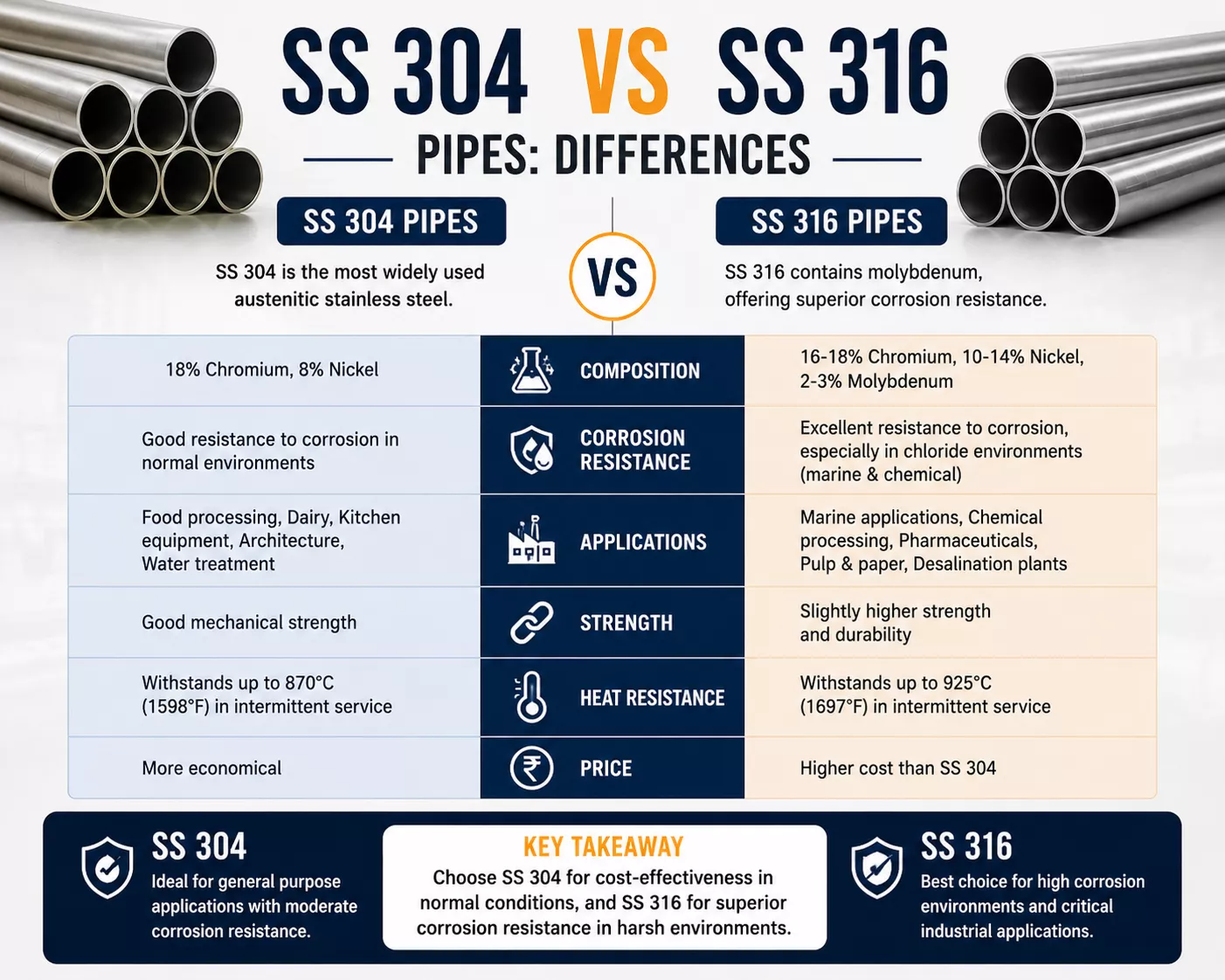
What is SS 304 Pipe?
SS 304 Pipe is the most widely used stainless steel pipe grade in the world and is often referred to as the industry standard for general-purpose stainless steel applications. Manufactured from austenitic stainless steel containing approximately 18% chromium and 8% nickel, SS 304 pipes offer an excellent combination of corrosion resistance, strength, durability, weldability, and cost-effectiveness.
When buyers compare SS 304 vs SS 316 Pipes, SS 304 is usually the preferred option for applications that require reliable corrosion resistance without the additional cost associated with molybdenum-containing stainless steel grades. It performs exceptionally well in freshwater environments, food processing facilities, architectural structures, water treatment systems, and general industrial piping applications.
One of the biggest advantages of SS 304 pipes is their versatility. They are available in seamless, welded, ERW, and fabricated forms and can be manufactured in various sizes, schedules, and specifications to meet diverse project requirements. Their excellent formability and weldability make them easy to fabricate into complex piping systems without compromising structural integrity.
SS 304 stainless steel pipes also provide excellent resistance to oxidation, atmospheric corrosion, moisture, and many mild chemicals. Because of their hygienic surface finish and ease of cleaning, they are widely used in industries where cleanliness and product purity are critical.
Key Features of SS 304 Pipes
- Excellent Corrosion Resistance in most industrial and atmospheric environments
- Good Mechanical Strength and durability
- Outstanding Weldability and fabrication properties
- Attractive Surface Finish for architectural applications
- High Temperature Resistance for moderate heat exposure
- Cost-Effective Alternative to higher alloy stainless steel grades
- Widely Available in seamless and welded pipe forms
Common Standards for SS 304 Pipes
- ASTM A312 TP304
- ASTM A213 TP304
- ASTM A269 TP304
- ASME SA312 TP304
SS 304 pipes are commonly selected for projects where excellent corrosion resistance, long service life, easy fabrication, and competitive pricing are required. However, for applications involving seawater exposure, chlorides, or aggressive chemicals, many engineers choose SS 316 pipes because of their superior resistance to pitting and crevice corrosion.
Get Expert AssistanceWhat is SS 316 Pipe?
SS 316 Pipe is a premium austenitic stainless steel pipe grade widely used in environments where superior corrosion resistance is essential. Compared to SS 304, SS 316 contains approximately 16–18% chromium, 10–14% nickel, and 2–3% molybdenum. The addition of molybdenum significantly improves resistance to chlorides, saltwater, chemicals, and other aggressive corrosive environments, making SS 316 pipes the preferred choice for demanding industrial applications.
When comparing SS 304 vs SS 316 Pipes, SS 316 is often selected for projects where long-term reliability and corrosion protection are more important than initial material cost. Its enhanced resistance to pitting and crevice corrosion allows it to perform exceptionally well in marine environments, offshore facilities, chemical processing plants, pharmaceutical industries, and coastal infrastructure projects.
SS 316 stainless steel pipes are available in seamless, welded, ERW, and fabricated forms and are manufactured according to international standards to meet stringent industrial requirements. These pipes offer excellent strength, durability, weldability, and temperature resistance while maintaining their corrosion-resistant properties even in harsh operating conditions.
Another major advantage of SS 316 pipes is their ability to withstand exposure to acidic solutions, industrial chemicals, and chloride-rich environments that may cause premature corrosion in lower-grade stainless steels. This makes them a preferred material for critical process piping systems where equipment reliability and service life are top priorities.
Key Features of SS 316 Pipes
- Superior Corrosion Resistance in chloride and marine environments
- Excellent Resistance to Pitting and Crevice Corrosion
- High Strength and Long Service Life
- Outstanding Weldability and Fabrication Properties
- Excellent Performance at Elevated Temperatures
- Suitable for Harsh Chemical Processing Applications
- Reliable Performance in Offshore and Coastal Installations
Common Standards for SS 316 Pipes
- ASTM A312 TP316
- ASTM A213 TP316
- ASTM A269 TP316
- ASME SA312 TP316
Although SS 316 pipes are generally more expensive than SS 304 pipes, their superior corrosion resistance often results in lower maintenance costs and longer service life in aggressive operating environments. For applications involving seawater, chemical exposure, pharmaceutical processing, or coastal installations, SS 316 pipes are frequently considered the most reliable stainless steel piping solution.
Request a QuoteChemical Composition Comparison
The primary difference between SS 304 Pipes and SS 316 Pipes lies in their chemical composition. While both grades belong to the austenitic stainless steel family and contain chromium and nickel as their main alloying elements, SS 316 includes an additional element—molybdenum (Mo)—which significantly enhances its corrosion resistance in aggressive environments.
This seemingly small difference in composition has a major impact on performance. The presence of molybdenum improves resistance to pitting corrosion, crevice corrosion, chloride attack, and chemical exposure, making SS 316 pipes more suitable for marine, offshore, and chemical processing applications. SS 304, on the other hand, offers excellent corrosion resistance in general industrial and atmospheric environments while remaining a more economical option.
When evaluating SS 304 vs SS 316 Pipes, understanding their chemical composition helps engineers, procurement teams, and project managers select the right material based on operating conditions, corrosion risks, and budget requirements.
SS 304 vs SS 316 Chemical Composition
| Element | SS 304 (%) | SS 316 (%) |
|---|---|---|
| Chromium (Cr) | 18.0 – 20.0 | 16.0 – 18.0 |
| Nickel (Ni) | 8.0 – 10.5 | 10.0 – 14.0 |
| Molybdenum (Mo) | Not Present | 2.0 – 3.0 |
| Carbon (C) | 0.08 Max | 0.08 Max |
| Manganese (Mn) | 2.0 Max | 2.0 Max |
| Silicon (Si) | 1.0 Max | 1.0 Max |
| Phosphorus (P) | 0.045 Max | 0.045 Max |
| Sulfur (S) | 0.03 Max | 0.03 Max |
| Iron (Fe) | Balance | Balance |
Key Difference in Composition
- SS 304 contains chromium and nickel, providing excellent general corrosion resistance and good mechanical properties.
- SS 316 contains additional molybdenum, which improves resistance to chlorides, saltwater, acids, and harsh industrial chemicals.
- The higher nickel content in SS 316 also contributes to improved corrosion performance in demanding environments.
- SS 304 is ideal for general-purpose industrial applications, while SS 316 is preferred for marine, offshore, pharmaceutical, and chemical processing industries.
Although both grades offer excellent durability and corrosion resistance, the addition of molybdenum makes SS 316 pipes the superior choice for environments where chloride exposure, seawater contact, or aggressive chemical service conditions are present.
SS 304 vs SS 316 Comparison Table
When comparing SS 304 Pipes vs SS 316 Pipes, both grades offer excellent corrosion resistance, durability, and mechanical strength. However, differences in chemical composition, corrosion performance, temperature resistance, and cost make each grade suitable for specific applications. The following comparison table provides a quick overview to help buyers, engineers, and procurement teams select the right stainless steel pipe grade for their project requirements.
| Parameter | SS 304 Pipe | SS 316 Pipe |
|---|---|---|
| UNS Number | S30400 | S31600 |
| Chromium Content | 18–20% | 16–18% |
| Nickel Content | 8–10.5% | 10–14% |
| Molybdenum Content | Not Present | 2–3% |
| Corrosion Resistance | Excellent | Superior |
| Chloride Resistance | Moderate | Excellent |
| Pitting Resistance | Good | Excellent |
| Marine Environment Suitability | Limited | Highly Recommended |
| Chemical Resistance | Good | Excellent |
| Temperature Resistance | Very Good | Excellent |
| Mechanical Strength | High | High |
| Weldability | Excellent | Excellent |
| Fabrication | Easy | Easy |
| Food Processing Applications | Excellent | Excellent |
| Pharmaceutical Applications | Good | Preferred |
| Offshore Applications | Not Recommended | Preferred |
| Typical Service Life | Long | Longer in Corrosive Environments |
| Relative Cost | Lower | 15–40% Higher |
| Best For | General Industrial Applications | Marine & Chemical Applications |
In summary, SS 304 Pipes are the most cost-effective choice for general-purpose industrial applications, while SS 316 Pipes provide enhanced corrosion resistance and superior performance in marine, offshore, pharmaceutical, and chemical processing environments. The right choice ultimately depends on your operating conditions, corrosion exposure, and project budget.
Get Best PriceCorrosion Resistance Comparison
When comparing SS 304 vs SS 316 Pipes, corrosion resistance is often the most important factor influencing material selection. Both grades belong to the austenitic stainless steel family and offer excellent resistance to rust, oxidation, and atmospheric corrosion. However, the addition of 2–3% molybdenum in SS 316 significantly enhances its ability to withstand aggressive environments containing chlorides, salts, acids, and industrial chemicals.
SS 304 pipes perform exceptionally well in most indoor and outdoor environments, freshwater applications, food processing facilities, and general industrial systems. They provide excellent protection against moisture, humidity, and many common chemicals. For this reason, SS 304 remains the most widely used stainless steel pipe grade worldwide.
However, in environments where chlorides are present, such as coastal areas, offshore installations, marine structures, and chemical processing plants, SS 304 may become susceptible to pitting and crevice corrosion over time. These localized forms of corrosion can gradually weaken the material and reduce service life.
SS 316 pipes are specifically designed to overcome these challenges. The molybdenum content improves resistance to chloride attack and provides superior protection against pitting corrosion, making SS 316 the preferred choice for seawater exposure, pharmaceutical production, chemical handling, and offshore applications.
Corrosion Resistance Comparison
- SS 304: Excellent resistance in general industrial environments.
- SS 304: Suitable for freshwater and low-chloride applications.
- SS 304: Cost-effective solution for standard operating conditions.
- SS 316: Superior resistance to chlorides and saltwater.
- SS 316: Better protection against pitting and crevice corrosion.
- SS 316: Ideal for chemical and marine environments.
- SS 316: Longer service life in highly corrosive conditions.
For projects involving seawater, coastal exposure, pharmaceutical manufacturing, or aggressive chemical processing, SS 316 pipes are generally considered the safer long-term investment despite their higher initial cost.
Winner: SS 316 Pipe
Strength & Mechanical Properties
Both SS 304 and SS 316 pipes offer excellent mechanical strength and durability, making them suitable for demanding industrial applications. Since both grades are austenitic stainless steels, their mechanical properties are very similar under normal operating conditions.
SS 304 pipes provide excellent tensile strength, impact resistance, and toughness. They can withstand heavy mechanical loads while maintaining good ductility and formability. These properties make SS 304 suitable for structural applications, process piping, fabrication projects, and general industrial systems.
SS 316 pipes offer comparable strength characteristics while providing additional protection in corrosive environments. Although the difference in tensile and yield strength between the two grades is relatively small, SS 316 often performs better in harsh operating conditions where corrosion and chemical exposure can affect long-term reliability.
Mechanical Property Comparison
- Tensile Strength: Both grades offer high tensile strength.
- Yield Strength: Similar performance in most applications.
- Impact Resistance: Excellent for both grades.
- Ductility: High ductility and formability.
- Toughness: Maintains toughness at low temperatures.
- Durability: SS 316 performs better in corrosive environments.
For purely mechanical performance, both grades perform exceptionally well. The final selection is usually driven more by corrosion requirements than strength differences.
Winner: Tie
Strength & Mechanical Properties
Both SS 304 and SS 316 pipes offer excellent mechanical strength and durability, making them suitable for demanding industrial applications. Since both grades are austenitic stainless steels, their mechanical properties are very similar under normal operating conditions.
SS 304 pipes provide excellent tensile strength, impact resistance, and toughness. They can withstand heavy mechanical loads while maintaining good ductility and formability. These properties make SS 304 suitable for structural applications, process piping, fabrication projects, and general industrial systems.
SS 316 pipes offer comparable strength characteristics while providing additional protection in corrosive environments. Although the difference in tensile and yield strength between the two grades is relatively small, SS 316 often performs better in harsh operating conditions where corrosion and chemical exposure can affect long-term reliability.
Mechanical Property Comparison
- Tensile Strength: Both grades offer high tensile strength.
- Yield Strength: Similar performance in most applications.
- Impact Resistance: Excellent for both grades.
- Ductility: High ductility and formability.
- Toughness: Maintains toughness at low temperatures.
- Durability: SS 316 performs better in corrosive environments.
For purely mechanical performance, both grades perform exceptionally well. The final selection is usually driven more by corrosion requirements than strength differences.
Winner: Tie
Temperature Resistance
Both SS 304 and SS 316 pipes offer excellent temperature resistance and can be used in applications involving elevated temperatures. Their austenitic microstructure helps maintain strength and corrosion resistance across a broad operating range.
SS 304 performs well in heat exchangers, industrial equipment, food processing systems, and general high-temperature applications. However, prolonged exposure to certain temperature ranges may affect corrosion resistance in aggressive environments.
SS 316 provides slightly better performance in high-temperature and chemically aggressive conditions. Its molybdenum content improves resistance to scaling and oxidation while maintaining corrosion protection.
Temperature Resistance Benefits
- Excellent oxidation resistance.
- Suitable for elevated-temperature service.
- Good thermal stability.
- Reliable performance in industrial environments.
- SS 316 offers additional protection in corrosive high-temperature applications.
For standard industrial temperatures, both grades perform exceptionally well. For combined heat and chemical exposure, SS 316 is generally preferred.
Winner: SS 316 Pipe
Weldability & Fabrication
One of the major reasons behind the popularity of SS 304 and SS 316 pipes is their excellent weldability and fabrication characteristics. Both grades can be welded using conventional welding processes without significant difficulty.
SS 304 pipes are widely used in fabrication shops because they are easy to cut, bend, roll, machine, and weld. Their excellent formability allows manufacturers to create complex piping systems and fabricated components efficiently.
SS 316 pipes also offer excellent fabrication properties and can be welded using similar procedures. However, due to their alloy content, tooling wear and machining effort may be slightly higher compared to SS 304.
Fabrication Advantages
- Excellent weldability.
- Easy bending and forming.
- Good machinability.
- Suitable for custom fabrication projects.
- Compatible with most industrial welding methods.
- Excellent finish after fabrication.
For most fabrication projects, both grades are highly suitable and provide excellent manufacturing flexibility.
Winner: Tie
Enquire NowConclusion
When comparing SS 304 vs SS 316 Pipes, both stainless steel grades offer excellent durability, strength, corrosion resistance, and long-term performance across a wide range of industrial applications. The right choice ultimately depends on the operating environment, exposure conditions, performance requirements, and project budget.
SS 304 Pipes remain the most widely used stainless steel pipes because they provide an ideal balance of corrosion resistance, mechanical strength, weldability, availability, and cost-effectiveness. They are suitable for general industrial piping, water treatment systems, food processing plants, architectural projects, and commercial applications where exposure to aggressive chemicals or chlorides is limited.
SS 316 Pipes, on the other hand, offer superior corrosion resistance due to the addition of molybdenum. This makes them the preferred choice for marine environments, offshore facilities, chemical processing plants, pharmaceutical industries, coastal infrastructure, and applications involving chlorides, acids, or harsh industrial chemicals. Although SS 316 pipes typically have a higher initial cost, their enhanced durability and longer service life often result in lower maintenance and replacement expenses over time.
For standard industrial and commercial applications, SS 304 pipes provide excellent value and reliable performance. However, when operating conditions are more demanding and corrosion resistance is critical, investing in SS 316 pipes can significantly improve system reliability and longevity.
Before selecting a stainless steel pipe grade, it is important to evaluate factors such as corrosion exposure, temperature requirements, mechanical demands, industry standards, maintenance expectations, and overall project costs. By understanding the differences between SS 304 and SS 316 pipes, engineers, contractors, procurement teams, and project owners can make a confident and cost-effective material selection.
Frequently Asked Questions
The primary difference is that SS 316 contains 2–3% molybdenum, which provides superior resistance to chlorides, saltwater, and corrosive chemicals. SS 304 does not contain molybdenum and is typically used for general-purpose applications.
Neither grade is universally better. SS 304 is ideal for general industrial and commercial applications, while SS 316 is preferred for marine, chemical processing, pharmaceutical, and coastal environments where higher corrosion resistance is required.
SS 316 contains higher amounts of nickel and molybdenum, which increase raw material costs and provide enhanced corrosion resistance compared to SS 304.
SS 304 pipes can be used in some marine applications, but prolonged exposure to saltwater and chlorides may lead to pitting corrosion. SS 316 pipes are generally recommended for marine and offshore environments.
SS 316 pipes offer superior corrosion resistance because the molybdenum content improves protection against chlorides, chemicals, pitting, and crevice corrosion.
Yes. Both SS 304 and SS 316 stainless steel pipes are widely used in food processing, dairy, beverage, and pharmaceutical industries because of their hygienic surface and corrosion-resistant properties.
SS 316 pipes are generally preferred for chemical processing applications because they provide greater resistance to acids, solvents, and aggressive industrial chemicals.
The most accurate identification methods include material test certificates (MTC), PMI testing, laboratory analysis, and grade markings provided by the manufacturer.
SS 304 is the most widely used stainless steel pipe grade globally due to its excellent balance of corrosion resistance, strength, availability, and cost-effectiveness.
Both grades can provide decades of reliable service when properly selected and maintained. SS 316 generally offers a longer service life in highly corrosive, marine, and chemical environments.
Looking for High-Quality SS 304 and SS 316 Pipes?
Kamal Piping is a trusted manufacturer, supplier, and exporter of SS 304 Pipes, SS 316 Pipes, Stainless Steel Seamless Pipes, Stainless Steel Welded Pipes, Duplex Steel Pipes, and Nickel Alloy Pipes. We offer a wide range of sizes, schedules, and specifications to meet the requirements of industrial, commercial, marine, pharmaceutical, and chemical processing applications.
Our experienced team can help you select the right Stainless Steel Seamless Pipe Grades based on corrosion resistance requirements, operating conditions, industry standards, and project budget.
Contact us today for competitive pricing, stock availability, technical specifications, and expert material selection support.