
-
-
-
Girgaon, Mumbai - 400004
Stainless Steel Pipe Sizes Chart
Stainless Steel Pipe Sizes Chart: Dimensions, Schedules, Weight & Selection Guide
Stainless Steel Pipes are essential components in modern industries, valued for their strength, corrosion resistance, durability and ability to perform in demanding environments. Whether transporting chemicals in a processing plant, carrying water through treatment facilities, supporting pharmaceutical production, or serving critical applications in oil and gas operations, the right pipe size plays a vital role in ensuring efficiency, safety and long-term performance.
Choosing the correct stainless steel pipe size is not simply about diameter. Factors such as wall thickness, pipe schedule, pressure requirements, flow capacity and application conditions all influence the overall performance of a piping system. This is why engineers, contractors, fabricators and procurement teams rely on standardized pipe size charts to make informed decisions during project planning and execution.
At Kamal Steels, we understand that selecting the right piping solution can significantly impact project success. As a trusted manufacturer, supplier, stockist and exporter of stainless steel pipes in India, we offer a wide range of seamless and welded pipes in various sizes, schedules and grades to meet the needs of industries worldwide.
This guide provides a comprehensive Stainless Steel Pipe Sizes Chart along with useful information on NPS and DN conversions, pipe schedules, common applications and selection tips. Whether you are planning a new installation, upgrading an existing system, or comparing available options, this resource will help you choose the most suitable stainless steel pipe for your requirements.
Get Expert Assistance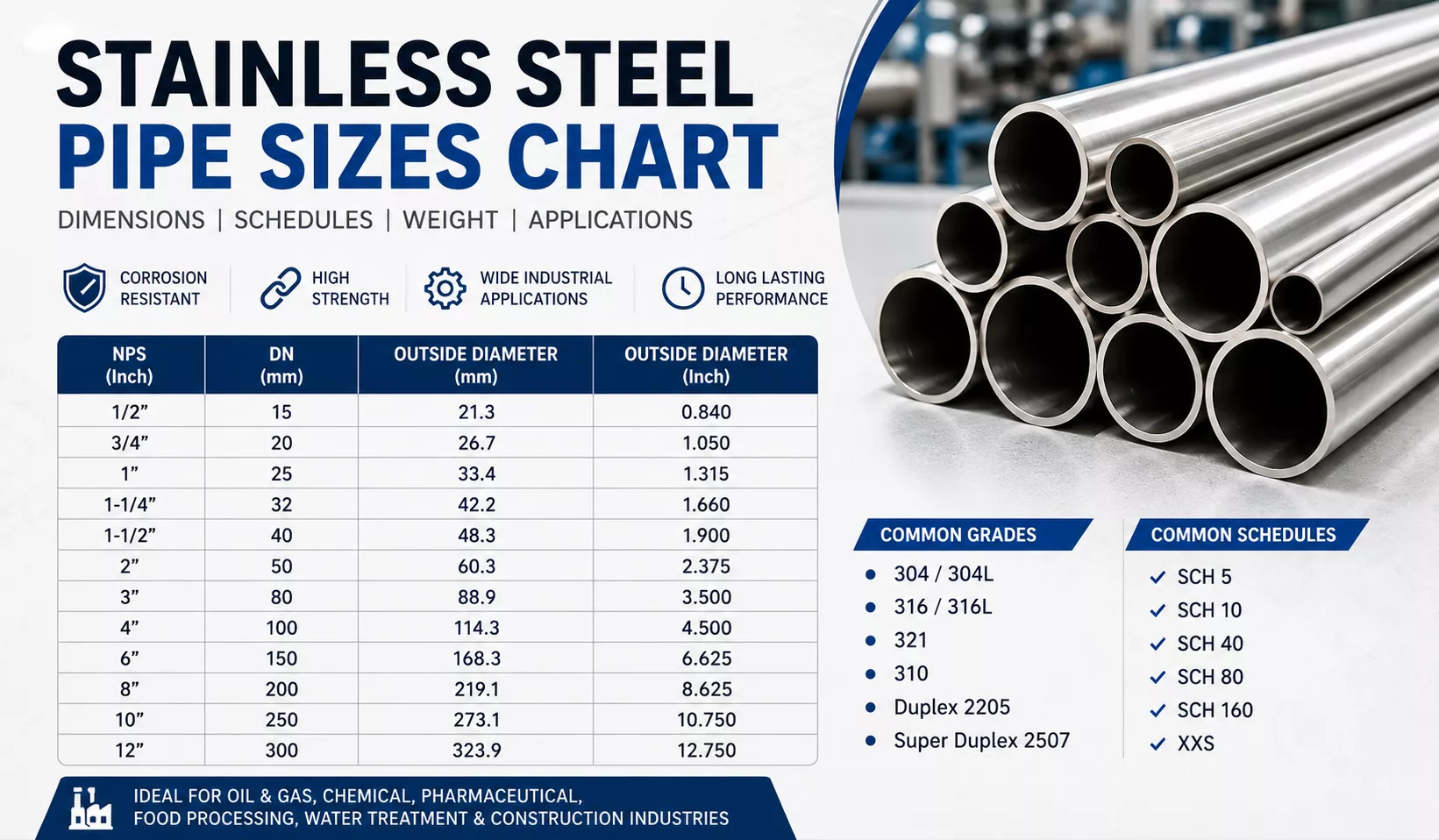
What Is a Stainless Steel Pipe Sizes Chart?
A Stainless Steel Pipe Sizes Chart is a standardized technical reference used to identify and compare pipe dimensions for industrial and commercial applications. It provides essential information such as Nominal Pipe Size (NPS), Diameter Nominal (DN), Outside Diameter (OD), wall thickness, pipe schedule, and weight per meter, helping engineers and buyers select the correct pipe for specific operating conditions.
These charts are widely used during the design, procurement, fabrication, and installation of piping systems to ensure compatibility with fittings, flanges, valves, and other piping components. By referring to a stainless steel pipe size chart, project teams can accurately determine the dimensions required to meet flow, pressure, temperature, and performance requirements.
A typical stainless steel pipe sizes chart includes the following key parameters:
- Nominal Pipe Size (NPS): The standard pipe size designation used primarily in North America.
- Diameter Nominal (DN): The metric equivalent of NPS commonly used in international projects.
- Outside Diameter (OD): The actual external diameter of the pipe.
- Wall Thickness: The thickness of the pipe wall, which affects strength and pressure rating.
- Pipe Schedule: A numerical designation indicating wall thickness and pressure-handling capability.
- Weight Per Meter: The approximate pipe weight used for transportation, installation, and structural calculations.
Whether you are specifying stainless steel Seamless Pipes or Welded Pipes understanding pipe dimensions through a reliable size chart helps improve system efficiency, reduce installation errors, and ensure compliance with industry standards such as ASME B36.19 and ASTM A312.
Standard Stainless Steel Pipe Sizes Chart
Stainless steel pipes are manufactured in a wide range of standard sizes to accommodate varying flow rates, pressure requirements, and industrial applications. These dimensions are standardized according to internationally recognized specifications such as ASME B36.19 and ASTM A312, ensuring consistency and compatibility across piping systems worldwide.
The table below highlights some of the most commonly used stainless steel pipe sizes, along with their corresponding DN (Diameter Nominal) designations and outside diameters. These sizes are widely utilized in industries such as oil and gas, chemical processing, pharmaceuticals, food and beverage manufacturing, water treatment, power generation, and construction.
| NPS | DN | Outside Diameter (mm) | Outside Diameter (Inches) |
|---|---|---|---|
| 1/2" | DN15 | 21.3 | 0.840 |
| 3/4" | DN20 | 26.7 | 1.050 |
| 1" | DN25 | 33.4 | 1.315 |
| 1-1/4" | DN32 | 42.2 | 1.660 |
| 1-1/2" | DN40 | 48.3 | 1.900 |
| 2" | DN50 | 60.3 | 2.375 |
| 3" | DN80 | 88.9 | 3.500 |
| 4" | DN100 | 114.3 | 4.500 |
| 6" | DN150 | 168.3 | 6.625 |
| 8" | DN200 | 219.1 | 8.625 |
| 10" | DN250 | 273.1 | 10.750 |
| 12" | DN300 | 323.9 | 12.750 |
These are among the most frequently specified stainless steel pipe sizes for industrial and commercial projects worldwide. Smaller pipe sizes such as 1/2" to 2" are commonly used in pharmaceutical, food processing, and instrumentation systems, while larger sizes ranging from 4" to 12" are widely used in process plants, water treatment facilities, chemical industries, and oil and gas infrastructure.
Selecting the correct pipe size is essential for maintaining proper flow rates, minimizing pressure losses, improving system efficiency, and ensuring long-term operational reliability. Engineers and procurement teams should always consider pipe size alongside schedule, material grade, operating pressure, and application requirements when specifying stainless steel piping systems.
NPS vs DN Pipe Size Conversion Chart
When working with stainless steel piping systems, you may encounter two different sizing standards: NPS (Nominal Pipe Size) and DN (Diameter Nominal). NPS is the standard sizing system primarily used in the United States and Canada, while DN is the metric designation widely adopted across Europe, Asia, the Middle East, and international engineering projects.
Understanding the relationship between NPS and DN is essential for engineers, procurement teams, fabricators, and project managers involved in global projects. Accurate conversion helps ensure compatibility between pipes, fittings, flanges, valves, and other piping components sourced from different regions and manufacturers.
The following NPS vs DN conversion chart provides a quick reference for some of the most commonly used stainless steel pipe sizes:
| NPS (Nominal Pipe Size) | DN (Diameter Nominal) |
|---|---|
| 1/2" | DN15 |
| 3/4" | DN20 |
| 1" | DN25 |
| 1-1/4" | DN32 |
| 1-1/2" | DN40 |
| 2" | DN50 |
| 3" | DN80 |
| 4" | DN100 |
| 6" | DN150 |
| 8" | DN200 |
| 10" | DN250 |
| 12" | DN300 |
While NPS and DN are often used interchangeably, they are not exact measurements of the pipe's outside diameter. Instead, they serve as standardized designations that simplify pipe specification and selection across industries. Referring to a reliable conversion chart can help prevent procurement errors, improve project accuracy, and ensure smooth integration of piping components in domestic and international installations.
Understanding Stainless Steel Pipe Schedules
Pipe schedule refers to the wall thickness of a stainless steel pipe and directly influences its pressure-handling capability, mechanical strength, and overall durability. While the outside diameter (OD) remains constant for a particular Nominal Pipe Size (NPS), the wall thickness varies depending on the schedule number. Generally, higher schedule numbers indicate thicker pipe walls and greater resistance to pressure and mechanical stress.
Selecting the appropriate pipe schedule is essential for ensuring safe and efficient operation in industries such as oil and gas, chemical processing, power generation, food manufacturing, pharmaceuticals, and water treatment. The choice depends on factors such as operating pressure, temperature, fluid type, and project specifications.
| Schedule | Typical Application |
|---|---|
| SCH 5 | Low-pressure systems and lightweight piping applications |
| SCH 10 | Process piping, food processing, pharmaceutical and sanitary systems |
| SCH 40 | General industrial service and medium-pressure applications |
| SCH 80 | High-pressure systems and demanding industrial environments |
| SCH 160 | Heavy-duty industrial and critical process applications |
| XXS | Extreme pressure and highly demanding service conditions |
Although higher schedules provide greater strength and pressure resistance, they also increase pipe weight, material consumption, and overall project costs. Therefore, selecting the correct schedule helps achieve the right balance between performance, safety, and cost-effectiveness.
Stainless Steel Pipe Weight Considerations
Pipe weight is a critical factor in project planning, transportation, structural support design, and installation. Understanding the weight of stainless steel pipes helps engineers and procurement teams estimate handling requirements, transportation costs, support structures, and overall project budgets.
The weight of a stainless steel pipe depends on several variables, including its diameter, wall thickness, material grade, length, and schedule. As pipe size and wall thickness increase, the overall weight per meter also increases significantly.
Factors Affecting Pipe Weight
- Pipe Diameter: Larger outside diameters result in heavier pipes.
- Wall Thickness: Higher schedules increase material volume and weight.
- Material Grade: Different stainless steel grades have slightly varying densities.
- Pipe Length: Total weight increases proportionally with length.
- Schedule Number: Thicker-walled pipes weigh more than lower schedule alternatives.
Accurate weight calculations are especially important for large-scale projects involving transportation, lifting equipment, structural supports, and installation planning. Engineers often use stainless steel pipe weight charts and calculators to estimate total project requirements before procurement.
Most Common Stainless Steel Pipe Sizes Used Across Industries
The most suitable stainless steel pipe size varies depending on the industry, application, flow requirements, operating pressure, and system design. Different sectors rely on specific pipe dimensions to ensure optimal performance, efficiency, and safety.
Food & Beverage Industry
Common Sizes: 1/2" to 2"
These smaller pipe sizes are widely used for hygienic fluid transfer, dairy processing, breweries, beverage production, and sanitary process systems where cleanliness and corrosion resistance are critical.
Pharmaceutical Industry
Common Sizes: 1/2" to 3"
Pharmaceutical facilities utilize stainless steel pipes for sterile manufacturing processes, purified water systems, and cleanroom environments where product purity must be maintained.
Chemical Processing Plants
Common Sizes: 2" to 8"
Medium-sized stainless steel pipes are commonly used to transport corrosive chemicals, solvents, and process fluids while maintaining safety and operational efficiency.
Water Treatment Facilities
Common Sizes: 4" to 24"
Larger diameter pipes are used for water distribution, filtration systems, wastewater treatment, and municipal infrastructure projects requiring high-volume fluid transportation.
Oil & Gas Industry
Common Sizes: 2" to 36"
The oil and gas sector utilizes a wide range of pipe sizes for pipelines, refineries, offshore platforms, process plants, and high-pressure fluid transportation systems.
Power Generation Plants
Common Sizes: 4" to 24"
Power plants rely on stainless steel piping for steam distribution, cooling water systems, condensate lines, and critical process applications operating under demanding conditions.
Understanding the most commonly used pipe sizes across industries helps engineers and procurement teams select suitable stainless steel piping solutions that meet performance requirements while optimizing project costs.
How to Select the Right Stainless Steel Pipe Size
Choosing the correct stainless steel pipe size is essential for ensuring efficient fluid flow, reliable system performance, long service life, and cost-effective project execution. Selecting an undersized pipe can result in excessive pressure drops and reduced efficiency, while oversized piping may increase material, installation, and maintenance costs unnecessarily.
Engineers, contractors, and procurement professionals should evaluate the following factors before finalizing a stainless steel pipe size for any industrial application:
1. Flow Rate Requirements
The volume of liquid, gas, or steam being transported is one of the most important factors when selecting pipe size. Higher flow rates generally require larger pipe diameters to maintain efficient fluid movement and minimize pressure losses throughout the system.
Properly sized pipes help improve operational efficiency, reduce energy consumption, and ensure consistent process performance across industrial applications.
2. Operating Pressure
The pressure at which the piping system operates directly affects pipe size and schedule selection. High-pressure systems typically require thicker wall pipes such as SCH 80, SCH 160, or XXS to withstand internal pressure safely and prevent mechanical failure.
Understanding system pressure requirements is essential for maintaining safety, regulatory compliance, and long-term reliability.
3. Temperature Conditions
Operating temperature can significantly influence material performance and pipe selection. Applications involving elevated temperatures may require specialized stainless steel grades such as 310, 321, or other heat-resistant alloys designed to maintain strength and corrosion resistance under extreme conditions.
Selecting the appropriate pipe size and grade helps ensure reliable performance in both high-temperature and cryogenic environments.
4. Corrosion Resistance Requirements
Different operating environments expose pipes to varying levels of corrosion, chemical attack, moisture, and aggressive process media. Industries such as chemical processing, marine engineering, pharmaceuticals, and offshore operations often require highly corrosion-resistant stainless steel grades.
Common choices include Stainless Steel 316L, Duplex 2205, and Super Duplex 2507 for applications where superior corrosion resistance is critical.
5. Installation Space and Layout
Available installation space can influence pipe sizing decisions. Compact facilities, congested process areas, and complex piping layouts may require careful planning to ensure the selected pipe size fits within structural and operational constraints.
Considering space requirements early in the design phase helps simplify installation and reduce modification costs later in the project.
6. Future Expansion and Capacity Planning
Many industrial facilities plan for future production increases and system upgrades. Selecting a stainless steel pipe size that accommodates potential expansion can eliminate the need for costly modifications and system replacements in the future.
Investing in properly sized piping infrastructure today can provide significant long-term savings while supporting future operational growth.
Most Popular Stainless Steel Pipe Grades
- Stainless Steel 304 Pipes
- Stainless Steel 304L Pipes
- Stainless Steel 316 Pipes
- Stainless Steel 316L Pipes
- Stainless Steel 321 Pipes
- Stainless Steel 310 Pipes
- Duplex Stainless Steel Pipes
- Super Duplex Stainless Steel Pipes
Stainless Steel Grade Selection Chart
| Application | Recommended Grade |
|---|---|
| Food Processing | 304, 316L |
| Pharmaceutical | 316L |
| Chemical Processing | 316L, 904L |
| Marine Applications | 316L, Duplex 2205 |
| Offshore Projects | Duplex 2205, Super Duplex 2507 |
| High Temperature Service | 310, 321 |
| Water Treatment | 304, 316 |
Why Buy Stainless Steel Pipes from Kamal Steels?
Kamal Steels is a trusted stainless steel pipe manufacturer, supplier, stockist and exporter in India with decades of industry experience.
We Supply:
- Stainless Steel Seamless Pipes
- Stainless Steel Welded Pipes
- ASTM A312 Stainless Steel Pipes
- Schedule 5, 10, 40, 80, 160 & XXS Pipes
- Custom Length Stainless Steel Pipes
- Large Diameter Stainless Steel Pipes
- Project-Specific Piping Solutions
Available Grades:
- SS 304 Pipes
- SS 304L Pipes
- SS 316 Pipes
- SS 316L Pipes
- SS 321 Pipes
- SS 310 Pipes
- Duplex 2205 Pipes
- Super Duplex 2507 Pipes
Frequently Asked Questions
2-inch and 4-inch stainless steel pipes are among the most widely used sizes across industrial applications.
NPS is an inch-based sizing system, while DN is a metric designation used internationally.
SCH 10 and SCH 40 are the most commonly specified schedules for stainless steel piping systems.
ASME B36.19 is the primary dimensional standard for stainless steel pipes.
Stainless steel pipes can be manufactured in sizes exceeding 48 inches depending on project requirements.
Yes, stainless steel pipes are available as both seamless and welded pipes based on application requirements.
316L, Duplex 2205, and Super Duplex 2507 are commonly used in marine environments.
Yes, Kamal Steels supplies custom-cut stainless steel pipes according to project specifications.
Buy Stainless Steel Pipes from a Trusted Supplier in India
Looking for stainless steel pipes in standard or custom sizes? Kamal Steels offers a complete range of stainless steel seamless pipes and welded pipes with competitive pricing, fast delivery, and full material test certification.
Contact our team today for the latest stainless steel pipe price list, stock availability, technical support, and a customized quotation for your industrial project requirements.